Dify Beginner's Guide: Building Enterprise-Grade AI Apps on an Open-Source Platform

Dify is an open-source AI platform that lets developers and enterprises build production-grade AI apps without complex coding.
Dify is an open-source AI application platform sitting between foundation LLMs and business applications. It supports private deployment, visual workflow orchestration, and Agent construction — making it ideal for enterprises with data compliance needs. This guide covers who Dify is for, how it compares to Coze, its core advantages, and a practical learning path.
What Is Dify
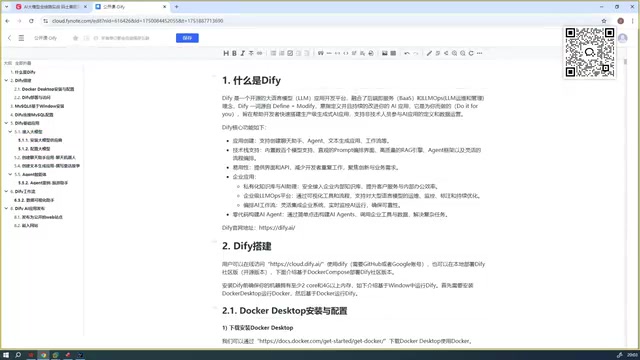
As AI application development becomes increasingly mainstream, platforms that lower the barrier to entry and accelerate deployment have become more valuable than ever. Dify is exactly that kind of tool — it's an open-source AI application platform that lets developers and enterprises build all kinds of AI applications quickly, without writing complex code from scratch.
To appreciate Dify's value, it helps to understand where it sits in the technology stack. AI application platforms occupy the middle-layer infrastructure between foundation large language models (LLMs) and end-user business applications. As models like GPT-4, Claude, and Gemini have grown explosively in capability, the real challenge for enterprises is no longer "is the model powerful enough?" — it's "how do we efficiently embed model capabilities into business processes?" That means solving a range of engineering problems: API calls, context management, multi-step orchestration, permission control, and more. Dify was built precisely to bridge that gap.
Applications built on Dify can serve individual productivity use cases or be custom-tailored to solve real internal business problems at the enterprise level.
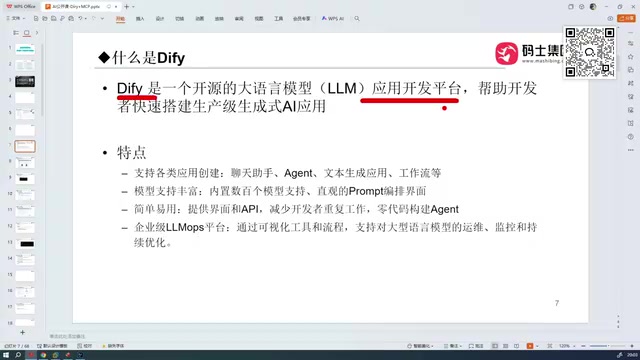
One of Dify's most distinctive characteristics is its open-source nature: the source code is fully public, meaning developers and enterprises can freely obtain it, deploy it on private infrastructure, or even fork and customize it to their specific needs. Open source software (OSS) allows anyone to view, modify, and distribute the source code. For an AI application platform, this means enterprises can run the entire system on their own infrastructure, keeping data entirely within their internal network. This is fundamentally different from the SaaS model, where data must be uploaded to the vendor's cloud — introducing compliance risks. Private deployment is essentially a hard requirement in heavily regulated industries like finance, healthcare, and government, making this a critical advantage for organizations that prioritize data security and self-sovereignty.
Who Is Dify For
When discussing Dify's positioning, a common question arises: is it aimed at individual developers or enterprise teams?
The answer is both. Whether you want to build a personal AI toolkit to boost your daily productivity, or you need to create complex applications that solve core business problems across an entire organization, Dify can handle it.
Dify vs. Coze: A Comparison
In practice, Dify is frequently compared to Coze. The two products have distinctly different positionings:
- Coze leans toward individual developers and small teams. Its design is relatively lightweight and flexible, primarily delivered as a hosted cloud service — extremely fast to get started with, but limited in customization depth.
- Dify excels in enterprise-level scenarios and is favored by large organizations and teams with stricter data compliance requirements. It supports full private deployment and source-level customization.
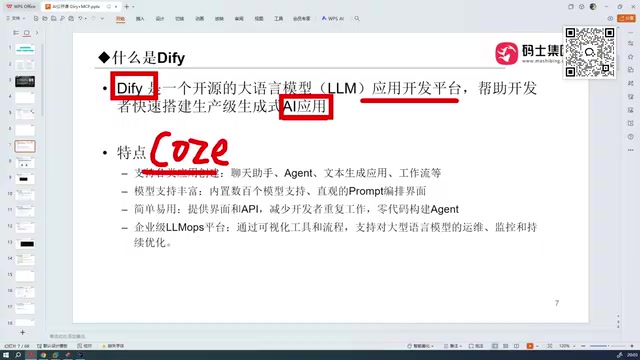
This difference isn't about one being better than the other — it's about different priorities. If your needs lean toward complex enterprise scenarios requiring stronger control and extensibility, Dify is typically the more suitable choice.
Why Choose Dify
Taken together, Dify's core advantages can be summarized as follows:
1. Open Source and Self-Sovereign
Open source means enterprises can deploy the platform on their own servers, completely eliminating the risk of data leakage. This is especially important in data-sensitive industries like finance and healthcare. At the same time, ongoing contributions from the open-source community keep the platform evolving rapidly, so enterprises don't have to depend on a single vendor's development roadmap.
2. Wide Scenario Coverage
Dify supports both major AI application paradigms: Workflow orchestration and Agent construction. Workflow orchestration organizes multiple AI processing steps into a visual node graph, defining data flow logic and branching conditions — ideal for scenarios with fixed processes and clearly defined steps. Agents, on the other hand, are intelligent systems that can autonomously plan, dynamically invoke external tools (such as search engines, databases, and APIs), and iteratively execute tasks — suited for complex tasks requiring flexible decision-making. The combination of both paradigms allows Dify to cover everything from personal productivity tools to enterprise-grade business applications, providing a unified development framework that supports the full lifecycle from prototype validation to production deployment, without constant tool-switching.
3. Low Barrier to Entry
Thanks to visual workflow orchestration, even non-engineers can quickly build functional AI applications. This is the foundation behind the claim in many tutorials that "you can build an AI application in just a few days."
Recommended Learning Path for Dify
To systematically master Dify, the following step-by-step approach is recommended:
- Understand the fundamentals: Start by clarifying what an AI application platform is and the role Dify plays in the broader AI development ecosystem — it sits between LLM APIs and business applications, solving engineering deployment challenges rather than model research problems.
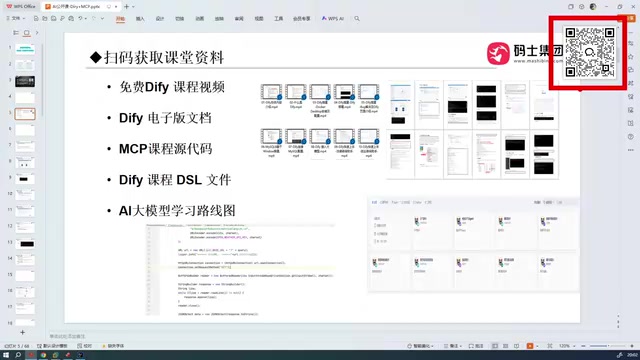
- Get hands-on: Reinforce what you've learned through real projects (such as enterprise-level case studies). Dify supports exporting DSL files, making it easy to reuse and share existing application configurations. A DSL (Domain-Specific Language) file is essentially a structured description of a complete AI application — covering workflow nodes, model configurations, prompt templates, knowledge base references, and all other elements — allowing developers to share an entire application "blueprint" the same way they'd share code.
- Go deeper: Once you've mastered the basics, progressively explore advanced features like workflow orchestration, knowledge base integration (RAG — Retrieval-Augmented Generation), and Agent construction, refining application quality against specific business scenarios.
The DSL file import/export mechanism provides tremendous convenience for both learning and team collaboration — you can directly reuse existing application templates, quickly understand their internal logic, and avoid a lot of trial and error.
Summary
As an open-source, flexible, enterprise-oriented AI application platform, Dify is becoming the go-to choice for a growing number of developers and enterprises building AI applications. It dramatically lowers the development barrier while preserving sufficient control and extensibility — open-source code, private deployment, visual orchestration, and the DSL reuse mechanism together form the core competitive advantages that set Dify apart from comparable tools.
For individuals and teams looking to rapidly deploy real-world AI applications amid the current AI wave, mastering Dify is a high-value skill investment. Start by understanding the foundational concepts, combine that with hands-on project practice, and you can build the capability to independently create AI applications in a relatively short period of time.
Key Takeaways
Related articles

Disaster and Glory of the Apollo Program: The History We Must Revisit Before Returning to the Moon
From the fatal Apollo 1 fire to Apollo 8's daring lunar orbit to Apollo 11's successful landing—revisiting the disasters, fears, and compromises of the Apollo program and their lessons for today's return to the Moon.

Netflix Trust Exercise Turns Into Firing Trap: Where Are the Boundaries of Corporate Trust?
A Netflix employee was fired after sharing private info in a trust exercise. We analyze the risks of corporate trust exercises and how employees can protect themselves.

AMD CDNA5 Architecture Deep Dive: Technical Evolution and the AI Computing Competition Landscape
Deep analysis of AMD's CDNA5 architecture covering Chiplet packaging upgrades, HBM memory evolution, and low-precision compute optimization, examining how AMD challenges NVIDIA's AI chip dominance.