Dify × RAG for Beginners: Build Your Own Game AI Assistant from Scratch

A beginner's hands-on guide to building a RAG-powered game AI assistant using Dify.
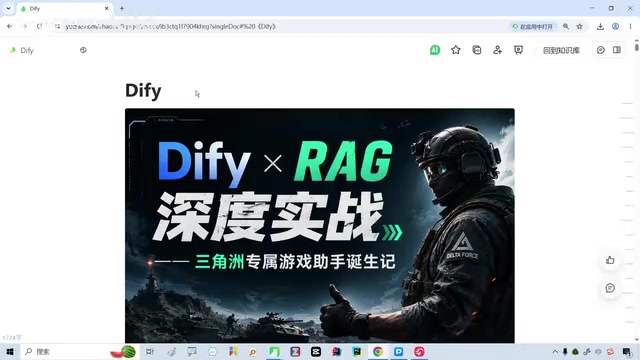
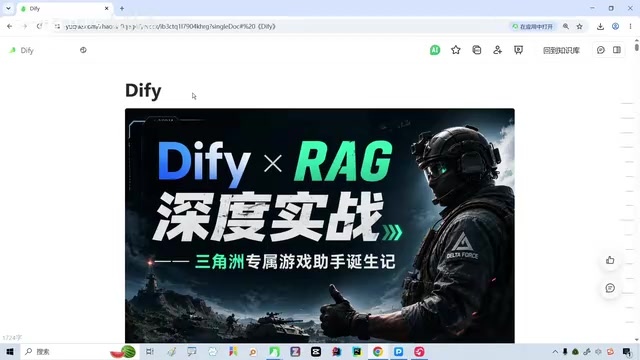
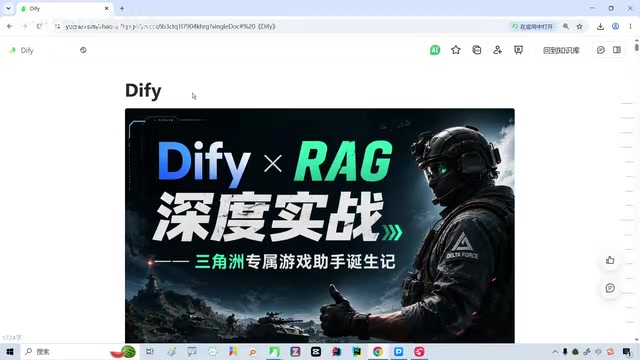
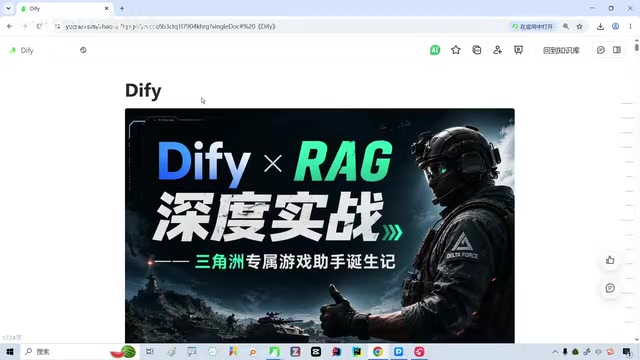
This tutorial uses a Delta Force game assistant as a practical case study to introduce complete beginners to Dify and RAG. It covers core concepts like intelligent agents and Retrieval-Augmented Generation, then walks through the full workflow: preparing knowledge base materials, uploading and indexing documents in Dify, connecting an agent, and tuning retrieval parameters — no coding required.
Why Anyone Can Master Dify and RAG — No Coding Required
For those just getting started with AI application development, concepts like "intelligent agents" and "RAG knowledge bases" can sound intimidating and out of reach. But as low-code AI development platforms continue to mature, building a smart application from scratch is no longer the exclusive domain of seasoned engineers. This tutorial is designed for complete beginners. Using a fun, hands-on project — building a dedicated game assistant for the popular title Delta Force — we'll walk you through the world of Dify and RAG step by step.
As the original tutorial puts it, many learners with no technical background have "never used Dify, don't know what an intelligent agent does, and have no idea what people mean when they talk about a RAG knowledge base." So instead of diving into deep theory, we'll use a concrete, engaging project to spark your curiosity first — and let the underlying logic reveal itself naturally as you build.
What Are Intelligent Agents and RAG, Really?
Before we start building, let's clarify two core concepts.
An Intelligent Agent is an AI program capable of autonomously perceiving its environment, making decisions, and executing tasks. It's far more than a simple Q&A chatbot — it can call tools, retrieve information, and complete complex multi-step tasks based on user input. The concept originates from "autonomous agent" research in AI, and modern LLM-based agents typically follow the ReAct (Reasoning + Acting) framework, which alternates between reasoning and tool-calling during inference. The key difference from traditional chatbots: agents can use tools — search the web, run code, read and write files, call external APIs, or even coordinate other AI sub-agents to tackle complex, multi-system workflows.
RAG (Retrieval-Augmented Generation) is the centerpiece of this tutorial. The technique was formally introduced by Meta AI in the 2020 paper "Retrieval-Augmented Generation for Knowledge-Intensive NLP Tasks," and it directly addresses two fundamental limitations of large language models: hallucination and knowledge staleness. An LLM's knowledge is frozen at its training cutoff date and cannot include private or niche domain information. RAG fixes this by retrieving relevant content from your own knowledge base before the model generates a response, then feeding that content as context to the model — producing answers that are more accurate and domain-specific. Think of it as giving the model a real-time, queryable "external memory." This dramatically reduces hallucinations without the cost and complexity of fine-tuning.
Dify: The Best Starting Point for AI App Development
Dify is an open-source LLM application development platform whose greatest strength is intuitiveness. Launched by a Chinese team in 2023, Dify is built on Python and integrates core capabilities from frameworks like LangChain — but exposes them to users through a visual workflow (Workflow) interface. Dify supports dozens of model providers including OpenAI, Anthropic, and major Chinese LLMs, offers built-in support for multiple vector databases, and provides full API and WebApp publishing capabilities.
For beginners, Dify replaces what would otherwise require extensive coding with drag-and-drop configuration. As the tutorial author notes, Dify lets you understand agents and RAG in "a very intuitive way" — and that "what you see is what you get" experience is precisely why it's ideal for newcomers. You don't need to understand the internals of a vector database or write retrieval logic from scratch. Upload your documents, configure your settings, and an AI application with knowledge retrieval capability is up and running. For more advanced users, Dify also supports self-hosted deployment to meet enterprise data security requirements.
Why a Game Assistant Makes the Perfect Teaching Case
Choosing a "dedicated Delta Force game assistant" as the driving example is a clever instructional design decision. Game guides, weapon stats, and map information have three notable characteristics:
- High verticality: General-purpose LLMs tend to be fuzzy on specific game details, which perfectly highlights the core value of a RAG knowledge base.
- Need for freshness: Game patches and updates roll out frequently, making the knowledge base easy to maintain and update — showcasing the advantage of dynamic content management.
- High engagement: Game scenarios are far more motivating than dry enterprise document Q&A.
By anchoring learning around "a fun, motivating case," learners naturally discover why RAG exists and how it works as they build.
Building a RAG Game Assistant from Scratch: The Core Workflow
The overall process is straightforward and breaks down into four key steps.
Step 1: Prepare Your Knowledge Base Materials
Collect Delta Force-related content — strategy guides, weapon configuration tables, map overviews — that will serve as the data source for RAG retrieval. The quality of your materials directly determines the accuracy of the assistant's answers. Aim for well-structured, clearly organized text. The more structured your documents, the better the subsequent chunking and retrieval performance will be.
Step 2: Create a RAG Knowledge Base in Dify
Upload your documents to Dify's knowledge base module. Dify automatically handles text chunking and embedding (vectorization), converting your documents into a semantic vector index that can be retrieved — this is the foundation of the "retrieval" capability in RAG.
Understanding what these two automated steps actually do will help you tune performance later. Text chunking strategy directly affects retrieval quality: chunks that are too large introduce noise, while chunks that are too small lose context. Common strategies include fixed-length chunking and paragraph-based semantic chunking. Vectorization uses an embedding model (such as OpenAI's text-embedding-ada-002 or open-source models like the BGE series) to convert text into high-dimensional mathematical vectors stored in a vector database. When a user asks a question, the query is converted into a vector as well, and cosine similarity is used to find the most semantically relevant document chunks in milliseconds. This is why semantic retrieval outperforms traditional keyword search — it understands that "AK rifle damage" and "assault rifle output" carry the same meaning, rather than just matching literal strings.
Step 3: Build the Agent and Connect the Knowledge Base
Create a conversational application and link it to the knowledge base from the previous step. When a user submits a question, Dify first retrieves relevant chunks from the knowledge base, then combines them with the LLM to generate a response. At this point, your "dedicated Delta Force game assistant" is essentially ready.
Step 4: Tune and Test
In practice, you'll need to iterate on retrieval parameters, prompts, and chunking strategies to make the assistant's responses both accurate and natural. The two parameters you'll adjust most often are Top K (the number of most relevant chunks to return) and the similarity threshold. This hands-on tuning process is also the most direct way to truly understand how RAG works — every adjustment is a fine-tuning of a specific stage in the retrieve-then-generate pipeline.
From a Game Assistant to a Broader World of AI Applications
What makes this tutorial genuinely valuable is how it wraps complex technical concepts inside a specific, enjoyable project. For beginners, getting people interested first and letting them understand agents and RAG through practice is far more effective than starting with theory.
That said, if you're already an experienced LLM application developer, this material may feel foundational. But for the vast majority of people hoping to enter AI application development, the Dify + RAG combination offers an exceptionally low barrier to entry: no deep programming background required to build something that actually works.
Starting from a game assistant, you can easily transfer the same approach to enterprise knowledge base Q&A, personal learning assistants, intelligent customer service, and many other scenarios. This is perhaps what's most exciting about the low-code AI era — whether it's RAG's retrieval-augmented mechanism, an agent's tool-calling capabilities, or the way platforms like Dify abstract away complex engineering details, the barrier to building AI applications keeps getting lower. Anyone with an idea can become an AI application creator.
Key Takeaways
Related articles

The Truth Behind Codex 'Build a Website in 5 Minutes': AI Isn't Creating Sites—It's Helping You Copy Them
Exposing the truth behind viral Codex 5-minute website videos: creators aren't building original sites with AI—they're copying shared prompts or scraping others' work. Learn AI coding tools' real limits.

Getting Started with AI Agent Development: A Complete Guide from Concept to Practice
A comprehensive guide to AI Agent architecture and development, covering automated marketing, intelligent customer service, and investment analysis scenarios with single and multi-agent collaboration.

The Truth Behind Codex 'Build a Website in 5 Minutes': AI Isn't Creating Sites — It's Helping You Copy Them
Exposing the truth behind viral Codex 5-minute website videos: creators aren't building original sites with AI — they're copying shared prompts or scraping others' work.