Enterprise AI Agent Learning Roadmap: A Complete Guide from Beginner to Production

A four-stage roadmap for learning AI Agent development from basics to enterprise-grade deployment.
This guide outlines a systematic AI Agent learning path divided into four stages: foundational concepts (tool calling, memory, prompt engineering), core frameworks (LangChain, LangGraph), scenario-based practice covering 80% of enterprise use cases, and advanced product thinking. It emphasizes building transferable mental models over scattered tutorials.
Why You Need a Systematic Agent Learning Roadmap
AI Agent development has become the central direction for deploying large language models in real-world applications — yet the quality of available tutorials varies wildly. As the creator of this Bilibili course puts it, after spending a month researching every Agent tutorial on the internet — from videos with millions of views to obscure ones with barely a hundred — the conclusion was clear: the space is full of noise, lacking both structure and practical grounding.
This is the real struggle for many AI beginners: fragmented knowledge can't be assembled into a coherent skill set, and after watching countless videos, you still can't build a working agent. A truly valuable learning roadmap should help complete beginners understand the fundamentals while providing enough hands-on projects to develop real skills. This article, based on that course's framework, outlines a practical AI Agent learning path — from zero to enterprise-grade deployment.
Background: The Technical Evolution of AI Agents AI Agents aren't a new concept — their theoretical roots trace back to Multi-Agent Systems research in the 1990s. But the real turning point that made Agents practical was the 2022 explosion of large language models (LLMs), led by ChatGPT. LLMs gave Agents powerful language understanding and reasoning capabilities. Combined with tool calling and memory management modules, Agents evolved from a lab concept into deployable engineering products. In 2023, the viral spread of open-source projects like AutoGPT and BabyAGI made "AI that autonomously completes tasks" feel tangible for the first time — igniting widespread industry enthusiasm for Agent development.
The Four Stages of AI Agent Learning
This curriculum divides the complete Agent knowledge system into four modules: Foundational Concepts, Core Frameworks, Scenario Practice, and Advanced Topics. This layered design follows the natural progression of technical learning — build understanding first, master the core, get extensive hands-on practice, then elevate your thinking.
Stage 1 — Foundational Concepts: Building Your First Agent
The foundation stage covers the core components of AI Agents, framework selection, prompt engineering, tool calling logic, and memory mechanisms — all essential to understanding how Agents operate.
Several concepts are especially critical:
-
Tool Calling: The ability to let an LLM invoke external functions, APIs, or databases — this is what fundamentally distinguishes an Agent from a standard conversational model. Tool calling has evolved significantly, from prompt-based parsing to structured APIs. Early implementations relied on techniques like ReAct, where models output "action instructions" in text format for external code to parse and execute — a fragile process. When OpenAI introduced Function Calling (now renamed Tool Use) in 2023, models gained the ability to output structured JSON parameters directly, dramatically improving reliability. Anthropic, Google, and other major vendors soon followed, making tool calling a standard capability of LLM APIs. In production, a single Agent may need to integrate dozens of tools, making tool selection strategy, error retry mechanisms, and result validation critical engineering challenges.
-
Memory Mechanisms: An Agent's memory system is far more complex than just a "context window." The industry typically distinguishes four layers: Working Memory — the current conversation context window, limited by token count; Episodic Memory — stored summaries of past conversations, retrieved via vector database similarity search; Semantic Memory — structured domain knowledge forming the Agent's dedicated knowledge base; and Procedural Memory — step-by-step templates for executing specific tasks. Vector databases (such as Pinecone, Chroma, and Weaviate) are the key infrastructure for the latter three, and form the backbone of RAG (Retrieval-Augmented Generation) — determining whether an Agent can maintain coherence across multi-turn interactions and draw on past experience.
-
Prompt Engineering: How to design system prompts that constrain and guide Agent behavior. In Agent contexts, prompt engineering matters far more than in ordinary chat applications. A production-grade Agent's system prompt requires careful design across multiple dimensions — role definition, behavioral constraints, output format specifications, error handling strategies, and tool usage priorities — often running hundreds to over a thousand words. Several mature paradigms have emerged: ReAct (Reasoning + Acting) improves decision quality by alternating reasoning and action steps; Chain-of-Thought improves complex reasoning accuracy through explicit intermediate steps; and Tree-of-Thoughts handles highly uncertain problems through multi-path exploration.
After completing this stage, you'll be able to build your first simple agent capable of automated Q&A, document organization, and other basic tasks.
Stage 2 — Core Frameworks: Mastering the Underlying Logic
The course creator emphasizes that the most essential Agent logic lives in the Core Frameworks stage. This is a sharp insight — once you truly understand the underlying nature of how Agents work, tackling intermediate and advanced scenarios is fundamentally just "swapping tools and contexts." No memorization required.
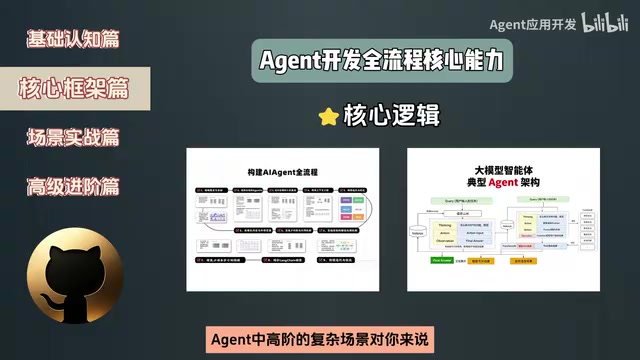
Whether you're working with LangChain, LangGraph, or another mainstream framework, the core thinking revolves around the Perceive → Plan → Execute → Feedback loop. It's worth understanding the technical positioning of the two dominant frameworks: LangChain, released by Harrison Chase in late 2022, is built around the concept of "chain composition" — linking LLM calls, tool execution, and data processing components into reusable Pipelines. LangGraph, designed to handle more complex control flow requirements, models an Agent's execution as a directed graph where each node represents a processing step and each edge represents a state transition condition — enabling conditional branching, retry loops, parallel execution, and arbitrarily complex logic. This design philosophy echoes Microsoft AutoGen's multi-agent collaboration approach and represents the mainstream direction of Agent engineering. Once you internalize this universal paradigm, the cost of migrating to new frameworks drops dramatically. This is precisely why systematic learning beats watching scattered videos — it builds transferable mental models rather than isolated operational tricks.
From Skeleton to Flesh: The Core Value of Scenario Practice
The course uses a vivid analogy: the Core Frameworks stage builds the skeleton; the Scenario Practice stage adds the muscles and blood. Without hands-on projects to fill it out, Agent capability remains an empty shell.

The Scenario Practice stage covers a full spectrum of real-world deployment scenarios. Each lesson focuses on one theme and includes a complete project review exercise:
- Automated Office Assistant: Handling documents, emails, scheduling, and other repetitive tasks
- E-commerce Customer Service Agent: Automated responses, order inquiries, after-sales processing
- Content Creation Agent: Copywriting and content planning
- Data Analysis Assistant: Data processing and insight generation
- Private Domain Operations Bot: User engagement and community management
- Workplace Reporting Tool: Automated report and summary generation

By this stage, your Agent development skills are sufficient for everyday demands — covering 80% of enterprise-grade commercial use cases. Most enterprise AI Agent requirements fundamentally revolve around these common scenarios. Mastering these template-based capabilities equips you to handle the vast majority of freelance and project development work.
Advanced Topics: From Tool Thinking to Product Thinking
The course's most valuable insight emerges in the Advanced stage. The creator identifies a critical dividing line: don't force requirements into templates — design Agents using product logic from the start.
This is a qualitative leap from "knowing how to use tools" to "knowing how to build products." Many developers remain stuck at the feature implementation level, building Agents that earn only polite praise from clients. Developers with product thinking genuinely understand the logic behind business requirements — and build solutions that actually delight users in practice.
The difference between product thinking and tool thinking is especially pronounced in the AI Agent space. Technical implementers tend to be driven by "feature completeness" — can the Agent call the right tools and output structured results? Product designers focus on "user goal achievement" — where is the friction in real workflows? How gracefully does the Agent handle edge cases? How deeply does it integrate with existing business systems?
Take an e-commerce customer service Agent as an example. A technical perspective might stop at "can it correctly answer refund policy questions?" A product perspective asks: how should the Agent adjust its tone when a user is upset? When an order anomaly falls outside the knowledge base, how does it seamlessly escalate to a human agent? How do you find the optimal balance between automation rate and user satisfaction? The answers to these questions determine whether an Agent project is a Demo-level technical showcase or a solution that generates real business value.
This distinction is fundamentally the gap between a technical implementer and a solution designer. The former asks "can it be done?"; the latter asks "should it be done this way?" and "how can it be done better?" In the rapidly evolving AI Agent space, versatile professionals who combine technical and product thinking are especially rare — and that is the core of real career competitiveness.
Career Return Path for AI Agent Learning
From a career development perspective, the growth trajectory for systematically learning Agent development is quite clear:
- Beginner Stage: Master the fundamentals; independently build simple agents
- Intermediate Stage: Understand core frameworks; handle complex business scenarios
- Practitioner Stage: Cover commercial use cases; take on freelance and development projects
- Expert Stage: Develop product thinking; lead customized enterprise-grade development
According to the course plan, investing 6 hours per week, you can independently build complete business-grade agents in under six months. While AI Agent development covers a broad knowledge base, the actual barrier to entry is considerably lower than traditional software development — thanks to the heavy lifting done by existing frameworks and LLM capabilities.
Conclusion
The greatest insight from this learning framework isn't in the specific course content — it's the systematic learning methodology itself. In an era of rapid AI iteration, acquiring knowledge in fragments makes it increasingly difficult to build genuine competitive advantage. Regardless of which course you choose, the progressive path of Foundational Concepts → Core Frameworks → Scenario Practice → Product Thinking is worth following.
The core logic is simple: first build a solid understanding of how AI Agents work at a fundamental level; then accumulate experience through extensive hands-on practice; finally, use product thinking to bridge from technical capability to real business value. For developers looking to establish a competitive edge in the AI Agent wave, this may be the most practical growth path available.
Key Takeaways
Related articles

Disaster and Glory of the Apollo Program: The History We Must Revisit Before Returning to the Moon
From the fatal Apollo 1 fire to Apollo 8's daring lunar orbit to Apollo 11's successful landing—revisiting the disasters, fears, and compromises of the Apollo program and their lessons for today's return to the Moon.

Netflix Trust Exercise Turns Into Firing Trap: Where Are the Boundaries of Corporate Trust?
A Netflix employee was fired after sharing private info in a trust exercise. We analyze the risks of corporate trust exercises and how employees can protect themselves.

AMD CDNA5 Architecture Deep Dive: Technical Evolution and the AI Computing Competition Landscape
Deep analysis of AMD's CDNA5 architecture covering Chiplet packaging upgrades, HBM memory evolution, and low-precision compute optimization, examining how AMD challenges NVIDIA's AI chip dominance.