FastAPI Fundamentals: Frontend-Backend Separation and RESTful API Design Explained
Learn the architecture and API design principles every FastAPI developer needs before writing a single line of code.
This article lays the conceptual groundwork for learning FastAPI by explaining frontend-backend separation architecture, the role of JSON in modern web APIs, and RESTful resource-oriented design. It covers HTTP methods (GET, POST, PUT, DELETE), idempotency, and why FastAPI adopts the REST standard — giving developers the mental model they need before tackling routing and dependency injection.
Why FastAPI Is Worth Learning
FastAPI is one of the fastest Python web backend frameworks available today, and it's increasingly becoming the go-to choice for backend development. Its positioning is crystal clear: it was designed from the ground up for frontend-backend separation — the modern web development paradigm.
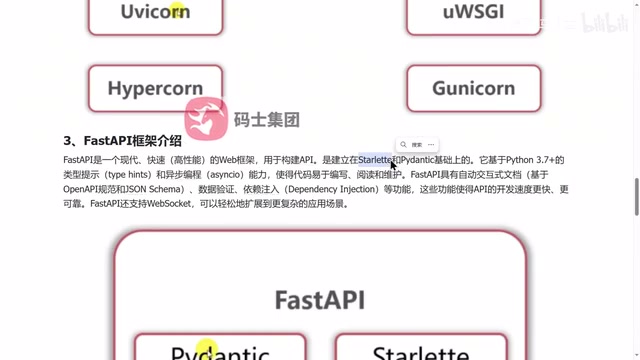
One important detail: FastAPI isn't built from scratch. It sits on top of the Starlette framework, which itself is built on the ASGI (Asynchronous Server Gateway Interface) protocol — the standard interface for Python async web services and the async successor to the traditional WSGI protocol. WSGI (used by Flask and Django by default) follows a synchronous, blocking model where each request must wait for the previous one to complete. ASGI, on the other hand, allows the server to handle large numbers of concurrent connections simultaneously — and that's the fundamental reason behind FastAPI's outstanding performance. Starlette focuses on API development and backend services, while also retaining the ability to integrate the Jinja2 templating engine. This means that while FastAPI primarily targets frontend-backend separated projects, it can also handle traditional server-side page rendering when needed.
Before diving into FastAPI's specific syntax, a few foundational concepts are absolutely critical — they determine whether you can truly get the most out of this framework. This article focuses on web development patterns and API interface standards, helping you build the right mental model.
Tightly Coupled Frontend-Backend: The Limitations of the Old Model
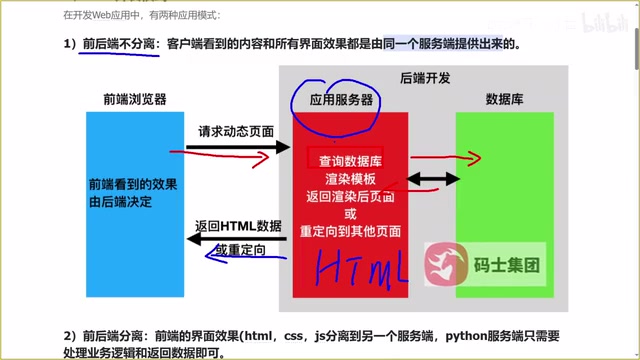
Tightly coupled (non-separated) frontend and backend means everything the browser sees — the UI, interactions, and data — is served from a single server.
In this model, when a user makes a request in the browser, it reaches the application server, which queries the database, processes business logic, and returns a fully rendered HTML page. The UI, data, and interactions are all generated in that one application server.

The core problem with this model is high coupling. Development requires a finalized UI design before the server can handle data queries and page rendering in sync, which reduces development efficiency and makes parallel teamwork difficult. As a result, tightly coupled frontend-backend development is an older approach — it's mostly relevant today as background knowledge.
Frontend-Backend Separation: The Dominant Architecture for Enterprise Projects
Frontend-backend separation is the development model used in over 90% of enterprise-grade web projects today. Its core idea is to split responsibilities along technical boundaries:
- Frontend server (static file server): Dedicated to storing and serving static assets like HTML, CSS, JS, and images — responsible for UI layout and interactive effects.
- Backend server (e.g., a Python application server): Dedicated to business logic and data processing, exposing a unified set of API endpoints.
The biggest advantage of this split is parallel development. The frontend and backend teams can work simultaneously as soon as the API contract is agreed upon — no waiting on each other. At runtime, the two are also independent service processes, each doing its own job.

In this architecture, browser requests are distributed: UI requests go to the frontend server, data requests go to the backend API. The data returned by the backend is almost always in JSON format — currently, over 95% of web apps, desktop programs, and mobile apps (Android and iOS) use JSON as their server response format.
JSON (JavaScript Object Notation) originally came from JavaScript's object literal syntax, but its minimalist key-value structure has made it a truly cross-language data exchange standard. Compared to the XML that was popular in earlier years, JSON has a smaller footprint (typically 30–50% less data transferred), requires no complex tag closing, and virtually every mainstream programming language has a built-in JSON parsing library. Python's json module and the Pydantic library used internally by FastAPI both enable seamless conversion between JSON data and Python objects — which is a key reason why FastAPI's developer experience feels so smooth.
It's worth emphasizing: the backend server doesn't care where the data will ultimately be displayed. Whether it's a browser, a WeChat Mini Program, or a mobile app, the backend only handles logic and returns data. How the client renders that data is entirely the client's concern. This decoupling is the essence of modern server-side architecture.
What Is an API?
Now that we understand the development model, we can understand FastAPI's core subject matter — API endpoints.
API stands for Application Programming Interface — essentially an entry point that an application exposes for data operations. That entry point can be a function, a class, or a URL. When a client wants to call it, it simply sends a request to the corresponding address.
Today, the two dominant API standards in backend development are REST and RPC. Think of them as agreed-upon communication protocols — a protocol is fundamentally a set of rules that developers agree to follow.
RPC (Remote Procedure Call) abstracts remote service calls to look like local function calls. Its flagship technology, gRPC (introduced by Google, built on HTTP/2 and Protocol Buffers binary encoding), still plays an important role in microservice-to-microservice communication, offering roughly 7–10x better performance than REST. However, it's complex to debug and not convenient for public-facing APIs. REST, on the other hand, aligns naturally with HTTP, has rich tooling support, is highly usable, and offers strong security — making it the dominant choice for external-facing APIs, far ahead of RPC in market share. FastAPI's choice of the REST style represents the optimal balance between development convenience and universality.
RESTful: A Resource-Oriented API Design Standard
REST stands for Representational State Transfer, introduced by Roy Fielding in his doctoral dissertation in 2000. Think of it as an internationally mainstream API design standard — don't get bogged down in literal translation, just as you wouldn't try to decode what "ISO 9001" means word by word. What matters is understanding the design philosophy it represents.
REST is a resource-oriented programming model. The core idea: the backend's job is to provide data, and data is what we call a "resource." Each API endpoint corresponds to a type of resource — when a client requests an endpoint, it retrieves or manipulates the corresponding resource.
URLs Describe Resources; HTTP Methods Describe Operations
In RESTful design, the URL path represents the data resource being operated on, while the specific type of operation is expressed through different HTTP request methods:
- GET: Retrieve data. For example, requesting
/studentsto get all students, or/students/1to get the student with ID 1. - POST: Create data. For example, sending a POST request to
/studentsto add a student record. - PUT: Update data. For example, updating the information for the student with ID 1.
- DELETE: Delete data. For example, deleting the student record with ID 1.

Beyond their semantic differences, these four methods carry an important engineering concept — idempotency. GET, PUT, and DELETE are idempotent, meaning that executing the same request multiple times produces the same result as executing it once. POST is not idempotent — sending the same POST request multiple times will create multiple duplicate records. This property is critical when retrying requests over unstable networks, serving as an important constraint for ensuring data consistency. It also directly affects which FastAPI route decorators (@app.get, @app.post, etc.) are appropriate in which situations.
As you can see, for operations on the same "student" resource, combining an HTTP method with a URL path clearly expresses the intent — whether creating, reading, updating, or deleting. This design is both intuitive and standardized, and it's the style FastAPI naturally follows for API development.
Summary
Rather than jumping straight into FastAPI's syntax, this article started at a deeper conceptual level, laying out the foundational knowledge you need before studying this framework:
FastAPI is built on Starlette and the ASGI async protocol, making it one of the highest-performance backend frameworks in the Python ecosystem. It's designed around the frontend-backend separation model. Truly getting value out of this framework requires understanding the architectural division of responsibilities in frontend-backend separation, JSON-based data exchange, and the RESTful resource-oriented design philosophy — including the idempotency constraints of HTTP methods.
With these fundamentals in place, everything that follows — whether it's diving into FastAPI's routing and dependency injection, or integrating tools like LangGraph for AI agent development — will go much more smoothly.
Key Takeaways
Related articles

Disaster and Glory of the Apollo Program: The History We Must Revisit Before Returning to the Moon
From the fatal Apollo 1 fire to Apollo 8's daring lunar orbit to Apollo 11's successful landing—revisiting the disasters, fears, and compromises of the Apollo program and their lessons for today's return to the Moon.

Netflix Trust Exercise Turns Into Firing Trap: Where Are the Boundaries of Corporate Trust?
A Netflix employee was fired after sharing private info in a trust exercise. We analyze the risks of corporate trust exercises and how employees can protect themselves.

AMD CDNA5 Architecture Deep Dive: Technical Evolution and the AI Computing Competition Landscape
Deep analysis of AMD's CDNA5 architecture covering Chiplet packaging upgrades, HBM memory evolution, and low-precision compute optimization, examining how AMD challenges NVIDIA's AI chip dominance.