Fizz Lawsuit: VC Allegedly Leaked Confidential Fundraising Information to Competitor Sidechat

Fizz sues VC firm Maveron for allegedly leaking confidential fundraising data to campus social rival Sidechat.
Campus social app Fizz has expanded its lawsuit against competitor Sidechat, alleging that a partner at VC firm Maveron shared confidential business information obtained during fundraising meetings with the rival startup. The case exposes a longstanding gray area in venture investing around trade secret protection, information barriers, and conflict-of-interest management — with significant implications for the broader startup funding ecosystem.
Overview
College social app Fizz has expanded its lawsuit against competitor Sidechat, alleging that a partner at venture capital firm Maveron obtained confidential information during fundraising meetings and shared it with the rival startup.
Fizz was founded in 2021 by Stanford University students. The app focuses on anonymous campus social experiences verified through school email addresses, and has since expanded to hundreds of U.S. colleges. Sidechat targets the same campus anonymous social niche, and the two products are highly similar in form and function. Both grew rapidly during the anonymous social media boom of 2022–2023, essentially filling the void left by Yik Yak's shutdown.
Yik Yak was founded in 2013 by two Furman University students. It quickly swept U.S. campuses with its location-based anonymous posting mechanism, reaching a peak valuation of $400 million. However, the platform repeatedly became a breeding ground for cyberbullying, harassment, and threats. Multiple universities banned it outright, ultimately forcing it to shut down in 2017. This history provided important product design lessons for Fizz and Sidechat: both introduced school email verification to establish community boundaries while preserving anonymity, attempting to strike a balance between "true anonymity" and "manageable community."
Maveron is a prominent consumer technology–focused venture capital firm co-founded in 1998 by former Starbucks CEO Howard Schultz and Dan Levitan. Headquartered in Seattle, its portfolio includes well-known consumer brands such as eBay and Zulily. Maveron's core investment philosophy centers on finding brands that forge emotional connections with consumers — a natural fit for high-engagement social and consumer apps. This strategy explains why the firm approached multiple startups in the campus social space simultaneously, and why it now finds itself entangled in the conflict-of-interest issues this case has exposed.
This lawsuit shines a light on a longstanding gray area in the startup funding ecosystem that is rarely discussed openly: when founders disclose sensitive trade secrets to VCs during fundraising, where are the boundaries of that information? And who is accountable for potential leaks?
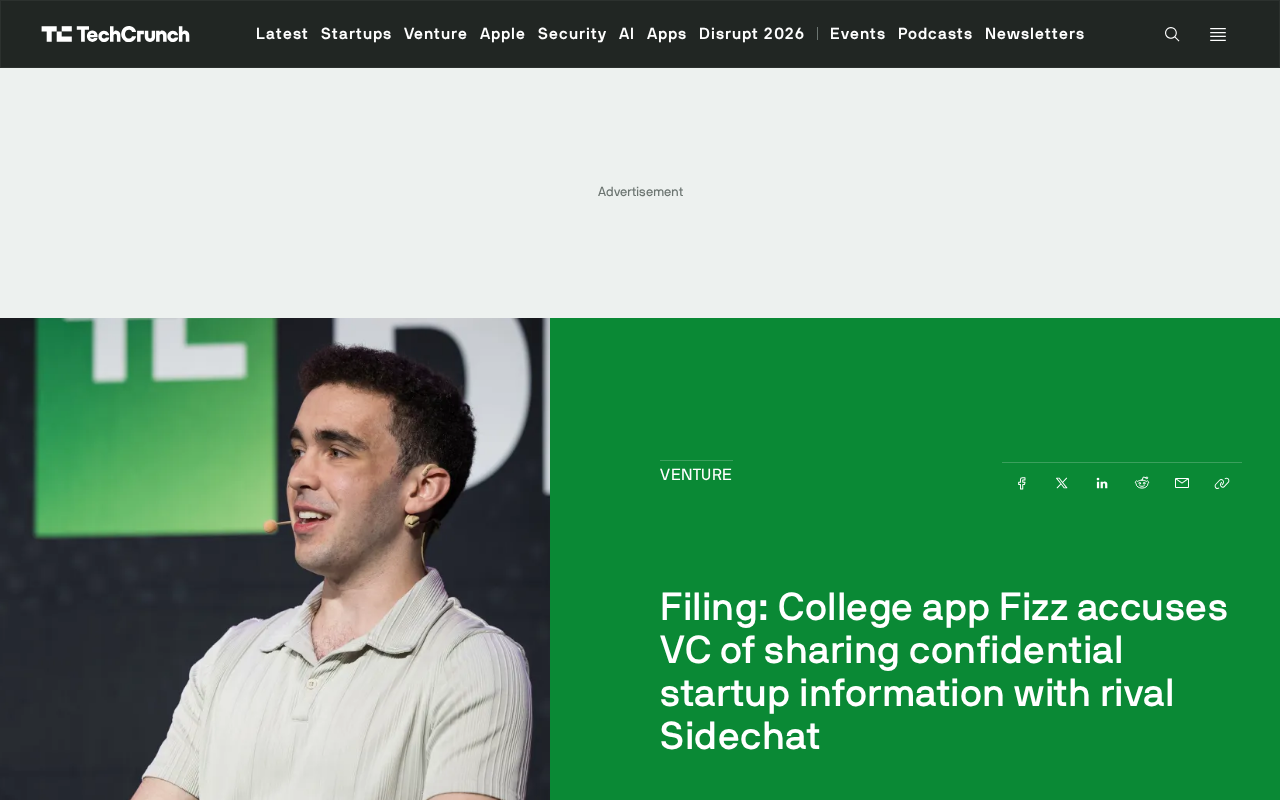
A Crisis of Trust in Fundraising Negotiations
According to court filings submitted by Fizz, a Maveron venture investor gained access to the company's confidential business information during fundraising discussions. Maveron also had ties to competitor Sidechat, and Fizz alleges that the investor passed the sensitive information along to that rival.
The Double-Edged Sword of Due Diligence
During startup fundraising, founders are often required to share large volumes of core data with potential investors — including user growth curves, business model details, financial status, product roadmaps, and technical architecture — in order to secure investment. This disclosure is a necessary part of fundraising negotiations, but it also places startups in an extremely vulnerable position.
Venture capital due diligence is a systematic process of information gathering and evaluation, typically divided into three stages: initial screening, deep due diligence, and investment decision. During deep due diligence, startups are often required to open a Data Room and share core materials with investors, including financial models, user retention rates, CAC/LTV ratios, technical architecture documents, and key contracts.
It's worth explaining CAC (Customer Acquisition Cost) and LTV (Lifetime Value) specifically — they are the two core metrics for evaluating the commercial viability of consumer apps. CAC measures the average marketing and operational cost of acquiring one new user; LTV represents the total value a single user generates for the platform over their entire usage lifecycle. Healthy business models typically require an LTV/CAC ratio greater than 3. For campus social apps, these metrics are especially sensitive: CAC in the campus market is directly influenced by penetration strategies (such as the scale and cost of campus ambassador programs). If a competitor obtains these figures, they can precisely reverse-engineer the other party's operational efficiency and cash burn rate, enabling targeted competitive strategies.
Notably, Virtual Data Room (VDR) technology has evolved from simple file sharing into professional platforms with granular permission management. Modern VDR tools such as Datasite and Intralinks support file watermarking, access logging, screenshot protection, and automatic permission revocation upon expiry — creating a complete digital audit trail of who accessed which documents and when. In trade secret litigation, this can serve as critical evidence. However, in many early-stage fundraising scenarios, startups don't fully leverage these security mechanisms, and information is often shared in more informal ways.
This information asymmetry is structurally embedded in fundraising negotiations — founders must "give first" before receiving an investment commitment. Industry data suggests that an average startup contacts dozens of VCs before completing a funding round, meaning sensitive information may remain in multiple firms' filing systems even after negotiations fall through, with no effective mechanism for destruction or return.
For a campus social app like Fizz operating in a fiercely competitive market, core data falling into a competitor's hands could directly compromise market strategy and competitive advantage. The scenario described in the lawsuit is precisely the nightmare many founders fear most: an investor who should have kept secrets instead became a channel for information leakage.
Cutthroat Competition in the Campus Social Space
Fizz and Sidechat are both anonymous social apps targeting college students, competing directly in the campus market. These apps typically build communities around individual universities, where users can post anonymously, discuss campus life, and share opinions.
The Market Logic of Anonymous Social Media
Campus anonymous social is a market that is highly dependent on network effects. Network effects refer to the economic phenomenon where a product or service's value increases exponentially as more users join. The network effects of campus social apps are highly geographically constrained — a single university is an independent network node, and users only care whether their fellow students are on the same platform.
This dynamic leads to a typical "local monopoly" structure in the campus social market: the app that first reaches critical mass at a given school can effectively crowd out competitors entirely, because users have no incentive to split their attention across multiple similar platforms.
This dynamic closely mirrors the rise and fall of Yik Yak — the app dominated U.S. campus anonymous social from 2013 to 2016, and the user vacuum left by its closure is precisely the battleground Fizz and Sidechat are currently fighting over. Whoever first achieves campus-level network coverage can lock in an entire student body's social attention, creating barriers that are nearly impossible to replicate.
What Fizz and Sidechat are fundamentally competing for is "school-level network control." Whoever first establishes an active community at key universities gains a first-mover advantage that is very hard to dislodge. This is why competition between the two is so intense — if a competitor uses acquired confidential information (such as a list of priority target schools or user activation strategies) to leapfrog ahead, the injured party has almost no opportunity to recover. Any confidential information related to expansion strategy and user operations carries extremely high value, which explains why Fizz has escalated the trade secret leak to the level of legal action. In a winner-takes-all market, information asymmetry often determines the outcome.
The VC Industry's Conflict-of-Interest Problem
This lawsuit brings to the forefront a sensitive issue in the venture capital industry: when an investment firm simultaneously engages with multiple competing companies in the same sector, how should it manage conflicts of interest and protect founders' trade secrets?
Why Information Barriers Fail
In theory, professional VC firms should establish strict information barriers — colloquially known as "Chinese Walls." This term originated from financial regulatory reforms following the 1929 U.S. stock market crash and was later institutionalized by the Securities Exchange Act of 1934. It was initially used within investment banks to separate the information flow between research departments and underwriting departments to prevent insider trading. In the investment banking context, the mechanism is backed by a complete compliance system: separate office spaces, tiered system access permissions, dedicated compliance officers, and regular audits.
In the venture capital context, this mechanism requires firms to prevent information cross-contamination through personnel separation, tiered system access, and process audits when simultaneously engaging with competing companies in the same space. Many top investment institutions also explicitly avoid investing in directly competing companies simultaneously, in order to maintain founder trust.
However, the organizational structure of VC firms is fundamentally different from investment banks. Most VC funds are small with flat team structures — partners communicate frequently on a daily basis and typically share CRM systems, attend meetings together, and openly discuss portfolio companies at partner meetings. These structural characteristics make "separation" impractical at both the physical and institutional levels. More importantly, the VC industry lacks mandatory requirements for information barriers comparable to securities regulations, relying primarily on professional ethics and contractual constraints. When the same partner or the same firm has contact with multiple competing companies, the flow of information is very difficult to track completely or constrain effectively. Fizz's allegations — if true — are a textbook example of this mechanism failing.
Legal Framework and the Challenges of Building a Case
In the United States, such trade secret disputes primarily seek relief under the Defend Trade Secrets Act (DTSA), passed in 2016, and various state Uniform Trade Secrets Acts (UTSA). The DTSA is America's first federal-level civil trade secret protection statute, filling the gap left by previously fragmented state laws. It grants federal courts jurisdiction and allows plaintiffs to apply for an Ex Parte Seizure Order — meaning law enforcement can seize property used to disseminate trade secrets without notifying the defendant. This is a core advantage distinguishing it from traditional state law remedies.
However, the evidentiary requirements for such cases are quite stringent: plaintiffs must simultaneously prove three things — that the information has independent economic value and is not publicly known; that the company took reasonable measures to maintain its secrecy; and that the defendant engaged in demonstrable misappropriation or unauthorized disclosure. The evidentiary challenge in the Fizz case is concentrated especially on the third element — in a context where internal VC communications often lack written records, reconstructing the complete causal chain of information transmission will be the key to winning or losing the lawsuit. Fizz's decision to expand the lawsuit to include the Maveron partner individually may be precisely an attempt to shift the evidentiary focus to the specific actor's subjective intent and conduct, bypassing the legal barriers that might shield the institution as a whole.
A Warning to the Startup Funding Ecosystem
Regardless of the ultimate outcome, this case sends a clear warning signal to the entire startup ecosystem. Founders need to more carefully assess investors' potential conflicts of interest during fundraising, consider signing more stringent NDAs before disclosing sensitive information, or adopt a staged disclosure strategy to protect core data.
It's worth noting that NDAs have significant practical limitations in VC fundraising contexts. Many top VC firms explicitly refuse to sign NDAs during early-stage contact, arguing that they simultaneously engage with large numbers of similar companies and that signing NDAs would expose them to a thicket of legal risks. Even when NDAs are signed, the definition of "confidential information" is often disputed — what counts as "publicly accessible market information" versus "protected proprietary knowledge" can be difficult to clearly delineate in court. Additionally, competitive losses resulting from trade secret leaks are hard to monetize directly, and quantifying damages is extremely complex.
For VCs, this is also a wake-up call regarding professional ethics and compliance management. Trust is the cornerstone upon which the venture capital industry operates — once that trust is systematically eroded, the reputation of the entire industry will suffer.
Conclusion
Fizz's allegations against Sidechat and Maveron remain in litigation, with specific facts yet to be determined by the court. But the core issues this case touches on — information security during fundraising, VC conflict-of-interest management, and information barriers between competitors — are real challenges that every founder and investor needs to take seriously.
In an era where information is competitive power, finding the right balance between open fundraising and protecting trade secrets will become an essential skill for founders to master. From improving tiered access permissions in data rooms (including deploying VDR tools with complete audit logs), to establishing staged information disclosure protocols, to conducting systematic background checks on potential investors for conflicts of interest — these practices are evolving from industry "best practices" into survival essentials for founders. For regulators, the Fizz case may also become an opportunity to push the VC industry toward establishing clearer information management standards.
Related articles

AI Art Prompt Structure Breakdown: Creating a Desert Crystal Pyramid Scene
Breaking down a popular Reddit AI artwork to reveal the five core elements of structured prompts: subject, material, lighting, environment, and atmosphere for AI art scene creation.

$100 Million Deal: AI Gives 50,000 Ukrainian Kamikaze Drones Autonomous Target Lock
A U.S. company struck a $100M deal with Ukraine to deploy AI visual lock-on capabilities on 50,000 cheap kamikaze drones, enabling terminal autonomous guidance to defeat electronic warfare jamming.

The Privacy Boundaries of AI Data Collection: Your Bedroom Is Becoming a Model Training Ground
A humorous tweet about clothes entering AI training data reveals the privacy dilemma of AI data collection. We explore machine unlearning challenges, consent issues, and how users can balance convenience with privacy.