Flock: Building an AI Development Squad with Claude Code to Reshape Team Programming Workflows

Flock uses Claude Code to orchestrate a multi-agent AI dev squad that manages your entire coding workflow.
Flock is a self-hosted, multi-agent development bot built on Claude Code. It assigns distinct roles — Planner, Coder, Tester, Reviewer, and Arbiter — to transform AI programming from simple code completion into a fully traceable development pipeline, complete with isolated workspaces and an automated review feedback loop.
What Problem Does Flock Actually Solve
When we talk about AI programming tools, the conversation usually centers on a single question: can AI write code? But for working developers, that's long ceased to be the biggest pain point. The real time sink is the constant context-switching between chat tools, terminals, and code hosting platforms — translating requirements into tasks, branching, running tests, opening reviews, handling comments, and finally merging. That's exactly the workflow gap Flock was built to address.
Flock is an intelligent development team bot that runs on a server. You describe what you need in a chat, and it dispatches a squad of Claude Code agents to plan, branch, test, review, and ultimately deliver a Pull Request.
It helps to understand Claude Code's positioning first: it's Anthropic's command-line AI programming tool for developers, built on the Claude family of large language models. Unlike IDE plugins such as GitHub Copilot, Claude Code's primary interface is the terminal — it can directly read and write the filesystem, execute shell commands, and run Git operations, giving it strong autonomous execution capabilities. Flock uses Claude Code as the execution engine for each Agent role, essentially upgrading Claude Code from a single-user tool into an orchestratable team component.
In other words, Flock transforms AI programming from "a code completion snippet" into "a traceable development pipeline."
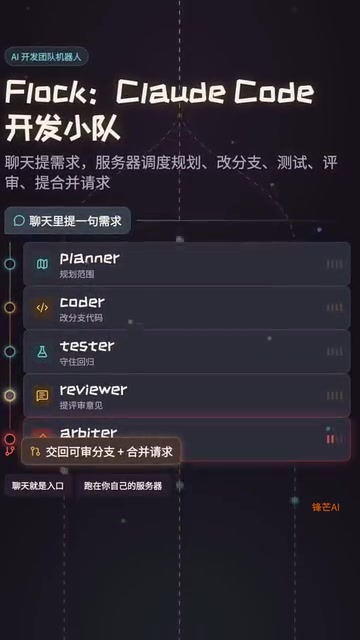
Flock's value proposition isn't about making any one Agent smarter at writing code — it's about restructuring how developers collaborate across their toolchain, consolidating fragmented operations into a single unified entry point.
To appreciate this value, it helps to view it through the lens of AI programming tool evolution. These tools have gone through roughly three phases: Phase 1 was "code completion" tools like GitHub Copilot, focused on line- or function-level code suggestions. Phase 2 brought "conversational editing" tools like Cursor and Windsurf, capable of understanding requirements and making file-level modifications. Phase 3 is now emerging — represented by Devin, SWE-agent, and Flock — with the goal of "autonomously completing full development tasks," covering requirement understanding, code changes, test verification, and review collaboration. Phase 3 carries the greatest technical challenges, but once mature, it has the most profound potential to reshape the development process.
Not a Single Agent, But a Role-Based Multi-Agent Pipeline
Flock's core design philosophy is not to rely on a single powerful Agent, but to build a multi-agent collaboration pipeline with clearly defined roles. That pipeline consists of several key players:
- Planner: Defines the scope of requirements, breaking down vague chat requests into concrete tasks.
- Coder: Does the actual hands-on code modification.
- Tester: Guards against regression, ensuring changes don't break existing functionality.
- Reviewer: Provides code feedback, simulating a human Code Review step.
- Arbiter: Interrupts potential infinite loops, serving as a flow control mechanism.
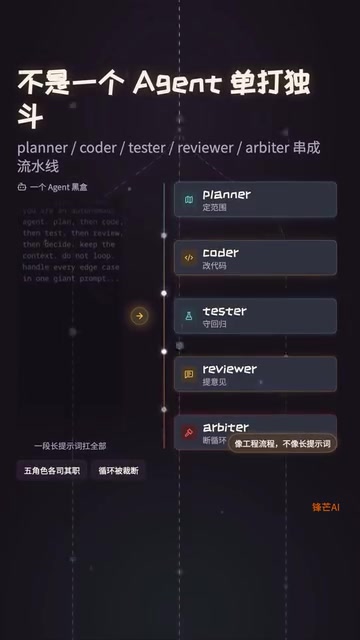
Multi-agent collaborative architecture is one of the central research directions in AI engineering today. Unlike a single large model completing tasks independently, multi-agent systems borrow the "Separation of Concerns" principle from software engineering, decomposing complex tasks among sub-agents with distinct responsibilities. This approach has been explored academically through projects like AutoGen and MetaGPT, and in industry through efforts like Devin. Its core advantage is that each Agent's context window stays more focused, errors are more easily caught by downstream roles, and the overall process more closely mirrors how human teams actually collaborate.
This division of labor makes Flock "feel more like an engineering process than a long prompt." Compared to a single Agent iteratively self-correcting, a multi-role collaborative pipeline has clear advantages in terms of accountability boundaries, controllability, and output consistency. The Arbiter role in particular directly addresses one of the most common failure modes in current AI Agents — getting stuck in infinite loops. When the modify-validate cycle between Coder and Tester fails to converge, the Arbiter identifies this state and forces an interruption, preventing wasteful resource consumption.
Isolated Workspaces and Review Feedback Loop
Flock has a practical engineering design: each chat session gets its own isolated workspace and code branch, keeping different requirements separate so they never contaminate each other's code state.
More noteworthy is its review feedback loop — review comments from the code platform are polled and automatically pulled back into the original chat thread. This bridges the gap between "submitting a requirement" and "getting code reviewed": you no longer need to switch back and forth between your chat tool and the GitHub page — review feedback flows directly back to where you originally made the request.
Code review has long been one of the most information-fragmented steps in the development workflow. Requirements are raised in chat tools, code is written in IDEs, reviews happen on GitHub/GitLab pages, and feedback is relayed back to the developer — every cross-platform jump in this chain means lost context and increased collaboration friction. Flock's polling mechanism is essentially building an "event-driven context synchronization pipeline," letting review feedback automatically flow back to the originating session and maintaining information continuity. In software engineering terms, this corresponds to a "closed-loop feedback" design principle.
For teams managing multi-repository or microservices architectures, this feature is especially valuable. When a project is spread across multiple codebases, requirement tracking and review collaboration are often the first things to spiral out of control — and Flock attempts to consolidate these steps into a single, traceable operations console.
It's Team Infrastructure, Not a Lightweight Toy
Flock isn't something you casually spin up and play with. The official documentation is clear: it requires self-hosting, whitelist configuration, code platform access tokens, and Claude authentication — and the hosting server must be located in a supported region.

Self-hosted deployment is a common choice in enterprise-grade developer tooling, especially in organizations with strict code security and compliance requirements. The core value is data sovereignty — code, requirement descriptions, and review content all stay within your own infrastructure, avoiding sensitive IP flowing to a third-party SaaS platform. The trade-off is significantly higher operational complexity: maintaining servers, managing authentication tokens, and handling regional restrictions. By choosing this path, Flock is sending a clear positioning signal to engineering teams in compliance-sensitive industries like finance, healthcare, and government.
This deployment barrier defines Flock's true positioning — team-level development infrastructure, not a plug-and-play lightweight tool. If you just want to quickly generate a few snippets of code, Flock's heavyweight configuration is more burden than benefit. But if you need a traceable, collaborative development workflow with regression testing support, the upfront investment is justified.
Project Status and a Realistic Assessment
In terms of project activity, Flock has 718 stars and 3 forks on GitHub, with recent code commits still happening. These numbers indicate it's still quite an early-stage project.

Taken together, Flock represents an important direction in the evolution of AI programming tools — moving from "helping write code" toward "orchestrating the development process." Multi-agent collaboration, role specialization, controllable workflows, and review feedback loops all reflect deep thinking about real-world engineering scenarios.
But "early-stage" also means risk: the community is still small, deployment complexity is high, and potential adopters need to carefully weigh the cost-benefit ratio.
Which Teams Should Pay Attention to Flock
If you fall into any of the following categories, Flock is worth adding to your watchlist:
- Development teams managing multi-repository or microservices architectures
- Engineering organizations looking to integrate AI programming into a standardized, traceable workflow
- Technical teams with data compliance requirements who are willing to invest in self-hosted configuration in exchange for process control
Conversely, if you just need a quick code generation assistant, Flock's complexity may not be worth it. If you want to explore further, search for "WGO Flock" — and keep its positioning in mind: an intelligent development squad console powered by Claude Code.
Related articles

The Truth Behind Codex 'Build a Website in 5 Minutes': AI Isn't Creating Sites—It's Helping You Copy Them
Exposing the truth behind viral Codex 5-minute website videos: creators aren't building original sites with AI—they're copying shared prompts or scraping others' work. Learn AI coding tools' real limits.

Getting Started with AI Agent Development: A Complete Guide from Concept to Practice
A comprehensive guide to AI Agent architecture and development, covering automated marketing, intelligent customer service, and investment analysis scenarios with single and multi-agent collaboration.

The Truth Behind Codex 'Build a Website in 5 Minutes': AI Isn't Creating Sites — It's Helping You Copy Them
Exposing the truth behind viral Codex 5-minute website videos: creators aren't building original sites with AI — they're copying shared prompts or scraping others' work.