From RAG to Agent: A Complete Architecture Guide for AI-Native Systems

A macro-level guide to the full AI-native stack, from LLM and RAG to Agents, MCP, and production infrastructure.
This article maps out the complete architecture of enterprise AI-native systems across four layers: LLM semantic reasoning, RAG retrieval (vector search, knowledge graphs, and BM25), Agent-based execution with MCP tool calling, and production infrastructure including AI gateways and observability. It also covers the shift from single-agent ReAct patterns to Multi-Agent architectures.
Why Understanding the Overall AI System Architecture Matters More Than Learning Any Single Technology
Many developers fall into the same trap when learning AI application development: they study RAG, then study Agent frameworks, and end up struggling to use either effectively. The root cause isn't that any individual concept was missed — it's the lack of a holistic, macro-level understanding of modern AI system architecture.
As seasoned AI practitioners with enterprise backgrounds have repeatedly emphasized: you need to map out the entire technical stack at a macro level before you can figure out how to build and ship a production system step by step. Without a clear picture of the full pipeline, cherry-picking individual modules rarely leads anywhere.
This article takes an enterprise deployment perspective to systematically walk through the complete AI-native architecture — from user request to Agent execution — and help you build a clear technical map.

Layer 1: LLM Semantic Understanding and Reasoning — Where It All Begins
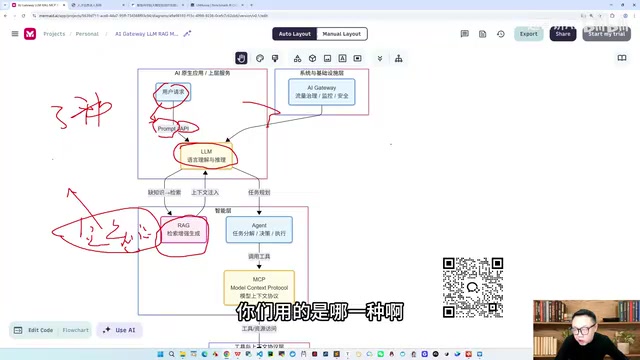
No matter how complex a modern AI system gets, the core pipeline follows the same thread: everything starts with a user request, which is fundamentally just a prompt.
The system calls a large language model (LLM) via API to understand and reason about the semantics of that prompt. This is the most foundational — and most critical — layer in the entire system.
To understand why this layer has inherent limitations, you need to understand how LLMs are trained. Large language models acquire language understanding and reasoning capabilities through pre-training on massive text datasets — a process that typically takes months and tens of millions of dollars in compute. Once training is complete, the model weights are "frozen," and the model's knowledge is permanently locked to the training data cutoff date. This means models like GPT-4 and Claude have no knowledge of events after their training cutoff, and no access to internal corporate databases, real-time pricing systems, or private documents.
This creates an unavoidable core problem: LLM knowledge is frozen. Ask it to "analyze our company's financial performance this year," and it simply doesn't know — the most common consequence being confident-sounding nonsense, what the industry calls "hallucination."
Layer 2: Three Core RAG Paradigms for Retrieval-Augmented Generation
To address the knowledge gap and hallucination problem, you need to introduce RAG (Retrieval-Augmented Generation), which in enterprise settings typically takes the form of a "local knowledge base" or "enterprise knowledge base."
Many people mistakenly equate knowledge bases with vector search — that's an oversimplification. There are actually three mainstream knowledge retrieval approaches, and understanding the differences between them is a prerequisite for building a high-quality knowledge base.
1. Vector Search (VectorDB)
The most common approach. Text is converted into high-dimensional numerical vectors (typically 768 to 3,072 dimensions) using embedding models like text-embedding-ada-002 or BGE, and retrieval is based on semantic similarity. At query time, the system computes cosine similarity between the query vector and all vectors in the store, returning the nearest neighbors. Popular vector databases include Pinecone, Weaviate, Milvus, and pgvector.
The key advantage of vector search is its ability to understand semantic relationships — "automobile" and "car" will be recognized as highly related — rather than just keyword matching. It's well-suited for handling fuzzy queries and questions phrased differently but semantically equivalent.
2. Knowledge Graph
Another form of knowledge base, but significantly more complex to build than vector-based solutions. Knowledge is organized as entities and relationships forming a graph structure, making it well-suited for complex multi-hop reasoning queries — for example, "who are all the direct reports of my manager's manager?" Knowledge graph retrieval doesn't rely on semantic similarity; instead, it traverses relationship edges within the graph. This makes it irreplaceable in highly structured domains like organizational hierarchies, supply chains, and medical relationship networks.
3. Full-Text Search (BM25 Keyword Retrieval)
Keyword-based exact matching using the BM25 algorithm (Best Match 25). BM25 is a classic information retrieval algorithm validated over decades of use, addressing the shortcomings of early TF-IDF through term frequency saturation and document length normalization. It's also the default relevance algorithm in Elasticsearch. For exact-match scenarios involving product SKUs, regulatory clause numbers, and proper nouns, BM25 typically outperforms vector search in recall precision.
In practice, all three approaches often need to be combined (hybrid retrieval) to achieve optimal results — for example, using BM25 to filter a candidate set, then reranking with vector similarity. Dumping a PDF in without any data cleaning and expecting good retrieval results is wishful thinking.
Layer 3: From ChatBot to Agent — The Qualitative Leap in AI Systems
LLM + RAG alone doesn't constitute a true AI system — at best, it's an upgraded search tool, or a question-answering bot (ChatBot). This is the first-generation AI application: one question, one answer, offering suggestions but incapable of taking real action.
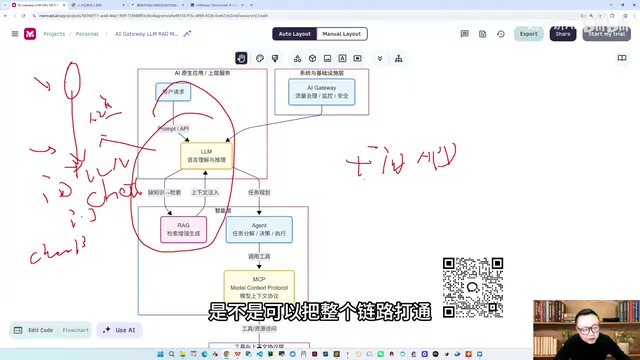
The real turning point is the Agent. Take "order me a coffee" as an example: a ChatBot tells you how to order; an Agent actually runs the entire workflow — finding the nearest coffee shop, placing the order, processing payment, and confirming the delivery address.
The essence of an Agent is giving the LLM "hands and feet." The workflow involves four core steps:
- Environment perception: Receive and understand user input
- Intent understanding: Analyze what the user actually wants
- Task planning: Break down complex goals into a series of executable actions
- Tool invocation: Complete actual operations through interfaces
The tool invocation layer involves MCP (Model Context Protocol). MCP is an open protocol released by Anthropic in late 2024, analogous to a "USB standard" for AI — before MCP, every Agent framework had its own tool-calling format, creating a highly fragmented ecosystem. MCP defines a unified server and client specification, allowing a single tool implementation to be reused by any MCP-compatible Agent. Agents call diverse APIs through MCP — ordering interfaces, payment interfaces, and completely different services — integrating them into a complete execution pipeline. Leading AI development tools including Claude and Cursor now support the MCP protocol.
Layer 4: Stability and Observability Infrastructure for Production-Grade AI Systems
Getting the logic to work is just the first step. Making the system run stably over the long term at production scale requires robust infrastructure. Two core requirements stand out: stability above all else, and continuous improvement.
AI Gateway
The AI Gateway is the first line of defense for the entire system, handling rate limiting, monitoring, security interception, and authentication. It serves as the central hub for traffic management. Without gateway protection, systems are highly vulnerable to crashes under high concurrency or malicious requests.
Observability
Continuous optimization requires a solid observability solution. By collecting real user feedback and long-term call chain data, the system can form a closed loop for ongoing iteration.
One point worth highlighting: content sent to public APIs is often collected by service providers and used as training data for future model iterations. This is precisely why enterprise applications must treat data security seriously, using gateways to intercept sensitive information.
The Limitations of Single-Agent ReAct and the Rise of Multi-Agent
Among Agent implementation patterns, the most classic is ReAct (Reasoning + Acting) — proposed by Google DeepMind in 2022. Its core idea is having the LLM alternate between "Thought → Action → Observation" cycles until the task is complete. This pattern is transparent and interpretable, with every reasoning step traceable.
However, ReAct has clear limitations in complex scenarios:
- Unstable task planning success rates: Complex multi-step tasks are prone to planning errors; each LLM call introduces latency, and complex tasks can require ten or more cycles, causing cumulative latency and error rates to climb significantly
- Error accumulation over long chains: Small deviations at each step can be amplified in subsequent steps
- Limited support for multi-role collaboration: A single agent's context and capability boundaries constrain complex task handling
This is the core driver behind the industry's shift from single-agent toward Multi-Agent architectures. Multi-Agent borrows from the microservices architecture philosophy in software engineering: complex tasks are distributed across multiple specialized Agents running in parallel, with an Orchestrator managing task distribution and result aggregation. Each sub-Agent can focus on a specific domain (e.g., a search Agent, a code Agent, a review Agent), reducing single-point context pressure; parallel execution significantly reduces overall latency; and task failures can be retried at the individual sub-Agent level without global rollback. Representative frameworks include Microsoft's AutoGen, LangGraph, and CrewAI.
Keeping Agent task planning and execution success rates consistently above 95% is the central engineering challenge that AI application engineers must continuously tackle.
Closing Thoughts: The Rare Value of Systems-Level Engineers

Engineers who can connect the entire stack — LLM, RAG, Agent, MCP, AI Gateway, and observability — and successfully ship it to production are extremely rare in today's market. Market compensation for this type of engineer reflects exactly that.
The core logic is clear: real value doesn't come from knowing how to use a single tool, but from the ability to take a macro-architectural view and systematically bring an AI system to production-grade quality, phase by phase.
Those who complain that "AI is useless and keeps making mistakes" are usually the ones who haven't applied systems thinking to solve problems at the critical layers. If you want to become a qualified AI application systems engineer, the first step is building the complete technical map laid out in this article — and then going deep into each layer through hands-on practice.
Key Takeaways
Related articles

Disaster and Glory of the Apollo Program: The History We Must Revisit Before Returning to the Moon
From the fatal Apollo 1 fire to Apollo 8's daring lunar orbit to Apollo 11's successful landing—revisiting the disasters, fears, and compromises of the Apollo program and their lessons for today's return to the Moon.
Netflix Trust Exercise Turns Into Firing Trap: Where Are the Boundaries of Corporate Trust?
A Netflix employee was fired after sharing private info in a trust exercise. We analyze the risks of corporate trust exercises and how employees can protect themselves.

AMD CDNA5 Architecture Deep Dive: Technical Evolution and the AI Computing Competition Landscape
Deep analysis of AMD's CDNA5 architecture covering Chiplet packaging upgrades, HBM memory evolution, and low-precision compute optimization, examining how AMD challenges NVIDIA's AI chip dominance.