Gemini 3.1 Pro + Claude Opus 4.6: The Ultimate AI Coding Combo — A Practical Guide

Claude Opus plans + Gemini Pro executes: dual-AI workflow builds a Minecraft clone for free
This article introduces a multi-model collaborative AI programming approach: leveraging Claude Opus 4.6's deep planning strengths to create detailed architectural blueprints, then using the more cost-effective Gemini 3.1 Pro to efficiently generate code based on those plans. Using Google's free Anti-Gravity IDE, the two models collaboratively built a fully functional Minecraft clone from scratch—complete with infinite terrain generation, mob systems, and inventory—demonstrating the power of the "planning-execution" separation paradigm in AI programming.
When Google's Gemini 3.1 Pro meets Anthropic's Claude Opus 4.6, the ceiling of AI programming is shattered once again. These two models each have distinct strengths—one excels at planning, the other at execution—and combining them can build a fully functional Minecraft clone from scratch. Even better, with Google's Anti-Gravity IDE, all of this can be achieved for free.
The Complementary Strengths of Gemini 3.1 Pro and Claude Opus 4.6
Claude Opus 4.6: The Strategic Brain for Deep Planning
Claude Opus 4.6 is Anthropic's flagship model, a powerhouse for deep strategic planning and expert-level knowledge work. With its million-token context window, it excels at long-text reasoning, debugging, and complex architectural design. A context window refers to the maximum amount of text a large language model can process in a single interaction—a million-token context window means the model can read and understand hundreds of thousands of lines of code or hundreds of pages of documentation at once, which is critical for architecting large software projects. Traditional models are limited by smaller context windows (typically thousands to tens of thousands of tokens), causing them to "forget" earlier information when handling complex projects, leading to inconsistent code generation.
In benchmarks like SWE-bench, Opus 4.6 leads in real-world expert-level tasks, demonstrating stronger reasoning endurance and long-range planning capabilities. SWE-bench is a software engineering benchmark developed by a team at Princeton University that extracts bug-fixing tasks from real GitHub open-source projects, requiring AI models to understand codebase context and generate correct patches—it's widely regarded as the gold standard for measuring practical AI coding ability.
However, Opus comes at a significant cost. Rather than having it do all the work, it's better to position it as the "architect"—responsible for creating implementation plans, defining the tech stack and directory structure—then handing off execution to a more cost-effective model.

Gemini 3.1 Pro: The Efficient Code Craftsman
Google's newly released Gemini 3.1 Pro brings significant improvements in abstract reasoning and multimodal tasks, covering image, video, PDF processing, and tool calling. Multimodal means the model can simultaneously process and understand multiple types of input—text, images, video, audio—meaning Gemini 3.1 Pro can not only generate code from text descriptions but also parse design mockup images, PDF documents, or even video demonstrations to understand development requirements. Tool Use (Function Calling) refers to the model's ability to proactively invoke external APIs or tools during reasoning to complete tasks, such as executing code, querying databases, or calling search engines—this elevates AI from a pure text generator to an intelligent agent capable of interacting with external systems.
More importantly, it costs roughly 7 to 8 times less than Opus, offering a clear cost-efficiency advantage.
Gemini performs particularly well in frontend development and UI generation, producing aesthetically pleasing interfaces—a fact validated across multiple tests. But it also has notable weaknesses—it's prone to hallucinations, and output quality can be inconsistent. AI hallucination is one of the most critical challenges in the LLM field, referring to the model generating content that appears reasonable but is actually incorrect or entirely fabricated. In programming scenarios, hallucinations may manifest as calling non-existent APIs, inventing fake library functions, generating syntactically correct but logically flawed code, or conjuring configuration parameters out of thin air. The fundamental cause of hallucinations lies in the fact that LLMs are essentially probability-based text prediction systems—they don't truly "understand" code semantics but generate the most likely next token based on statistical patterns in training data.
This is precisely why it needs a solid implementation plan for guidance, preventing it from drifting off course. Providing a detailed implementation plan as contextual constraints significantly reduces the probability of the model deviating—this is essentially a Prompt Engineering strategy that narrows the model's output space through structured constraints.
Why Combine Two AI Models?
The core logic is simple: let Opus handle planning, let Gemini handle execution. Opus generates comprehensive architectural blueprints and implementation steps; Gemini accurately generates all component code based on these specifications. This approach delivers robust architecture and clean modular code while effectively controlling overall AI programming costs.
This multi-model collaborative pattern reflects an important trend in AI programming: shifting from single-model "conversational programming" to multi-model "Orchestrated Programming," where the developer's role transforms from code writer to AI workflow designer and reviewer.
Hands-On Demo: Building the Collaborative Workflow in Anti-Gravity IDE
Anti-Gravity IDE is Google's AI-native integrated development environment, representing a new generation of development tool design philosophy—deeply integrating AI models into every stage of the development workflow, rather than serving merely as code completion assistants. Unlike the traditional VS Code + Copilot model, an AI-native IDE allows developers to switch between different AI models within the same interface, set different working modes (such as planning mode and execution mode), and provides Human-in-the-Loop mechanisms to review AI-generated content.
Step 1: Create the Implementation Plan with Claude Opus 4.6
After opening Anti-Gravity IDE, first select Thinking Mode (Planning Mode) and choose Claude Opus 4.6 as the planning model. In the prompt, describe the project requirements as thoroughly as possible, including:
- System architecture and tech stack
- Game engine architecture and directory structure
- Detailed feature specifications (inventory, basic lighting, etc.)
- Game loop design (ensuring 60Hz refresh rate)
- World system and chunk lifecycle
- Infinite terrain generation and data persistence
The game loop is the core architectural pattern of all real-time games, repeatedly executing three phases at a fixed frequency: "input processing → state update → rendering." A 60Hz refresh rate means the entire loop must complete one iteration in approximately 16.67 milliseconds, imposing strict performance optimization requirements on the code. In 3D voxel games (like Minecraft), performance bottlenecks typically occur in chunk mesh construction and rendering—each visible chunk may contain thousands of faces, requiring optimization techniques like Greedy Meshing, Frustum Culling, and Occlusion Culling to reduce GPU draw calls. AI is particularly error-prone when generating such performance-sensitive code, which is why high-quality architectural planning is needed to ensure performance constraints are factored into the design.
Opus 4.6 generates an extremely detailed implementation plan, including high-level architecture, tech stack selection, directory structure, and detailed descriptions of each component, all clearly presented in Markdown format.
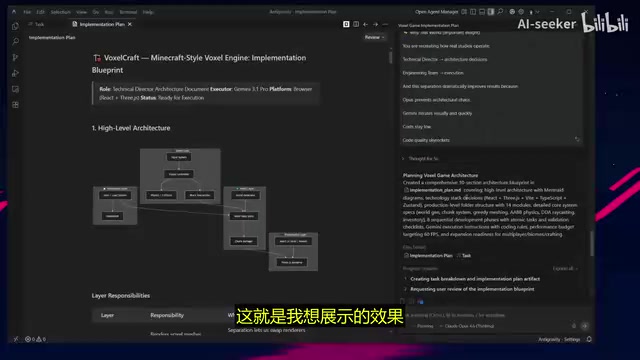
The quality of this plan is stunning—it not only covers all requested components but proactively considers extensibility, ensuring the architecture is designed for future requirements.
Step 2: Switch to Gemini 3.1 Pro for Code Generation
Once planning is complete, switch to Fast Mode and select Gemini 3.1 Pro's High mode. Send a detailed prompt explicitly stating that development should follow the implementation plan generated by Opus.
Gemini automatically begins generating code phase by phase according to the implementation plan:
- Phase 1: Set up the complete project structure and file scaffolding
- Phase 2: Write all game development logic and procedural terrain generation features
Procedural Terrain Generation is a classic technique in game development, and the original Minecraft is its iconic application. Its core typically relies on Perlin noise or Simplex noise algorithms—invented by Ken Perlin in 1983, these algorithms generate continuous, natural pseudo-random value distributions used to simulate mountains, plains, rivers, and other natural landscapes. In Minecraft-style games, the world is divided into fixed-size "Chunks," each containing 16×16×256 blocks. The game engine only loads chunks within the player's view range, while distant chunks are unloaded to save memory—this is known as "chunk lifecycle management." Infinite terrain relies on deterministic seeds—the same seed and coordinates always generate the same terrain, allowing the world to be generated and destroyed on demand without losing consistency.
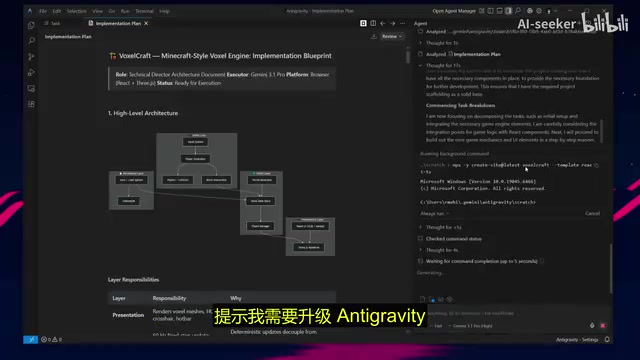
Throughout the process, Anti-Gravity IDE supports Human-in-the-Loop intervention, letting you monitor the generation process in real-time and approve content only after review. This mechanism is widely advocated in AI safety—it ensures that AI-generated code undergoes human developer review before being incorporated into the project, effectively preventing hallucinated code or security vulnerabilities from inadvertently entering production environments.
Handling Free Tier and Rate Limits
In Anti-Gravity's free version, you may hit rate limits. When this happens, you have several options:
- Wait approximately five hours before continuing generation
- Use the Open Code plugin with other free models as alternatives
- Upgrade Anti-Gravity for more quota
Alternative models may produce lower-quality output, but they're perfectly viable as a fallback.
The Final Result: A Minecraft Clone Built from Scratch
The output from the two AI models working in tandem is impressive—a remarkably complete Minecraft clone with the following features:
Core Gameplay:
- Survival mode and creative mode options
- Freely explorable 3D world
- Real-time framerate display
- Functional inventory system with block placement and item crafting
World Generation:
- Infinite procedural terrain generation
- Underground cave systems containing various ores (including diamond ore)
- Natural terrain elements like flowers and trees
- Lava generation

Mobs and Interactions:
- Automatically spawning mobs (sheep, chickens, etc.)
- Mob interactions (killing, resource collection)
- Block-breaking animations and sound effects
- Health bar system affected by falls and lava
- Stepping into lava causes death, consistent with the original Minecraft experience
Of course, the AI-generated game isn't perfect—ocean blocks lack fine-tuning, some trees are missing leaves, and certain elements need adjustment. But considering this was built from scratch by two AI models, the level of completion is remarkable. It's worth noting that full development of this type of voxel game would typically take a traditional team weeks or even months—the AI collaborative workflow compressed this to a matter of hours, serving as a powerful validation of AI programming capability boundaries.
Core Methodology of AI Programming Collaborative Workflows
The essence of this workflow boils down to one principle: let each model do what it does best.
| Dimension | Claude Opus 4.6 | Gemini 3.1 Pro |
|---|---|---|
| Role | Architect/Planner | Executor/Developer |
| Strengths | Strategic reasoning, architecture design, multi-step planning | Frontend generation, UI polish, rapid iteration |
| Weaknesses | High cost | Prone to hallucinations, inconsistent output |
| Use Cases | Creating implementation plans, code refactoring, debugging | Generating code from plans, prototyping |
Additionally, you can bring Opus 4.6 back after development to refactor the codebase—while costly, its performance in substantive debugging and code optimization is top-tier. This three-phase "plan → execute → review" cycle essentially simulates the classic "architect-developer-reviewer" team collaboration model in software engineering, except the team members have shifted from humans to AI models with different specialties.
This "planning-execution" separation pattern in AI programming isn't limited to game development—it's entirely applicable to web applications, mobile development, and other project types. Through sensible task scheduling, you can fully leverage both models' greatest strengths in AI code generation while keeping costs within reasonable bounds. As more AI models emerge and AI-native development tools mature, this multi-model orchestration development paradigm is likely to become the mainstream practice in future software engineering.
Key Takeaways
- Claude Opus 4.6 excels at deep planning and architecture design, while Gemini 3.1 Pro excels at code execution and UI generation—together they form an optimal complementary workflow
- The core methodology is "planning-execution" separation: use Opus to create detailed implementation plans, then use Gemini to generate code based on those plans, avoiding hallucination issues
- Using the free tier of Google's Anti-Gravity IDE, you can leverage this model combination for development at zero cost
- In practice, the two models collaboratively built a fully functional Minecraft clone from scratch, complete with infinite terrain, mob systems, inventory, and other complete features
- Gemini 3.1 Pro costs roughly one-seventh to one-eighth of Opus—smart task scheduling effectively controls costs while maintaining quality
Related articles
 Tutorials
ChatGPT Plus Subscription Guide: Are GPT-5.5, image-2, and Codex Worth the Upgrade?
A detailed look at ChatGPT Plus features — GPT-5.5, image-2, and Codex — with a Plus vs Pro comparison and a complete step-by-step subscription guide for users outside the US.
 Tutorials
Harness AI Engineering in Practice: Using Claude Code to Master Enterprise-Level E-Commerce Development
Deep dive into Harness AI Engineering: master enterprise e-commerce development with Claude Code using the Rules, Skills, Wiki, and Changes framework.
 Tutorials
Cursor + Codex Dual-IDE Collaboration: A Practical Methodology for Open-Source Project Customization
A complete methodology for open-source project customization based on real-world experience, detailing the Cursor+Codex dual-IDE workflow, seven-stage process, MVP validation, and AI source code reading techniques.