Gemini 3.5 Flash In-Depth Review: A Comprehensive Analysis of Agent Capabilities, Video Generation & Coding Performance

Google's Gemini 3.5 Flash leads across Agent tasks, coding, and video generation capabilities.
Google's Gemini 3.5 Flash is positioned as an Agent-first architecture model, excelling in Agent tasks (83.6%), coding ability (76.2%), and video generation speed (under one minute). It can autonomously decompose complex tasks, execute with error correction, and supports conversational real-time video editing. Compared to GPT's strengths in logical reasoning and image generation, and Doubao's expertise in Chinese-language scenarios, each model is building differentiated competitive moats—users should choose based on their specific needs.
What Makes Google's Gemini 3.5 Flash So Powerful? Breaking Down Three Core Capabilities
Since the second half of 2025, the competition among AI large language models has reached a fever pitch. OpenAI continues to iterate on its GPT series, ByteDance's Doubao is cultivating deep expertise in Chinese-language scenarios, and Google has introduced an ambitious new contender—Gemini 3.5 Flash. This model has a very clear positioning: it's not just a chat assistant, but a true Agent-first architecture, focused on autonomous planning, execution, and error correction.
Based on publicly available benchmark data, Gemini 3.5 Flash scored 83.6% on Agent tasks and 76.2% on coding ability, firmly placing it in the top tier. What's even more noteworthy is that it's currently one of the few models that simultaneously supports natural language conversational video generation and real-time editing, achieving across-the-board leadership in all three core capabilities.

Agent-First Architecture: From Chat Tool to AI Productivity Engine
What Is an Agent-First Architecture?
The interaction pattern of traditional large language models is "you ask, I answer"—users pose questions, the model provides responses, and the round ends. The Agent-first architecture adopted by Gemini 3.5 Flash means the model can autonomously break down complex tasks, formulate execution plans, detect errors during the process, automatically correct them, and ultimately deliver complete results.
Here's a practical example: if you ask a traditional model to "create a market analysis report for me," it might only give you a block of text. But under the Agent architecture, Gemini 3.5 Flash can theoretically search for data autonomously, organize charts, write analysis, check logical consistency, and ultimately output a fully structured report. This leap from "tool" to "assistant" is the critical step for AI to truly become a productivity asset.
Gemini 3.5 Flash Coding Performance in Practice
What does a 76.2% coding score actually mean? In real-world development scenarios, this level is already capable of handling most medium-complexity programming tasks, including code generation, bug fixing, and code refactoring. For developers, it's no longer just a code completion tool—it's a collaborative partner that can participate in the entire development workflow.

AI Video Generation Speed Comparison: The "Flash" Name Is Well-Deserved
What Does Sub-One-Minute Video Generation Feel Like?
The "Flash" in Gemini 3.5 Flash is no empty branding. For video generation—the most computationally intensive and time-consuming task—mainstream models typically require several minutes of waiting time to generate a 10-second video. Gemini 3.5 Flash can complete the output in under one minute, with quality and detail that fully hold up.

This speed advantage is enormously valuable in actual workflows. Whether content creators need to quickly generate assets or product managers need to produce concept demo videos, the dramatic reduction in wait time directly improves iteration efficiency.
More importantly, Gemini 3.5 Flash supports conversational real-time editing—you can tell it in natural language to "change the background to blue" or "make the character walk slower," and the model will modify the existing video directly without regenerating from scratch. For creative scenarios that require repeated adjustments, the time savings are considerable.
Gemini 3.5 Flash vs. GPT: Each Has Its Strengths
While Gemini 3.5 Flash shines in Agent tasks and video generation, the GPT series still has deep expertise in logical reasoning and image generation. Take educational and research scenarios as an example: with just a simple prompt requesting a "photosynthesis educational diagram," GPT can automatically present all key elements including reaction formulas, hydrolysis processes, and the Calvin cycle, with information density and accuracy that's ready for direct classroom use.
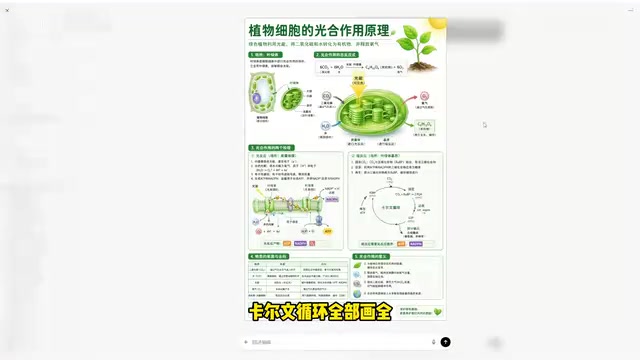
This reveals an important trend: different AI models are building their own competitive moats. GPT excels in deep reasoning and detailed image generation, Doubao specializes in daily tool integration within Chinese-language contexts, while Gemini 3.5 Flash has established clear advantages in autonomous Agent execution and multimodal speed. For users, the smartest strategy isn't betting on a single model, but choosing the most appropriate tool based on the specific task at hand.
How to Choose an AI Model in 2025? A Scenario-Based Matching Guide
Facing an increasingly rich selection of models, here's a decision framework based on key dimensions:
- Complex task automation (e.g., project management, multi-step workflows): Prioritize Gemini 3.5 Flash's Agent capabilities
- Code development and technical writing: Both the GPT series and Gemini 3.5 Flash have their strengths—cross-validate results
- Rapid video content creation: Gemini 3.5 Flash's generation speed and real-time editing features are currently in the lead
- Daily Chinese-language use cases: Domestic models like Doubao have stronger localization advantages
- Research and educational illustrations: GPT's image generation stands out in information accuracy
The AI landscape from 2025 to 2026 has shifted from "one dominant player" to "a hundred flowers blooming." True productivity gains come from understanding each model's core strengths and integrating them into your own workflow. The release of Gemini 3.5 Flash has undoubtedly added a highly competitive option to this ecosystem.
Related articles
 Tech Frontiers
A Rare Quiet Day in AI: Recursive Self-Improvement Stirs Beneath the Surface
A rare quiet day in AI sees multiple sources go silent simultaneously. Behind the calm, Recursive Self-Improvement (RSI) research continues. What this means for the industry.
 Tech Frontiers
Reve 2 vs. Ideogram 4: A Deep Dive into Layout Control in AI Image Generation
A deep comparison of Reve 2 and Ideogram 4's layout control capabilities, covering technical approaches, real-world use cases, and industry trends for designers and creators.
 Tech Frontiers
In the Weights: Check Your Influence Score in the AI World
In the Weights is an AI influence search engine that quantifies your presence in the AI world with a score. Explore how it evaluates practitioners and what it means for digital identity.