Gemini 3.5 Flash-Lite Released: The Smallest, Fastest Model Outperforms Gemini 3
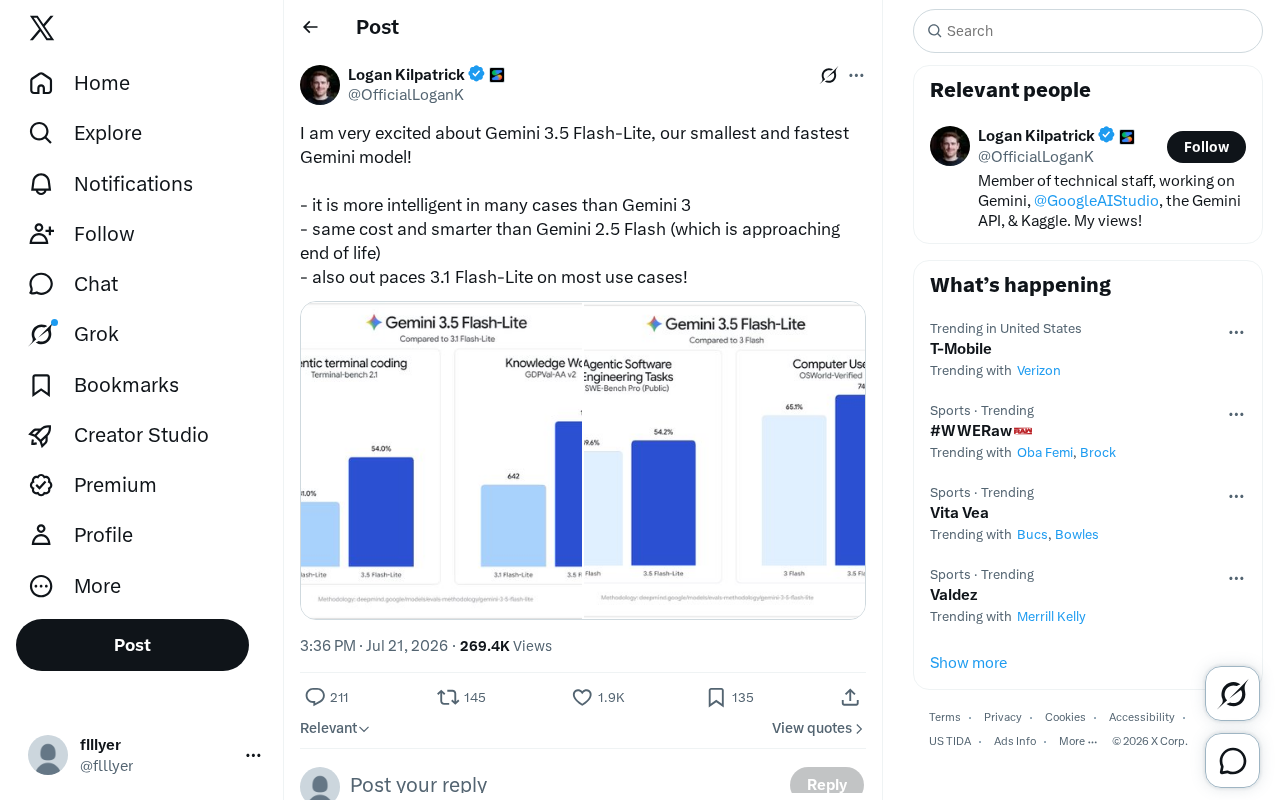
Google's Gemini 3.5 Flash-Lite is its smallest, fastest model yet — and it outperforms the larger Gemini 3.
Google has released Gemini 3.5 Flash-Lite, the smallest and fastest model in the Gemini family, which surprisingly outperforms the larger Gemini 3 in many scenarios. Priced the same as the soon-to-retire Gemini 2.5 Flash, it offers stronger intelligence at no extra cost. The release highlights the growing trend of lightweight models closing the gap with larger ones through techniques like knowledge distillation and RLHF, giving developers more cost-effective options for production AI deployments.
A New Lightweight Member Joins the Gemini Family
Google has officially launched Gemini 3.5 Flash-Lite, the smallest and fastest model in the Gemini lineup. According to official information, despite being positioned as a lightweight model, it surprisingly outperforms the larger Gemini 3 in terms of intelligence across many scenarios.
This release continues an important trend in the AI industry: model capability is no longer tied solely to parameter scale. Through better training methods, data quality, and architectural optimization, smaller models are gradually catching up to — and even surpassing — the performance of larger ones. One of the core techniques behind this is Knowledge Distillation, a method that compresses a large model's knowledge into a smaller one. The principle involves having the small model learn the output probability distributions of the large model, rather than just the hard labels from raw training data, thereby inheriting the large model's deep understanding of the data. Combined with post-training techniques like RLHF (Reinforcement Learning from Human Feedback) and DPO (Direct Preference Optimization), small models can significantly improve instruction-following ability and output quality without increasing parameter count. For developers and enterprise users, this means stronger AI capabilities at lower cost.
Gemini 3.5 Flash-Lite Key Highlights: Smarter, Cheaper, Faster
Based on official disclosures, Gemini 3.5 Flash-Lite offers several key advantages:
Intelligence That Surpasses Gemini 3
Google explicitly states that Flash-Lite is smarter than Gemini 3 in many scenarios. This is quite disruptive — we typically expect lightweight models to sacrifice capability in exchange for speed and cost, but Gemini 3.5 Flash-Lite has achieved the "small model beats big model" phenomenon. This reflects Google's continued progress in model distillation, training data curation, and post-training optimization. Specifically, Google likely used a higher-tier large model (such as Gemini Ultra-level) as the teacher model to distill Flash-Lite, while investing significant engineering resources in training data filtering and synthesis. This results in the small model's performance density (capability output per unit of parameters) far exceeding that of earlier large models.
Same Cost, Stronger Performance
Compared to Gemini 2.5 Flash, which is approaching its End of Life, Gemini 3.5 Flash-Lite delivers stronger intelligence at the same cost. In the AI-as-a-Service (AIaaS) space, model lifecycle management is a critical operational concept — when a model is announced as entering its End of Life phase, providers gradually cease maintenance and eventually shut down its API endpoints. Major AI providers like Google, OpenAI, and Anthropic typically issue retirement notices months in advance and provide migration guides. For enterprises deploying AI applications at scale, the release of Gemini 3.5 Flash-Lite is a direct win: they get a performance upgrade without increasing their budget, along with a clear upgrade path for the upcoming model migration.
Comprehensively Outperforms the Previous 3.1 Flash-Lite
Google also notes that Gemini 3.5 Flash-Lite outperforms 3.1 Flash-Lite in most use cases. This means that even within internal iterations of the lightweight model line, Google has achieved meaningful capability improvements rather than simple version number bumps.
The Strategic Significance of Lightweight AI Models
Why "Small and Fast" Models Matter So Much
In real-world production environments, not every task requires calling the most powerful model. A large volume of everyday tasks — such as text classification, summarization, simple Q&A, and content moderation — are extremely sensitive to latency and cost. The value of lightweight models is precisely demonstrated in these high-frequency, low-complexity scenarios.
To understand this, consider the enormous impact of inference costs in large-scale deployments. AI APIs typically charge based on the number of input and output tokens. For an application with a million daily active users, even a $0.001 difference in cost per call can accumulate to tens of thousands of dollars per month. Latency directly affects user experience — in real-time conversations, search recommendations, and similar scenarios, every additional 100 milliseconds of response time can increase user drop-off rates by several percentage points. Therefore, in production, choosing a model that's "just good enough" rather than the most powerful one is often the better engineering decision.
Models like Gemini 3.5 Flash-Lite can handle massive request volumes with lower latency and cost, enabling AI capabilities to be economically embedded into every interaction point of various products. For applications that need to handle large-scale user requests, inference speed and unit cost often matter more than absolute intelligence level.
Google's Tiered Product Strategy for the Gemini Lineup
This release reveals that Google is building a clear capability gradient: from flagship Gemini Pro/Ultra, to the balanced Flash, down to the ultra-lightweight Flash-Lite. This Model Tiering strategy has become the standard product layout for major AI companies — OpenAI has different tiers like GPT-4o and GPT-4o-mini, Anthropic offers a three-tier lineup of Claude Opus, Sonnet, and Haiku, and Meta's Llama series provides options ranging from 8B to 405B parameters.
The underlying logic of this strategy is that different business scenarios have varying requirements for intelligence, response speed, and cost. An intelligent customer service system might handle 80% of inquiries with a lightweight model, routing only complex issues to a more powerful one. This "Model Routing" architecture is becoming a best practice in enterprise AI deployment, allowing developers to make flexible trade-offs between performance and cost based on specific task requirements.
You may not have noticed, but as Gemini 2.5 Flash approaches its end of life, Google is using the 3.5 series to complete a generational product line refresh. This serves as a reminder for developers still using older model versions to evaluate their migration paths promptly.
Practical Impact of Gemini 3.5 Flash-Lite for Developers
For teams building AI applications, the release of Gemini 3.5 Flash-Lite brings several action items worth noting:
Migrate from older model versions as soon as possible: If you're currently using Gemini 2.5 Flash, given its upcoming retirement, you should test and migrate to the new model promptly. This migration will most likely deliver the dual benefit of unchanged costs and improved performance.
Evaluate the possibility of replacing Gemini 3: In scenarios where you're currently using Gemini 3, consider whether the faster and cheaper Flash-Lite could serve as a replacement. Since Google claims it's smarter in many scenarios, real-world A/B testing may well deliver pleasant surprises.
Watch for cost optimization opportunities: The continuous improvement of lightweight models means the boundary of "doing more with less" keeps expanding. For cost-sensitive startups and large-scale deployment scenarios, models like Gemini 3.5 Flash-Lite will become an increasingly important option.
Conclusion
The release of Gemini 3.5 Flash-Lite once again confirms an increasingly apparent pattern in the AI field: improving model capability is no longer a one-dimensional race of "bigger is better," but rather a search for the optimal balance among capability, speed, and cost. When the "smallest and fastest" model can outperform its larger predecessor in most scenarios, it's not just a product update — it's a microcosm of efficiency gains across the entire industry.
For developers, staying attuned to these lightweight models often reveals unexpected cost-performance sweet spots in real-world applications.
Related articles

GPT-5.6 Hands-On Review: Analyzing the Agent Capabilities Behind Its #1 Ranking on the Frontend Development Leaderboard
GPT-5.6 SoulX High tops the frontend dev leaderboard at 1636 points with Agent Arena rank #2. Hands-on tests of portfolio pages and mystery games reveal its task decomposition and self-correction capabilities.
Harness Engineering: The Core Infrastructure for Taking AI Agents from Demo to Production
Deep dive into Harness Engineering: why AI Agents need memory management, durable execution, guardrails & approvals to go from demo to production.

Claude Code vs Codex: Hands-On Comparison and Installation Guide for AI Programming Tools
In-depth comparison of Claude Code and Codex AI programming tools covering accuracy, installation, and network setup tips to help developers choose the best solution.