Gemini Multimodal Agent Development in Practice: Full-Pipeline Architecture from Understanding to Generation

Technical deep-dive into building native multimodal Agents with the Gemini API
At the AI Engineer conference, a Google DeepMind engineer demonstrated a complete solution for building multimodal Agents using the Gemini API. Gemini adopts an "Any2Any" architecture supporting arbitrary modality input and output, with a main model handling understanding and specialized models handling generation, orchestrated through function calling that lets Agents autonomously dispatch image and speech generation models. Its 1-million-token context window can process 9 hours of audio at once, with support for native image generation, multilingual speech generation, and real-time interaction capabilities.
At the AI Engineer conference, Patrick from Google DeepMind gave a detailed presentation on how to build native multimodal Agents using the Gemini API. From multimodal understanding to native image and speech generation, and then to real-time interaction, he demonstrated the complete process of building a Notebook LM clone application. This article provides an in-depth analysis of the architecture design and implementation details of this multimodal Agent technical solution.
Any2Any: The Full Landscape of Gemini's Multimodal Capabilities
Gemini's core design philosophy is "Any2Any" — any modality in, any modality out. On the input side, Gemini can not only understand text but also process code, images, audio, video, URLs, and even Google Search results. On the output side, beyond traditional text generation, it now supports native image generation, speech generation, video generation, function calling, and code generation.
The "Any2Any" architecture represents a paradigm shift in AI system design. Early AI systems typically handled only a single type of data — for example, the GPT series focused on text, while DALL-E focused on image generation. The unified multimodal architecture encodes information from different modalities into a common vector representation through a Unified Representation Space, enabling the model to understand and generate content across modalities. The technical foundation of this concept is the modality-agnostic nature of the Transformer architecture: whether text tokens, image patches, or audio frames, all can be processed uniformly. Gemini emphasizes native multimodal training rather than post-hoc fusion, which shares both commonalities and differences with approaches like OpenAI's GPT-4o and Meta's ImageBind.
However, Patrick candidly noted that this is not currently accomplished by a single model. The current architecture centers on the Gemini 3 main model for multimodal understanding (with output still in text), complemented by specialized native generation models — such as the Nanobanana model for image generation and a Gemini-based speech generation model. This "understanding + generation" division of labor architecture is precisely the foundation for building multimodal Agents.
Multimodal Understanding: 9 Hours of Audio in a Single Input
Minimalist Multimodal Input Code
The code for multimodal understanding using the Gemini API is extremely concise. Through the Google GenAI SDK, developers simply upload files of different formats (PDF, video, MP3, etc.) and then call client.models.generate_content. For smaller files, they can even be passed directly as inline data.
# Upload files and call Gemini for multimodal understanding
client.models.generate_content(
    model="gemini-3-flash",
    contents=[pdf_file, video_file, audio_file, prompt]
)
The Practical Significance of the 1-Million-Token Context Window
A noteworthy data point: Gemini has a 1-million-token context window. For audio, 1 minute equals approximately 1,920 tokens, which translates to over 9 hours of audio content in a single input; for video, it can process approximately 1 hour of footage. Developers can also analyze specific segments by specifying timestamps — for example, analyzing only the content from minute 5 to minute 15.
The context window refers to the maximum number of tokens a language model can process in a single inference pass. Early GPT-3 had a context window of only 4,096 tokens, while Gemini's 1-million-token window represents approximately a 250x improvement. The technical key to this breakthrough lies in efficient attention mechanism improvements, including Multi-Query Attention and Ring Attention proposed by Google, as well as optimized KV Cache management. The practical significance of ultra-long context windows goes far beyond processing long documents — it fundamentally changes the necessity assessment of RAG (Retrieval-Augmented Generation): when an entire book, movie, or codebase can fit into the context, traditional chunked retrieval strategies need to be reconsidered. Of course, ultra-long context also introduces the "attention dilution" problem, where the model's attention to middle portions of the context decreases — this is an important topic in current research.

Additionally, Patrick shared two practical tips: first, you can directly pass in a YouTube URL for content analysis; second, by combining the Context Caching feature, you can save up to 90% of API call costs for long files that need repeated querying.
Multimodal Generation: Native Image and Speech Output
Agent-Driven Generation Architecture
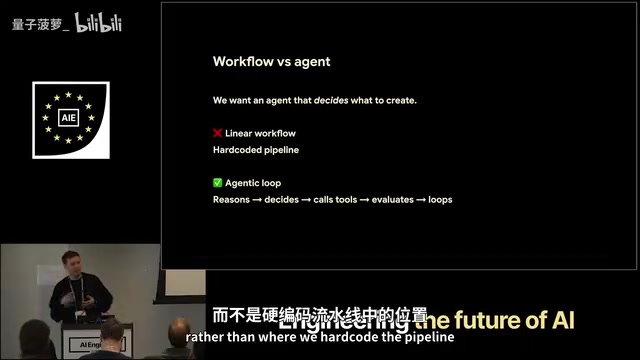
Unlike traditional hard-coded workflows, Patrick's proposed solution is to build a true multimodal Agent — with Gemini as the reasoning model, driving specialized generation models through Function Calling. The Agent can autonomously decide which concepts need visual diagrams and which chapters are suitable for audio summaries, rather than having developers prescribe the workflow in advance.
Function Calling is the core mechanism of modern LLM Agent architectures, first introduced by OpenAI in 2023 and quickly becoming an industry standard. Its essence is to have the language model output structured JSON-format instructions rather than directly executing code, with external systems responsible for the actual invocation and returning results to the model. This design achieves decoupling of "reasoning and execution": the model focuses on understanding intent and planning steps, while the tool layer handles interaction with the external world. In multimodal Agent scenarios, the value of Function Calling is particularly prominent — it allows a general-purpose reasoning model (Gemini) to dynamically dispatch multiple specialized generation models, forming an AI system similar to a microservices architecture. Compared to hard-coded workflows, the Agent-based architecture has stronger adaptability: when input content changes, the Agent can autonomously adjust which tools to call and how many times, without developers needing to pre-enumerate all possible execution paths.
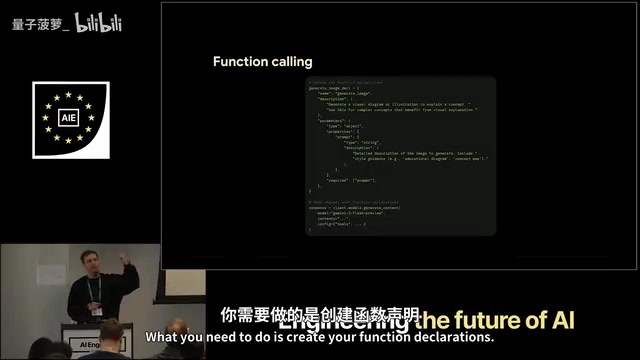
In terms of concrete implementation, developers need to create Function Declarations, providing each function with a name, description, and parameter definitions to help the model understand when to call which tool.
Unique Advantages of Native Image Generation
The image generation is called "native" because these models are trained on Gemini, inheriting Gemini's deep understanding of the world. Patrick demonstrated two impressive cases:
- Map Understanding and Image Generation: Drawing an arrow pointing to a location on a map, the model can recognize it as the Golden Gate Bridge and generate a corresponding image
- Math Grading: Nanobanana 2 can directly grade math homework, generating images with correction annotations, because it truly understands mathematical logic
In practical applications, the model is particularly good at generating infographics — simply specifying "create an infographic" in the prompt yields clearly structured visual content.
Multilingual Speech Generation Capabilities
The speech generation model is currently based on Gemini 2.5 and supports multilingual and multi-accent output. Patrick demonstrated British accent and Bavarian German accent speech effects live, which sounded quite natural. The model also supports two-person dialogue mode, generating podcast-style audio content — this is precisely one of Notebook LM's most popular features.

Real-Time Interaction: Live API and Audio-to-Audio Model
Gemini has also launched a completely new real-time interaction model — Gemini 3.1 Flash Live. This is a true "audio-to-audio" model.
Related articles
 Tutorials
ChatGPT Plus Subscription Guide: Are GPT-5.5, image-2, and Codex Worth the Upgrade?
A detailed look at ChatGPT Plus features — GPT-5.5, image-2, and Codex — with a Plus vs Pro comparison and a complete step-by-step subscription guide for users outside the US.
 Tutorials
Harness AI Engineering in Practice: Using Claude Code to Master Enterprise-Level E-Commerce Development
Deep dive into Harness AI Engineering: master enterprise e-commerce development with Claude Code using the Rules, Skills, Wiki, and Changes framework.
 Tutorials
Cursor + Codex Dual-IDE Collaboration: A Practical Methodology for Open-Source Project Customization
A complete methodology for open-source project customization based on real-world experience, detailing the Cursor+Codex dual-IDE workflow, seven-stage process, MVP validation, and AI source code reading techniques.