Getting Started with Agent Skills: Progressive Disclosure Design Philosophy and Implementation Guide

Agent Skills enables intelligent agents to load tools on demand via progressive disclosure, middleware, and dynamic tool mounting.
Agent Skills is an engineering framework that lets AI agents load tools and context progressively — only when needed — rather than preloading everything upfront. Built on progressive disclosure, middleware, and dynamic tools, it addresses context bloat and decision interference, offering a lighter alternative to Multi-Agent architectures for context-sensitive tasks.
What Are Agent Skills
As large model capabilities continue to advance, enabling agents to efficiently invoke external capabilities and load tools on demand has become a central challenge in building practical AI applications. Agent Skills is an engineering solution built around exactly this need.
The background behind this need is worth exploring in depth. Since OpenAI formally introduced the Function Calling mechanism in GPT-4, the paradigm of agents invoking external tools has gradually matured — but the resulting context management problems have become increasingly prominent. While mainstream models' context windows have expanded from the early 4K tokens to 128K or even longer, research shows that overly long contexts cause the model's attention to scatter, leading to the "Lost in the Middle" effect — where the model's ability to extract information from the middle of the context window drops significantly. Agent Skills is an engineering response to this real-world constraint.
In simple terms, Agent Skills is a mechanism that provides agents with pluggable, extensible capabilities. Instead of requiring all tools and context to be stuffed into a prompt at once, it lets agents access the relevant information and capabilities only when they actually need them. This design both conserves the precious context window and significantly improves decision accuracy.
The best entry point for understanding Agent Skills is not memorizing some framework's API, but first grasping its design philosophy — why it was built this way, and which pain points of traditional approaches it addresses.
Core Idea: Progressive Disclosure
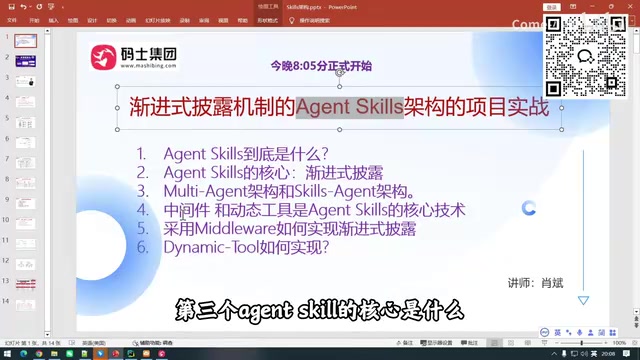
The core of Agent Skills can be summarized in two words: Progressive Disclosure.
Why Progressive Disclosure Is Needed
Progressive disclosure is not an original concept from the AI field — it originated in User Experience (UX) design, proposed by IBM researcher John M. Carroll in the 1980s. Its core idea is "only present relevant information when the user needs it" to reduce cognitive load. This principle closely aligns with the cognitive psychology theory of "limited working memory capacity" — the human brain can process approximately 7±2 information chunks simultaneously in working memory (George Miller, 1956). Applying this principle to the tool-calling context of large language models is essentially an acknowledgment that an LLM's attention mechanism has similar "effective processing bandwidth" limitations: too many tool descriptions dilute the model's focus on the current task.
Traditional approaches often write all tool descriptions, parameter definitions, and usage examples directly into the system prompt. As the number of tools grows, this creates two clear problems:
- Context bloat: A large volume of tool descriptions crowds out the reasoning space needed for the actual task;
- Decision interference: Faced with too many tools, the model struggles with "choice overload," which actually reduces call accuracy.
The core idea behind progressive disclosure is: only expose the information and tools the agent truly needs at the right moment. Like a book's table of contents, the agent first sees a capability overview, then progressively unfolds the details as it decides to go deeper into a particular direction — ensuring awareness of the overall capability landscape while avoiding information overload.
Differences from Multi-Agent Architecture
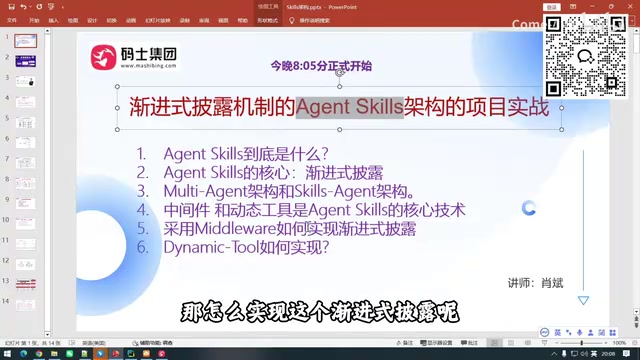
Many developers confuse Agent Skills with Multi-Agent architecture. While both address the problem of "decomposing complex tasks," their approaches are fundamentally different.
Multi-Agent architecture has gained widespread recognition in recent years through frameworks like AutoGen, CrewAI, and LangGraph. Its core pattern is to break down complex tasks and distribute them across multiple agents with different roles for parallel processing, with the agents collaborating through message passing or shared state. This architecture excels in scenarios requiring high parallelism and clear role separation — for example, code review (one agent writes code, another handles testing). However, the coordination overhead and state synchronization complexity of Multi-Agent systems are high; when a task is inherently single-threaded and heavily context-dependent, introducing multiple agents can actually increase system fragility. Agent Skills opts for vertical capability scaling within a single agent — a lighter-weight and more debuggable alternative.
| Dimension | Multi-Agent Architecture | Agent Skills |
|---|---|---|
| Core Approach | Horizontal division of labor across multiple agents | Vertical capability scaling within a single agent |
| Complexity Management | Divide and conquer, role separation | Load on demand, elastic expansion |
| Applicable Scenarios | Large-scale parallel tasks | Context-sensitive dynamic tasks |
Understanding this distinction helps in choosing the more appropriate architecture for real-world projects.
Key Technologies: Middleware and Dynamic Tools
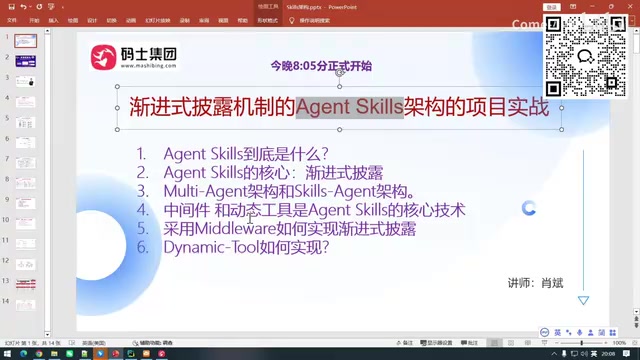
Progressive disclosure relies on two key technologies at the engineering level: Middleware and Dynamic Tools.
The Role of Middleware
Middleware is an extremely classic architectural pattern in software engineering, particularly prevalent in web development — mainstream frameworks like Express.js, Koa, and Django all use middleware chains as the core mechanism for request processing. Its essence is a "Pipe and Filter" architecture: before a request reaches the final handler, it passes through a series of pluggable processing units in sequence, each of which can read, modify, or terminate the request. Bringing this pattern into agent engineering means developers can use a declarative approach to orchestrate "pre-processing logic" — such as permission checks, context injection, and tool filtering — without coupling this logic into the core reasoning process. This Separation of Concerns makes the entire system easier to test and extend.
In the context of Agent Skills, middleware acts as a "dispatch layer" in the agent's request-response chain. Before the agent actually invokes a tool, it dynamically determines:
- Which capabilities should be disclosed to the model at this moment;
- What context information needs to be injected;
- What irrelevant content should be filtered out.
Think of middleware as an intelligent gateway between the agent and its tools — it is precisely this gateway that transforms "progressive" from a concept into reality.
Dynamic Tools
The concept of Dynamic Tools is philosophically very similar to Retrieval-Augmented Generation (RAG) — both exist to address the fundamental constraint that "it's impossible to preload all knowledge/capabilities into a model." RAG solves the problem of dynamic knowledge retrieval: when answering a question, it pulls relevant document fragments from an external knowledge base in real time and injects them into the context. Dynamic Tools solves the problem of dynamic capability mounting: when executing a task, it loads relevant tool definitions from a tool registry in real time. Both rely on some form of "relevance judgment" mechanism to decide what to retrieve or load. The difference is that RAG's retrieval unit is a text fragment, while Dynamic Tools' retrieval unit is an executable function definition and its parameter schema.
Working in tandem with middleware, the Dynamic Tools mechanism allows agents to add or remove available tools in real time based on task progress:
- When a skill is activated, the related tools are "mounted";
- When the task direction shifts, old tools can be unloaded to free up space.
Middleware determines when to disclose; Dynamic Tools determines what to disclose. Together, they jointly support the core operational logic of Agent Skills.
Agent Middleware: The Metawheel Implementation
At the concrete implementation level, the agent middleware is called Metawheel — it is the key component that brings the above concepts to life in code.
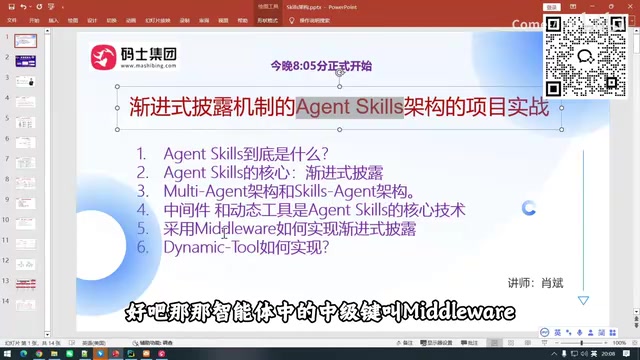
When writing a Metawheel, you need to think through the following core questions:
- How to intercept the agent's invocation requests?
- How to determine which capabilities should be disclosed given the current context?
- How to organize the logic for dynamically mounting and unmounting tools?
- How to ensure the entire logic remains clean and maintainable?
The recommended learning path from beginner to practitioner is: first clarify the motivation behind progressive disclosure at a conceptual level, then understand the division of responsibilities between middleware and dynamic tools, and finally build a minimal working Metawheel from scratch to run the full "disclose on demand" flow end-to-end. You've truly mastered the essence of Agent Skills only when you can personally make an agent load the right skills at the right moment.
Summary
Agent Skills represents an important direction in agent engineering. Its value lies not in any specific framework, but in the design philosophy of progressive disclosure: enabling agents to work like human experts — first grasping the big picture, then diving into details as needed. This philosophy is rooted in the working memory theory from cognitive science, classic principles from UX design, and the time-tested middleware pattern from software engineering — a convergence of wisdom from multiple disciplines in AI engineering practice.
For developers looking to enter this space, the recommended learning sequence is:
Understand the concept → Distinguish the architecture → Master middleware and dynamic tools → Implement Metawheel
Only by thoroughly internalizing the design motivation can you apply it flexibly in real projects and avoid the trap of "using it just for the sake of using it."
Key Takeaways
Related articles

The Truth Behind Codex 'Build a Website in 5 Minutes': AI Isn't Creating Sites—It's Helping You Copy Them
Exposing the truth behind viral Codex 5-minute website videos: creators aren't building original sites with AI—they're copying shared prompts or scraping others' work. Learn AI coding tools' real limits.

Getting Started with AI Agent Development: A Complete Guide from Concept to Practice
A comprehensive guide to AI Agent architecture and development, covering automated marketing, intelligent customer service, and investment analysis scenarios with single and multi-agent collaboration.

The Truth Behind Codex 'Build a Website in 5 Minutes': AI Isn't Creating Sites — It's Helping You Copy Them
Exposing the truth behind viral Codex 5-minute website videos: creators aren't building original sites with AI — they're copying shared prompts or scraping others' work.