Getting Started with AI Agents: A Deep Dive into the Perception-Decision-Action Loop

A beginner's guide to AI Agents: the perception-decision-action loop and the four core technical pillars.
This article explains how AI Agents work, contrasting them with traditional programs and breaking down the core perception-decision-action loop. It covers the three generations of agent evolution and the four technical pillars—LLMs, tool calling, memory systems, and RAG—to build a solid foundation for agent development.
From Traditional Programs to Agents: A Paradigm Shift
In recent years, intelligent chatbots, autonomous driving, and smart healthcare AI products have emerged in rapid succession. Whether a product is truly useful essentially depends on the technology powering its backend. If it's built on technology from over a decade ago, the user experience is often mocked as "artificial stupidity"; but if it adopts the AI Agent technology that has risen in recent years, the odds of it being genuinely useful increase dramatically.
The concept of AI agents can be traced back to Multi-Agent System (MAS) research in the 1990s. MAS originated in the distributed artificial intelligence field of the 1980s-1990s, with theoretical foundations blending game theory, economic mechanism design, and distributed computing. Early pioneers included Yoav Shoham, Michael Wooldridge, and others. The core idea was to have multiple autonomous agents collaborate, compete, or negotiate to jointly accomplish complex tasks—early representative applications included robot soccer (RoboCup, held annually since 1997, which drove the development of real-time multi-agent collaboration algorithms) and distributed problem-solving systems. However, at that time, "agents" were constrained by computing power and algorithms, and were far from the commercial viability of truly understanding natural language. It wasn't until the breakthrough of large language models (LLMs) that they truly gained commercial value. The release of ChatGPT in late 2022 was a pivotal turning point—it gave the public their first intuitive experience of an AI that "understands intent." Subsequently, OpenAI introduced the Function Calling feature in June 2023, allowing developers to describe external functions to the model in a structured way, with the model able to decide whether to trigger a call during inference. The profound significance of this mechanism is that it gave LLMs "hands," freeing them from being limited to text generation and enabling them to truly control external systems—marking the formal evolution of LLMs from "conversational tools" to "the core of task-executing agents." Notably, Function Calling was not an isolated innovation but was built upon the powerful structured output capabilities of the Transformer architecture—proposed by the Google Brain team in the 2017 paper Attention Is All You Need. Its Self-Attention mechanism gave the model the ability to precisely follow complex instruction formats, which is the underlying guarantee for reliable structured tool calling. It's worth adding that after the birth of the Transformer architecture, researchers discovered a predictable power-law relationship between model capability and parameter count, training data volume, and compute—known as "Scaling Law," which OpenAI systematically quantified in 2020 in Scaling Laws for Neural Language Models. This discovery directly drove the R&D investment in ultra-large-scale models such as GPT-3 (175 billion parameters) and GPT-4, and explained from a theoretical standpoint why larger models generally perform better—this is also the scaling foundation that enabled LLMs to become the decision-making core of agents. In 2024, OpenAI further upgraded Function Calling into the more general Tool Use specification, and mainstream vendors such as Anthropic and Google successively released compatible interfaces, gradually forming a cross-platform industry standard. Among these, the MCP (Model Context Protocol) released by Anthropic in late 2024 is particularly noteworthy: it defines a universal communication protocol between LLMs and external tools and data sources, enabling tools from different vendors to be called by any MCP-compatible model—similar to how the USB interface unified the hardware ecosystem. It is regarded by the industry as a significant milestone in standardizing the agent tool ecosystem. Meanwhile, frameworks like LangChain, AutoGPT, and BabyAGI emerged one after another, further lowering the barrier to agent development and forming an entirely new software development paradigm centered on LLMs.
So, what exactly is the fundamental difference between an agent and a traditional program?
Traditional programs, whether developed in Java, Python, or other languages, all share a common trait: fixed input corresponds to fixed output. This is like a vending machine—you select a cola, insert coins, and it precisely gives you a can of cola, with no variation whatsoever, because all responses are preset in advance.
An agent, by contrast, is more like an assistant with the ability to think. When you give it a vague requirement, such as "I want to travel on May 1st," it will proactively analyze your current city, traffic conditions, and holiday-appropriate destinations, then offer personalized recommendations. It no longer relies on precise instructions but can understand intent and make dynamic decisions.
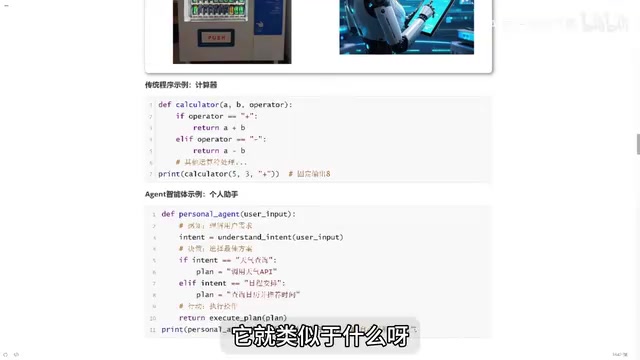
Comparing them through code makes it even clearer: a traditional calculator function takes numbers A, B, and an operator, and produces output that matches expectations exactly; whereas an agent function only needs to receive a "requirement," and it will first understand what the user wants (for example, recognizing a weather-query intent from "what's the temperature today"), then decide which tool to call to return the result. The key point is: the input is vague, and the output is dynamic.
The Three Core Capability Loops of AI Agents
The reason agents are "smart" comes from the complete capability loop they build: perception → decision → action. These three correspond precisely to the human senses, brain, and limbs.
Perception Engine: Accurately Understanding User Intent
The perception engine is equivalent to human eyes and ears, responsible for receiving and understanding external input. When a user says "help me book a cheap hotel," the agent automatically breaks it down into three key elements:
- Action: booking (rather than immediate execution)
- Object: hotel
- Condition: low price
More importantly, modern perception engines are not limited to text. Voice, text, and images can all serve as input—this is what's known as multimodal capability. Multimodal means the model can simultaneously process and understand multiple types of data, including text, images, audio, and video. Its underlying implementation relies on modality alignment technology: images are encoded into image tokens via a Vision Encoder (such as ViT, i.e., Vision Transformer, also based on the self-attention mechanism, which slices an image into fixed-size patches and processes them sequentially), audio is converted into text or acoustic features via models like Whisper, and finally all are uniformly mapped alongside text tokens into the same semantic space. The concept of this "unified semantic space" is crucial—information from different modalities is projected into vector representations of the same dimension, allowing the model to perform cross-modal attention computation and semantic reasoning rather than processing each independently. OpenAI's CLIP model was a milestone in early multimodal alignment; through Contrastive Learning, it aligns image and text representations in the vector space: during training, matching image-text pairs are pulled closer while non-matching ones are pushed apart, ultimately making the distance between "a picture of a cat" and the text "a cat" close in the vector space. GPT-4V, Gemini Ultra, and Claude 3 built upon this to achieve truly native multimodal reasoning. Traditional NLP models could only process text, whereas multimodal models can "describe images" and "understand meaning from sound," greatly expanding the interaction boundaries of agents, enabling them to handle screenshots, voice commands, or even video clips uploaded by users.
Decision Brain: Reasoning Based on Large Language Models
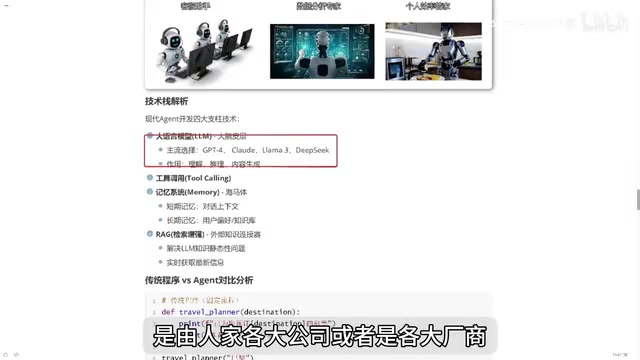
After perception, the agent needs to determine "what exactly should be done," which relies on the reasoning capabilities of large language models (LLMs). GPT, DeepSeek, Tongyi, and others all belong to this category of models.
A Large Language Model (LLM) is a neural network model based on the Transformer architecture and pre-trained on massive amounts of text data. The core innovation of the Transformer—the Multi-Head Self-Attention mechanism—allows the model to dynamically attend to the information of all other words in a sequence when processing each word, breaking through the previous bottleneck of RNN architectures that could only process sequentially, enabling highly parallelized training and thereby supporting the scaling to hundreds of billions or even trillions of parameters. The "reasoning" ability of an LLM is not logical reasoning in the human sense, but rather predicting the most appropriate next word (Token) in a given context through statistical learning of language patterns in training data. GPT-4 has about 1.8 trillion parameters, and DeepSeek-V3 has about 671 billion parameters. When large enough in scale, this "next-word prediction" mechanism gives rise to higher-order abilities resembling reasoning, planning, and code generation—this is known as "Emergent Abilities."
Emergent abilities are not linear progress but a qualitative leap: Google DeepMind's 2022 research paper Emergent Abilities of Large Language Models systematically documented this phenomenon, in which around the hundred-billion parameter scale, models suddenly exhibited chain-of-thought reasoning, multi-step math problem solving, and other capabilities that smaller models entirely lacked. This phenomenon echoes the aforementioned Scaling Law—the scaling law predicts continuous improvement in capabilities, while emergence describes an abrupt leap in capabilities at a specific scale threshold; together they form a theoretical framework for understanding the boundaries of LLM capabilities. It's worth noting that the mechanism behind emergent phenomena is still debated—some researchers believe it is a genuine phase transition, while others (such as a 2023 Stanford rebuttal paper) argue that emergence is a "measurement artifact" caused by the choice of evaluation metrics, and that with smoother metrics, capability improvements are actually continuous. Regardless, this very debate illustrates the depth and complexity of research into LLM capability boundaries. Emergent abilities are precisely the fundamental reason LLMs can serve as the decision-making brain of agents—they are responsible for understanding, reasoning, and content generation, determining which functions or tools should be called next.
In practice, an agent's decision-making process is typically structured with the help of Chain-of-Thought (CoT) and the ReAct framework. CoT was proposed by Google Brain in 2022; by guiding the model to "think step by step" in the prompt, it significantly improves the accuracy of complex reasoning tasks. The ReAct (Reasoning + Acting) framework, on the other hand, interweaves reasoning with tool calling, having the model output its thought process before each action, then observe the result after acting before deciding the next step, forming an iterative loop of "think → act → observe." This pattern has become the core execution paradigm of mainstream frameworks like LangChain Agent and AutoGPT, enabling agents to maintain logical coherence in complex multi-step tasks.
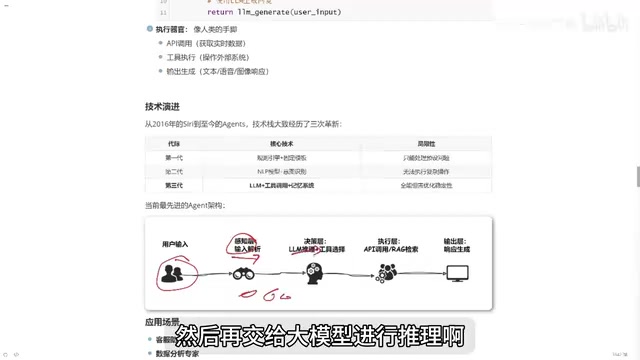
Execution Layer: Calling Tools to Complete Tasks
Once the brain has analyzed what content to return to the user, the execution layer begins to "do the work"—like human limbs, it is responsible for calling specific APIs, databases, and even hardware devices, generating the final result and feeding it back to the user.
Three Generations of Technological Evolution: From Siri to the Modern Agent
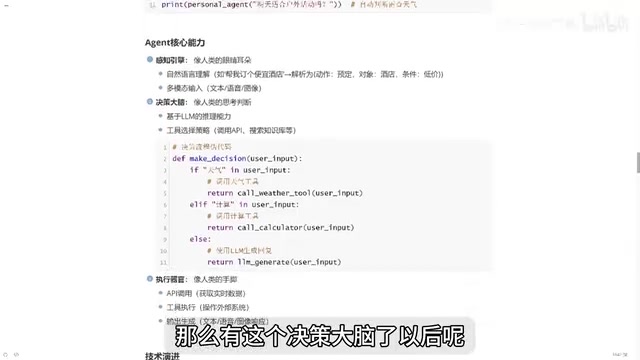
Looking back at the development of voice assistants, AI agent technology has roughly gone through three generations of evolution.
First Generation: Rule Engine + Fixed Templates
Exemplified by early Siri. If you asked "what time is it," it could answer accurately; but as soon as you rephrased it—say, "can you adjust the time for me"—it would respond, "Sorry, I don't understand your command." This kind of product only recognized preset commands, and even a slight deviation made it unable to comprehend. Currently, some smart speakers on the market still remain at this stage.
Second Generation: NLP Models + Intent Recognition
Second-generation products could preliminarily understand user needs and would not fail simply because of rephrasing. Intent Recognition in Natural Language Processing (NLP) was the core technology of this generation. Typical representative frameworks include Google's Dialogflow and Facebook's wit.ai, which used the "Slot Filling" mechanism: first recognizing the intent category (such as "check weather" or "set alarm"), then extracting entities from the sentence to fill predefined slots (such as city, date). Early implementations commonly used traditional machine learning methods like SVM and random forests, later evolving to fine-tuning solutions based on pre-trained models like BERT, greatly improving recognition accuracy. BERT (Bidirectional Encoder Representations from Transformers, proposed by Google in 2018) was an important milestone in applying the Transformer to downstream NLP tasks. Its bidirectional encoding capability allowed the model to consider the context on both the left and right of a word simultaneously, greatly surpassing previous methods in tasks such as intent classification and named entity recognition, establishing the dominance of the "pre-training + fine-tuning" paradigm and directly driving the maturation of second-generation agent products.
However, the fundamental limitation of intent recognition is that it relies on a manually predefined intent library; the system is essentially closed-domain, and once a user's expression falls outside the covered range, the system fails. This also explains the typical flaw of second-generation products—the lack of a memory system: if you first ask "what's the weather like today" and then ask "is today good for going out," it cannot connect to the previous turn of conversation, treating each interaction as a brand-new session.
Third Generation: Large Models + Tool Calling + Memory Systems
This is the current mainstream agent architecture. The third-generation solution completely abandoned the predefined intent library; the LLM can understand any expression in an open domain, which is precisely why it has comprehensively replaced the second-generation solution. No matter how vague or tricky the question, it can analyze the true need through the large language model, call the corresponding tools (including built-in program functions, databases, cameras, and other external resources), and possess continuous memory capabilities, able to execute tasks continuously based on the previous step, resulting in a more complete and smooth interaction experience.
The complete workflow of a modern agent is: user inputs a requirement → perception recognizes keywords → the large model reasons and selects a tool → the execution layer calls an API or RAG database → generates and returns the result.
Tech Stack Breakdown: The Four Pillars of Building an AI Agent
If you want to build an AI agent yourself, you need to master the following four core technologies:
-
Large Language Models (LLMs): As the "decision brain," responsible for understanding, reasoning, and content generation. GPT-4, Claude, DeepSeek, and others all belong to this category. Their emergent abilities are the fundamental source of an agent's intelligence. Modern mainstream LLMs generally adopt the training paradigm of "pre-training + RLHF (Reinforcement Learning from Human Feedback)": during the pre-training stage, they learn language patterns on trillion-token-scale corpora, while during the RLHF stage, a reward model is trained using human preference annotation data, and then reinforcement learning is used to perform alignment fine-tuning on the LLM, making its output better conform to human values and instruction intent—this is precisely the fundamental reason why ChatGPT is significantly "more obedient" than the pure pre-trained GPT-3. It's worth adding that the Test-Time Compute Scaling technology that emerged in 2024 (represented by OpenAI o1 and DeepSeek-R1) further extends this paradigm: the model trades off a large number of internal "thinking" steps during inference (usually presented in the form of Chain-of-Thought) for higher-quality output, enabling LLMs to achieve qualitative breakthroughs in tasks requiring deep reasoning such as math competitions and code generation, and also providing stronger underlying capabilities for agents to handle complex multi-step decision tasks.
-
Tool Calling: After the large model determines the execution direction, it completes specific tasks by calling external tools, without developers having to manually write all the logic. The working principle of tool calling is: developers describe the name, function, and parameter format of available tools to the model in advance (usually as a JSON Schema); when the user asks a question, the model determines whether a tool needs to be called, and if so, outputs a structured call instruction, which is actually executed by external code and the result returned to the model, upon which the model generates the final reply. JSON Schema plays a crucial "contract" role here—it defines the input and output specifications of the tool in a standardized, machine-readable format, allowing the call parameters generated by the model to be directly parsed and executed, while also giving the tool interface cross-model and cross-framework interoperability. This mechanism transforms LLMs from "only able to talk" into "able to do work," serving as the core bridge connecting AI to the real world and one of the key technologies for building practical AI agents. In multi-agent scenarios, tool calling can also extend to "agents calling agents"—an orchestration-layer agent (Orchestrator) breaks down a complex task and, through the tool-calling interface, dispatches subtasks to specialized sub-agents (such as a search agent, code-execution agent, or file-processing agent), which execute in parallel and then aggregate the results. This pattern is known as a Multi-Agent collaboration architecture and is the mainstream engineering solution for handling extremely complex tasks. This architecture is in the same vein as the "task decomposition and negotiation" idea in 1990s MAS research, except that the underlying agents have been upgraded from rule-driven to LLM-driven.
-
Memory System (Memory): Equivalent to the "hippocampus," responsible for remembering the context of previous operations, ensuring the coherence of multi-step tasks. Memory systems are typically divided into four categories: short-term memory (the context window of the current conversation, subject to token limits, typically ranging from 4K to 200K, similar to RAM—limited capacity but extremely fast access), long-term memory (persistently stored in vector databases such as Pinecone, Chroma, and Milvus for cross-session semantic retrieval, similar to a hard drive—large capacity but requiring retrieval), entity memory (specifically recording structured information about specific people and matters), and procedural memory (operational habits learned from historical interactions).
The working principle of vector databases deserves separate explanation: their foundation is Embedding technology—mapping discrete data such as text and images into continuous high-dimensional vectors, where semantically similar content is also close in distance within the vector space. Mainstream embedding models include OpenAI's text-embedding-3-large (outputting 3072-dimensional vectors) and the open-source BGE-M3 (supporting both Chinese and English, single-vector 1024 dimensions). After historical conversations or knowledge documents are converted by an embedding model, the vector database uses approximate nearest neighbor algorithms such as HNSW (Hierarchical Navigable Small World graph) to complete semantic similarity retrieval over millions of vectors within milliseconds—this capability makes it possible to "find semantically similar historical records," whereas traditional keyword indexing is completely powerless against content that is semantically similar but uses different wording. When the conversation history exceeds the model's token limit, engineering strategies such as summarization compression, sliding windows, or hierarchical retrieval must be employed—this is one of the core challenges in ensuring an agent's long-range coherence.
-
RAG (Retrieval-Augmented Generation): Aimed at addressing the two major problems of insufficient timeliness of training data and model "hallucination," RAG was proposed by Facebook AI Research in 2020. The essential root of the hallucination problem lies in the LLM's generation mechanism—the model always predicts the "most probable next word," and when the training data lacks relevant knowledge, the model generates content that sounds reasonable but is actually incorrect, which is an unacceptable risk in high-precision scenarios such as medicine, law, and finance. RAG fundamentally mitigates this problem through the "retrieve first, then generate" architecture. Its workflow consists of two stages: first, the user's question is converted into a vector (Embedding, commonly using models like text-embedding-ada-002 or BGE), and semantic similarity matching is performed in an external knowledge base via approximate nearest neighbor search (ANN, such as the HNSW algorithm) to recall the most relevant document fragments; then, these documents are concatenated into the prompt as context, allowing the LLM to generate an answer based on real material rather than fabricating one.
In engineering practice, the document chunking strategy is one of the key challenges in implementing RAG: the granularity of splitting directly affects retrieval quality—chunks that are too large introduce noise interference, while chunks that are too small lose contextual semantics. Mainstream approaches include Fixed-size chunking, Semantic chunking, and Recursive character splitting (LangChain's default approach). Advanced approaches also include HyDE (Hypothetical Document Embeddings, which first has the LLM generate a hypothetical answer and then uses its vector for retrieval, improving recall), Reranking (Reranker, using a cross-encoder to precisely rank the coarsely recalled results, commonly using models like BGE-Reranker and Cohere Rerank), multi-path recall fusion (using both vector retrieval and BM25 keyword retrieval simultaneously, fusing results via the RRF algorithm to balance semantic similarity and lexical exact matching), and GraphRAG (proposed by Microsoft in 2024, which builds a knowledge graph to replace pure vector retrieval and performs significantly better than traditional RAG in complex Q&A scenarios requiring multi-hop reasoning), among other techniques to improve retrieval precision. Compared to directly fine-tuning a model, RAG not only allows the knowledge base to be updated in real time at extremely low cost, but also provides information traceability—each answer can be traced back to a specific source document, meeting the audit requirements of high-compliance scenarios such as finance and medicine. It is currently the most mainstream knowledge-augmentation solution for enterprise-level AI applications.
Typical Application Scenarios
The implementation scenarios for AI agents are quite broad:
- Intelligent customer service assistant: Compared to the rigid robotic replies of the early days, modern intelligent customer service answers more naturally and can flexibly handle various types of inquiry scenarios.
- Data analysis assistant: Hand the data directly to the agent, and it can automatically complete common analyses, while also supporting on-demand customized analysis tasks.
- Personal productivity manager: For example, "Remind me at 9 AM tomorrow to submit the report and recommend a commute route," and the agent will break it down into two subtasks—creating a calendar event and querying real-time traffic—and execute them separately.
Summary
Understanding AI agents boils down to grasping two things: first, their fundamental difference from traditional programs—fixed input with fixed output vs. dynamic perception with dynamic response; and second, their core capability loop—perception is responsible for understanding needs, decision-making for analyzing what to do, and action for executing and feeding back results.
At the tech stack level, large language models, tool calling, memory systems, and RAG together form the skeleton of a modern agent. Among them, the LLM's emergent abilities are the source of intelligence, tool calling is the bridge connecting to the real world, the memory system ensures task coherence, and RAG solves the problem of knowledge timeliness and accuracy. These four pillars complement each other and are indispensable—without an LLM, there is no open-domain understanding capability; without tool calling, the agent can only "say" but not "do"; without a memory system, multi-step tasks would be fragmented; without RAG, the model would be trapped within the temporal boundaries of its training data. It's worth mentioning that these four pillars do not operate in isolation but work in concert on the unified foundation of the Transformer architecture: the LLM provides the reasoning core, tool calling extends its boundaries of action, and the memory system and RAG respectively compensate for the LLM's inherent limitations from the two dimensions of temporal coherence and knowledge accuracy. In addition, Scaling Law and emergent phenomena together form the theoretical framework for understanding the boundaries of LLM capabilities, while reasoning frameworks such as Chain-of-Thought and ReAct, standardized protocols such as MCP, and Multi-Agent collaboration architectures together form the engineering practice ecosystem surrounding these four pillars. Mastering this cognitive framework is a solid first step toward entering hands-on development with LangChain and agents.
Key Takeaways
Key Takeaways
Related articles

OpenAI Academy's European Tour: How SMEs Can Break Through with AI
OpenAI Academy visits six European nations with its SME AI Accelerator and multilingual workshops, helping small businesses overcome AI adoption barriers through real-world training and hands-on use.

Framework 13 Pro In-Depth Review: The Modular Laptop That Finally Stops Compromising
Framework 13 Pro in-depth review covering build quality, display, performance, and Linux experience. This modular laptop achieves 85% of MacBook Pro's refinement with far superior repairability and upgradeability.

Anthropic Opus 5 Real-World Testing: Outperforms Competitors at Half the Price
Anthropic Opus 5 hands-on review: first to break 30% on ARC-AGI, near Fable 5 agentic coding at half the price. Benchmarks, token costs, and GPT-5.6 comparison.