Getting Started with AI Agents: Principles, Frameworks, and a Guide to Building Enterprise-Grade Agents

A deep dive into AI Agent principles, frameworks, Agent Tuning, and enterprise deployment cost trade-offs.
This article explains why LLMs need Agent technology, traces the evolution from Prompt to RAG to Agent, details Agent Tuning as a specialized fine-tuning approach for small models, and evaluates the cost trade-offs between self-built fine-tuning and API calls for enterprise-grade agent deployment.
Why Large Models Need Agent Technology
The capabilities of large language models are already astonishing, but if you directly ask ChatGPT or Baidu Wenxin "How old is Andy Lau this year," it may not give you an accurate answer. The reason is that large models are essentially probability-based "black boxes"—they suffer from hallucination problems, and they are limited by the training data's cutoff date, unable to perceive real-time changes in the world.
Understanding the technical roots of the hallucination problem is crucial. The "hallucination" of large language models stems from their training mechanism: models learn the probability distribution relationships between words through massive amounts of text, and during generation, they are essentially performing probability sampling in a high-dimensional space rather than "querying" facts from a structured knowledge base. This means that when faced with questions outside the range of their training data, models tend to "fabricate" plausible-sounding answers—confident in tone, coherent in logic, but potentially entirely false in content.
From an architectural perspective, this phenomenon is rooted in the autoregressive generation mechanism of the Transformer: during pretraining, the model learns the probability distribution through the Next Token Prediction task. Each output is essentially continuous sampling of "what is the most likely next word given the preceding context," rather than a precise query to a factual database. To understand the deeper implications of this mechanism, we need to trace back to the design philosophy of the Transformer architecture itself—it is essentially a sequence-to-sequence conditional probability modeler, whose parameters are frozen after training concludes, forming a static "snapshot" of the world as presented by the training corpus. This means that no matter how recent the facts involved in a question are, the model can only perform probability extrapolation from this frozen snapshot, rather than making a genuine query. The academic community has currently proposed multiple mitigation paths: RLHF (Reinforcement Learning from Human Feedback) guides the generation of more truthful content through a reward model; knowledge graph integration attempts to inject structured factual constraints into the model; and RAG and Agent tool calling bypass hallucination at the architectural level by directly obtaining answers from trusted external sources. This characteristic is determined by the model architecture and cannot be eradicated through simple parameter adjustments—which is precisely the fundamental motivation for introducing external information sources.
In this Agent development tutorial, the instructor vividly illustrates the value of Agents using several typical scenarios: asking "What are today's sales" requires access to an internal enterprise database; "Why is there traffic ahead" requires real-time traffic conditions; and "How old is Andy Lau" requires combining the current date with calculation. What these questions have in common is that—they all require real-time or external information and cannot be answered by the model alone.
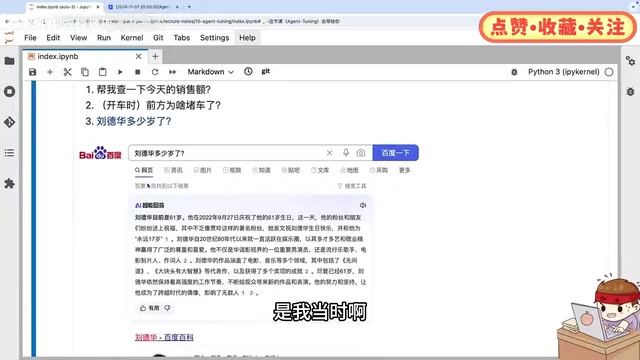
The instructor showed a real case: a previous version of Baidu Wenxin answered that Andy Lau was "61 years old," based on an outdated web page from 2022; whereas the upgraded Wenxin can now call tools to query the birthday, combine it with the current time to precisely calculate the age, and fully present the intermediate reasoning process. This is precisely the typical form of an AI Agent application.
Worth noting is the Function Calling mechanism launched by OpenAI in 2023, which dramatically lowered the engineering barrier to implementing Agent tool calls. Unlike relying on Prompt formats to parse tool calls, Function Calling predefines tool interfaces through JSON Schema, and the model directly outputs structured function call requests, completely avoiding the uncertainty of text parsing. From a technical implementation perspective, the key innovation of Function Calling lies in injecting tool descriptions into the model's system prompt layer, and through specialized fine-tuning, teaching the model to output structured call requests conforming to JSON Schema specifications rather than free-form text—this allows downstream systems to reliably extract call intent using standard JSON parsers, no longer relying on fragile regular expression matching. This mechanism was subsequently adopted by Anthropic (Claude's tool_use) and Google (Gemini's Function Calling), gradually becoming an industry standard, and is also an important alignment target for tool-calling capability training in Agent Tuning.
Agents Solve Three Major Pain Points of Large Models
The instructor summarizes the reasons for introducing Agent technology into large models into three points:
- Hallucination problems are difficult to eradicate: Large models are probability-based generative models, and bias is inevitable. In serious scenarios, external knowledge must be introduced to ensure accuracy.
- Parameters cannot be updated in real time: Model training costs are extremely high, and models are essentially static, making it difficult to establish a real-time connection with the real world.
- Complex business requires multi-step execution: Requirements like "book a flight to Shanghai on Friday" often require multi-step operations, tool calls, and even repeated interaction with the user—far from something that can be accomplished with a single question and answer.
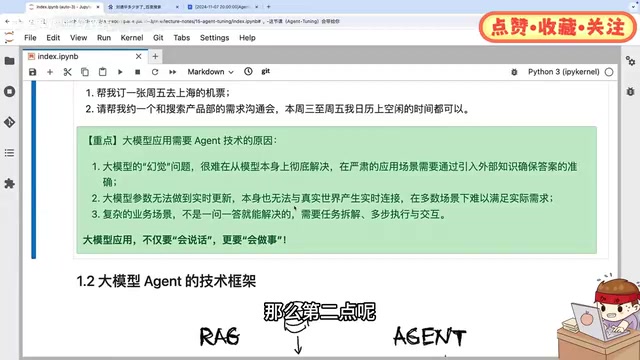
In a nutshell: it is not enough for a large model to "be able to talk"—we need it even more to "be able to do things." AI Agents are precisely the key technology that truly brings large models into practical application.
The Evolution Path from Prompt to RAG to Agent
Using a framework diagram, the instructor clearly outlines the three evolutionary stages of large model applications.
Stage One: Direct Prompt Q&A A user instruction comes in, and the model outputs a result as a black box. The form is simple, but the capability is limited—it cannot handle real-time information or complex tasks.
Stage Two: RAG Retrieval-Augmented Generation When facing questions that require real-time or precise information, the system first retrieves relevant context from an index library, knowledge base, or the entire web, then inputs the reference material together with the question into the large model, effectively mitigating the hallucination problem. This is a relatively lightweight augmentation solution.
The core idea of RAG (Retrieval-Augmented Generation) is to decouple "retrieval" from "generation": first use a vector database or keyword search to find the most relevant text fragments from external knowledge sources, then concatenate these fragments as Context into the prompt, allowing the model to generate answers based on real reference material. The fundamental value of this architecture lies in separating the two functions of "fact storage" and "language generation" into different systems—the vector database is responsible for updatable, auditable fact storage, while the language model focuses on fluent expression based on the given context, each doing its own job without coupling. This means updating the knowledge base no longer requires retraining the model, greatly reducing the engineering cost of injecting private domain knowledge.
At the technical implementation level, RAG's vector retrieval relies on Embedding models to encode text into dense vectors (typically 512 to 4096 dimensions), computing semantic distance through cosine similarity or inner product. In engineering practice, FAISS (Facebook AI Similarity Search) supports approximate nearest neighbor retrieval at the billion-vector scale, while Chroma and Weaviate provide more complete cloud-native vector database capabilities, supporting metadata filtering and hybrid retrieval (keyword + vector). It is worth noting that Chunk splitting strategies (text block size and overlap ratio) and Reranking (secondary refined ranking of preliminary recall results) often determine the final answer quality more than the model itself—these are two key engineering variables affecting RAG effectiveness. Specifically, chunks that are too large introduce noise and dilute key information, while chunks that are too small may truncate semantic integrity; Reranking typically uses a Cross-Encoder model to re-score the preliminary recalled Top-K results, which has stronger semantic understanding capabilities than the vector similarity of Bi-Encoders, but at correspondingly higher computational cost. This makes RAG the most cost-effective solution for injecting private domain knowledge without retraining the model.
Stage Three: Agent (Intelligent Agent) Complexity increases significantly. Agents no longer rely on a single retrieval tool, but possess a rich toolset deeply integrated with the business, while also having long- and short-term Memory and reasoning and Planning capabilities, enabling them to break down complex tasks into subtasks, execute them in multiple steps, and iterate repeatedly until the goal is achieved.
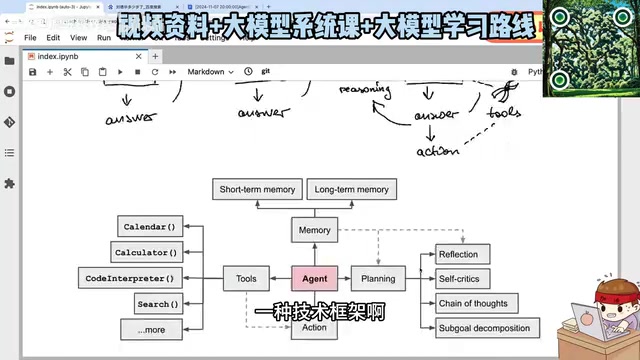
From the detailed framework diagram, the core of an Agent consists of several parts: the Planning module is responsible for deep thinking, self-criticism, and chain-of-thought decomposition; the toolset covers various external capabilities; combined with short-term and long-term memory, it ultimately outputs Action instructions to complete calls.
The Planning module in an Agent is typically implemented based on reasoning frameworks such as Chain-of-Thought (CoT) or ReAct (Reasoning + Acting). ReAct was proposed by Google in 2022, structuring the loop of "Thought → Action → Observation" into a model output format, enabling language models to complete tool calls and multi-step reasoning in an interpretable manner. The core contribution of ReAct lies in breaking the binary separation of "reasoning" and "action"—before this, mainstream methods either had the model reason purely (CoT) or directly output an action, while ReAct interweaves the two into a unified sequence, so that each action step has an explicit reasoning trace available for review and debugging, significantly improving the interpretability and debuggability of Agent behavior. At the engineering implementation level, mainstream frameworks such as LangChain and LlamaIndex encapsulate ReAct as a standard Agent executor, and developers only need to register the Tool Description to enable the model to autonomously decide when to make calls. Parallel to ReAct is the Plan-and-Execute paradigm: first use a planning model to generate a complete task decomposition all at once, then have the execution model complete it step by step—the former is suitable for long-horizon complex tasks, while the latter is more efficient in scenarios with high tool-call frequency and requiring real-time feedback. Before executing a task, the model first decomposes subgoals, reasons step by step, and dynamically adjusts subsequent plans at each step based on the tool's returned results—this "observe-think-act" loop is precisely the core mechanism distinguishing an Agent from single-turn Q&A.
Building on the single-Agent architecture, Multi-Agent Systems are becoming a new paradigm for handling ultra-complex tasks. Frameworks such as AutoGen (Microsoft) and CrewAI allow multiple specialized Agents to collaborate and divide labor: the Planner Agent is responsible for task decomposition, the Executor Agent performs specific tool calls, and the Critic Agent evaluates the quality of results. The core value of multi-agent architecture lies in two points: first, it distributes the context window bottleneck faced by a single Agent—each sub-Agent only needs to maintain the context of the subtask it is responsible for, rather than the entire history of the whole long-horizon task; second, specialized division of labor allows each Agent to be specifically optimized for particular capabilities (for example, an Agent dedicated to code execution can be equipped with a sandbox environment), so the overall system capability thus exceeds the ceiling of any single generalist Agent. This architecture distributes the context window bottleneck of a single Agent, enabling the system to handle long-horizon tasks far exceeding the capability boundary of a single model, and is an important technical trend in current enterprise-grade Agent deployment.
The memory system is divided into short-term memory (conversation history within the current session's context window) and long-term memory (cross-session knowledge persistently stored in a vector database), enabling the Agent to accumulate personalized knowledge with use. This structure makes the Agent a mature model for complex business deployment.
What Is Agent Tuning, and Why Do We Need It
Since we can implement an Agent using Prompt + tools + Memory (like the AutoGPT approach), why do we still need to specifically perform Agent Tuning?
The instructor gives a key premise: this "follow-the-manual" approach requires the model to be smart enough. Writing a Prompt is essentially writing a "work manual" for the model, but practice has proven that, except for top-tier models like GPT-4, many models including GPT-3.5 struggle to follow complex Prompts to complete tasks—feeding AutoGPT-style complex instructions to a small-scale model, it often cannot understand them at all.
Agent Tuning is a specialized direction of Supervised Fine-Tuning (SFT), but its training data composition has significant differences. Traditional SFT mainly uses question-answer pairs, while Agent Tuning's training samples are complete "task trajectories" (Trajectory), containing: user instruction → model thinking → tool call request → tool return result → model re-reasoning → final answer, a complete sequence. By repeatedly learning such trajectory data, small models can internalize the behavioral patterns of "when to call tools, how to parse return values, how to plan the next step," no longer relying on lengthy instruction descriptions in the Prompt. The essential difference from traditional SFT is: ordinary Q&A pairs only teach the model to "output correct answers," while trajectory data teaches the model the "correct thinking and action process"—the latter is an irreplaceable training signal for Agent tasks requiring multi-step decision-making.
Three Practical Constraints Driving Agent Tuning
- Private deployment needs: Many enterprises require private on-premise deployment on their intranet, and commercial APIs such as GPT-4 cannot be used directly.
- Inference cost control: A balance needs to be sought between cost and performance, and self-built models are more controllable and flexible.
- Small models are equally capable: Practice has proven that after specialized Agent Tuning training, small models with 3B or 7B parameters can also achieve good Agent capabilities, with lower inference costs and more convenient deployment.
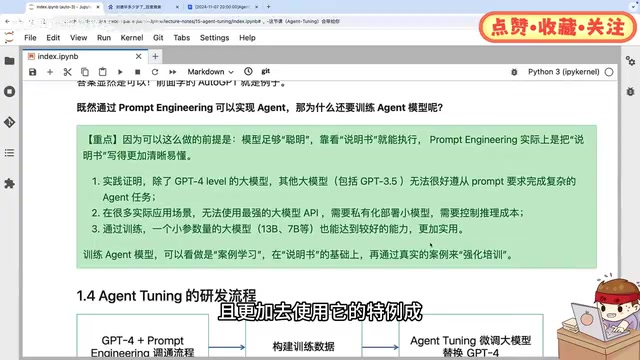
Here is a counterintuitive conclusion worth noting: models at the 3B and 7B parameter scale (such as the LLaMA, Mistral, and Qwen series) clearly lag behind GPT-4 on general conversation tasks, but after domain-specific Agent Tuning, they can significantly narrow the gap on specific tool-calling tasks. This path already has ample methodological support in academia: Stanford's Alpaca (distilling LLaMA from GPT-3.5) and Microsoft's Orca series (distilling small models from GPT-4) verified the effectiveness of high-quality trajectory data for transferring capabilities to small models; Berkeley's Gorilla and ToolLLM projects specifically focus on constructing tool-calling trajectory data, providing important data engineering paradigms for Agent Tuning. The underlying logic is: the complexity of Agent tasks comes from the planning of business processes and the timing judgment of tool calls, rather than the depth of language understanding itself. Once training data sufficiently covers the target toolset and business scenarios, small models only need to learn to "call the right tool at the right time," and this capability threshold is far lower than general reasoning—Agent Tuning is precisely the key means to complete this specialized capability transfer. From the perspective of parameter efficiency, the maturity of parameter-efficient fine-tuning methods such as LoRA (Low-Rank Adaptation) has further lowered the engineering barrier of Agent Tuning—by simply freezing the original model parameters and training a small number of low-rank matrices (typically only 0.1%~1% of the total parameter count), significant capability improvements on specific tool-calling tasks can be achieved, reducing GPU memory requirements from the tens of GB required for full-parameter fine-tuning to a range that a single consumer-grade GPU can handle.
The instructor made an apt analogy: Agent Tuning is like the "on-the-job training" that university students receive before entering the workforce. General education provides a foundation of general capabilities, but truly being competent for a job requires reinforced training combined with real cases. Agent Tuning is precisely the reinforcement learning completed with real business data on top of the Prompt "manual."
Agent Tuning R&D Process and Cost Evaluation
The instructor provides a typical R&D closed-loop process that is logically clear and practically valuable:
- Debug the process with a strong model: First use a powerful model like GPT-4 to run through and verify the entire Agent business process.
- Build training data: On the basis of the debugged process, use the strong model to automatically generate data, supplemented by manual correction, to build a high-quality training set.
- Perform Agent Tuning: Use this batch of data to fine-tune your own small model.
- Replace and close the loop: Replace the expensive GPT-4 with the fine-tuned model, completing the R&D closed loop.
This process is also known as the "knowledge distillation" path—having the large model act as a "teacher model" and training the "student model" through the high-quality trajectory data it generates, which is currently the most cost-effective methodology in the industry for reducing Agent deployment costs. Data quality is the core variable of this process: the trajectory data generated by GPT-4 needs to undergo manual review to filter out noisy samples such as tool-call errors and reasoning skips, in order to ensure fine-tuning effectiveness. This challenge is equally emphasized in academia—how to ensure that the trajectory data generated by the teacher model has sufficient diversity and correctness, avoiding distilling the large model's errors into the small model along with everything else, is the primary quality checkpoint in the engineering practice of Agent Tuning. In actual engineering, this data screening process typically requires building an automated verification pipeline: for tool-call trajectories, call correctness can be automatically judged by actually executing the tool functions and comparing return values; for reasoning trajectories, human annotators need to perform step-by-step review to ensure the logical self-consistency of each Thought step—this is why "manual correction" is always an indispensable key link in building high-quality Agent training data.
Training Cost Is a Key Variable in Technology Selection
The instructor particularly reminds: Agent Tuning is not a mandatory option for all scenarios. If the business can directly call APIs such as OpenAI's and the cost is acceptable, there is no need to invest additional training resources.
The course also provides specific cost references: taking a 7B model as an example, the training data is about 4.7 million tokens, trained for 5 epochs. Estimated at cloud A100 prices, four cards in parallel are needed to run it, and the machine-hour cost is not negligible. If repeated iteration and adjustment are needed, the cost will continue to accumulate.
From a decision-making framework perspective, calling the OpenAI GPT-4 API is a pure variable cost (billed by token), requires no infrastructure investment, and is suitable for cold start and low-frequency scenarios; the fixed costs of a self-built 7B fine-tuned model include training fees and the long-term rental fee for inference servers, but the marginal cost is extremely low, and ROI improves rapidly as call volume increases. It is generally believed that when the average daily API call volume exceeds 100,000, the overall cost of private deployment begins to have an advantage. On the inference side, quantization techniques (such as GPTQ and AWQ compressing model weights from FP16 to INT4) can reduce the memory requirement of a 7B model from about 14GB to 4-6GB, enabling a single consumer-grade GPU to handle production-grade inference services, further lowering the hardware threshold for private deployment. In addition, data security compliance (in heavily regulated industries such as finance and healthcare) is often a non-economic decisive factor driving private deployment—in such scenarios, even if the API cost is lower, the compliance requirement that data not leave the local premises makes self-built fine-tuning the only option.
This pragmatic cost list reminds developers: technology selection should return to the business value itself, making a rational trade-off between self-built fine-tuning and directly calling the API. For internal tool-type Agents with limited daily call volume, the total cost of directly calling the GPT-4 API may be far lower than the one-time investment of self-built fine-tuning; while for high-concurrency, latency-sensitive consumer-facing products, a privately deployed fine-tuned model has a greater advantage in long-term ROI.
Conclusion
The value of this tutorial lies in that it does not stay at the superficial level of "Agents are cool," but progressively explains three key questions in depth: why AI Agents are needed, what the Agent's technical framework is, and how to weigh the cost-benefit of Agent Tuning during enterprise deployment. For developers who wish to build enterprise-grade agents, understanding the core logic that "large models can talk, but Agents can do things" is the first step toward practical application.
Key Takeaways
Related articles

The Truth Behind Codex 'Build a Website in 5 Minutes': AI Isn't Creating Sites—It's Helping You Copy Them
Exposing the truth behind viral Codex 5-minute website videos: creators aren't building original sites with AI—they're copying shared prompts or scraping others' work. Learn AI coding tools' real limits.

Getting Started with AI Agent Development: A Complete Guide from Concept to Practice
A comprehensive guide to AI Agent architecture and development, covering automated marketing, intelligent customer service, and investment analysis scenarios with single and multi-agent collaboration.

The Truth Behind Codex 'Build a Website in 5 Minutes': AI Isn't Creating Sites — It's Helping You Copy Them
Exposing the truth behind viral Codex 5-minute website videos: creators aren't building original sites with AI — they're copying shared prompts or scraping others' work.