Google SynthID Watermarking Explained: How AI Content Provenance Works

Google's SynthID has invisibly watermarked 100B+ AI-generated assets across four media modalities.
Google DeepMind's SynthID embeds invisible watermarks into AI-generated images, video, audio, and text at massive scale — over 100 billion assets and counting. Paired with the C2PA Content Credentials standard and integrations in Google Search and Chrome, SynthID makes AI content provenance a mainstream reality, though challenges around coverage, robustness, and industry-wide standardization remain.
AI Content Authenticity: A Trust Crisis in the Digital Age
As generative AI tools proliferate rapidly, a pressing question faces everyone: how do we tell what's AI-generated versus what's been genuinely photographed or created by a human? With the barrier to deepfake technology continuing to fall, content provenance — the documented origin and modification history of digital content — has evolved from a technical detail into essential social infrastructure.
Deepfake technology is built on generative adversarial networks (GANs) and diffusion models from deep learning. By training on large datasets, these systems learn the distribution of faces, voices, or images to generate convincingly realistic synthetic content. Early deepfakes required professional GPU clusters and thousands of sample images; today, tools like Stable Diffusion and Midjourney allow ordinary users to produce realistic face-swapped videos from a single photo in just minutes. This exponential drop in the technical barrier has driven the cost of producing misinformation toward zero, while the cost of detecting it continues to rise. Notably, regulators are also accelerating their response — the EU AI Act explicitly requires labeling and disclosure of deepfake content, and major regulatory jurisdictions including China and the United States have introduced similar requirements. This global tightening of policy has transformed content provenance from a voluntary corporate practice into a compliance imperative.
It is against this backdrop that Google's DeepMind developed SynthID — a solution that embeds invisible digital watermarks into AI-generated content. Google recently published a progress summary for SynthID, disclosing the current deployment scale and ecosystem of this provenance technology.

SynthID Watermarking: Expanding from Images to All Modalities
The core idea behind SynthID is to embed a layer of digital watermarks into AI-generated content — imperceptible to the human eye, yet detectable by machines. This watermark doesn't affect visual or audio quality, but can be reliably traced back as a kind of "AI certificate of origin."
The underlying logic of digital watermarking is encoding invisible information into the perceptual redundancy layers of media. Image watermarks typically exploit the human visual system's (HVS) insensitivity to high-frequency detail, hiding identifier information in pixel values or frequency-domain coefficients. Audio watermarks leverage auditory masking effects to embed signals below the perceptual threshold. SynthID's innovation lies in deeply integrating the watermark generation process into the denoising steps of the diffusion model — the architecture underlying mainstream tools like Stable Diffusion and DALL-E 3, which learns to progressively restore images from noise. Embedding the watermark natively into this generative process, rather than applying it as a post-processing step, significantly improves the watermark's robustness against compression, cropping, and other downstream operations.
The technology's evolution is worth noting. SynthID was originally designed for images only, and has since expanded to cover four modalities: video, audio, and text. Whether it's an AI-generated image, short video, synthesized voice, or text written by a large language model — all can theoretically be marked and identified with invisible watermarks.
In terms of deployment scale, the numbers are striking:
- Over 100 billion images and videos have been watermarked with SynthID
- The equivalent of 60,000 years of audio content has been processed
This scale demonstrates that AI watermarking is no longer a laboratory concept — it has been deployed at massive scale as a default capability across Google's generative AI product lineup.
Verification for Everyone: Ordinary Users Can Now Identify AI Content
For everyday users, the real value of watermarking lies in verifiability. Google has revealed that users can now directly verify whether content carries a SynthID watermark at the following touchpoints:
- Google Search
- Gemini in the Chrome browser
- The Gemini App
According to official data, these verification features have been used over 50 million times. Embedding detection capabilities into high-frequency touchpoints like search and browsers is a critical product decision — it brings the ability to identify AI content down from the realm of specialized tools into everyday browsing. When a user questions the authenticity of an image, the cost of verification is dramatically reduced.
C2PA Content Credentials: The Other Half of the Provenance Puzzle
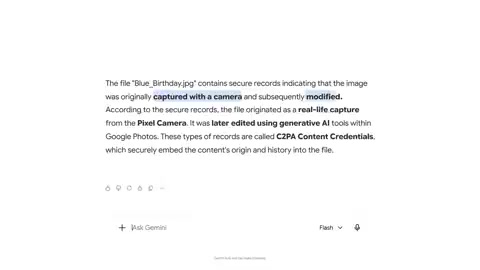
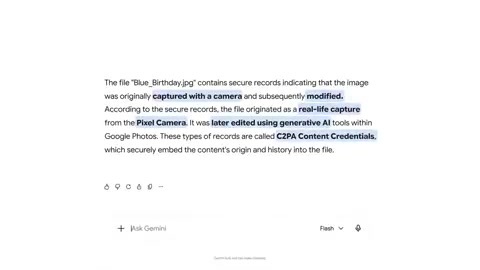
Invisible watermarks alone aren't sufficient to build a complete content provenance system. Google has announced that it is increasingly adopting the C2PA Content Credentials standard across its generative AI tools, including images and videos created within the Gemini App.
C2PA (Coalition for Content Provenance and Authenticity) is an open industry standard jointly launched in 2021 by Adobe, Microsoft, Intel, the BBC, Sony, and others. C2PA credentials are essentially cryptographically signed metadata manifests attached to media files, recording the creation tool, creator identity, capture device parameters, and timestamps and operation types for every edit — similar in concept to a blockchain's immutable ledger, but implemented using the lighter-weight PKI (Public Key Infrastructure). They can be embedded directly into mainstream file formats like JPEG and MP4 without relying on external on-chain storage.
The division of responsibility between SynthID and C2PA is worth clarifying:
- SynthID watermarks answer the question: "Was this AI-generated?"
- C2PA credentials provide richer metadata — where the content originally came from, and what modifications it has undergone since
Together, users can not only know that an image is AI-generated, but also trace its origin chain and editing history. This dual-track "watermark + credentials" mechanism is widely considered the industry's best-practice direction for content provenance.
Open Source and Cross-Vendor Collaboration: Provenance Can't Be a Solo Effort
In its progress summary, Google sends a clear signal: content provenance is not a task any single company can accomplish alone.
On the open-source front, Google has made its text watermarking technology publicly available. Text watermarking has consistently been the most technically challenging of the four modalities — text has low information entropy and is easily rewritten, meaning watermarks can readily be lost during editing. Mainstream text watermarking approaches include lexical substitution (replacing specific words with synonyms) and token generation bias (fine-tuning the probabilities of specific tokens during the LLM sampling stage) — the latter being the core mechanism of SynthID's text watermarking. However, the watermark signal can disappear with even simple paraphrasing, translation, or partial excerpting, making text watermark robustness an ongoing core challenge for the industry. Opening up this capability to the community should accelerate broader exploration and problem-solving.
On cross-vendor collaboration, Google is working with OpenAI, NVIDIA, Apple, and others to advance SynthID's adoption across a wider range of generative media scenarios. This lineup of partners is significant — it signals that AI watermarking and provenance is moving beyond Google's ecosystem toward a cross-vendor universal standard. Only when major AI content producers all adopt compatible watermarking and credentials mechanisms will ordinary users be able to have a consistent verification experience anywhere on the internet.
Real-World Challenges: Three Difficulties Beyond the Technology
Despite SynthID's encouraging progress, content provenance technology still faces challenges that cannot be ignored.
Coverage gaps: Watermarks only work for AI tools that have adopted the technology. Content produced by non-participating or deliberately evasive generative models remains undetectable. Malicious actors are precisely the ones least likely to voluntarily embed watermarks.
Robustness issues: Whether watermarks survive repeated compression, cropping, transcoding, or rewriting directly determines the technology's practical value — and text watermarks are especially vulnerable on this front. While image watermarks benefit from stronger robustness thanks to being embedded in the diffusion model's generation process, they remain susceptible to erasure under professional-grade adversarial attacks — a frontier that academia and industry continue to battle over.
Standards fragmentation: Although SynthID and C2PA are aligned in direction, if the industry cannot converge on a truly interoperable unified standard, users will still face a fragmented verification experience.
From this perspective, Google's choice to open-source its text watermarking and pull in competitors to build a shared ecosystem may be more strategically significant than the technical advances themselves. In an era of ever-increasing AI-generated content, building a trustworthy, universal, and user-friendly provenance system has become a necessary investment in maintaining the basic trust that underpins the digital world.
Key Takeaways
Related articles

The Era of AI Capability Overhang: Why You Need to Reset Your Ambition Every 3 Months
Understanding Capability Overhang in the AI era: when model capabilities far exceed application imagination, how teams should reset feasibility boundaries quarterly to avoid ceding advantages to competitors.

Firemaps Spain: Real-Time Wildfire Monitoring Map with Wind Flow Visualization
Firemaps Spain is an open-source real-time wildfire monitoring tool for Spain and Portugal, combining fire hotspot data with wind flow visualization to help assess fire spread direction.

Google AI Studio Hiring TPM Lead: Decoding the Three Key Criteria Including 'AI Pilled'
Google DeepMind's AI Studio team is hiring a TPM lead with three key criteria: AI pilled, high agency, and pushing the frontier. A deep dive into Google's acceleration strategy and AI talent trends.