GPT 5.6 + Codex In-Depth Review: Three-Tier Models and Ultra Mode Fully Explained

GPT 5.6 brings three model tiers, Ultra mode, 350K context, and fixes a key output bug in Codex.
OpenAI's GPT 5.6 update to Codex introduces a three-tier model system (Sol/Terra/Luna), an Ultra thinking mode with aggressive sub-Agent orchestration, expanded 350K token context, and stronger autonomous loop capabilities. It also fixes the long-standing bug where conversational text was written into structured outputs. The trade-off is significantly faster quota consumption.
Article Content
OpenAI recently updated Codex and launched the new GPT 5.6 model. Unlike previous updates that only differentiated between standard and Pro versions, this release brings notable changes across model tiers, thinking intensity levels, context length, and Agent autonomous loop capabilities. Based on comprehensive hands-on testing, this article breaks down the core upgrades and real-world experience with GPT 5.6.
Three New Model Tiers: Sol, Terra, and Luna
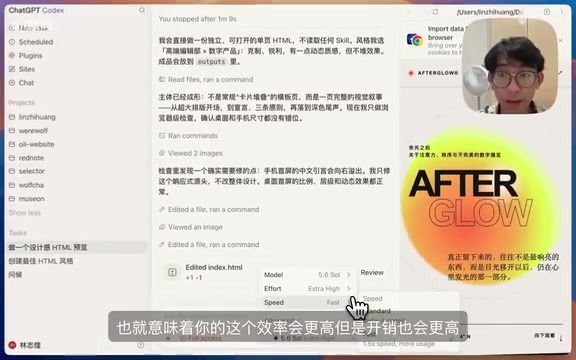
The most significant structural change in GPT 5.6 is the introduction of a three-tier classification system similar to Anthropic's Claude family (Opus/Sonnet/Haiku). The three tiers are named after celestial bodies, ranked from highest to lowest capability:
- Sol (Sun): The top tier, comparable to the previous GPT 5.5 and roughly analogous to Fable 5 on the market.
- Terra (Earth): The mid-tier, with capabilities broadly equivalent to the previous GPT 5.5.
- Luna (Moon): The most economical tier, designed for low-cost inference.
Industry context for tiered model systems: This layered design has become standard practice among major LLM providers. Anthropic pioneered the Opus/Sonnet/Haiku naming scheme, representing a "powerful flagship / balanced workhorse / lightweight fast" gradient; Google built a four-tier system with Gemini Ultra/Pro/Flash/Nano; Meta's Llama series likewise offers multiple scale variants based on parameter count. The technical rationale behind this trend is that the relationship between model scale (parameter count) and inference cost is super-linear — doubling a model's parameters often more than doubles inference latency and compute overhead. A single model therefore cannot simultaneously satisfy both "maximum performance" and "low-cost, high-concurrency" use cases. Through tiering, providers can cover the full spectrum from enterprise-grade complex reasoning to lightweight on-device inference within a single product line, allowing developers to dynamically select models based on task complexity and make fine-grained trade-offs between accuracy and token costs.
From an API pricing perspective, this system is clearly positioned to compete with Claude. Standard GPT 5.6 pricing remains in line with GPT 5.5; Terra is priced at $15 per million output tokens and Luna at $6; Sol is $30 per million output tokens — more competitive than Fable 5's $50. Testing suggests Sol and Fable 5 are close in capability, though Sol hasn't fully caught up to Fable 5 at its absolute best.
The core value of this tiered system is that developers can flexibly allocate models based on task complexity — using Sol for nuanced reasoning while calling Terra or Luna as sub-Agents, significantly reducing token costs without sacrificing overall quality.
Ultra Thinking Mode: More Aggressive Sub-Agent Collaboration
Beyond model tiering, GPT 5.6 also adds a new level to thinking intensity. Previously, Codex's maximum thinking intensity was Extra High — now there's an Ultra tier.
The core logic of Ultra mode is aggressive orchestration of multiple sub-Agents to collaboratively execute tasks, following a Dynamic Workflow approach — similar in concept to Ultra mode in Claude Code.
Dynamic Workflow and sub-Agent orchestration: Dynamic Workflow is an important paradigm in Agent system architecture, as opposed to Static Workflow. Static workflows predefine all steps before execution — suitable for scenarios with fixed processes and predictable input/output formats, with the advantage of being highly predictable and easy to debug. Dynamic workflows, by contrast, allow the primary Agent to decide in real time — based on intermediate results — whether to decompose sub-tasks, which sub-Agents to invoke, and in what order. This is essentially an adaptive scheduling system that fuses "planning" and "execution" into one. In this architecture, the primary model acts as an Orchestrator, breaking complex programming tasks into parallelizable or serializable sub-tasks that are delegated to lighter-weight sub-Agents, with the primary model responsible for aggregating and validating the final output. The key advantage of this architecture is its ability to handle complex tasks with ambiguous requirements or mid-task feedback needs — but the trade-off is that token consumption multiplies, since each sub-Agent requires its own context window and inference overhead, and the primary model must re-read and integrate all sub-task outputs, often resulting in total consumption that is several times — or even tens of times — higher than a single direct execution.
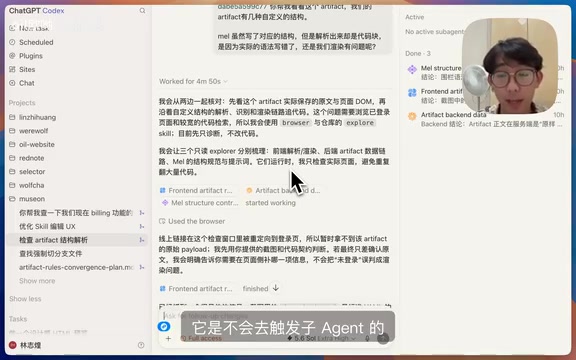
In Codex, Ultra mode causes the model to proactively decompose and advance more sub-tasks to improve overall efficiency, at the cost of noticeably higher token consumption. Notably, the sub-Agent triggering logic has also changed. Previously, Codex's prompt explicitly specified that sub-Agents would only be triggered upon user request; now, even without explicit instructions, Codex will proactively invoke sub-Agents to advance tasks. The interface has also been updated with a new UI design featuring icons for different sub-Agents.
Expanded Context and Enhanced Autonomous Loop Capability
In terms of context length, GPT 5.6's available context within Codex has increased from approximately 260K tokens (GPT 5.5) to approximately 350K — an increase of nearly 100K tokens.
Context length and token economics: Context window refers to the total amount of text a large language model can "remember" and process in a single session, measured in tokens (roughly 1 Chinese character ≈ 1.5 tokens, 1 English word ≈ 0.75 tokens). From GPT-3's 4K to GPT-4's 128K, to the approximately 350K tokens now available in Codex with GPT 5.6, the expansion of context directly determines how large a codebase or document the model can handle — 350K tokens is roughly equivalent to reading and comprehending the entire source code of a medium-sized open-source project in one pass. However, a longer context is not without cost: the Self-Attention mechanism in Transformer architecture has quadratic computational complexity relative to sequence length — doubling the context causes the Attention matrix computation to grow fourfold, with inference latency and GPU memory usage rising sharply in tandem. This is why, despite the model API supporting up to 1M token context, Codex sets a 350K cap for subscribers — an engineering compromise between user experience, cost control, and functional completeness. Worth noting: the model itself supports 1M context at the API level, and Codex has not yet opened full quota to subscription users.
More noteworthy is the improvement in autonomous loop capability. Previously, you had to repeatedly remind Codex via specific instructions to "keep looping until the goal is achieved." Now, you can simply hand it a task, and even without activating any special mode, it can autonomously run for two to three hours, with significantly more accurate understanding of goals and tool invocation.
Skill invocation capability has also improved markedly. When a user configures thirty or forty or more Skills, GPT 5.5 would often become confused when Skills had overlapping responsibilities — sometimes not using any of them. GPT 5.6 is now more proactive and accurate in selecting and executing the appropriate Skill.
Fixing the Long-Standing "Conversation Content Written into Output" Bug
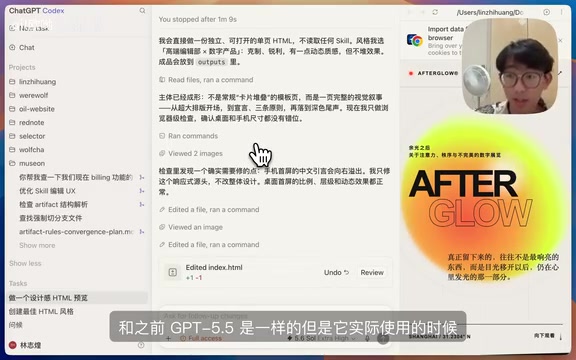
Among all the upgrades in this release, the most important improvement identified in testing is the fix of a serious issue that had plagued GPT 5.5: the model would write content intended as user-facing conversational feedback directly into the delivered output.
Technical root cause of the "conversation written into output" problem: When generating structured outputs (such as code, HTML, or documents), large language models face the classic challenge of "meta-level confusion": the model must simultaneously maintain two fundamentally different output modes — a natural language explanation layer for the user, and a structured content layer for machine execution. When the model misjudges "which layer it should currently be outputting," descriptive language from the conversational layer bleeds into the artifact layer, creating the "conversation written into output" problem. From a technical perspective, this typically stems from imprecise reward signal design around output boundaries during RLHF (Reinforcement Learning from Human Feedback) training — human annotators may assign high scores to outputs that are "broadly correct" while overlooking fine-grained format violations such as "descriptive text mixed into code." Fixing this type of issue requires constructing targeted contrastive data pairs (correct format examples vs. format-violating error examples) and reinforcing the model's judgment of output boundaries through additional supervised fine-tuning (SFT) rounds. It is a technically challenging detail in model alignment engineering that often requires multiple iterations to fully eliminate.
A typical example: when asked to create a "blue-themed, minimalist geek-style" page, GPT 5.5 would embed user-facing descriptions like "This is a blue geek-style website" directly into the HTML code — one of the main reasons its document writing and frontend output quality was poor. After a full day of testing, GPT 5.6 did not reproduce this issue in any document writing or HTML output.

In terms of design capability, GPT 5.6 has improved over its predecessor but retains some ingrained stylistic preferences: a tendency toward heavy font weights, tight line heights, high-contrast non-mainstream typography, a preference for beige or gray backgrounds, and a habit of layering grid textures with green gradients. Overall, the design aesthetic is noticeably more palatable than before, though idiosyncratic tendencies haven't been fully eliminated.
Quota Consumption Accelerates Significantly — Plan Usage in Advance
Although GPT 5.6's API pricing is the same as GPT 5.5, testing reveals that subscription quota is consumed noticeably faster. Quota that previously was difficult to exhaust within 5 hours (at the $200 tier) can now be depleted by running a single task for an hour or two. In just one day, 26% of the weekly quota was consumed — far exceeding previous levels.
The structural difference between subscription quotas and API pricing: There is a structural difference between AI model subscription plans (e.g., ChatGPT Pro at $200/month) and pay-per-use API pricing. Subscription plans are essentially a "pre-purchased compute + bundled discount" model: providers estimate the average usage of subscribers in advance, offer credits at a discounted rate below the API unit price, and rely on uneven usage distribution (light users' remaining credits subsidizing heavy users' excess consumption) to maintain overall commercial balance — the same profit logic as gym memberships. When a model upgrade drives more aggressive token consumption (such as multi-Agent decomposition in Ultra mode or longer context processing), providers maintaining API prices face two adjustment options: raise subscription prices to cover rising compute costs, or quietly reduce the real token volume that a subscription translates to — effectively lowering the "leverage ratio" without announcement. The latter is less perceptible to users, manifesting as "the same money runs out faster," but is commercially easier to implement.
For the surge in consumption, there are two plausible explanations: the longer context directly drives up token consumption; or Codex has adjusted the "leverage ratio" in subscription plans, reducing the real token volume translated from the subscription fee. Since API pricing hasn't changed, simply switching models shouldn't theoretically make much difference in cost — making the latter explanation worth keeping in mind.
That said, the three-tier model system gives users more room to maneuver — calling Terra or Luna as sub-Agents when using subscription plans can effectively control overall token expenditure.
Summary: Stronger Performance, but Cost Requires Careful Management
Based on comprehensive testing, the core changes in GPT 5.6 + Codex can be summarized as: more refined model tiering, more aggressive thinking modes, longer context, significantly enhanced autonomous loop and Skill invocation capabilities, and the fix of the long-standing "conversation written into output" bug. These improvements collectively raise the usability and stability of Codex as an AI coding Agent.
On the flip side, Ultra mode and more aggressive sub-Agent invocation create noticeable quota pressure. For subscription users, finding the right balance between performance and cost — strategically mixing Sol, Terra, and Luna — will become an unavoidable consideration when using GPT 5.6.
Key Takeaways
Related articles

The Truth Behind Codex 'Build a Website in 5 Minutes': AI Isn't Creating Sites—It's Helping You Copy Them
Exposing the truth behind viral Codex 5-minute website videos: creators aren't building original sites with AI—they're copying shared prompts or scraping others' work. Learn AI coding tools' real limits.

Getting Started with AI Agent Development: A Complete Guide from Concept to Practice
A comprehensive guide to AI Agent architecture and development, covering automated marketing, intelligent customer service, and investment analysis scenarios with single and multi-agent collaboration.

The Truth Behind Codex 'Build a Website in 5 Minutes': AI Isn't Creating Sites — It's Helping You Copy Them
Exposing the truth behind viral Codex 5-minute website videos: creators aren't building original sites with AI — they're copying shared prompts or scraping others' work.