GPT-5.6 Explained: Sol, Terra & Luna — Tiered Positioning and Capability Comparison

OpenAI's GPT-5.6 debuts three tiered models—Sol, Terra, and Luna—ushering in the era of AI model selection.
OpenAI previews the GPT-5.6 series with three simultaneous models: flagship Sol, balanced Terra, and low-cost Luna. This article breaks down each model's capabilities, use cases, and pricing, along with new concepts like Max Reasoning Effort and the multi-agent Ultra architecture, helping developers and enterprises make informed AI selection decisions.
GPT-5.6: One Release, Three Models
OpenAI recently announced an important development: the start of the GPT-5.6 series preview. Unlike previous launches, this time it wasn't a single model debuting, but three models arriving simultaneously—Sol, Terra, and Luna.
These three names aren't just a branding exercise. They carry a key signal: OpenAI is turning AI models into a clearly defined product line. Just as smartphone chips or graphics cards are divided into flagship, mid-range, and entry-level tiers, AI models are now being stratified by capability, cost, and use case.
This product line tiering strategy wasn't invented by OpenAI—it's a natural extension of mature business models from the cloud computing and chip industries into the AI space. NVIDIA's GPU product lines (consumer-grade GeForce, professional-grade Quadro, data center-grade A/H series) and AWS's EC2 instance types (general purpose, compute optimized, memory optimized) all follow the same logic: different compute requirements map to different price ranges, letting users pay for what they need rather than being forced to buy the flagship configuration. Notably, this tiering strategy is equally common in Software-as-a-Service (SaaS)—companies like Salesforce and Adobe have covered customers of different sizes with Starter/Professional/Enterprise three-tier pricing for decades, which is essentially a commercial application of the economic principle of "price discrimination": charging differentiated prices to user groups with different willingness to pay, thereby maximizing total revenue and expanding market coverage. OpenAI's Sol/Terra/Luna three-tier architecture essentially brings this mature "tiered sales" strategy into the large model API market—it can serve cost-sensitive small and medium enterprises while also catering to high-end customers willing to pay for peak performance, all while maximizing the commercial value per unit of compute.
The core positioning of the three models is as follows:
- Sol (Flagship): The most powerful, aimed at complex reasoning, high-difficulty coding, scientific research analysis, and security-related tasks
- Terra (Balanced): The value-for-money choice, suitable for everyday office scenarios like writing documents, making summaries, and analyzing materials
- Luna (Fast, Low-Cost): Focused on large-scale repetitive tasks such as batch rewriting, content classification, customer service replies, and high-frequency API calls

The essence of this shift is a fundamental change in the logic of AI usage. Previously, everyone only cared about "which model is the strongest." But OpenAI's answer now is: different tasks match different models. Choose Sol for maximum capability, Terra for value, and Luna for speed and cost.
Sol Flagship Model: Three Core Capability Improvements
OpenAI states that GPT-5.6 Sol is currently the most powerful model, with significant improvements in three key directions.
Coding: From Execution to Autonomous Planning
OpenAI mentions that Sol has reached a new level on Terminal-Bench 2.0. Terminal-Bench 2.0 is a benchmark specifically designed to evaluate an AI's ability to work autonomously in real command-line environments. To understand the value of this benchmark, one needs to know the evolution of code evaluation benchmarks: the early HumanEval (2021, proposed by OpenAI) tested function-level code completion—input a function signature and comment, output the function implementation; MBPP similarly focused on single-function generation. As model capabilities improved, these benchmarks quickly saturated—GPT-4 already exceeded 85% pass rate on HumanEval, making it hard to distinguish the capability gaps between top models. SWE-bench (2024) was an important intermediate upgrade, expanding the evaluation target from functions to fixing real GitHub Issues, requiring models to understand codebase context and submit valid patches; but its tasks were still mostly single issues, lacking consideration of multi-step engineering practices.
Terminal-Bench 2.0 represents a new generation of "agent-level" evaluation thinking: expanding the evaluation scenario from "writing a function" to "completing an engineering project in a real Shell environment," requiring the model to complete multi-step engineering tasks without human intervention—including installing dependencies, debugging errors, operating the file system, running scripts, and dynamically adjusting strategy based on results. This type of evaluation is closer to an engineer's real workflow and harder to game through benchmark-focused training. In other words, Sol is more like a "programmer assistant" capable of autonomously completing engineering tasks, rather than a traditional code completion tool. This leap from "single-point completion" to "full-process autonomy" is a key milestone in AI programming tools evolving from an assistive role to an independent collaborator.
Scientific Research: Long-Task Processing and Cost Control
OpenAI placed emphasis on the bioinformatics workflow scenario, including genomic analysis, quantitative biological analysis, and long-cycle research tasks. Bioinformatics is one of the most representative research fields for AI implementation: genomic analysis involves alignment, variant detection, and functional annotation of sequences with billions of base pairs—the raw data produced by a single whole-genome sequencing can reach over 100GB, and analysis pipelines often chain together dozens of tools (such as BWA alignment, GATK variant detection, Annovar functional annotation); quantitative biological analysis includes protein structure prediction (DeepMind's AlphaFold has ushered this field into a new era), drug molecular docking, single-cell transcriptome analysis, and other directions. The common characteristics of such tasks are: long pipelines, many intermediate steps, and the need for domain expertise to interpret intermediate results and decide the next operation—requiring AI to read large amounts of literature, perform multi-step reasoning, and control output costs. Research institutions typically face strict computing resource budget constraints; in recent AI-assisted research papers published in top international journals like Nature and Science, computational cost control has become one of the important metrics for assessing method reproducibility.
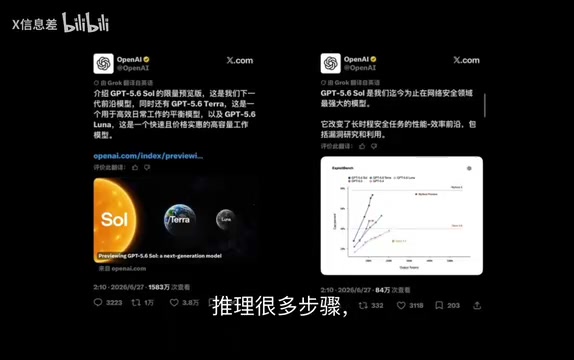
Worth noting is that OpenAI claims Sol consumes fewer Tokens than GPT-5.5 when completing similar tasks. A Token is the basic unit large language models use to process text—typically an English word is roughly equal to 1-2 Tokens, and a Chinese character is likewise roughly 1-2 Tokens. Vendors like OpenAI bill their APIs separately for input Tokens and output Tokens. For tasks such as research analysis and long-document processing, each inference may consume thousands to tens of thousands of Tokens, so Token efficiency directly determines usage cost—which is especially critical for research institutions that usually have strict computing budget limits. From a technical perspective, lower Token consumption usually means the model has internally achieved more efficient "knowledge compression"—expressing conclusions of the same quality with a more concise reasoning path, which is closely related to knowledge distillation and reward signal design in reinforcement learning fine-tuning (RLHF/RLAIF). Sol's ability to complete tasks of the same quality with more compact output means its internal reasoning path is more optimized—highly consistent with the core theme of "tiered cost reduction" in this release.
Cybersecurity: Capability Improvement Alongside Boundaries
OpenAI's wording on the security aspect is relatively cautious. Sol is more capable in vulnerability research, security analysis, and penetration testing, but it also emphasizes that the model has not reached the so-called Cyber-Critical level. Understanding this concept requires knowing OpenAI's overall security assessment framework: its "Preparedness Framework" (released in 2023) divides AI capability risks into four levels—low, medium, high, and critical—covering cybersecurity, chemical weapons, biological weapons, nuclear and radiological weapons, and model autonomous replication, among other dimensions. This framework draws on the U.S. government's tiered management experience in export controls (EAR/ITAR) and biosecurity. Its core logic is: once a capability threshold is crossed, risk transforms from quantitative to qualitative change, requiring a corresponding increase in control intensity.
Cyber-Critical represents the highest risk level, specifically referring to a model's ability to significantly enhance the capacity of nation-state actors to launch major cyberattacks—for example, autonomously discovering and exploiting zero-day vulnerabilities, designing self-propagating malware, or disrupting critical infrastructure. OpenAI stipulates that any model reaching or exceeding the "high" level must not be released before adequate mitigation measures are deployed. Not reaching Cyber-Critical means that although Sol can assist security researchers with vulnerability analysis and penetration testing, its capabilities have not yet touched the boundary of independently planning or executing nation-state-level cyberattacks—this proactive disclosure of risk ratings reflects OpenAI's self-restraint in capability disclosure, and provides a reference model of industry self-regulation. Notably, this transparency is itself a reputational asset: against the backdrop of increasing regulatory pressure from the EU AI Act, U.S. executive orders, and others, proactively disclosing security ratings helps build trust with regulators and the public, paving the way for the compliant release of higher-capability models in the future.
OpenAI's intent is clear: they want Sol to help security practitioners discover vulnerabilities and patch systems, not become an attack tool. Therefore, this capability improvement and security restriction were rolled out simultaneously.
Two Key New Concepts: Max Reasoning Effort and Ultra
Max Reasoning Effort: Adjustable Thinking Depth
This feature can be understood as letting the model "invest more time in deep thinking." What lies behind it is the dynamic control of "Chain-of-Thought" (CoT) reasoning depth. Since Google's research team published the CoT paper in 2022, having models generate intermediate reasoning steps before giving a final answer has become a core technique for improving accuracy on complex tasks. The deeper reason for this discovery lies in the computational characteristics of the Transformer architecture: each Token generated consumes a fixed amount of forward-pass compute, so letting a model "think a few more steps" is equivalent to allocating it more computing resources to explore the problem space. OpenAI's o-series models (o1, o3) further developed this into "Extended Thinking," allowing models to perform extensive internal reasoning before outputting—this strongly echoes the dual-process theory in human cognitive science of "System 1 (fast intuition)" and "System 2 (slow deliberation)," with the slow-thinking mode often showing significant accuracy improvements on tasks like mathematical proofs and logical fallacy identification.
Max Reasoning Effort essentially exposes this internal reasoning budget as a user-configurable parameter—simple questions don't need it, but for tasks like complex code projects, research analysis, and security investigations, deeper reasoning processes are often indispensable. At low settings, the model responds quickly, suitable for simple queries; at high settings, the model performs deeper self-verification and multi-path exploration. This turns "thinking depth" into a user-adjustable parameter—developers can dynamically balance between response speed and reasoning quality based on task complexity and cost budget, without having to bear the highest reasoning cost for every request. This design philosophy shares the same spirit as a database query optimizer: letting the system dynamically allocate computing resources based on task importance, rather than adopting a one-size-fits-all resource allocation strategy.
The Ultra Model and Multi-Agent Collaboration Architecture
This concept represents a more far-reaching direction. OpenAI states that Ultra will leverage Super Agents—multiple sub-agents working collaboratively: some responsible for looking up materials, some for writing code, some for testing and verification, and some for summarizing output, ultimately collaborating to complete complex tasks.

The academic research on multi-agent systems (MAS) can be traced back to the field of distributed artificial intelligence (DAI) in the 1980s, and has recently been revitalized by the improvement in large language model capabilities. Microsoft's open-source AutoGen framework (2023) allows multiple LLM instances to collaborate on tasks through natural language dialogue; LangGraph builds on this by introducing directed graphs to manage the control flow between agents; Stanford's "Generative Agents" experiment (2023) demonstrated the emergent capabilities of 25 AI characters socializing and planning autonomously in a virtual town. Anthropic's Claude model also already supports tool calling and subtask delegation, and Google DeepMind's Gemini series continues to invest in multi-step agent tasks—indicating that multi-agent architecture has become a common strategic direction for top AI labs, not a technical path unique to OpenAI.
The core difference between OpenAI's Super Agents architecture and these works lies in vertical integration—all sub-agents share the same underlying model provider, which theoretically enables tighter context sharing and lower coordination latency. Compared to monolithic models, the core advantages of multi-agent systems are: parallel processing to improve efficiency, specialized models reducing single-point errors, and failure isolation enhancing overall robustness; the challenges lie in coordination overhead between agents, guaranteeing output consistency, and controlling the risk of "hallucination propagation" (an erroneous output from one agent being accepted as fact by downstream agents). This "division of labor and collaboration" approach marks AI architecture evolving from monolithic large models toward multi-agent systems, and is an important trend in current AI engineering implementation.
Security System: Using AI to Test AI
OpenAI repeatedly emphasized security in this release, stating that the GPT-5.6 series is equipped with the most powerful security system to date, covering internal model detection mechanisms, account-level risk assessment, tiered open monitoring, and full-process testing.
Security assurance no longer relies solely on the model's own "refusal to answer," but adds multiple layers of protection in an outer layer. Once the system identifies high-risk content, the generation process may be paused and handed over to a larger reasoning model for review; if content is deemed to violate policy, it is directly blocked and not output to the user. This "outer shield" design is similar to the "Defense in Depth" principle in the cybersecurity field—any single line of defense may be breached, and true security comes from stacking multiple independent layers of protection, so that an attacker must bypass multiple mechanisms simultaneously to obtain harmful output.

One detail worth noting: OpenAI states that it invested over 700,000 hours of A100-equivalent compute in automated red team testing. Red teaming originates from the adversarial mindset of simulating enemy attacks in military exercises. During the Cold War, it was systematized by the U.S. Department of Defense into a dedicated drill mechanism for assessing one's own defensive weaknesses, later widely adopted by the cybersecurity industry, and in recent years introduced into the AI security assessment system as large models' social influence expanded. The AI executive order signed by U.S. President Biden in 2023 explicitly required high-capability AI models to undergo red team testing before release, elevating it from a voluntary practice to a potential regulatory requirement.
The A100 is NVIDIA's data center-grade GPU, with a single-card compute of approximately 312 TFLOPS (FP16); based on an estimated market rental price of about $0.8-1 per card-hour for the A100, 700,000 hours corresponds to roughly $560,000-700,000 in pure compute cost, which speaks to the scale of this security investment. In the past, red team testing mainly relied on manually crafting adversarial prompts—time-consuming, labor-intensive, and limited in coverage, with creativity constrained to the fixed thinking patterns of human attackers; now OpenAI has begun using its own AI to automatically, continuously, and at scale probe the boundaries of target models—institutions like Anthropic and DeepMind have all published related research in the automated red teaming field (such as the early exploration of automated adversarial testing in Anthropic's "Constitutional AI" paper), and this trend is becoming an industry standard for top AI labs. AI security testing itself is also becoming an AI-driven process.
Limited Preview and Tiered Pricing Strategy
GPT-5.6 is not yet fully open. OpenAI states it will first provide access to a small number of trusted partners and organizations, primarily through the API and Codex, while ordinary ChatGPT users cannot use it directly for now. It will subsequently be gradually opened to ChatGPT, Codex, and API users—which is why this is called a "limited preview" rather than a large-scale release. This "staged rollout" strategy is known in Silicon Valley software engineering practice as "Canary Release" or "gradual release." Its core purpose is to collect real feedback and discover potential problems among a small range of users, avoiding the uncontrollable risks caused by launching everything at once—this strategy is especially important for high-capability AI models with potential security sensitivity. There are precedents for this approach: Google similarly adopted an invited early-access model when launching Gemini Ultra, and Meta gradually opened access via an application system when releasing the Llama series. Staged rollout has become an industry convention among leading AI labs.
Pricing likewise reflects the tiered logic: Sol is the most expensive, Terra in the middle, and Luna the cheapest. OpenAI states that Terra's performance is close to GPT-5.5 but at about half the price; Luna is positioned at the lowest cost, specifically designed for scaled scenarios.
OpenAI's thinking is thus clearly presented: future AI competition is not just about maximum capability, but also about cost, speed, stability, and scenario fit.
Conclusion: AI Enters the Era of "Model Selection"
The real significance of the GPT-5.6 release lies not in adding three names, but in OpenAI formally turning AI models into a structurally clear product line: Sol focuses on peak capability, Terra on value-for-money efficiency, and Luna on low-cost scalability.
For developers and enterprise users, the way AI is used is changing. The first question in the future may no longer be "which model is the strongest," but: which tier of AI should this task use? This is highly similar to the way a cloud architect must weigh EC2 instance types, storage tiers, and network bandwidth when designing a system—technology selection is replacing pure performance pursuit, becoming one of the core competencies of AI engineers. On this dimension, model selection ability will stand alongside prompt engineering and agent orchestration as one of the three core skills for AI application developers.
The shift from "pursuing the strongest" to "selecting on demand" marks the maturation of AI applications—moving from a stage of technical showmanship into a pragmatic phase of engineering and commercialization.
Key Takeaways
Related articles

The Truth Behind Codex 'Build a Website in 5 Minutes': AI Isn't Creating Sites—It's Helping You Copy Them
Exposing the truth behind viral Codex 5-minute website videos: creators aren't building original sites with AI—they're copying shared prompts or scraping others' work. Learn AI coding tools' real limits.

Getting Started with AI Agent Development: A Complete Guide from Concept to Practice
A comprehensive guide to AI Agent architecture and development, covering automated marketing, intelligent customer service, and investment analysis scenarios with single and multi-agent collaboration.

The Truth Behind Codex 'Build a Website in 5 Minutes': AI Isn't Creating Sites — It's Helping You Copy Them
Exposing the truth behind viral Codex 5-minute website videos: creators aren't building original sites with AI — they're copying shared prompts or scraping others' work.