GPT-5.6 Price Cut by 80%: The Deeper Game Behind the AI Model Price War

GPT-5.6's 80% price cut signals AI's shift to mature-stage competition where ecosystems matter more than models.
OpenAI's upcoming GPT-5.6 series features massive price cuts—Luna by 80% and Terra by 20%—directly challenging Google's Gemini Flash. This article analyzes the deeper implications: LLMs lack user stickiness due to near-zero switching costs, Google's real moat lies in ecosystem integration rather than model pricing, Microsoft quietly profits by packaging cheap models into premium subscriptions, and open-source models are eroding closed-source pricing power from below.
OpenAI's Massive Price Cut: Luna 80% Cheaper, Terra 20% Cheaper
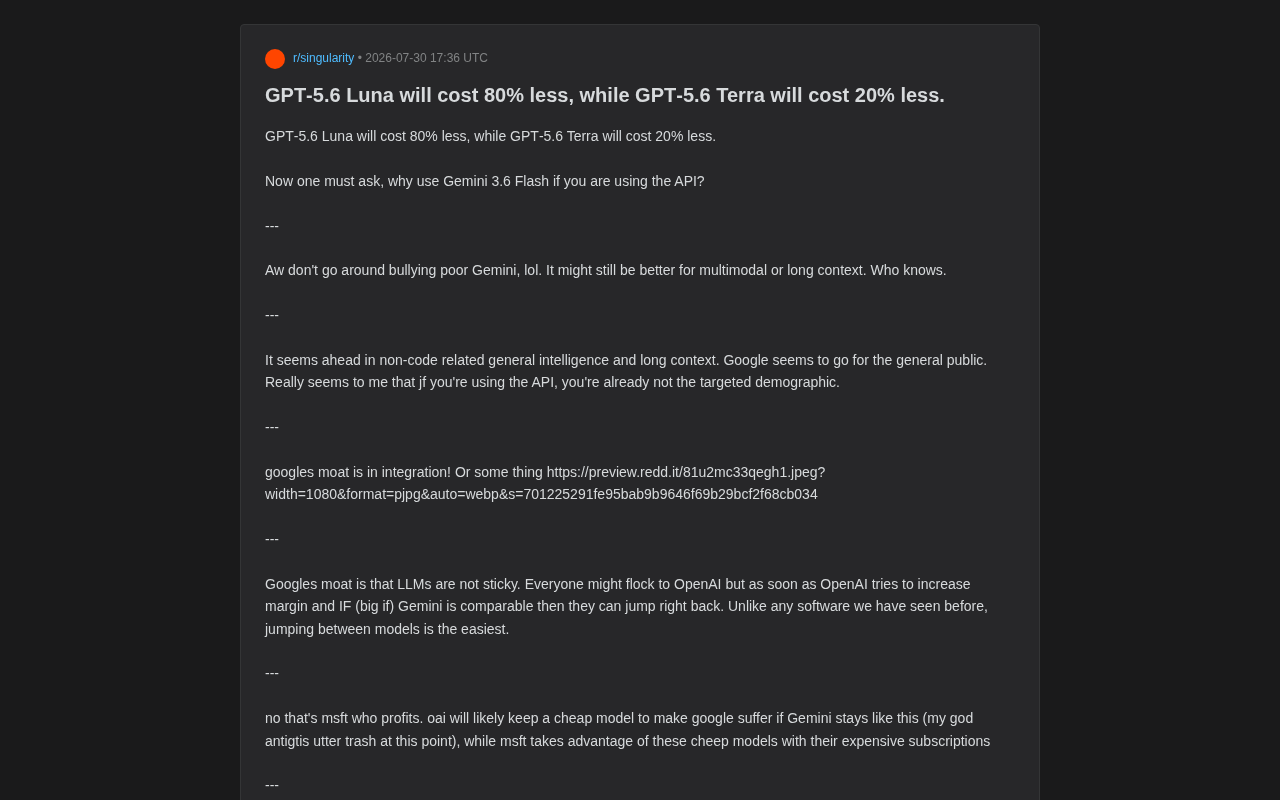
Recently, a post circulating on Reddit sparked widespread discussion among AI practitioners: OpenAI's upcoming GPT-5.6 series will see significant price reductions—the lightweight GPT-5.6 Luna will be priced 80% lower, while the more powerful GPT-5.6 Terra will drop by 20%.
This magnitude of price adjustment is uncommon in the industry. To understand its impact, you need to grasp the basics of API pricing: Tokens are the fundamental unit of measurement for how large language models process text—typically one English word corresponds to about 1-1.5 tokens, while one Chinese character corresponds to roughly 1.5-2 tokens. API pricing is usually calculated per million input/output tokens. For example, GPT-4o is currently priced at $2.5 per million input tokens and $10 per million output tokens. In high-frequency use cases like customer service bots handling tens of thousands of conversations daily, token costs can account for 30%-50% of total operating costs.
For developers relying on API calls, an 80% cost reduction means previously unscalable application scenarios (such as high-frequency calls, extended conversations, and batch content generation) will become economically viable. A business previously spending $10,000 per month might only need $2,000, fundamentally changing the ROI calculation for many projects. The direct effect of this price cut is pulling back a large number of token-cost-sensitive users into OpenAI's ecosystem.
This round of price cuts is widely interpreted as OpenAI launching a direct pricing offensive against competitors—especially Google Gemini. When the price gap is leveled or even reversed, the decision-making logic for developers will fundamentally change.
Can Gemini Flash Still Compete? API Choices After the GPT-5.6 Price Cut
After the news broke, the community posed a cutting question: "If you're using the API, why would you still use Gemini 3.6 Flash?"
Google's Gemini Flash series is a lightweight model designed specifically for low-latency, high-throughput scenarios. Its core technical features include Knowledge Distillation from larger Gemini Pro/Ultra models, and a Sparse Mixture of Experts (MoE) architecture to reduce the actual computation per inference. Typical use cases for Flash models include real-time search summaries, document classification, simple conversations, and other tasks that don't require deep reasoning. Its pricing is typically 1/10 to 1/5 of the same-generation Pro model.
The question behind this reflects the brutal reality of the API market—for developers who rely purely on model capability and pricing, choosing a model comes down to just two dimensions: cost-effectiveness and performance. Once OpenAI matches on price, Gemini Flash's core positioning of "cheap and good" is significantly undermined.
However, some rational voices cautioned against writing off Gemini too soon. Comments pointed out that Gemini may still maintain advantages in multimodal capabilities and ultra-long context processing:
"Gemini seems to be ahead in non-code general intelligence and long context. Google is targeting the mass market—if you're using the API, you were never their target audience."
Multimodal capability here refers to a model's ability to simultaneously process multiple input types including text, images, audio, and video. The Gemini series' advantage stems from Google DeepMind's native multimodal training approach—the model receives multiple modalities of data from the pre-training stage rather than being stitched together later. Regarding long context, Gemini supports context windows of up to 1 million or even 2 million tokens, equivalent to processing roughly 1,500 pages of text at once. This is crucial for scenarios like legal document review, codebase analysis, and long video comprehension. In comparison, GPT-4o's standard context window is 128K tokens—sufficient for most applications but still trailing in ultra-long document processing.
This observation is quite astute: Google's product strategy is fundamentally misaligned with OpenAI's. Gemini is more inclined to reach ordinary users through consumer-grade products (Search, Workspace, Android ecosystem) rather than going head-to-head in the developer API market.
Google's AI Moat: Ecosystem Integration or House of Cards?
The most valuable part of the discussion was the debate about "Google's moat." Participants offered several starkly different assessments.
View 1: The Moat Lies in Product Ecosystem Integration
Some argue that Google's true advantage lies in its massive product ecosystem integration capability—entry points like Gmail, Docs, Search, and Android allow Gemini to seamlessly penetrate the daily workflows of billions of users. This distribution advantage is something OpenAI cannot replicate in the short term.
View 2: LLMs Inherently Lack User Stickiness
Another camp holds a more pessimistic view—they believe LLMs inherently lack user stickiness:
"Google's moat problem is that LLMs are not sticky. People might flock to OpenAI, but the moment OpenAI tries to increase margins while Gemini is close enough (big if), users can switch right back. Unlike any software we've ever seen, switching between models is the easiest thing."
This assertion touches on a core anxiety across the entire AI industry: model migration costs are extremely low. The root cause is the high degree of API interface standardization—currently, major LLM providers (OpenAI, Anthropic, Google, Mistral, etc.) all follow similar RESTful design patterns: send a JSON request containing a system prompt and user message, receive model-generated text in return. Many open-source tools (such as LiteLLM, LangChain) even provide unified interface layers where developers only need to modify a single model name parameter to switch the underlying model.
This stands in stark contrast to traditional SaaS software, which typically involves expensive switching costs like data format migration, employee retraining, and workflow reconstruction. Switching LLMs requires virtually no relearning, involves no data lock-in, and only requires changing a few lines of API configuration. This means no vendor can build lasting barriers through model capability alone—competition ultimately returns to pricing, distribution, and ecosystem lock-in.
Is Microsoft the Real Winner? The Hidden Beneficiary of the AI Price War
Interestingly, the comments also highlighted a frequently overlooked player—Microsoft.
Some argue that the real beneficiary of this price war may not be OpenAI, but Microsoft:
"No, the real beneficiary is Microsoft. OpenAI will likely keep a cheap model around to make Gemini uncomfortable, while Microsoft uses those cheap models paired with their expensive subscription services to pocket the difference."
Microsoft's AI monetization strategy is a classic "infrastructure + application layer" dual-profit model. At the infrastructure layer, Azure provides compute for OpenAI and collects cloud service fees; at the application layer, Microsoft 365 Copilot embeds AI capabilities into Word, Excel, Outlook, and other office suites at $30 per user per month (enterprise edition). The key point is that even as underlying model API costs continue to drop, Copilot's subscription price doesn't decrease proportionally—Microsoft charges a premium for "integration value" and "enterprise compliance guarantees." It's estimated that the underlying model cost for Copilot calls may account for only 5%-15% of its subscription revenue, with the remainder being gross profit.
This analysis reveals a critical distinction in business models:
- OpenAI: Needs continuous cash flow to sustain operations, making it highly price-sensitive;
- Google: AI investment is subsidized by other profitable businesses (advertising, cloud, etc.), enabling a war of attrition;
- Microsoft: Monetizes cheap underlying models by packaging them as enterprise-grade services through high-priced subscription products like Copilot. The lower the model cost, the higher their profit margin.
In other words, even if a price war erupts at the model layer, the upstream application and distribution layers can still maintain considerable profits.
The Rise of Open-Source Models: The Greatest Threat to Closed-Source Pricing Power
The discussion's final focal point turned to a factor that could change the entire landscape—the rise of open-source models.
One comment suggested that as enterprises gain the ability to self-host open-source models (mentioning Kimi-k3 among others), the rationale for paying for closed-source chat services or Claude is weakening:
"In the future, any enterprise will be able to host their own choice of open-source model… at that point, why would you still pay for a chat service or Claude?"
Others pointed out that Microsoft has already moved ahead in this regard, "having integrated GLM," demonstrating an open attitude toward multi-model strategies.
In 2024-2025, open-source large models experienced explosive growth. Meta's Llama 3 series, Alibaba's Qwen series, DeepSeek series, Mistral, and others have approached or matched closed-source model performance across multiple benchmarks. The cost for enterprises to self-deploy open-source models is also dropping rapidly: a single server equipped with 8 H100 GPUs (approximately $300,000) can run a 70B-parameter model, providing unlimited calls for an entire company. For enterprises spending over $50,000 monthly on APIs, self-deployment typically recoups the hardware investment within 6-12 months. Furthermore, inference optimization frameworks like vLLM and TensorRT-LLM have brought open-source model throughput and latency close to commercial API levels, further eliminating the technical barrier that "building your own is worse than paying."
The maturation of open-source models means that model capability is gradually shifting from a "scarce resource" to "infrastructure." When enterprises can deploy open-source models approaching closed-source quality at low cost, the pricing premium for closed-source vendors will be further compressed.
Conclusion: Four Major Industry Trends Behind the AI Price War
Taking it all together, GPT-5.6's price cut is far from a simple price adjustment—it's a signal that the AI industry has entered a phase of mature-stage competition:
- Model capabilities are converging, making price the core competitive lever;
- Migration costs are extremely low, making it difficult for any vendor to lock in users through models alone;
- Ecosystem and distribution are the long-term moats, with Google and Microsoft each positioning accordingly;
- Open-source models are eroding closed-source vendors' pricing power from the bottom up.
For developers and enterprises, this is undoubtedly good news—cheaper, more powerful model choices mean lower barriers to deployment. For vendors, the real battlefield has long since moved beyond model parameters—it's about who can embed AI more deeply into users' work and lives.
Related articles

The Privacy Boundaries of AI Data Collection: Your Bedroom Is Becoming a Model Training Ground
A humorous tweet about clothes entering AI training data reveals the privacy dilemma of AI data collection. We explore machine unlearning challenges, consent issues, and how users can balance convenience with privacy.

LangGraph Studio Hidden Features: Practical Tips for Visually Debugging Agent Workflows
Explore LangGraph Studio's hidden features including time travel debugging, interactive state editing, and human-in-the-loop testing to efficiently debug AI Agent workflows.

Mecanum Wheel Motion Simulation Platform: A Detailed Guide to Low-Cost VR Haptic Solutions
A detailed look at a Mecanum wheel-based omnidirectional motion simulation platform using VR trackers for 3-DOF motion simulation and recentering correction — a viable low-cost VR immersion solution.