GPT Flagship Model Integrates with Codex: A Deep Dive into 750 Tokens/sec Inference Speed

OpenAI's flagship model targets 750 tokens/sec on Cerebras chips as open-source models rapidly close the gap.
OpenAI plans to integrate its top flagship model into Codex, targeting 750 tokens/sec on Cerebras wafer-scale hardware via a sparse MoE architecture. Subscription tiers may shift significantly around July 7th. Meanwhile, Tencent Hunyuan and the MIT-licensed Longcat 2.0 are delivering competitive open-source alternatives, reshaping the AI coding landscape.
Speed and Subscription: A Dual Shift
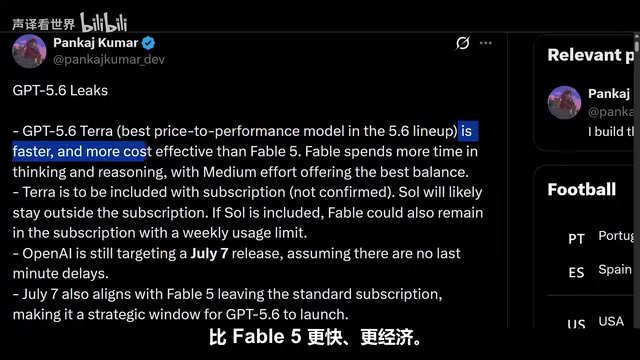
Recently, the Codedigipt channel on Bilibili revealed a major development: OpenAI plans to integrate its latest flagship model (widely speculated to be the top-tier version of its premium series) into the Codex programming environment, targeting 750 tokens per second inference speed on Cerebras chip hardware.
For developers who rely heavily on AI-assisted coding, this isn't just another model upgrade — it could signal a paradigm shift in coding workflows. This article explores three key threads: new model performance and speed, potential changes to subscription tiers, and parallel advances in the open-source ecosystem.
Note: Some figures and architectural details in this article come from community leaks and speculation and have not been officially confirmed. Please use your own judgment.
Leading Benchmarks and Remarkable Inference Speed
According to the leak, the flagship model scored 91.9% on the Dominion Bench benchmark, placing it first and surpassing several Anthropic models.
AI coding benchmarks have evolved rapidly — from early HumanEval (simple function completion) to SWE-Bench (real GitHub issue fixes), then to the more rigorous SWE-Bench Verified and SWE-Bench Pro. Dominion Bench, as a next-generation evaluation framework, focuses on complex, multi-step programming tasks including code comprehension, debugging, and architectural design. It's worth noting that benchmarks carry an "overfitting" risk — vendors may optimize specifically for known test sets, causing scores to diverge from real-world performance. This is why the GLM team's approach of using 270 cross-disciplinary experts for blind real-workflow evaluation is considered more reflective of actual model value than pure benchmark scores.
What truly caught developers' attention, however, is the model's actual speed on Cerebras wafer-scale chips.
Cerebras Systems' Wafer Scale Engine (WSE) is currently the largest single-chip processor in the semiconductor industry. While a typical GPU die is around 800mm², the Cerebras WSE-3 measures 46,225mm², integrating 4 trillion transistors and 900,000 AI-optimized cores. Its key innovation is treating an entire silicon wafer as a single chip, eliminating the PCIe bus bottleneck inherent in traditional multi-chip interconnects. It offers 44GB of on-chip SRAM with 21 PB/s bandwidth — roughly 1,000x faster than GPU HBM memory. This architecture is naturally suited for large model inference: model weights can reside directly in ultra-fast on-chip memory without repeated reads from external DRAM, fundamentally solving the "memory wall" problem — the hardware foundation for achieving 750 tokens/sec.
What does 750 tokens/sec mean in practice? In code generation scenarios, it's nearly instantaneous — like thinking and typing at the same time. Previous Codex models deployed on Cerebras already demonstrated impressive responsiveness. If the flagship version maintains this level, the pain point of "waiting for the model to think" will be largely eliminated.

In stark contrast is another inference model (codenamed Fable). It excels at complex reasoning, but at the cost of extreme latency — according to the leaker's own tests, completing a single task at maximum effort can take nearly two hours of thinking and tool calls. The tradeoff between "instant response" and "slow and thorough" is the central tension defining today's diverging AI coding models.
Architecture Deep Dive: How a Trillion-Parameter MoE Achieves 750 Tokens/sec
Speed is always backed by architecture. The leak cites deep analysis from several community researchers attempting to reconstruct how this speed milestone was achieved.
Sparse Activation in Mixture-of-Experts (MoE)
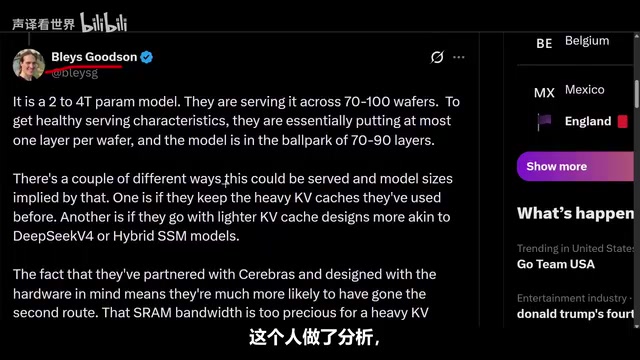
Analysts believe the model is very likely a Mixture of Experts (MoE) model with 2 to 4 trillion total parameters.
MoE is a conditional computation architecture that replaces the feed-forward layers of a neural network with multiple parallel "expert" sub-networks, dynamically selected by a lightweight router network. Top models including GPT-4, Mixtral, and Gemini all use MoE architectures. The key advantage: total parameter count can be massive (boosting model capacity and knowledge), while only a fraction of parameters are activated per inference (reducing compute). In the model described here, total parameters are 2–4 trillion, but only ~150 billion are activated per token — making the actual computation equivalent to a 150B dense model, while retaining the knowledge breadth of a trillion-parameter model. This "sparse activation" property enables MoE to strike an efficient balance between speed and capability, though it introduces engineering challenges around load balancing and routing efficiency.
Despite the enormous total parameter count, only approximately 150 billion parameters are activated per token, dramatically improving inference efficiency through sparse activation — MoE's core speed advantage over dense models.
Layer-per-Wafer Distribution Design
Hardware co-design is equally critical. Analysts speculate the model is distributed across approximately 70 to 100 Cerebras wafer-scale chips, with each chip handling roughly one neural network layer across 70–90 total layers. This "one chip, one layer" layout significantly reduces cross-node communication overhead during inference — and communication latency is one of the primary bottlenecks in large model inference.
Furthermore, OpenAI's deep collaboration with Cerebras may also incorporate a more lightweight KV cache mechanism. KV cache (Key-Value Cache) is one of the most critical optimizations in Transformer inference. During autoregressive generation, each new token requires recomputing the Key and Value matrices in the attention mechanism for all previous tokens. KV caching stores these intermediate results in memory to avoid redundant computation, reducing inference complexity from O(n²) to O(n). However, KV cache memory usage grows linearly with sequence length, potentially consuming tens of gigabytes for long-context tasks. Cerebras's ultra-high-bandwidth on-chip SRAM is well-suited to alleviate this bottleneck, making full use of its fast, relatively inexpensive on-chip memory.
Interestingly, the analyst's confidence in the parameter scale estimate comes precisely from hardware constraints: "750 tokens/sec running on 88 wafer nodes can only hold within a very narrow range of architectures and scales." In other words, the physical limits of the hardware effectively "reveal" the model's approximate size.
July 7th: A Critical Date for Subscription Tiers
If performance is the headline story of this leak, subscription policy changes are the subplot developers should watch most carefully.
The leak repeatedly emphasizes one date — July 7th. According to the source, starting that day, some Anthropic models will no longer be included in standard subscriptions, and users who want continued access may need to switch to API usage-based credit billing. OpenAI, meanwhile, is reportedly planning to launch its new model series on the same date.
This timing "coincidence" has sparked a chain of community speculation:
- The Ultra (top-tier) model will likely not be included in standard subscriptions, or will have its own weekly usage cap;
- The mid-tier, high-value model (codenamed Terra) will likely be included in subscriptions and serve as most users' everyday workhorse;
- Both companies' subscription strategies are in a competitive dance — if OpenAI includes high-end models in subscriptions, Anthropic may be forced to follow suit.
The implication for everyday developers is clear: future AI coding costs will increasingly depend on carefully choosing the right model tier. The blazing-fast top-tier model may come with higher fees or stricter usage quotas, making the value tier the sustainable choice for most use cases.
The Open-Source Push
While closed-source giants battle it out, the open-source ecosystem has been making impressive moves in the same timeframe.
Tencent Hunyuan Series Goes Open Source
Tencent has open-sourced its Hunyuan (HY3) model. On the Hugging Face benchmark comparison page, the model outperforms several competitors on Frontier Science tests and achieves overall performance comparable to the GLM series and high-end Anthropic models. Notably, its parameter count is only around 299 billion (~300B) — far smaller than trillion-parameter models — yet it delivers highly competitive performance.
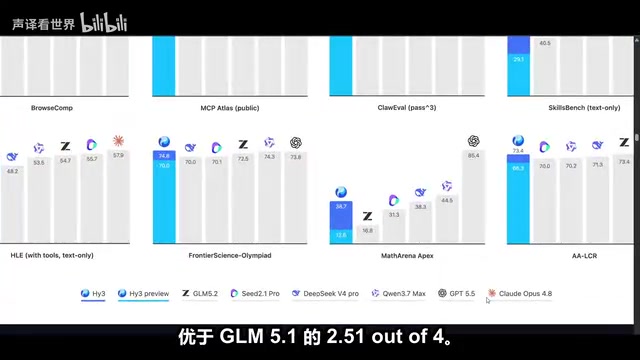
Even the GLM team lead publicly acknowledged this, noting that in a blind real-workflow evaluation involving 270 cross-disciplinary experts, Hunyuan scored 2.67/4 versus GLM's 2.51/4 — making it a strong open-source alternative to top closed-source models. This expert-blind-test methodology is specifically designed to avoid the benchmark overfitting problem mentioned earlier. By having domain experts complete real tasks without knowing which model they're evaluating, it most accurately reflects a model's real-world production value — widely regarded as the closest proxy to actual utility.
Longcat 2.0 Fully Open-Sourced Under MIT License
Another major announcement is that Longcat 2.0 has been fully open-sourced under the MIT license with no additional restrictions.
The choice of open-source license carries significant strategic weight in AI model releases. The MIT license is one of the most permissive, allowing anyone to freely use, modify, distribute, and commercialize the model — with the only requirement being that copyright notices are retained. By contrast, Meta's Llama series uses a custom license with restrictions for commercial applications exceeding 700M monthly active users; some models use CC BY-NC, explicitly prohibiting commercial use. MIT licensing means companies can deploy Longcat 2.0 directly on private servers without paying third parties or reporting usage — particularly valuable for industries with strict data security requirements like finance, healthcare, and government. From a competitive standpoint, open-sourcing a top-tier model under MIT is essentially trading openness for ecosystem influence and the ability to set technical standards — a strategy with the same logic as early Linux and Android.
Longcat 2.0 is a 1.6 trillion parameter MoE model that activates only ~48 billion parameters per inference. It's natively designed for agentic (Agent) scenarios, supports deployment on both GPU and NPU platforms, and integrates directly with mainstream Agent frameworks.
According to its blog, Longcat 2.0 outperforms several closed-source flagship models on SWE-Bench Pro. Agentic tasks have long been a core strength of premium closed-source models. If open-source models can reliably deliver near-top-tier closed-source Agent capabilities, it will once again reshape the competitive landscape.
Conclusion: Speed, Cost, and Openness — A Triple Movement
Taken together, this round of leaks and announcements shows the AI coding space evolving along three parallel trajectories:
- The speed revolution: Leveraging Cerebras wafer-scale chips, 750 tokens/sec is turning "real-time coding" from concept to reality;
- Cost restructuring: Tiered pricing between premium and everyday models is becoming more pronounced — subscription policy shifts are worth monitoring closely;
- Open source closing the gap: Models like Tencent Hunyuan and Longcat 2.0 are rapidly narrowing the distance to closed-source flagships, with smaller parameter counts and more permissive licenses.
For developers, the most rational strategy may be: embrace the efficiency gains promised by top-tier models, stay alert to subscription terms, and keep open-source models as a serious option for cost control and autonomy. In this fast-moving race, the only certainty is change itself.
Related articles

The Truth Behind Codex 'Build a Website in 5 Minutes': AI Isn't Creating Sites—It's Helping You Copy Them
Exposing the truth behind viral Codex 5-minute website videos: creators aren't building original sites with AI—they're copying shared prompts or scraping others' work. Learn AI coding tools' real limits.

Getting Started with AI Agent Development: A Complete Guide from Concept to Practice
A comprehensive guide to AI Agent architecture and development, covering automated marketing, intelligent customer service, and investment analysis scenarios with single and multi-agent collaboration.

The Truth Behind Codex 'Build a Website in 5 Minutes': AI Isn't Creating Sites — It's Helping You Copy Them
Exposing the truth behind viral Codex 5-minute website videos: creators aren't building original sites with AI — they're copying shared prompts or scraping others' work.