GPT Live Full-Duplex, Grok 4.5 Coding, Seedream 5.0 Images: AI Accelerates Across Three Tracks Simultaneously

OpenAI GPT Live, xAI Grok 4.5, and ByteDance Seedream 5.0 Pro launch simultaneously across three AI tracks.
OpenAI launched the full-duplex voice model GPT Live, xAI partnered with Cursor for the coding-focused Grok 4.5, and ByteDance released Seedream 5.0 Pro for image generation. This article analyzes the core capabilities, benchmark performance, and use cases of all three, revealing the real competitive landscape of today's AI model race.
Recently, the AI field has seen a wave of intensive releases: OpenAI launched the full-duplex voice model GPT Live, xAI partnered with Cursor to release Grok 4.5, and ByteDance's Seed team rolled out Seedream 5.0 Pro. These three products compete fiercely across three tracks—voice interaction, reasoning-based coding, and multimodal image generation—signaling that the AI model race is shifting from single-point breakthroughs to a comprehensive, multi-dimensional acceleration.
OpenAI GPT Live: Full-Duplex Architecture Reshapes Voice Interaction
OpenAI's newly launched GPT Live comes in two versions—GPT Live 1 and GPT Live 1 Mini. The core innovation lies in its adoption of a full-duplex architecture—the model can listen and speak simultaneously, completely abandoning the half-duplex mode of traditional voice assistants where "I wait for you to finish before I respond."
The Telecom Origins of Full-Duplex and the AI Implementation Barrier
The concept of full-duplex communication originates from the telecom field, referring to a scenario where both parties can send and receive simultaneously. Its counterpart, half-duplex, requires that when one party is sending, the other can only receive. Notably, the history of full-duplex communication traces back to early 20th-century telephone network design, where engineers achieved bidirectional synchronous transmission over a single copper wire using a Hybrid Coil. This physical-layer signal separation concept has been transformed into a semantic-perception problem for neural networks in AI voice systems—a leap spanning two entirely different technical paradigms: analog signal processing and deep learning.
Traditional voice assistants (such as early Siri and Alexa) were constrained by the serial design of Voice Activity Detection (VAD) and end-to-end speech recognition pipelines, requiring the user to finish an entire sentence before processing and responding. GPT Live's full-duplex architecture means parallel audio stream input and output are implemented at the underlying level, requiring the simultaneous resolution of multiple engineering challenges such as Echo Cancellation, real-time streaming decoding, and low-latency inference. The technical complexity far exceeds a simple "listen while speaking."
Echo Cancellation: From Analog Filters to Neural Networks
Echo cancellation is itself a mature but complex signal processing technology—when a device plays audio and captures sound simultaneously, the microphone picks up the speaker's output, creating echo interference. Traditional solutions rely on Adaptive Filters to estimate and cancel echo signals in real time; in AI voice systems, this process must also work in close coordination with the neural network's streaming inference, placing extremely high demands on the system's overall timing design.
From the analog filters of the telecom era to today's deep-learning-driven Neural Echo Cancellation, this field has undergone decades of evolution. Neural echo cancellation solutions typically feed both the raw near-end microphone signal and the far-end reference signal into the neural network, letting the model learn nonlinear room impulse responses and dynamically estimate residual echo. Compared to traditional adaptive filters, they perform more robustly in non-stationary noise and strong nonlinear distortion scenarios. Embedding this into a real-time AI inference pipeline requires the audio preprocessing, neural network inference, and speech synthesis modules to be strictly aligned within millisecond-level time windows—a genuinely new engineering challenge.
The direct experiential upgrade brought by this architecture is real-time translation and natural interjection capabilities. Users can interrupt at any point during a conversation, and the model responds smoothly. When facing complex tasks, GPT Live automatically delegates the request to more powerful backend models like GPT 5.5, and this entire delegation process does not affect the coherence of the front-facing conversation.
Model Orchestration Architecture: A System Design That Decouples Latency and Compute
This design approach of "low-latency front-end interaction, back-end scheduling of heavy compute" is essentially an AI system Orchestration architecture—analogous to the API gateway pattern in microservices: a lightweight front-end model handles real-time perception of user intent, maintains conversational state, and processes simple requests, while complex reasoning tasks are asynchronously routed to more powerful backend models. This design resolves the fundamental contradiction between large-model inference latency and user experience: models with more parameters generally have higher Time to First Token (TTFT), making them unsuitable for real-time voice scenarios. By layering models and routing tasks, it completely decouples the demands of voice experience from complex reasoning, representing an important evolutionary direction in the engineering of AI products.
Time to First Token (TTFT) and the Deep Mechanics of KV Cache
TTFT is a core metric for measuring large-model inference response speed, referring to the time interval between a user submitting a request and the model outputting its first Token. Factors affecting TTFT span multiple layers, including model parameter count, KV Cache hit rate, batch scheduling strategy, and hardware bandwidth.
KV Cache (Key-Value Cache) is a key mechanism for Transformer inference optimization: during autoregressive generation, generating each new Token requires accessing the attention key-value pairs of all historical Tokens. KV Cache caches these intermediate results in GPU memory to avoid redundant computation, significantly reducing latency in the Decode phase. However, KV Cache's memory footprint grows linearly with sequence length, placing severe pressure on memory capacity in ultra-long context scenarios. For example, with a 70-billion-parameter model optimized with GQA (Grouped Query Attention), processing a 100,000-Token conversation could require tens of GB of KV Cache memory, approaching the available memory limit of a single flagship GPU. This is one of the core contradictions in current inference system optimization, giving rise to a series of engineering innovations such as PagedAttention (virtual memory paging management in vLLM) and KV Cache quantization compression.
For real-time voice scenarios, the industry generally considers an acceptable TTFT ceiling to be around 200-300 milliseconds—beyond this threshold, users perceive noticeable response lag. This is precisely why full-duplex voice systems must use lightweight front-end models: even a quantized and compressed mid-sized model struggles to reliably meet these latency targets in a cold-start state.
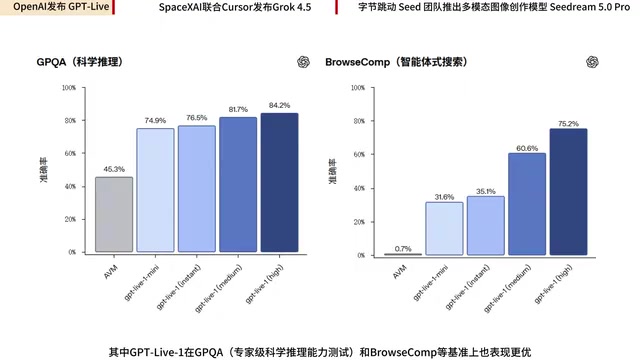
In official comparison tests, both GPT Live 1 and GPT Live 1 Mini significantly outperform the previous Advanced Voice Mode. More notably, GPT Live 1 also leads on reasoning- and retrieval-focused benchmarks such as GPQA and Browse Compound—demonstrating that the new generation of voice models is not just "eloquent" but also possesses solid underlying reasoning capabilities.
Grok 4.5: xAI and Cursor Team Up to Focus on Coding Scenarios
Grok 4.5 was jointly launched by xAI and the Cursor platform, and this combination itself sends a clear positioning signal: deeply serving developers and coding scenarios.
In terms of training scale, Grok 4.5 was trained on tens of thousands of NVIDIA GB300 GPUs, supports up to a 500,000-Token ultra-long context, and natively supports visual input.
The Engineering Significance of Ultra-Long Context and the Evolution of Attention Mechanisms
The Context Window determines the maximum amount of text a model can "see" in a single inference. 500,000 Tokens is roughly equivalent to 400,000 English words, comparable to a medium-sized codebase or hundreds of pages of technical documentation. In software engineering scenarios, ultra-long context enables the model to load an entire project's core files at once, significantly reducing information loss from chunked processing.
However, ultra-long context imposes quadratic growth in computational demands (due to the Transformer attention mechanism's O(n²) complexity), so the deployment of tens of thousands of GB300 GPUs is not mere compute stacking—the NVIDIA GB300 is a flagship compute card in the Blackwell architecture, with up to 288GB of HBM3e memory per card, providing nearly triple the memory capacity of the previous-generation H100, purpose-built for ultra-large-scale AI training and inference. Its fifth-generation NVLink interconnect bandwidth is also substantially improved, effectively alleviating cross-card communication bottlenecks. This further reflects xAI's system engineering capabilities in distributed training and inference optimization.
To alleviate the computational pressure of ultra-long context, the industry is also actively exploring alternative mechanisms such as Sparse Attention, Sliding Window Attention, and linear attention, aiming to reduce complexity from O(n²) to near O(n) while preserving long-range dependency capture. Among them, Sliding Window Attention (first scaled up by models like Mistral) limits each Token to attend only to historical Tokens within a fixed window, trading off ultra-long-distance dependencies for linear complexity. Linear attention rewrites attention computation into a recursive form via kernel function approximation, theoretically achieving true O(n) complexity, but still falls short of standard attention in accuracy on real tasks. Additionally, the Flash Attention series of optimizations significantly improves the practical computational speed of standard attention on long sequences by reorganizing GPU memory access patterns (IO-aware computation) without changing the mathematical definition of attention, becoming a standard base optimization for most current long-context models. Whether Grok 4.5 can maintain high accuracy and acceptable latency in 500,000-Token scenarios will be an important test of its engineering implementation level.
Ultra-long context is crucial for engineering scenarios such as processing large codebases and long-document analysis, while visual input further broadens the applicability boundaries of multimodal tasks.
Benchmarks: Leading Peer Models on Multiple Metrics
Grok 4.5 delivered impressive numbers on several key benchmarks:
- SWE-Bench Pro: 64.7%, surpassing GPT Live 1 and GPT 5.5
- Terminal Bench 2.1: 83.3%, exceeding Opus 4.8
- Deep SWE-Bench 1.0: 62.0%, clearly leading Opus 4.8
SWE-Bench: The Evaluation System Closest to Real Software Engineering
SWE-Bench (Software Engineering Benchmark), jointly launched by Princeton University and the University of Chicago, specifically measures a language model's ability to solve real GitHub Issues—given an open-source project's codebase and a problem description, the model must automatically generate a code patch that passes the test suite. Unlike traditional code completion tasks, SWE-Bench requires the model to possess full-chain engineering capabilities including cross-file understanding, error localization, code modification, and test verification, and is regarded by the industry as one of the evaluation standards closest to real software development scenarios.
SWE-Bench Pro and Deep SWE-Bench are advanced versions, containing more complex multi-file refactoring and system-level debugging tasks with significantly higher barriers. Notably, the validity of SWE-Bench evaluations also continues to face scrutiny: some models may "cheat" by memorizing GitHub commit histories in the training set rather than truly possessing generalized engineering reasoning capabilities. There is also controversy over test cases leaking into training data, prompting researchers to continually introduce new GitHub repository snapshots and stricter data decontamination processes. Some research also points out that models may boost scores through "brute-force testing" strategies (repeatedly generating and running patches until tests pass) rather than truly understanding code logic. This has driven evaluation protocols toward stricter modes such as "single attempt + no execution feedback" to ensure the benchmark's validity and credibility.
Terminal Bench focuses on evaluating a model's ability to complete real operations and scripting tasks in a command-line environment, covering scenarios such as file operations, process management, and network diagnostics, with higher demands on the model's Tool Use and multi-step planning capabilities. Therefore, when interpreting these benchmark results, one must also pay attention to the specific version and evaluation protocol used.
The above benchmarks all focus on software engineering capabilities (SWE stands for Software Engineering), confirming Grok 4.5's comprehensive advantages in code generation, terminal operations, and complex engineering tasks. For AI coding tools like Cursor, integrating a top-tier model specialized in coding can effectively strengthen their core competitiveness.

Pricing and Access Channels
Grok 4.5 is now available on the xAI console, Grok Build, and Cursor platform. In terms of pricing:
- Base model: Input $2 / million Tokens, Output $6 / million Tokens
- Fast variant: Input $4 / million Tokens, Output $18 / million Tokens
Users can also try the command-line tool for free via x.ai/cli. The base model pricing is competitive within its tier, while the fast variant trades higher cost for lower response latency, suitable for speed-sensitive production environments.
The Economics of Inference Pricing: Prefill, Decode, and Speculative Decoding
Large-model API input and output Tokens are typically priced asymmetrically, with output prices generally 3-5 times higher than input. This difference stems from the computational characteristics of the inference phase: input Tokens can be processed in parallel (the Prefill phase), while output Tokens must be generated one by one autoregressively (the Decode phase). The latter consumes far more GPU memory bandwidth than the former and is the primary driver of inference cost.
Specifically, the computational bottleneck in the Prefill phase lies in compute (Compute-bound), which modern GPUs' parallel computing power can handle efficiently. The Decode phase generates only one Token per step with extremely low computational load, shifting the bottleneck to memory bandwidth (Memory-bound)—the GPU must repeatedly read all model weights from memory, causing hardware utilization to drop drastically. This fundamental difference in computational characteristics explains why the marginal cost of output Tokens is far higher than that of input Tokens, and it has also driven the development of new technologies such as Speculative Decoding—using a lightweight Draft Model to quickly predict multiple candidate Token sequences, then having the target large model perform a single parallel verification of the entire sequence, accepting Tokens that conform to the large model's probability distribution and truncating at the first non-conforming one, thereby multiplying the effective parallelism of the Decode phase while guaranteeing equivalent output distribution. Currently, mainstream inference frameworks (such as vLLM and TensorRT-LLM) have adopted speculative decoding as a standard optimization option.
The high premium of the "fast variant" corresponds to dedicated compute resources reserved by inference service providers to guarantee low latency—equivalent to differentiated pricing between general-purpose compute resources and priority resources, essentially a commercialization of Quality of Service (QoS) guarantees.
Seedream 5.0 Pro: Multimodal Image Generation Moves Toward Specialization
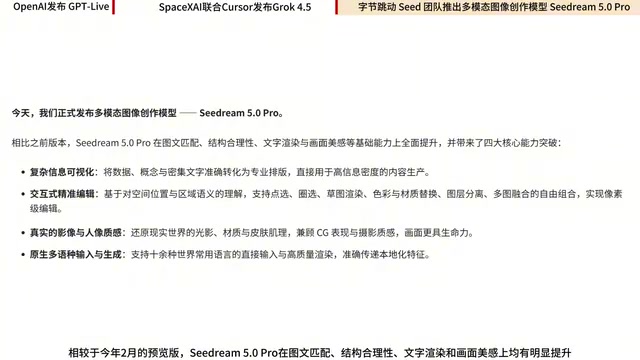
Seedream 5.0 Pro, launched by ByteDance's Seed team, is the flagship product on the image generation track in this round of releases. Compared to the earlier preview version, the official release shows marked improvements across four dimensions: image-text alignment, layout rationality, text rendering accuracy, and overall visual aesthetics.
Four Core Capabilities
Professional Infographic Generation. The model possesses data-logic understanding and layout planning capabilities, and can generate a complete infographic containing charts, multiple text segments, and visual elements in one go, suitable for scenarios such as science illustrations and product spec posters. This means it is no longer merely a "drawing tool" but has acquired a certain degree of design orchestration understanding.
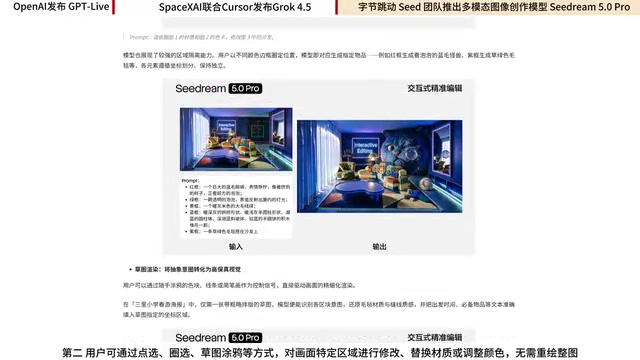
Local Refinement and Layer Operations. Users can modify specific areas of an image by clicking, lasso-selecting, or sketching, replacing materials or adjusting colors without redrawing the entire image. It also supports layer separation and multi-image fusion, making design iteration more free and efficient.
The Technical Path of Local Editing: From Inpainting to ControlNet
Image local editing (Inpainting) is a classic application direction of diffusion models. Early implementations masked the area to be modified and re-diffused, but this often resulted in inconsistencies in lighting and style between the modified area and the original background. Modern solutions introduce mechanisms such as Attention Guidance and Cross-Attention Injection, enabling the model to maintain awareness of global semantics and visual style during local repainting.
Sketch-based interaction further integrates ControlNet-type conditional control frameworks—ControlNet, proposed by Stanford University researchers in 2023, parallels a trainable control branch alongside the UNet structure of the diffusion model, allowing users to constrain the generation direction with structured signals such as edge maps, depth maps, pose skeletons, and even hand-drawn sketches, without modifying the original model weights. This "Zero Convolution" initialization design ensures the control branch does not interfere with the pretrained model's original capabilities in the early stages of training, gradually taking over structural control as training progresses—an exquisitely elegant transfer learning paradigm. ControlNet pushed "controllable generation" from a research concept into a practical tool and laid the foundation for the interaction paradigm of current AI design tools. Seedream 5.0 Pro deeply integrates this kind of control capability with ByteDance's proprietary generation foundation, greatly lowering the barrier to using professional design tools.
Enhanced Photorealistic Reproduction. The model strengthens its reproduction of lighting, materials, and skin textures, producing images closer to real photography, capable of meeting the professional standards of commercial advertising and portrait content.
Native Multilingual Text Rendering. Seedream 5.0 Pro natively supports input and generation in over a dozen languages, with accurate and compliant text rendering.
Text Rendering: A Long-Standing Pain Point of Diffusion Models and a Systematic Effort to Overcome It
Text Rendering has long been a core pain point for Diffusion Models. Its root cause lies in a profound cognitive gap: diffusion models model image generation as a denoising process from noise to pixel distribution—a paradigm naturally suited for generating continuous textures but structurally conflicting with the discrete symbolic nature of text. Text consists of semantic units defined by discrete character rules, whereas the latent space of diffusion models is continuous and unstructured, unable to explicitly encode hard constraints like "this must be the letter A." As a result, models can only learn "the statistical distribution of text appearance" rather than "the discrete symbolic rules of characters." Mainstream image generation models (such as Stable Diffusion and early versions of DALL-E) therefore often produce garbled text, distorted strokes, or spelling errors in generated images.
Solution paths typically include: introducing OCR supervision signals, designing dedicated text layout control modules, and constraining character shapes through conditional control mechanisms such as ControlNet. In recent years, AnyText (Alibaba DAMO Academy) has made significant progress in mixed Chinese-English layout scenarios by introducing text masks, character-level position encoding, and OCR-assisted discriminators; TextDiffuser (Microsoft Research) decomposes the text rendering problem into two stages—layout planning and per-character rendering—effectively improving the overall coherence of multi-line text through a "divide and conquer" approach.
Native support for over a dozen languages means targeted architectural improvements for non-Latin character systems such as Chinese and Arabic—Chinese has tens of thousands of commonly used characters, with glyph complexity far exceeding Latin letters; Arabic has unique rules such as character ligatures and right-to-left writing; scripts like Thai and Hindi have complex diacritical mark systems. This places special demands on the model's character encoding strategy, training data distribution, and layout planning capabilities, and is an important differentiating advantage for Seedream 5.0 Pro in international commercial scenarios.
Industry Observation: The Competitive Logic Behind the Three Main Threads
Examining these three products together, one can clearly see several trends in the current AI race.
Specialized Division of Labor in Capabilities. GPT Live focuses on voice interaction experience, Grok 4.5 targets coding and engineering capabilities, and Seedream 5.0 Pro digs deep into professional image design—each player no longer pursues "big and comprehensive," but instead goes deep and thorough in a specific niche scenario.
Engineering Innovation at the Architectural Level. GPT Live's full-duplex architecture and task delegation mechanism, and Grok 4.5's 500,000-Token ultra-long context, both reflect that model design is shifting from merely stacking parameter counts to fine-grained engineering optimization.
Clarity in Deployment Scenarios. Whether it's Cursor's deep coding integration or Seedream's design positioning for commercial advertising and infographics, both show that vendors are increasingly valuing the practical productivity value of models rather than simply competing on benchmark scores.
It should be noted that some of the model names and version information in this article (such as GPT 5.5, Opus 4.8, etc.) come from media reports, and readers are advised to refer to each vendor's official announcements before actual use. Overall, this round of intensive releases once again confirms the continued acceleration of the AI model iteration pace—the competitive landscape across the three main threads of voice, coding, and images is worth long-term attention.
Related articles

The Truth Behind Codex 'Build a Website in 5 Minutes': AI Isn't Creating Sites—It's Helping You Copy Them
Exposing the truth behind viral Codex 5-minute website videos: creators aren't building original sites with AI—they're copying shared prompts or scraping others' work. Learn AI coding tools' real limits.

Getting Started with AI Agent Development: A Complete Guide from Concept to Practice
A comprehensive guide to AI Agent architecture and development, covering automated marketing, intelligent customer service, and investment analysis scenarios with single and multi-agent collaboration.

The Truth Behind Codex 'Build a Website in 5 Minutes': AI Isn't Creating Sites — It's Helping You Copy Them
Exposing the truth behind viral Codex 5-minute website videos: creators aren't building original sites with AI — they're copying shared prompts or scraping others' work.