GPT Live Launches: Voice Is Becoming the New Gateway to AI Interaction

OpenAI's GPT Live signals a shift from typed input to real-time voice as the primary AI interface.
OpenAI released GPT Live, a next-generation voice model powering ChatGPT Voice interactions. This piece explores the key technical challenges of real-time voice AI — including latency, interruption handling, and streaming inference — and argues that the AI interaction paradigm is shifting from keyboard input toward natural, phone-call-like conversation.
From Typing to Talking: A Paradigm Shift in How We Interact with AI
OpenAI recently released a next-generation voice model called GPT Live, which the company says has begun powering the conversational experience in ChatGPT Voice. Based on observations of OpenAI's official RSS feed, this release is categorized under "Product," with the summary explicitly pointing toward "more natural human-AI voice interaction."
The significance of this update isn't just that there's another model name to remember — it's that the primary interface for AI interaction is shifting from typing to real-time voice. This is a directional signal: where we once relied on keyboards to communicate with AI, the future may increasingly resemble a phone call.
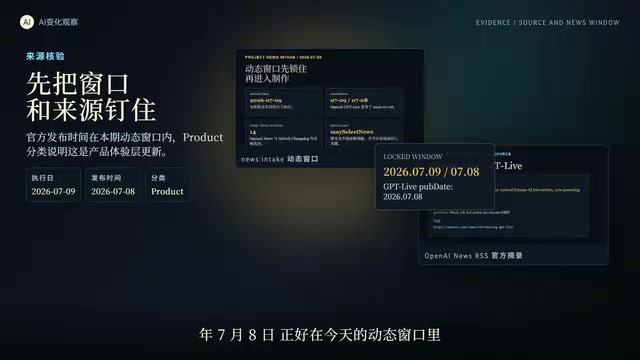
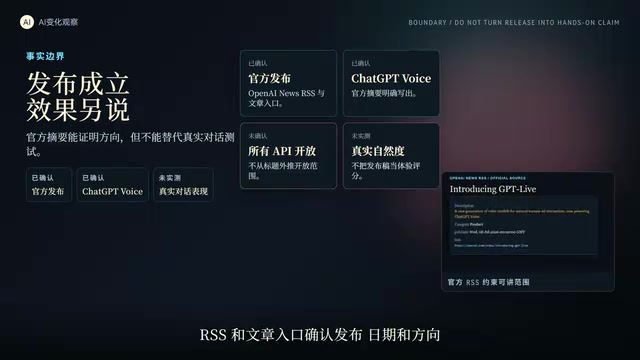
A note of caution: what can be confirmed right now is limited to the product direction disclosed through OpenAI's official RSS feed. Specific performance details for GPT Live — including whether a fully open API is available — have not been verified. This article makes no claims about actual conversation quality, nor does it describe the product as "fully available to the public."
What Makes Voice AI Hard: Latency, Interruptions, and "Keeping Up"
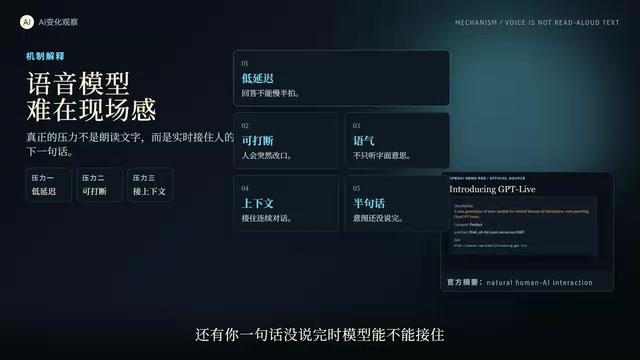
Many people assume voice AI simply means "reading text aloud," but the reality is far more complex. Truly natural real-time voice interaction requires solving a series of difficult engineering and experience challenges.
Architectural Evolution: From Cascaded to End-to-End
Traditional voice AI systems typically use a "cascaded" architecture: Automatic Speech Recognition (ASR) → Natural Language Processing (NLP) → Text-to-Speech (TTS), with each component running independently. Errors compound at every stage, and latency accumulates along the way. The new generation of voice models that GPT Live represents is moving toward an "end-to-end" architecture — the model processes audio input directly and outputs audio, bypassing intermediate text conversion. This dramatically reduces latency while preserving nuances from the original audio — tone, pauses, and emotional inflection — details that are often permanently lost during transcription.
It's worth noting that voice interaction is not a new arena. Siri (2011), Google Assistant, and Amazon Alexa formed the first wave of intelligent voice assistants, but they were fundamentally "command-response systems" — good at executing explicit instructions like "set an alarm for 8 AM tomorrow," but ill-suited for open-ended conversation. GPT-4o, released by OpenAI in 2024, was the first to demonstrate low-latency, emotionally aware real-time voice conversation, generating widespread excitement. GPT Live can be seen as a continuation of that trajectory — a leap from "functional" to "natural" — while competitors including Google's Gemini Live and various open-source models with expanding voice capabilities are racing in the same direction.
Latency and Real-Time Responsiveness
When typing, we can organize our thoughts slowly and revise as we go. Voice conversation is different — it's real-time, and even slight delays make an exchange feel awkward. A model must understand and respond within an extremely short window to maintain a natural conversational rhythm. Research shows that the normal turn-taking gap in human conversation is around 200 milliseconds — an exceedingly demanding benchmark for AI systems.
Handling Interruptions and Tone
In real conversations, people frequently interrupt, add to, or correct themselves mid-sentence. This relies on a critical underlying technology called Voice Activity Detection (VAD), which determines whether the user is still speaking. Early systems relied on fixed silence thresholds, often mistaking a brief thinking pause for the end of a turn, or misreading background noise as valid input. Modern systems combine semantic understanding with acoustic features to more accurately identify the right moment for a turn transition. Interruption handling goes a step further — it requires the model to immediately stop its output and shift its response state the moment it's cut off, rather than mechanically continuing with its previous logic. This is an enormous engineering challenge for the real-time scheduling of an inference engine.
The Ability to "Pick Up" Incomplete Thoughts
The most demanding scenario is this: before you've finished your sentence, can the model already grasp what you mean? This depends on Streaming Inference and predictive context modeling — the model doesn't wait for a complete sentence to end, but continuously updates its semantic understanding as the audio stream arrives, predicting the most likely direction of intent. It's similar to a skilled stenographer who starts writing before the speaker finishes. Achieving this requires a delicate balance between "uncertainty" and "response speed" — too aggressive and the model will frequently interrupt at the wrong moment; too conservative and it falls back into that familiar, awkward delay. As the source material puts it: "When a voice conversation gets awkward, both sides just have to endure it" — a stark contrast to the forgiving, edit-as-you-go experience of typing.
GPT Live vs. Developer Tool Updates
Within the same timeframe, GitHub Copilot also released its June update for VS Code — but that read more like a feature checklist aimed at a relatively niche developer audience.
GPT Live has a much broader potential impact, because it touches on the fundamental question of how everyday users "talk" to AI. Voice is a lower-barrier, more universal mode of interaction — roughly one billion people worldwide have difficulty reading or typing, and for this group, voice interaction is nearly the only accessible AI interface. Improvements here carry far more significance for the general public than incremental feature updates to professional tools.
A Trend to Watch: AI Interfaces Will Increasingly Feel Like Phone Calls
Based on this release, a trend worth following closely is: the next phase of AI interaction will look less like filling out a form and more like making a phone call.
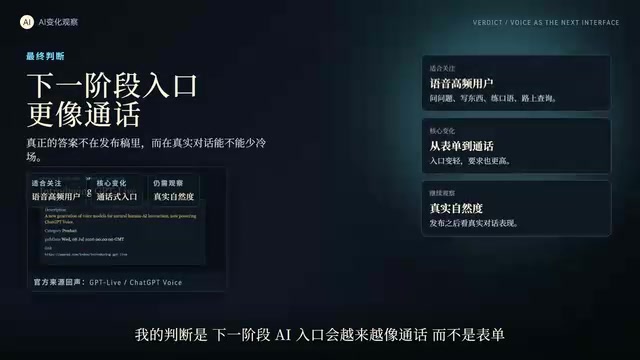
If this holds true, the following types of users should pay close attention to GPT Live's development:
- People who frequently use voice for questions or dictation: voice input could dramatically boost productivity
- Users looking to practice spoken language: real-time conversation is an ideal language-training environment
- Hands-free scenarios like driving or commuting: voice-based information queries will become a genuine necessity
How to Tell If It's "Actually Natural"
One final note: don't rely on the wording in the press release. Official copy will always use phrases like "more natural" to describe a product — but the real test is whether it reduces awkward silences and keeps up with what you're saying in actual use. There are a few actionable dimensions for evaluating voice AI quality: whether the first-response latency is under 500 milliseconds, whether it correctly handles mid-sentence pauses without cutting you off prematurely, and whether recognition accuracy holds up in noisy environments. These questions can only be answered through hands-on experience — not by reading a product launch page.
As AI interaction methods evolve rapidly, GPT Live may mark the beginning of a new phase. But staying grounded, keeping a rational perspective, and waiting for real-world feedback remains the most reliable approach to evaluating products like this.
Key Takeaways
Related articles

AI Art Prompt Structure Breakdown: Creating a Desert Crystal Pyramid Scene
Breaking down a popular Reddit AI artwork to reveal the five core elements of structured prompts: subject, material, lighting, environment, and atmosphere for AI art scene creation.

$100 Million Deal: AI Gives 50,000 Ukrainian Kamikaze Drones Autonomous Target Lock
A U.S. company struck a $100M deal with Ukraine to deploy AI visual lock-on capabilities on 50,000 cheap kamikaze drones, enabling terminal autonomous guidance to defeat electronic warfare jamming.

The Privacy Boundaries of AI Data Collection: Your Bedroom Is Becoming a Model Training Ground
A humorous tweet about clothes entering AI training data reveals the privacy dilemma of AI data collection. We explore machine unlearning challenges, consent issues, and how users can balance convenience with privacy.