GPT Live Real-Time Translation Tested: What Does It Mean for Simultaneous Interpreters?

GPT Live's full-duplex real-time translation puts simultaneous interpreter jobs under pressure.
OpenAI's GPT Live voice model achieves true full-duplex simultaneous translation — streaming English output before the Chinese speaker finishes — without relying on traditional ASR/MT/TTS pipelines. This end-to-end approach represents a potential disruption to the simultaneous interpretation profession, though real-world limitations in specialized terminology and complex audio scenarios mean human interpreters still hold an edge in high-stakes settings.
One Demo, Shaking a High-Paying Profession
Simultaneous interpretation has long been considered the "income ceiling" for foreign language professionals — top interpreters can earn thousands of yuan per hour, and demand consistently outstrips supply. Its steep barriers to entry and extreme scarcity have kept it firmly at the top of the language services pyramid.
Simultaneous Interpretation (SI) is the most demanding form of interpreting. Practitioners must listen to the source language while continuously delivering the target language output — maintaining a 3–5 second "Ear-Voice Span." This skill requires years of specialized training, and top interpreters typically graduate from a handful of elite institutions such as the École de Traduction et d'Interprétation (ETI) in Geneva or the Middlebury Institute of International Studies at Monterey. The International Association of Conference Interpreters (AIIC) is the field's most authoritative certifying body, with fewer than 3,000 members worldwide. The cognitive load is so intense that interpreters typically work in pairs, rotating every 30 minutes or less. These sky-high barriers and extreme scarcity have allowed simultaneous interpreters to command a sustained premium.
Now, OpenAI's GPT Live voice model is cracking that once-solid wall.
According to a hands-on demonstration by Bilibili creator "正在搞AI达图," GPT Live's real-time translation capability is compelling enough to make people question the very necessity of the simultaneous interpreter profession.

The creator's verdict was blunt: "Simultaneous interpreters charge thousands per hour — the moment GPT Live drops, it's going to wipe out that profession entirely." That may be an overstatement, but the underlying technological trend is something every professional in the field should take seriously.
The Core Breakthrough: True Full-Duplex Real-Time Translation
Previous machine translation — whether text or voice — was fundamentally "turn-based": finish a sentence, pause, wait for output, then continue. This works tolerably in casual conversation, but in high-stakes settings like professional conferences or live negotiations, even a fraction of a second of lag can severely disrupt the flow of communication.
English Output Flowing Before the Chinese Is Even Finished
What makes GPT Live most striking is precisely that it breaks the traditional "translate sentence by sentence" model.
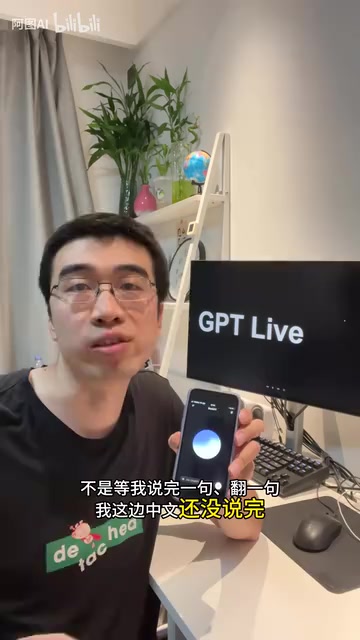
In the demo, English translation was already streaming out before the speaker had finished their Chinese sentence. This ability to "listen and speak simultaneously" is technically known as Full Duplex.
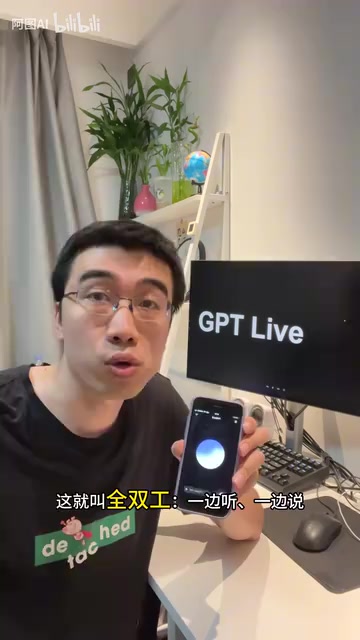
The term full duplex originates from communications engineering, referring to simultaneous two-way data transmission — as opposed to half duplex (like a walkie-talkie, where one side must stop transmitting before the other can speak). Achieving full duplex in an AI voice system poses enormous engineering challenges: the system must continuously receive and process incoming audio while simultaneously outputting audio, and it must solve echo cancellation to prevent the model from treating its own output as new input. Traditional voice assistants (like early Siri and Alexa) were all half-duplex by design, requiring users to wait for the system to finish before speaking. OpenAI first announced true real-time full-duplex voice interaction with the release of GPT-4o — a significant architectural breakthrough in the large language model space.
Full duplex means the model can simultaneously handle both input and output channels — continuously receiving and understanding the incoming source-language audio stream while generating target-language translation in real time. This is exactly the core skill of human simultaneous interpreters: maintaining a continuous 3–5 second lag between hearing and speaking, with no pauses from the speaker. GPT Live replicates this process directly through model capability.
End-to-End Model vs. Engineered Pipeline: Two Very Different Approaches
What's most thought-provoking about this release isn't just the simultaneous interpretation capability itself — it's how it's achieved.
For years, real-time speech translation has been a domain where specialized companies poured enormous engineering resources. It required chaining together Automatic Speech Recognition (ASR), Machine Translation (MT), and Text-to-Speech (TTS) modules in series, with extensive tuning for latency, sentence segmentation, and contextual consistency — just to get close to practical usability.
The core problem with this traditional pipeline architecture is error propagation — recognition errors in one module get amplified by downstream modules rather than corrected. Additionally, data format conversions and network calls between modules introduce non-trivial cumulative latency, typically on the order of 1–3 seconds. More importantly, the intermediate text representation discards paralinguistic information from the original speech — tone, pauses, stress — causing translations to lose emotional nuance.
OpenAI's approach is fundamentally different — as the video put it: "What private companies have spent years engineering, OpenAI just knocked out as a side effect of raw model capability."
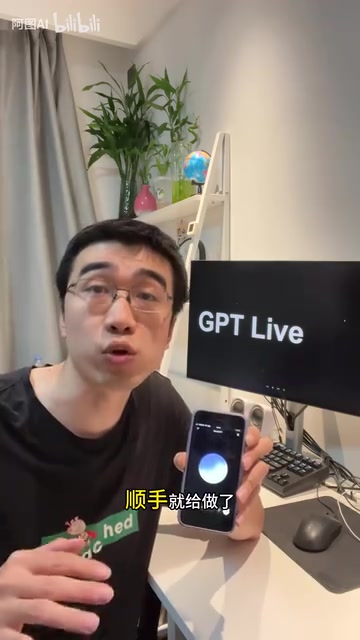
This is the classic end-to-end large model philosophy: rather than decomposing the task into independent modules, a unified multimodal model handles the entire process from speech input to speech output. By processing audio-to-audio mapping directly through a single neural network, the end-to-end model fundamentally sidesteps all the issues of the pipeline approach — and allows translations to better preserve the speaker's tone, intonation, and contextual meaning.
The Logic Behind AI "Incidentally" Disrupting an Industry
One observation from the video is particularly striking: GPT Live was never specifically designed for the simultaneous interpretation market. It's simply a byproduct of a general-purpose voice model — yet it has incidentally placed this high-paying profession in jeopardy.
This is precisely the most disruptive characteristic of the general-purpose large model era: capability spillover. This phenomenon has an academic counterpart — "Emergent Abilities," systematically described by a Google Research team in their 2022 paper Emergent Abilities of Large Language Models. The research found that when model scale crosses certain thresholds, certain capabilities jump suddenly from near-zero to significant levels — rather than growing linearly with parameter count. This means these capabilities are not explicitly trained in, but emerge spontaneously as byproducts of training on massive data. Simultaneous interpretation capability likely falls into this category: GPT-4o was not specifically optimized for SI scenarios, but its combined strengths in speech comprehension, cross-lingual semantic mapping, and real-time generation naturally produced performance approaching professional SI.
When a sufficiently powerful general-purpose model arrives, it typically isn't designed for any specific vertical — yet the capabilities that emerge from it can sweep through multiple specialized domains. Translation, writing, programming, customer service... these formerly distinct professional moats are being broken down one by one, almost as an afterthought of general-purpose models. This pattern of "byproduct disruption" will become increasingly common in the large model era, and it's the fundamental reason why its impact on vertical industries is so hard to anticipate or defend against.
What does this mean for the simultaneous interpretation industry? In the near term, AI likely cannot fully replace top-tier interpreters who handle culturally nuanced, terminology-heavy, high-stakes scenarios requiring real-time judgment. But for the large volume of mid-to-low-end, standardized translation needs — business meetings, travel accompaniment, online communication — AI's cost advantage and on-demand availability will be overwhelming.
A Measured View: Technical Promise and Real-World Limits
Worth noting: this analysis is primarily based on a single Bilibili creator's demonstration experience, and lacks cross-validation from independent sources. Demo results tend to be carefully curated; performance in genuinely complex real-world scenarios remains to be seen. Several dimensions in particular warrant ongoing scrutiny:
- Specialized terminology accuracy: Performance in highly technical fields like medicine, law, and finance
- Robustness to complex speech: Recognition quality with heavy accents, dialects, and overlapping multi-speaker conversations
- Long-session context consistency: Whether terminology and proper nouns remain consistent across extended meetings
- Real-world network latency impact: How stable real-time performance is across different network conditions
For these reasons, "wiping out simultaneous interpreters" is more of a directional forecast than a present-day fait accompli. A more rational prediction: AI will first take over standardized, low-error-tolerance translation scenarios, pushing practitioners to migrate toward higher-value work that requires human judgment.
Closing: Not an Ending, But a Reshaping
The emergence of GPT Live is less the end of simultaneous interpretation than the beginning of its redefinition. The role of language as a bridge for communication isn't going away — but the way that bridge gets built is being completely rewritten.
For everyday users, this is an exhilarating era — the barriers to cross-language communication are dropping at a visible pace. For professional interpreters, it's a serious challenge, but also an opportunity to move up the value chain and proactively embrace AI tools.
What would you use GPT Live for? Hidden within that question may be the answer to the next wave of productivity transformation.
Key Takeaways
Related articles

The Truth Behind Codex 'Build a Website in 5 Minutes': AI Isn't Creating Sites—It's Helping You Copy Them
Exposing the truth behind viral Codex 5-minute website videos: creators aren't building original sites with AI—they're copying shared prompts or scraping others' work. Learn AI coding tools' real limits.

Getting Started with AI Agent Development: A Complete Guide from Concept to Practice
A comprehensive guide to AI Agent architecture and development, covering automated marketing, intelligent customer service, and investment analysis scenarios with single and multi-agent collaboration.

The Truth Behind Codex 'Build a Website in 5 Minutes': AI Isn't Creating Sites — It's Helping You Copy Them
Exposing the truth behind viral Codex 5-minute website videos: creators aren't building original sites with AI — they're copying shared prompts or scraping others' work.