Graphify Knowledge Graph Tool Deep Dive: Is Giving AI Coding Assistants a "God's Eye View" Actually Worth It?
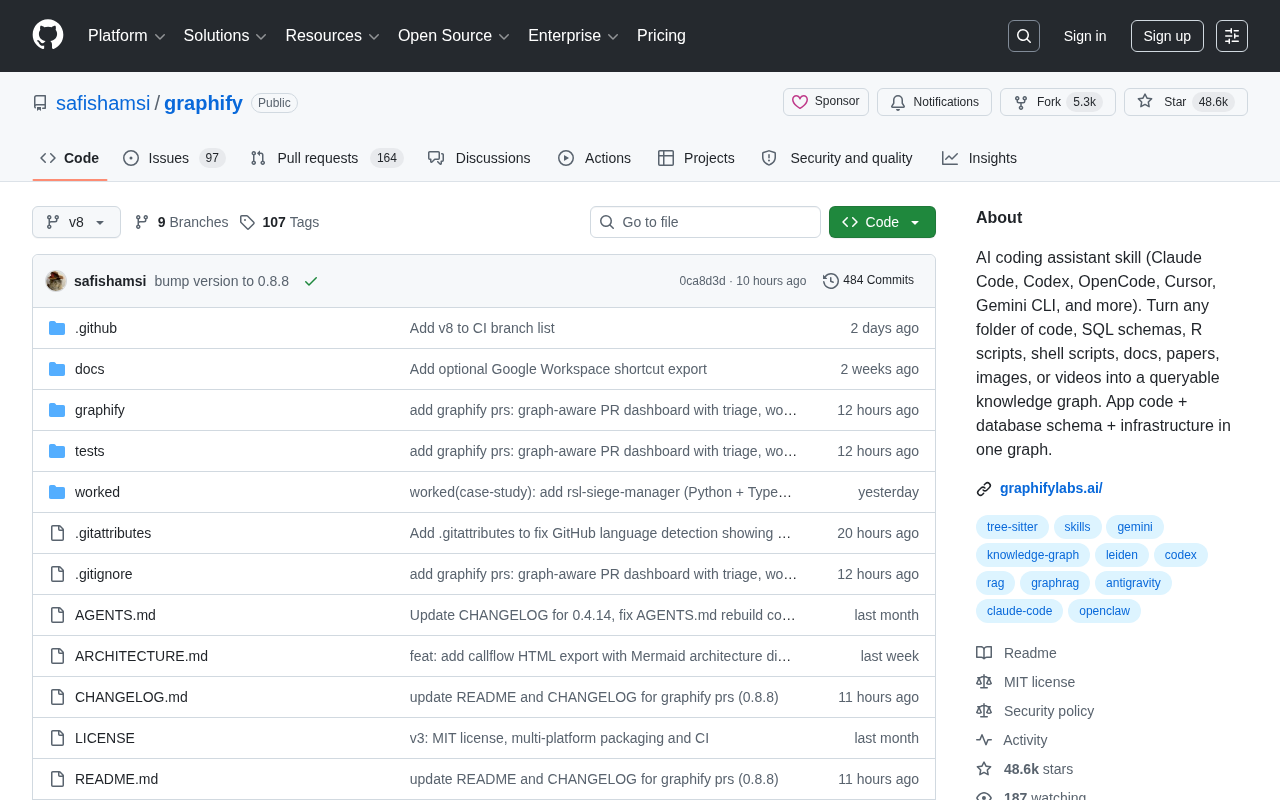
Graphify builds queryable knowledge graphs from your codebase to give AI coding assistants a full-project view.
Graphify is a rapidly rising open-source project that converts codebases, SQL schemas, docs, and more into a unified knowledge graph for AI coding assistants like Claude Code and Cursor. This deep dive explores how it addresses AI context limitations, its modular "skill" design philosophy, and three key concerns around graph freshness, input breadth, and abstraction risks.
Graphify Knowledge Graph Tool Deep Dive: Is Giving AI Coding Assistants a "God's Eye View" Actually Worth It?
Graphify is an open-source project that recently exploded on GitHub, racking up 41,000+ stars in a short period of time. What it does is deceptively simple — it converts your code folders, SQL schemas, documentation, and even videos into a queryable knowledge graph, then feeds that graph to AI coding assistants like Claude Code, Cursor, and Gemini CLI. It sounds great on paper, but does it actually solve real problems?
The Biggest Pain Point for AI Coding Assistants: No View of the Big Picture
Anyone who has used Claude Code or Cursor knows the feeling: the AI performs well on individual files, but the moment it faces a large codebase, it starts "feeling around in the dark." It can only see a limited file window at a time and lacks any systematic understanding of the project's overall architecture.
Ask it to modify a cross-module feature, and it might update file A while completely missing a dependency in file B. Ask it to optimize a database query, and it may have no idea how the tables are even related to each other.
This isn't a matter of the AI model being insufficiently intelligent — it's a matter of the AI's "view of the world being incomplete."
Graphify's Approach: Using a Knowledge Graph to Restore the AI's Vision
Graphify's core idea is remarkably precise — it doesn't try to optimize the AI's reasoning ability; it optimizes the AI's "eyesight."
Specifically, Graphify can weave the following inputs into a single semantic network:
- Application code: Code folders in any language, with parsed relationships between modules, functions, and classes
- Database schemas: SQL table structures, foreign key relationships, and index designs
- Infrastructure configs: Deployment scripts, shell scripts, and environment configurations
- Documentation and papers: Project docs, technical specs, and research papers
- R scripts: Data analysis code
- Even images and videos: More on this below
Once all of this information is integrated into a unified knowledge graph, AI coding assistants can query it to quickly understand things like "who calls this function," "which services are associated with this table," or "which deployment pipelines does this config file affect."
In short, Graphify gives the AI a panoramic map of the entire project.
"Skills" Not "Tools": A Design Philosophy Worth Noting
One of the most interesting things about Graphify is how it positions itself — not as a standalone tool, but as a "skill module" that can be invoked by multiple AI assistants.
Currently supported AI coding assistants include:
- Claude Code
- OpenAI Codex
- OpenCode
- Cursor
- Gemini CLI
- And more
This design aligns with the broader trend of AI toolchains moving toward modularity and composability. You don't need to switch AI assistants — you just "install" the Graphify skill on top of your existing one, and it gains knowledge graph query capabilities.
If executed well, Graphify has the potential to become an "infrastructure-level" component in the AI coding ecosystem — much like LSP (Language Server Protocol) is to code editors: a foundational, general-purpose capability layer.
Let's Be Realistic: Three Concerns That Need to Be Addressed
The 41,000+ stars signal that the developer community strongly resonates with this direction — but popularity doesn't equal maturity. There are a few issues that deserve honest scrutiny:
1. Keeping the Knowledge Graph Fresh
Code is alive. Every commit can make the graph stale. A function gets renamed, a table gets a new column, a microservice gets split apart — can these changes be synced to the knowledge graph accurately and in a timely manner?
The reliability of incremental updates directly determines the real-world viability of this tool. If a full rebuild is required every time, the cost of using it on large projects becomes prohibitive. And if incremental updates are inaccurate, a stale graph could actively mislead the AI.
2. Trying to Do Everything Might Mean Doing Nothing Well
From code to SQL schemas to shell scripts to academic papers to videos — Graphify's supported input types are wildly ambitious. But breadth is often the enemy of depth.
Parsing dependency relationships in Python code and parsing the knowledge structure of an academic paper are entirely different levels of technical challenge. Whether the parsing quality for each input type can reach production grade is still an open question.
3. The Risk of Abstraction Leakage
At its core, Graphify adds an intermediate layer between the AI assistant and the codebase. An intermediate layer implies abstraction, and abstraction implies the potential for distortion.
The most dangerous scenario: when the graph's understanding diverges from the actual semantics of the code, the AI may make more confident — but more dangerous — decisions based on a flawed global understanding. Without a graph, the AI at least knows it "can't see clearly" and tends to be cautious. With an inaccurate graph, the AI might instead "confidently make mistakes."
The Direction Itself Is Right
Despite these concerns, the direction Graphify is pursuing is fundamentally sound. The next breakthrough for AI coding assistants will most likely not come from the models themselves, but from giving models access to more complete and more structured contextual information.
Knowledge graphs are currently one of the most promising approaches for this. They offer more semantic depth than simple file indexing, more structure than full-codebase embeddings, and are easier to keep up to date than hand-written project documentation.
Graphify is built in Python and the project itself is open source. Developers who are curious can head directly to the GitHub repository to explore the source code and documentation.
The next bottleneck in AI-assisted programming isn't that the models aren't smart enough — it's that the world they see isn't complete enough. Whoever can give AI an accurate map will hold the keys to the next generation of developer tools.
Related articles
Deep Dive into AI Agent Skill Design: …
Deep Dive into AI Agent Skill Design: Engineering Practices from Anthropic and Perplexity
A deep dive into Skill design philosophy from Anthropic's Claude Code team and Perplexity's Agent team, covering the Tax Test, Gotchas Flywheel, progressive disclosure, and Eval-First practices for building high-quality AI Agent skill systems.
Deep Dive into OpenAI's Official GPT-5…
Deep Dive into OpenAI's Official GPT-5.6 Prompting Guide: The Shift from Manual to Automatic
A deep dive into OpenAI's official GPT-5.6 Sol prompting guide: conciseness-first, outcome-oriented design, autonomy boundaries, tool routing, and reasoning intensity tuning.
 Deep Dives
Deep Dive into How OpenClaw (Open-Source Crayfish) AI Agent Works
Deep analysis of OpenClaw AI Agent internals: System Prompt, tool calling, SubAgents, Skill system, memory, and Context Engineering explained.