Grok CLI + Fish Audio in Practice: Building a Full-Stack AI Voice Studio at Zero Cost

Build a full-stack AI voice studio in 42 minutes using Grok CLI, Fish Audio's free TTS API, and DeepSeek.
Fish Audio's free S2.1 Pro TTS API (83 languages) and Grok CLI's Composer 2.5 model together enable rapid full-stack AI development. Creator KatKat built Voxweaver Studio — a multi-character dubbing app with persistent voice cloning — in 42 minutes using just 14% of a SuperGrok monthly quota, demonstrating a practical planning-coding-review workflow with GPT-5.5, Composer 2.5, and Codex.
Combining a Free TTS API with AI-Assisted Development
Fish Audio recently opened its text-to-speech (TTS) API to developers at no cost — the S2.1 Pro model, supporting 83 languages including Chinese. The terms are fairly generous: no hard character limit, governed only by a fair-use policy, with free access extended through the end of July.
TTS technology has evolved through three generations: concatenative synthesis, parametric synthesis, and today's end-to-end neural synthesis. Modern TTS systems like Fish Audio S2.1 Pro are built on joint training of large language models and acoustic models, capturing fine-grained features like intonation, rhythm, and emotion to produce near-human-quality speech. S2.1 Pro's support for 83 languages relies on multilingual phoneme systems and cross-lingual transfer learning, allowing a single model to maintain consistent audio quality across different languages.
According to analysis by Bilibili creator KatKat, S2.1 Pro currently ranks 14th on the Artificial Analysis TTS leaderboard. While models like Google Flash and Alibaba Tongyi TTS rank higher, Fish Audio's biggest advantage is that it's completely free right now — making it ideal for developers building prototypes and exploring capabilities.
Even more noteworthy: the creator used Grok CLI (Grok Build) with the Composer 2.5 model to build an open-source AI audio studio from scratch — Voxweaver Studio — combining Fish Audio with DeepSeek. This article breaks down the entire workflow, from requirements planning to AI-powered coding.
Voxweaver Studio: A Full-Featured AI Voice Studio
At its core, this open-source project is a WebUI that integrates Fish Audio's TTS capabilities with DeepSeek's text optimization, forming a complete audio production workflow.
Multi-Character Voice Dubbing Workflow
The app's main page is the "Multi-Character Studio." Users enter text, select DeepSeek's Pro or Flash model, click "AI Split by Character," and the system automatically divides the text into narration and individual character lines, annotating each with its own style.
One practical engineering detail worth noting: during testing, the creator found that both Flash and Pro models occasionally dropped a small passage during character decomposition. To address this, a dedicated "AI Review" step was added to perform a second pass after character splitting, ensuring content completeness.
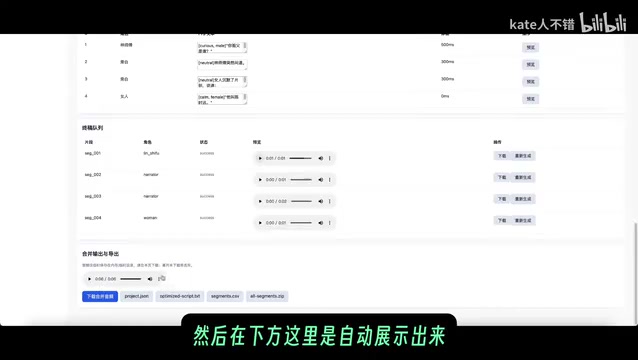
After splitting, users move to voice selection. Sample text is auto-generated by AI; users can preview it, regenerate it, and once satisfied, "lock it as the character's voice." Clicking merge displays previews of each audio segment at the bottom of the page, with options to regenerate or download individual clips, or download the full merged audio in one click.
Voice Library and Persistent Cloning
The "Voice Library" on the left side of the app is a key design element. Voices locked for specific characters are saved here, each with a reference ID. As long as you remember the ID, you can reproduce the exact same voice in future sessions — solving the core challenge of voice consistency in multi-character dubbing.
Voice cloning refers to extracting a speaker's vocal characteristics from a small number of audio samples and reproducing their voice. Modern approaches (including the one Fish Audio uses) typically employ a speaker encoder to map a voice into a high-dimensional embedding vector, which is then injected during TTS decoding to control voice output. A reference ID is essentially a server-side persistent index for this embedding vector, allowing developers to reliably reproduce the same voice using just the ID — without re-uploading audio each time. This is critical for maintaining voice consistency in long-form, multi-character dubbing scenarios.
The voice library also includes a large collection of built-in system voice IDs, and users can create persistent voice clones from their own samples. The settings page allows running health checks, editing DeepSeek prompts, and more — offering solid customizability.
AI Development in Practice: Three-Model Collaborative Workflow
The most valuable part of this project is the multi-AI collaborative development workflow the creator demonstrated: GPT-5.5 for planning, Grok Composer 2.5 for coding, and GPT-5.5 in Codex for review — each model playing to its strengths.
Writing a Detailed Spec Document with GPT-5.5
The first step was planning. The creator shared Fish Audio's developer documentation links, blog posts, and model identifiers with GPT-5.5, asking it to research the material before drafting the prompt.
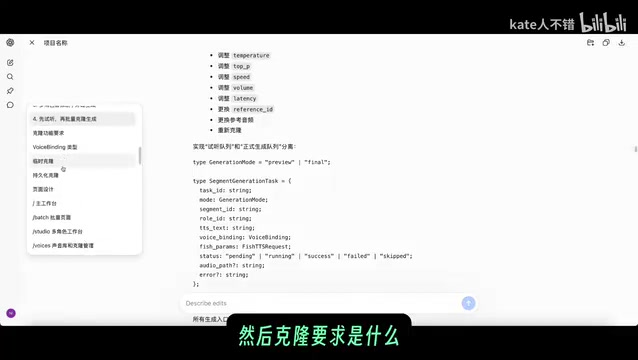
Why GPT for planning? According to the creator's analysis, GPT currently has the strongest search capabilities and produces the richest content. The same prompt was sent to Gemini and Claude (Aubis 4.8), but both produced comparatively sparse plans. The spec document GPT ultimately generated was highly detailed — covering which docs the AI should read, the tech stack, Fish Audio API requirements, DeepSeek optimization capabilities, four major feature modules, cloning requirements, UI design specifications, and a rich set of reference links.
The level of detail was intentional: to fully leverage Grok's Goal feature, a high-quality spec document is a prerequisite for successful automated coding.
Composer 2.5: A High-Value AI Coding Model
The coding phase used Grok Build (available with a SuperGrok subscription), with Composer 2.5 Fast as the core model. On benchmarks like SWE-Bench, this model falls into the "fast, high-quality, low-cost" category, and it's directly accessible within Grok — earning widespread praise from developers recently.
SWE-Bench (Software Engineering Benchmark) is one of the most authoritative AI coding evaluation benchmarks, published by Princeton University in 2023. It draws tasks from real GitHub Issues, requiring models to automatically generate patches that pass unit tests given a code repository and problem description. Unlike simple code completion, SWE-Bench tests a model's ability to understand large codebases, locate bugs, and design fixes — making it a core metric for assessing the real-world value of models like Composer 2.5.
Real development results confirmed this:
- Extremely fast: Given a prompt, Composer 2.5 would typically resolve the issue within a minute.
- Accurate fixes: For example, when clicking "AI Optimize" triggered a 500 error in the console, Composer quickly identified a JSON schema mismatch between DeepSeek's response and the project schema, and fixed it.
- Minimal back-and-forth: Aside from the initial long spec document prompt, subsequent prompts were short and simple, with very few iterative exchanges.
In total, the creator used only 14% of the monthly Grok CLI quota (running SuperGrok, not Heavy mode).
LLMs are billed by token — roughly corresponding to 0.75 English words or about 1.5 Chinese characters. The 741K tokens consumed in this session would cost tens of dollars at mainstream commercial API rates (like GPT-4o); under a SuperGrok subscription, this cost is covered by the monthly fee, representing just 14% of the quota. This "subscription-based compute bundle" model is becoming a mainstream way for individual developers to sidestep high pay-as-you-go costs — and is a core competitive strategy for Grok, Claude Pro, and similar products targeting the indie developer market.
Grok CLI: Key Features Explained
Beyond the coding itself, the creator systematically outlined tips for using Grok CLI — highly useful for developers looking to get started.
Keyboard Shortcuts and Slash Commands
The key to using Grok effectively is typing a slash in the TUI to see available commands, and using help to view keyboard shortcuts (which vary slightly by terminal). Commonly used ones include: Ctrl+R to search prompt history, Resume/Sessions/Fork to manage sessions, Context to display token usage, and Rewind to roll back to a previous conversation state.
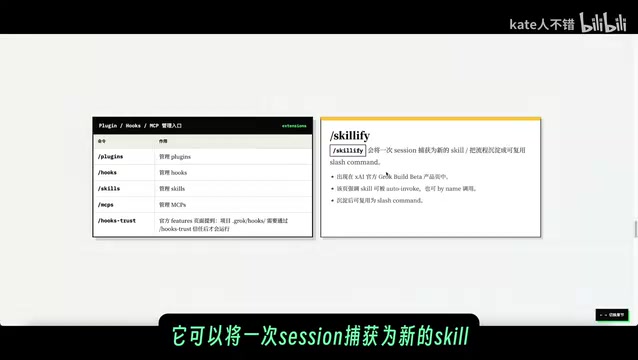
Other notable features include:
- Memory: Similar to Claude Code's memory capabilities;
- Image / Video Generation: Highly useful in app development;
- Skills Discovery: Skills installed in the
.agents/skillsfolder are auto-discovered by Grok; - Skillify: Captures a session as a new Skill, turning a workflow into a reusable slash command;
- Recap / Export: Quickly generates conversation summaries and exports multi-turn dialogues;
- Headless Script Mode: Parameters like
-pand-scan be used for automation scripts with other AI subscriptions (e.g., Codex).
The Goal Feature: Automated Verification and Auto-Fix
The highlight of this development session was Grok's Goal feature. Using the /Goal command, the creator instructed it to complete development based on the spec document.
Goal's core mechanism introduces a "Goal Completion" sub-agent responsible for verifying whether there are gaps between the plan and the code written by Composer 2.5 — and automatically triggering fixes when gaps are found. This design represents a typical example of current AI coding tools evolving toward "agentic workflows": unlike early single-turn code completion, agentic programming introduces a closed loop of "plan → execute → verify." The verifier agent continuously compares output against the spec document and triggers repair cycles until verification passes. This mechanism draws on the idea of self-play from reinforcement learning and shares design philosophy with OpenAI Codex Agent and Anthropic Claude Code — widely considered the key architectural leap that elevates AI from a "code assistant" to an "autonomous engineer."
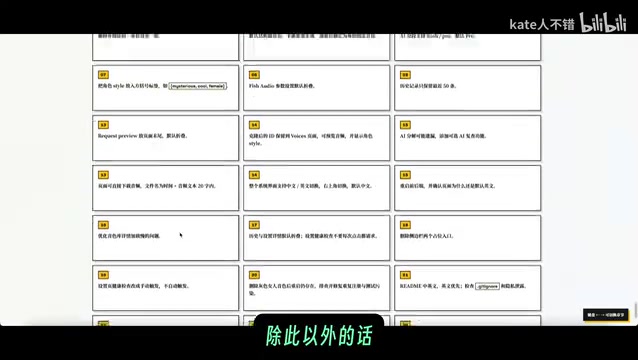
The creator observed that Goal initially showed 6 verification items, which later automatically expanded to 9. Sub-agent prompts are issued automatically by the Grok system, and when issues are found during verification, fixes continue until all checks pass.
The final result: one prompt plus one Goal, and Grok completed at least 95% of the application in approximately 42 minutes, consuming 741K tokens — with impressive quality.
Summary: A Complete Blueprint for Low-Cost Full-Stack AI Development
This case study connects the full chain of modern AI application development:
- Free capability access — Fish Audio S2.1 Pro's free TTS API, supporting 83 languages, is an excellent resource for prototype validation;
- Planning-coding-review division of labor — GPT-5.5 for detailed planning, Composer 2.5 for efficient coding, GPT-5.5 in Codex for security review — each model doing what it does best;
- Goal-driven automated verification — The sub-agent mechanism aligns plan with code, dramatically reducing manual rework.
For individual developers, this workflow reveals an important trend: as long as the spec document is sufficiently clear, high-value models like Grok Composer 2.5 can deliver a fully functional full-stack application at minimal cost (14% of monthly quota, 42 minutes). Voxweaver Studio has been open-sourced and the spec document will be shared as well — developers interested in trying this approach are encouraged to give it a go.
Related articles

Disaster and Glory of the Apollo Program: The History We Must Revisit Before Returning to the Moon
From the fatal Apollo 1 fire to Apollo 8's daring lunar orbit to Apollo 11's successful landing—revisiting the disasters, fears, and compromises of the Apollo program and their lessons for today's return to the Moon.
Netflix Trust Exercise Turns Into Firing Trap: Where Are the Boundaries of Corporate Trust?
A Netflix employee was fired after sharing private info in a trust exercise. We analyze the risks of corporate trust exercises and how employees can protect themselves.

AMD CDNA5 Architecture Deep Dive: Technical Evolution and the AI Computing Competition Landscape
Deep analysis of AMD's CDNA5 architecture covering Chiplet packaging upgrades, HBM memory evolution, and low-precision compute optimization, examining how AMD challenges NVIDIA's AI chip dominance.