How AI Technology Is Reshaping Cognitive Research on Wild Primates

AI technologies are transforming wild primate cognitive research through automated identification and deep learning.
Artificial intelligence is revolutionizing the study of wild primate cognition by overcoming traditional research limitations. Through computer vision for individual identification, machine learning for behavior classification, and deep learning for vocalization analysis, AI enables researchers to study primate memory, social cognition, and communication systems at unprecedented scale and precision, offering new insights into the evolutionary origins of human intelligence.
Introduction: When AI Enters the Jungle
For a long time, studying the cognitive abilities of wild primates has been one of the most challenging fields in behavioral science. Traditional observation methods rely on researchers spending extended periods in the field, manually recording data and making subjective judgments—a process that is not only time-consuming and labor-intensive but also susceptible to observer bias. Today, the introduction of artificial intelligence is injecting new vitality into this ancient discipline, ushering in a new era of wild primate cognitive research.
Primate cognitive research holds irreplaceable significance for understanding the evolution of human intelligence. Humans and chimpanzees shared their last common ancestor approximately 6–7 million years ago, and our kinship with other great apes is remarkably close. By comparing the cognitive abilities of different primate species—such as Theory of Mind, tool manufacturing, cultural transmission, and social learning—scientists can reconstruct the phylogenetic history of cognitive capabilities and infer which abilities are uniquely human innovations and which emerged at more ancient evolutionary nodes. This comparative approach provides a critical empirical foundation for answering the fundamental question: "What makes us human?"
Core Advantages of AI in Breaking Through Traditional Research Bottlenecks
From Manual Observation to Automated Identification
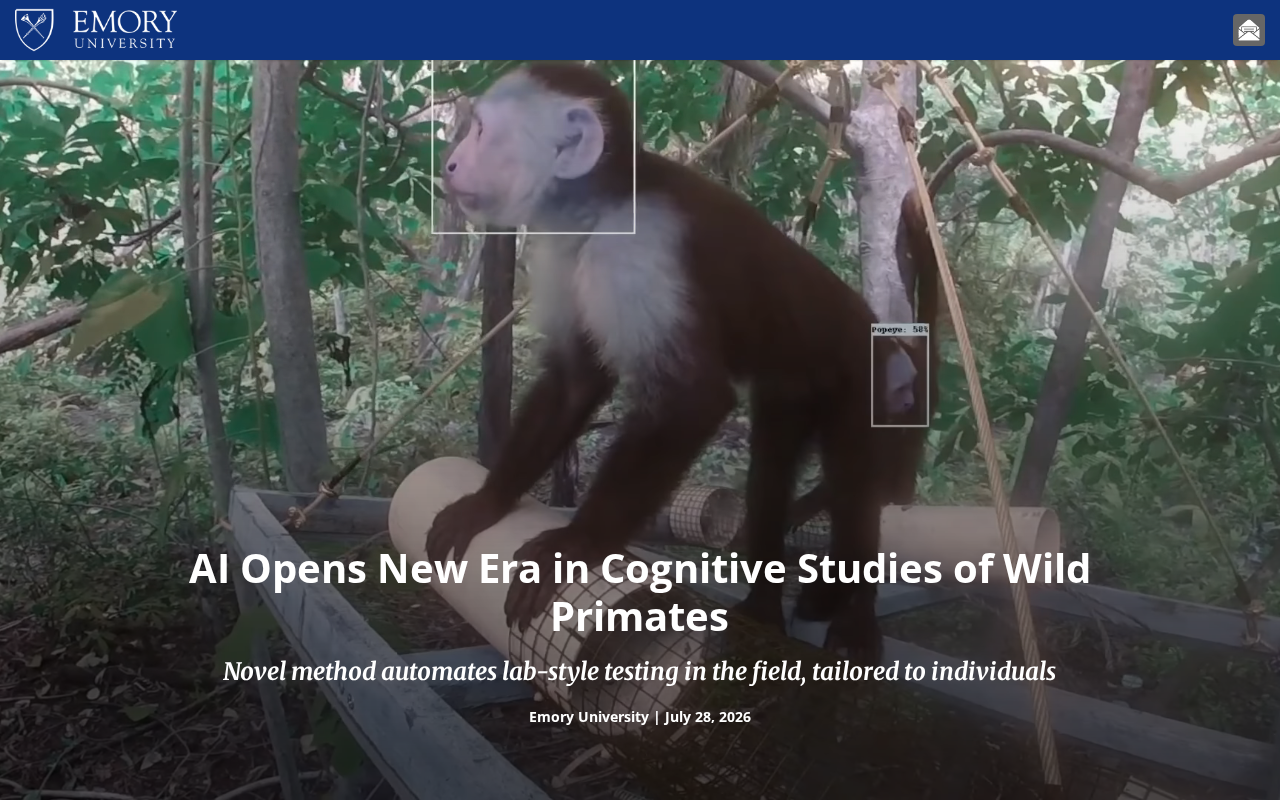
The core difficulty in studying wild animals lies in data collection. Primates inhabit complex natural environments, and individual identification, behavioral annotation, and long-term tracking often require enormous manpower. The maturation of computer vision technology now enables researchers to automatically identify different individuals through cameras and image recognition algorithms, track their movement trajectories, and record social interactions.
Computer Vision is a major branch of artificial intelligence that aims to enable machines to "understand" image and video content. Its core technologies include Convolutional Neural Networks (CNN), object detection (such as YOLO and Faster R-CNN), and instance segmentation. In field environments, these technologies face unique challenges: dramatic lighting changes, complex backgrounds (dense vegetation, shadows), frequent occlusion of target individuals, and unfixed camera angles. To adapt to these conditions, research teams typically need to collect large amounts of annotated field data for model fine-tuning and use data augmentation techniques to simulate various environmental disturbances, improving model robustness in real jungle scenarios.
This automation capability means research scale can be dramatically expanded. Previously, a team might only be able to track a dozen or so individuals, but with AI systems, researchers can simultaneously monitor the behavioral patterns of dozens or even hundreds of animals, obtaining statistically more reliable sample sizes.
Revealing Cognitive Details That Are Difficult to Observe
Cognitive research is concerned not only with what animals do but also with why they do it. Through deep analysis of massive video datasets, AI can capture subtle behavioral cues that are nearly imperceptible to the human eye—such as gaze direction, facial micro-expressions, and the sequential order of group decision-making. These data provide an unprecedented level of detail for studying primate memory, learning, social cognition, and even tool-use abilities.
Specific Application Scenarios of AI in Primate Cognitive Research
Facial Recognition and Individual Tracking
Technology similar to human facial recognition has been applied to primate research. By training deep learning models, systems can accurately distinguish between visually similar individuals, even when they are moving rapidly in the wild or partially occluded. This solves the most fundamental and critical challenge in long-term tracking: knowing "who is who."
Transferring facial recognition technology to animal individual identification requires overcoming cross-species morphological differences. Representative projects such as PrimNet and ChimpFace employ transfer learning strategies—pre-training models on large-scale human face datasets, then fine-tuning them with primate facial images. Unique features of primate faces, such as fur texture, facial pigment distribution, and scars, are learned by the model as discriminative features. Some studies have also introduced the Triplet Loss function, which improves recognition accuracy by learning the similarity between different photos of the same individual and the differences between different individuals, achieving over 90% identification accuracy in wild chimpanzee populations.
Behavior Classification and Pattern Discovery
Machine learning algorithms can automatically classify continuous animal behaviors into categories such as feeding, grooming, playing, and fighting. Furthermore, unsupervised learning methods may discover behavioral patterns that researchers had not previously anticipated, providing data-driven inspiration for proposing new research hypotheses in cognitive science.
Unsupervised learning is a class of machine learning methods that do not rely on manual annotations, including cluster analysis (such as K-means and DBSCAN), dimensionality reduction techniques (such as t-SNE and UMAP), and autoencoders. In animal behavior research, its value lies in its ability to break through human-predefined behavioral classification frameworks. Traditional behavioral studies rely on ethograms—behavior catalogs with categories predefined by researchers—but this approach may miss subtle or rare behaviors. Unsupervised methods can automatically discover cluster structures in high-dimensional behavioral data, potentially revealing behavioral subtypes that human observers have never noticed, thereby providing data-driven evidence for proposing new scientific hypotheses.
Sound Analysis and Communication Research
Beyond visual information, AI is equally promising in audio analysis. Primate vocalizations carry rich communicative information, and through deep learning analysis of spectrograms, researchers can decode the semantic functions of different calls and investigate whether structured communication systems similar to language exist among them.
Bioacoustics studies the physical characteristics and biological functions of animal vocalizations. AI applications in this field primarily rely on spectrogram analysis—converting audio signals into time-frequency domain image representations, then using deep learning models for classification and pattern recognition. Recurrent Neural Networks (RNN) and Transformer architectures are particularly suited for processing the temporal features of sound signals. In primate research, species such as Campbell's monkeys and gibbons have been found to possess combinatorial call systems—different call units can be combined to produce new meanings, which is considered a possible evolutionary precursor to the syntactic structure of human language. AI's automated analysis capabilities allow researchers to process thousands of hours of field recordings, systematically searching for such combinatorial rules.
Significance and Real-World Challenges of AI-Driven Research
Pushing the Boundaries of Cognitive Science
The introduction of AI technology not only improves research efficiency but, more importantly, enables scientists to pose and answer questions that were previously inaccessible. A deeper understanding of wild primate cognition helps us clarify the evolutionary roots of human intelligence and understand the evolutionary trajectory of social cognition, language, and culture across the primate lineage.
Data Bias and Ethical Considerations
However, AI is not a panacea. Model accuracy is highly dependent on the quality of training data, and biased data may lead to misleading conclusions. Additionally, how to deploy monitoring equipment in the field without disturbing animals' natural behavior is an issue that requires careful ethical consideration.
Data Bias in AI-driven wildlife research manifests in multiple forms: sampling bias (fixed camera positions leading to over-sampling of certain areas), annotation bias (manual annotations in training data reflecting the annotator's subjective judgments), and representational bias (certain individuals having excessive data due to their activity ranges being close to equipment). These biases can lead to uneven recognition accuracy across specific individuals or behavior types, subsequently affecting the reliability of downstream scientific conclusions. Solutions include Active Learning strategies, balanced sampling methods, and explicitly reporting model performance differences across subgroups in publications to ensure the robustness of scientific findings.
Conclusion
AI is becoming an indispensable tool in wild primate cognitive research. It transcends the limitations of traditional methods in scale, precision, and objectivity, enabling scientists to peer more deeply into the mysteries of animal minds. It is foreseeable that, as technology continues to advance, the integration of artificial intelligence and field biology will give rise to more major discoveries about the origins of intelligence. This is not merely a triumph of technology—it is an important leap forward in humanity's understanding of its own place in the natural world.
Related articles

AI Art Prompt Structure Breakdown: Creating a Desert Crystal Pyramid Scene
Breaking down a popular Reddit AI artwork to reveal the five core elements of structured prompts: subject, material, lighting, environment, and atmosphere for AI art scene creation.

$100 Million Deal: AI Gives 50,000 Ukrainian Kamikaze Drones Autonomous Target Lock
A U.S. company struck a $100M deal with Ukraine to deploy AI visual lock-on capabilities on 50,000 cheap kamikaze drones, enabling terminal autonomous guidance to defeat electronic warfare jamming.

The Privacy Boundaries of AI Data Collection: Your Bedroom Is Becoming a Model Training Ground
A humorous tweet about clothes entering AI training data reveals the privacy dilemma of AI data collection. We explore machine unlearning challenges, consent issues, and how users can balance convenience with privacy.