How the Single Responsibility Principle Is Revolutionizing Prompt Engineering: A Modular AI Narrative Architecture Explained

Open-source project applies software engineering's SRP to Prompt design, building a modular AI narrative system
The GitHub open-source project Singulari-Tea Codex applies the Single Responsibility Principle (SRP) from software engineering to Prompt architecture design, decomposing a complex narrative system into dozens of independent modules, each handling a single narrative dimension. Optimized for Gemini 2.5 Pro, it leverages the model's strong instruction adherence and million-token context window to achieve stable, scalable, and maintainable dynamic story generation—representing a paradigm shift in Prompt engineering from micro-level techniques to macro-level architectural design.
Project Overview: Rethinking Prompt Design Through a Software Engineering Lens
In the field of AI narrative generation, getting large language models to consistently produce complex, dynamic, and coherent stories has always been a tough challenge. An open-source project on GitHub called Singulari-Tea Codex offers a novel solution—applying the Single Responsibility Principle (SRP) from software engineering to Prompt architecture design, creating a modular narrative simulation system optimized for Google Gemini 2.5 Pro.
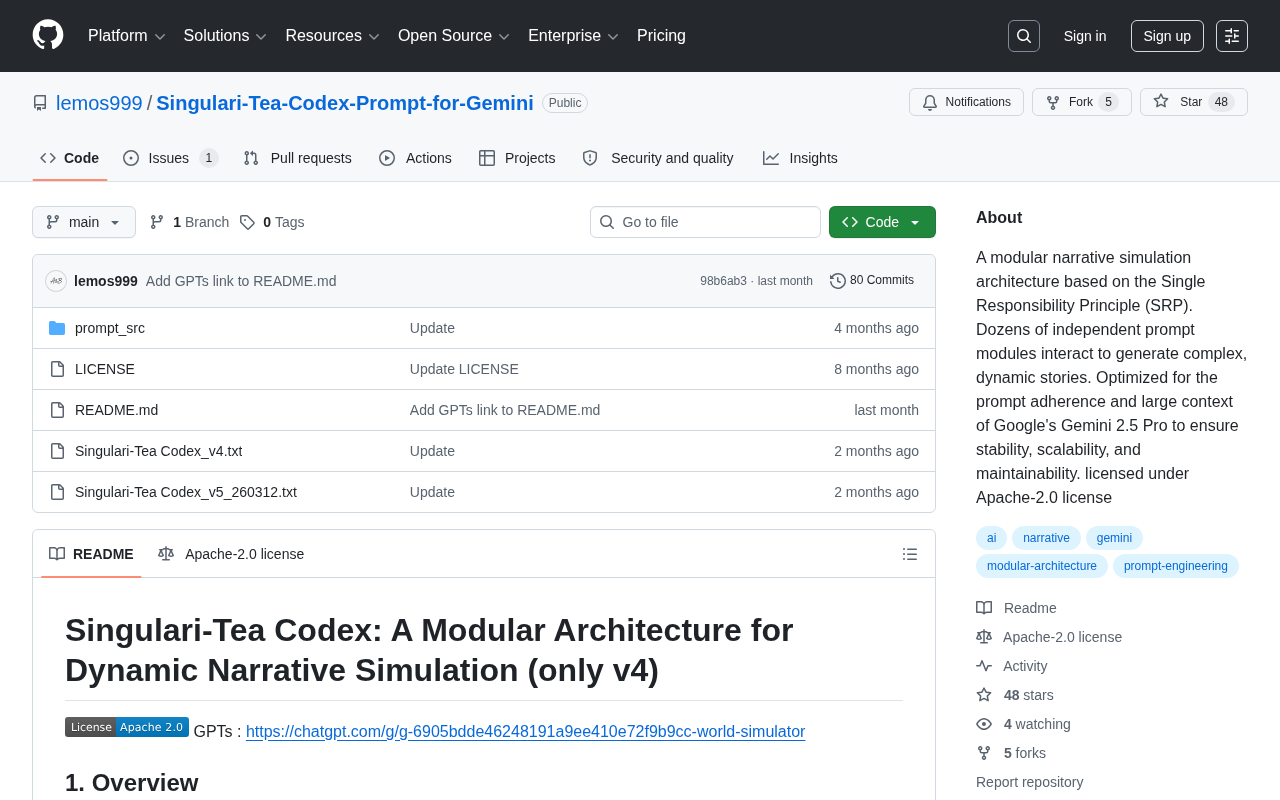
The project currently has 48 stars on GitHub and is released under the Apache-2.0 license. While modest in scale, its architectural philosophy is remarkably forward-thinking and worth examining in detail.
Core Design Philosophy: Implementing SRP in Prompt Engineering
How the Single Responsibility Principle Applies to Prompt Design
The Single Responsibility Principle is the first of the SOLID principles, and its core idea is simple: each module should do one thing, and change for only one reason.
The SOLID principles are an acronym for five core design principles in object-oriented programming, systematized by Robert C. Martin (known as "Uncle Bob") in the early 2000s. The five principles are: Single Responsibility Principle (SRP), Open-Closed Principle (OCP), Liskov Substitution Principle (LSP), Interface Segregation Principle (ISP), and Dependency Inversion Principle (DIP). SRP is the most fundamental among them, stemming from a simple engineering intuition—when a module takes on too many responsibilities, a change in any one of them can trigger a chain reaction, making the system fragile and hard to maintain. In traditional software development, SRP has been proven to significantly reduce code coupling and improve system testability. Migrating this principle to the Prompt engineering domain essentially acknowledges a fact: as AI application complexity grows, Prompts themselves have become software artifacts that need to be "engineered."
Singulari-Tea Codex brings this classic principle to the battlefield of Prompt design.
Traditional AI narrative Prompts are typically monolithic instructions that attempt to cram world-building, character personalities, plot progression, dialogue style, conflict mechanics, and everything else into a single block of text. This works fine for simple scenarios, but as narrative complexity increases, model adherence drops precipitously, and output quality becomes uncontrollable.
This failure isn't coincidental—it's closely related to the underlying architectural characteristics of large language models. LLMs are based on the Transformer architecture, and their self-attention mechanisms exhibit "attention dilution" when processing extremely long instructions. When a Prompt contains too many constraints across different dimensions, the model's attention weight for each instruction gets spread thin, causing some instructions to be ignored or poorly executed. Academics call this the "Lost in the Middle" problem—the model's information recall rate for the middle portions of long texts is significantly lower than for the beginning and end. Additionally, monolithic Prompts face the risk of "instruction conflicts": requirements across different dimensions may semantically contradict each other, and without clear priority guidance, the model often makes unpredictable compromises.
Singulari-Tea Codex takes a completely different path: it decomposes the narrative system into dozens of independent Prompt modules, each responsible for only one specific dimension of the narrative system. These modules each fulfill their own role while collaborating with one another to collectively drive complex dynamic story generation.
Three Key Advantages of Modular Prompt Architecture
Stability: When adjusting a particular narrative dimension, you only need to modify the corresponding module without affecting other parts. For example, optimizing the character emotion system won't accidentally disrupt world-building behavior.
Scalability: Adding new narrative features only requires inserting new modules—no need to start from scratch. Want to add a weather system, economic system, or political intrigue mechanics? Just add a new module.
Maintainability: Each module has clear responsibility boundaries, giving debugging and optimization well-defined targets, significantly reducing Prompt engineering maintenance costs.
Why Gemini 2.5 Pro? Two Key Technical Reasons
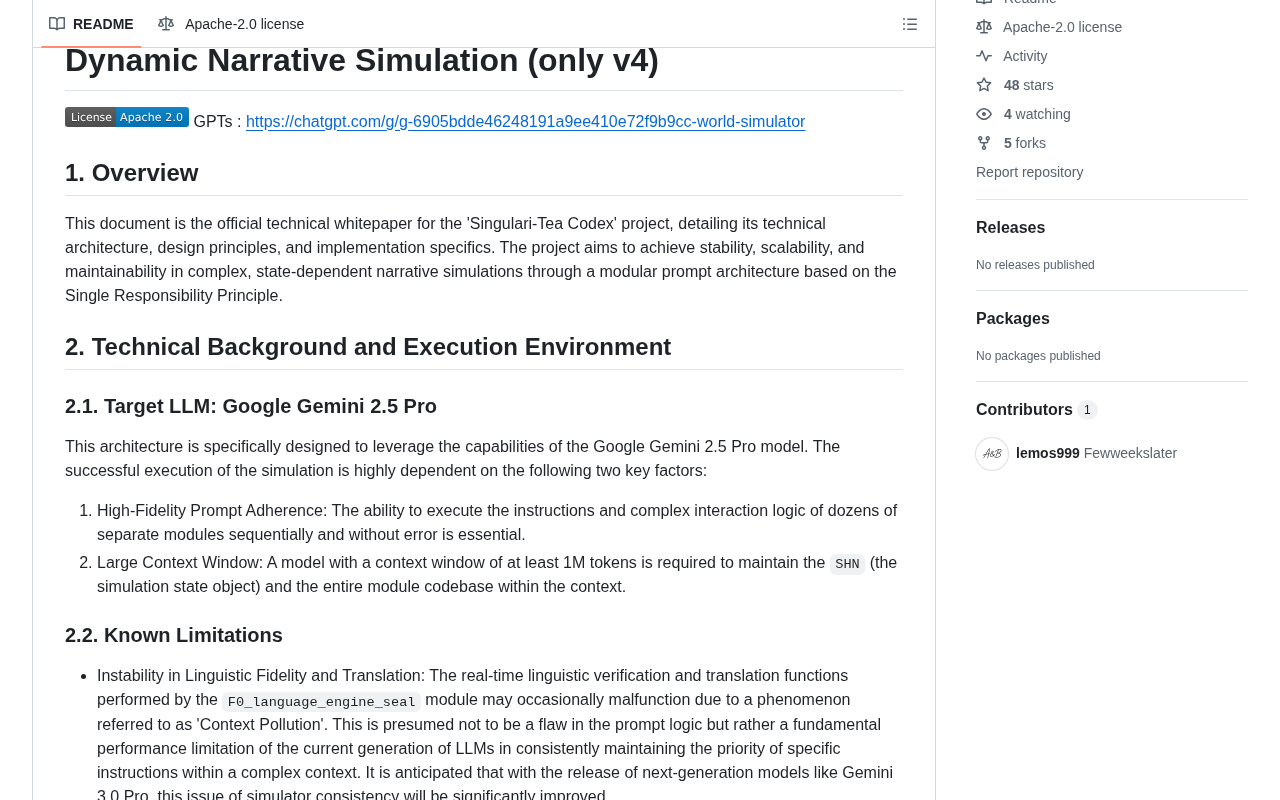
The project explicitly states it's optimized for Google Gemini 2.5 Pro, a choice backed by two technical considerations.
Excellent Prompt Adherence
Gemini 2.5 Pro excels at instruction following, which is critical for a modular Prompt architecture. Dozens of independent modules mean the model must simultaneously understand and strictly execute a large number of fine-grained instruction constraints. If the model's Prompt adherence falls short, inter-module collaboration breaks down and the entire system descends into chaos.
Million-Token Context Window
Gemini 2.5 Pro boasts a context window of up to 1 million tokens. For technical context, Google Gemini 2.5 Pro is a multimodal large language model from Google DeepMind and represents the flagship version of the Gemini series. Its 1-million-token context window is industry-leading—by comparison, GPT-4 Turbo has a 128K token context window, and Claude 3.5 Sonnet has 200K tokens. Gemini 2.5 Pro achieves this massive context capacity thanks to Google's breakthroughs in Sparse Attention mechanisms and efficient Key-Value Cache compression techniques. One million tokens is roughly equivalent to a 700,000-word novel, meaning the model can "remember" extremely rich contextual information within a single conversation.
Modular architecture inherently consumes context space—just defining dozens of modules occupies a significant number of tokens, and layering on the narrative state, character memories, and event histories that accumulate during storytelling makes context capacity demands substantial. A million-token context window is exactly what's needed to support this architecture.
Deeper Implications for Prompt Engineering
A Paradigm Shift: From "Writing Prompts" to "Designing Prompt Architectures"
The greatest value of Singulari-Tea Codex may not lie in narrative generation itself, but in demonstrating a paradigm leap in Prompt engineering.
In the past, Prompt engineering discussions focused mostly on micro-level refinements: wording techniques, Few-shot examples, Chain-of-Thought reasoning, and so on. It's worth explaining these foundational techniques: Few-shot Learning is a classic Prompt engineering technique where a small number of input-output examples are provided in the Prompt to help the model understand the task pattern and generate responses accordingly. For instance, providing two or three "question–SQL query" paired examples enables the model to learn to convert natural language into database queries. Chain-of-Thought (CoT) reasoning was proposed by the Google Brain team in 2022, with the core idea of adding prompts like "let's think step by step" or showing examples that include intermediate reasoning steps, encouraging the model to reason through problems before generating a final answer, significantly improving accuracy on complex tasks. Both techniques belong to the "micro-optimization" level of Prompt engineering, focusing on quality improvement within a single Prompt.
The approach represented by Singulari-Tea Codex is entirely different—it elevates the perspective to the level of architectural design, using mature software engineering methodologies to organize and manage Prompt systems.
This approach applies far beyond narrative generation. Any scenario requiring LLMs to handle complex, multi-dimensional tasks can benefit from SRP-based modular design:
- Game AI: Modularly managing NPC behavior, dialogue, decision-making, and emotions separately
- Intelligent Customer Service: Separating intent recognition, knowledge retrieval, response generation, and emotion management
- Code Generation: Running requirements analysis, architecture design, code writing, and test generation independently
How Modules Achieve Effective Collaboration
Here's a thought-provoking question: how do independent modules work together?
In traditional software engineering, modules communicate through interface definitions and message passing. In Prompt architecture, the "communication" mechanism between modules is fundamentally different—it's essentially "implicit communication" that relies on the LLM's comprehensive understanding and cross-reasoning across all module definitions within a unified context window. It's similar to all members of a team sharing a single whiteboard: everyone writes their responsibilities and rules on the board, and the LLM as the "executor" must read everything simultaneously and coordinate execution. The advantage of this mechanism is extreme flexibility—modules don't need strictly defined interface protocols. But the disadvantage is equally obvious—communication reliability depends entirely on the model's comprehension ability, lacking the type checking and contract verification guarantees found in traditional software engineering.
This places higher demands on the model's comprehensive capabilities, which also explains why the project chose Gemini 2.5 Pro—currently among the most capable models—as its underlying engine.
Industry Context: The Macro Trend of Prompt Engineering Systematization
Singulari-Tea Codex isn't an isolated case—it reflects the broader industry trend toward systematic Prompt engineering. Since 2023, multiple practices have emerged that bring software engineering methodologies into Prompt management: the DSPy framework abstracts Prompt optimization into programmable, modular pipelines; orchestration frameworks like LangChain and LlamaIndex provide infrastructure for Prompt templating and chained invocations; Microsoft's Semantic Kernel attempts to manage AI Skills and Plugins in an object-oriented manner. Academia is also driving related research—research teams at MIT and Stanford have proposed the concept of "Prompt Programs," treating complex Prompts as a new programming paradigm.
What makes Singulari-Tea Codex unique is that it doesn't rely on external orchestration frameworks—it achieves modularity purely through the structural design of the Prompts themselves. This "native Prompt architecture" approach has unique exploratory value for understanding the capability boundaries of LLMs—it directly tests whether a model can coordinate a complex multi-module system through context understanding alone, without external programmatic logic.
Current Limitations and Future Outlook
As an emerging project, Singulari-Tea Codex faces several practical challenges:
- Strong Platform Dependency: Deeply tied to Gemini 2.5 Pro; migrating to other models would likely require significant adaptation work
- High Barrier to Entry: Designing and debugging dozens of modules requires considerable Prompt engineering experience
- Heavy Context Overhead: Numerous module definitions consume precious context space, potentially compressing the token budget available for actual narrative content
However, these limitations don't prevent it from representing an important trend: Prompt engineering is evolving from artisanal "Prompt writing" toward systematic, engineering-driven "Prompt architecture design." As LLM capabilities continue to improve and context windows expand further, the advantages of modular architecture will only become more pronounced.
Conclusion
While Singulari-Tea Codex focuses on the vertical scenario of narrative simulation, the approach it demonstrates—integrating software engineering principles into Prompt architecture design—offers valuable lessons for the entire AI application development landscape. As LLMs grow increasingly powerful, designing better Prompt architectures to fully unlock model potential is becoming a topic every AI developer needs to seriously consider.
Related articles
Deep Dive into AI Agent Skill Design: …
Deep Dive into AI Agent Skill Design: Engineering Practices from Anthropic and Perplexity
A deep dive into Skill design philosophy from Anthropic's Claude Code team and Perplexity's Agent team, covering the Tax Test, Gotchas Flywheel, progressive disclosure, and Eval-First practices for building high-quality AI Agent skill systems.
Deep Dive into OpenAI's Official GPT-5…
Deep Dive into OpenAI's Official GPT-5.6 Prompting Guide: The Shift from Manual to Automatic
A deep dive into OpenAI's official GPT-5.6 Sol prompting guide: conciseness-first, outcome-oriented design, autonomy boundaries, tool routing, and reasoning intensity tuning.
 Deep Dives
Deep Dive into How OpenClaw (Open-Source Crayfish) AI Agent Works
Deep analysis of OpenClaw AI Agent internals: System Prompt, tool calling, SubAgents, Skill system, memory, and Context Engineering explained.