How to Choose AI Learning Books: A 5-Dimension Rational Evaluation Framework
A 5-dimension framework for rationally evaluating and selecting AI and machine learning books.
Faced with an overwhelming number of AI and machine learning books, learners struggle to identify what's truly worth their time. This article builds a practical evaluation framework across five dimensions: matching content depth to your level, assessing code quality and currency, checking publication recency, leveraging community reputation, and evaluating companion resources—so you can make smarter, better-informed choices.
Starting with a Reddit Question
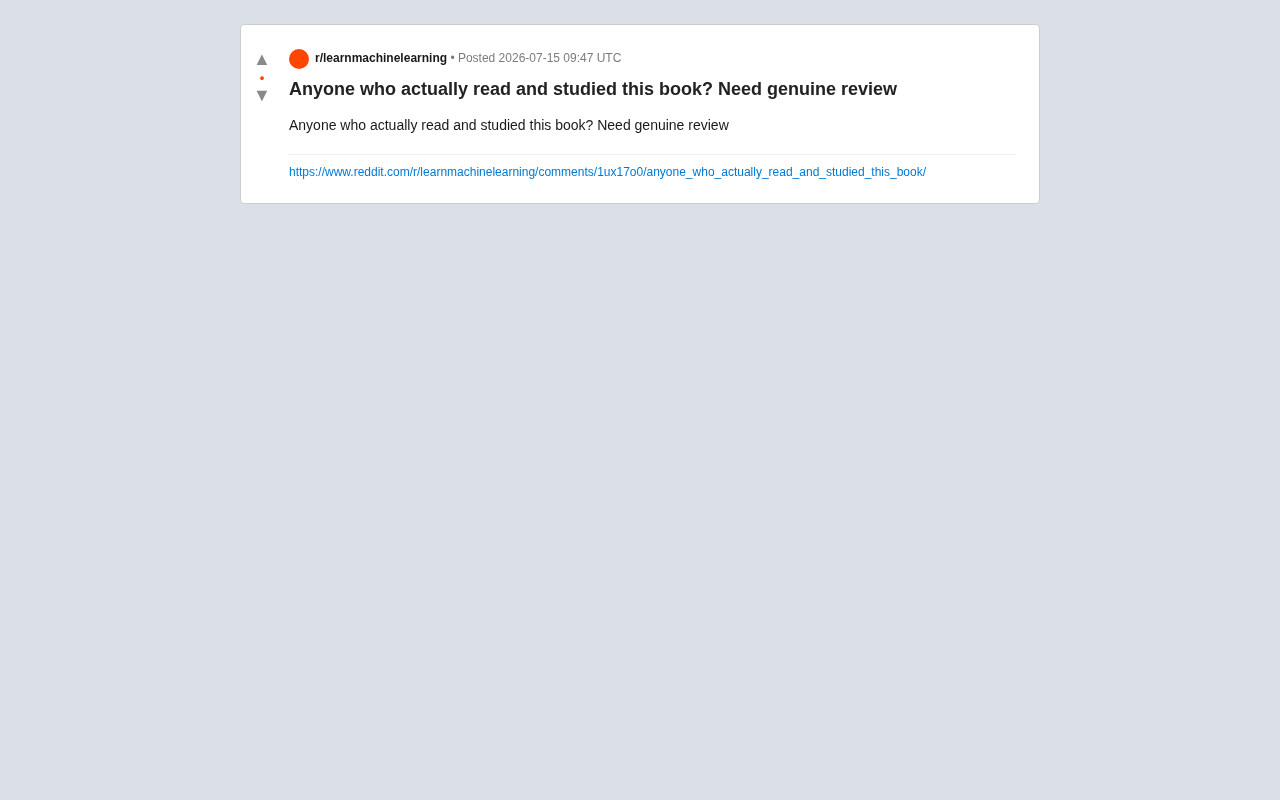
In Reddit's machine learning communities, you'll often come across posts like this: a learner shares the cover of an AI/machine learning book with a simple plea — "Has anyone actually read and studied this book thoroughly? Looking for an honest review."
This seemingly simple question reflects a challenge that almost every AI learner faces today: the market is flooded with books on artificial intelligence, machine learning, and deep learning — ranging from introductory overviews to dense mathematical derivations — yet the number of people who actually finish them and apply the knowledge in practice remains small. Cover design, publisher reputation, and Amazon ratings rarely answer the most critical question: Is this book right for me?
This article isn't a review of any specific book. Instead, it's about helping you build a rational methodology for evaluating AI learning materials, so you can make smarter choices in an age of information overload.
Why "Honest Reviews" Are So Hard to Find
The Distortion of Ratings and Word-of-Mouth
On e-commerce platforms, high ratings for technical books tend to come from two types of readers: those who skimmed a few pages right after purchase, and those who were excited by the content but hadn't yet put it into practice. The readers who actually "read and studied" a book — completed the exercises, reproduced the code, and applied the knowledge to real projects — rarely leave detailed feedback, because that process often takes months.
This phenomenon is closely tied to the Dunning-Kruger effect in cognitive psychology: beginners, lacking the context to judge what they don't know, tend to overestimate their comprehension and leave positive reviews after a quick browse. Meanwhile, those who've done the deep work are often the most aware of the material's limitations and the least likely to offer sweeping recommendations. The result is a systematic information asymmetry: the ratings you see reflect purchasing intent, not learning outcomes. Communities like Reddit are valuable precisely because they surface the voices of people who've actually put in the time.
The Individual Nature of Learning Goals
No single book works for everyone. A book built around mathematical derivations is a treasure for someone headed into research, but a roadblock for a developer who needs to ship something quickly. Any question of "is this book good?" without the context of "who am I and what am I trying to achieve?" is likely to generate a misleading answer.
Five Core Dimensions for Evaluating AI Books
1. How Well the Content Depth Matches Your Level
Start by identifying what level the book operates at. A rough breakdown:
- Conceptual/Overview level: Explains what AI is and what it can do, with minimal math or code — ideal for complete beginners building a mental model.
- Applied/Engineering level: Focuses on using mainstream frameworks (PyTorch, TensorFlow, scikit-learn) and hands-on projects — suited for developers who want practical results quickly.
- Theoretical/Research level: Contains substantial mathematical derivations and algorithm proofs — appropriate for those preparing for research or needing deep first-principles understanding.
Before buying, ask yourself: Which level of knowledge do I actually need most right now? Jumping straight to theoretical content with a weak foundation often leads to burnout; cycling through beginner overviews when you already have solid fundamentals is a waste of time.
The "half-life of knowledge" in AI varies dramatically by layer. Some researchers estimate that applied AI knowledge has a half-life of roughly one to three years, while foundational mathematics and statistical theory can remain relevant for decades. This asymmetry calls for a layered approach: treat tools like linear algebra, probability theory, and convex optimization as long-term investments, and treat specific framework APIs and model architectures as "live knowledge" that needs regular updating.
2. How Actionable the Code and Exercises Are
In AI learning, reading is never the same as understanding. A high-quality practical book should offer:
- Complete, runnable code examples (ideally with an accompanying GitHub repository);
- Exercises designed to build progressively;
- Framework versions that haven't fallen severely out of date.
One of the most common fatal flaws in technical books is outdated code. The rapid iteration of deep learning frameworks is the root cause. PyTorch, for instance, has gone through multiple major versions since its 2016 release, with significant changes to its API design, autograd mechanism, and distributed training interfaces. TensorFlow underwent a fundamental architectural shift from the static computation graphs of 1.x to the dynamic graphs of 2.x, rendering most early tutorials and books nearly unusable. Meanwhile, the Hugging Face Transformers library — which has become the de facto standard for NLP engineering since its rise in 2019 — is absent from many earlier books entirely. When evaluating a book, always check the last commit date of its companion code repository and the activity level in its Issues tab. These are meaningful signals of the book's practical engineering value.
3. Publication Date and Knowledge Currency
The knowledge half-life in AI is extremely short. The 2017 introduction of the Transformer architecture marks a clear watershed: many NLP methods from before that point have been substantially displaced, and since 2022, large language models have reshaped the entire field's technology stack once again.
The Transformer architecture, introduced in Google's 2017 paper Attention Is All You Need, fundamentally changed the paradigm of natural language processing. It abandoned the RNNs and LSTMs that had dominated the field in favor of a pure self-attention mechanism for processing sequential data — dramatically improving parallel computation efficiency and achieving breakthrough results on multiple NLP benchmarks. BERT, the GPT series, T5, and other large pretrained models all build on the Transformer, establishing the "pretrain + fine-tune" paradigm as the mainstream approach. The release of ChatGPT in late 2022 then brought large language models into public consciousness, compressing what might have been years of gradual adoption into a matter of months. The practical implication: a book on NLP published before 2018 may have core methods that are now largely superseded.
When evaluating any book, distinguish between foundational theory and cutting-edge techniques: linear algebra, probability theory, and optimization methods don't go stale, but chapters covering specific model architectures or state-of-the-art methods demand close attention to publication year.
4. Community Reputation and Author Credentials
Whether an author has genuine research or engineering experience largely determines the reliability of the content. Academically recognized classics — such as Goodfellow et al.'s Deep Learning or Bishop's Pattern Recognition and Machine Learning — are recommended repeatedly because they've been tested by time and by thousands of readers.
Deep Learning (2016, MIT Press), co-authored by Ian Goodfellow, Yoshua Bengio (2018 Turing Award laureate), and Aaron Courville, is one of the most-cited deep learning textbooks, known for its rigorous mathematical treatment. Christopher Bishop's Pattern Recognition and Machine Learning (PRML, 2006) remains a landmark reference in the statistical tradition of machine learning, covering Bayesian methods, kernel methods, graphical models, and more. Both share a key characteristic: their foundational theory sections are essentially timeless — but neither covers the modern large-model toolchain, so readers should supplement them with more recent materials.
Before committing, search for the book title in communities like r/MachineLearning and r/learnmachinelearning on Reddit. Prioritize evaluations from long-term practitioners, not marketing copy.
5. Completeness of Companion Resources
Modern technical learning rarely comes down to a single book. High-quality learning materials typically include: video courses, online practice platforms, community forums, and dataset downloads. These companion resources dramatically reduce frustration during the learning process and help you find a way forward when you get stuck.
Three Practical Tips for AI Self-Learners
Build the Framework First, Then Go Deep
Try doing a faster first read to build an overall mental model, then revisit key chapters for deep study and hands-on practice. Many learners stall on the mathematical derivations in chapter one and never make progress — but you can absolutely skip those sections, gain a broader picture of the subject, and then circle back to tackle them.
Let Projects Drive Your Reading
Rather than passively reading from cover to cover, set a concrete goal — say, "build an image classifier using what I learn from this book" — and then use the book to hunt for answers to specific questions.
This approach has strong backing in cognitive science. Psychologist Robert Bjork's theory of "Desirable Difficulties" holds that when learners actively retrieve knowledge in response to concrete problems, the depth of memory encoding is far greater than passive reception. Situated Learning Theory in educational psychology similarly emphasizes that knowledge acquired in contexts resembling its actual use transfers far more effectively to real tasks. For AI learners, this means that reproducing an experiment from a paper or solving a Kaggle competition problem with a newly learned method produces dramatically higher retention than simply reading theory chapters. Many top AI researchers have noted publicly that they truly understood an algorithm only when they implemented and debugged it themselves — not while reading about it. Goal-driven learning retains knowledge at a far higher rate than linear reading.
Use the Community to Verify Your Choices
Circling back to that Reddit question at the start: before purchasing or committing deeply to a book, actively asking the community for input and searching for genuine reviews is an extremely smart move. It filters out materials that look appealing but aren't right for you, and helps you invest your limited time in content that actually delivers value.
Closing Thoughts
At its core, that Reddit user's question was a search for signal in the noise — trying to find voices that had been genuinely tested by practice, amid a sea of recommendations and star ratings. It's a reminder that on the path to learning AI, choosing the right material is only the first step. What truly matters is sustained practice, reproduction, and application.
A book's value isn't determined by how authoritative it is — it's determined by whether you actually read it deeply and put it to work. Rather than endlessly agonizing over "which book is best," start doing something as soon as possible. In AI, taking action is itself the best form of learning.
Key Takeaways
Related articles

The Truth Behind Codex 'Build a Website in 5 Minutes': AI Isn't Creating Sites—It's Helping You Copy Them
Exposing the truth behind viral Codex 5-minute website videos: creators aren't building original sites with AI—they're copying shared prompts or scraping others' work. Learn AI coding tools' real limits.

Getting Started with AI Agent Development: A Complete Guide from Concept to Practice
A comprehensive guide to AI Agent architecture and development, covering automated marketing, intelligent customer service, and investment analysis scenarios with single and multi-agent collaboration.

The Truth Behind Codex 'Build a Website in 5 Minutes': AI Isn't Creating Sites — It's Helping You Copy Them
Exposing the truth behind viral Codex 5-minute website videos: creators aren't building original sites with AI — they're copying shared prompts or scraping others' work.