iFixit Megalodon Driver Kit: Handle Appliance Repairs and Furniture Assembly for $34.95

iFixit debuts the $34.95 Megalodon Driver Kit for home repairs and flat-pack furniture assembly.
iFixit has launched the Megalodon Driver Kit, a $34.95 compact tool set designed for home repairs and DIY projects like fixing appliances and assembling flat-pack furniture. It marks the company's expansion beyond electronics repair into broader household DIY, extending its Right to Repair mission to everyday users.
iFixit Moves Beyond Electronics Repair into Home DIY
iFixit has long been renowned for its detailed electronics teardown tutorials and professional repair tool kits, helping countless users open, diagnose, and fix all kinds of electronic products on their own. Founded in 2003, the company got its start publishing Apple device teardown guides and gradually grew into the world's largest free repair knowledge base, hosting over 100,000 device repair tutorials. Its founder, Kyle Wiens, has long been an active advocate in the Right to Repair movement, testifying before the U.S. Congress on multiple occasions to push for legislation requiring manufacturers to make repair manuals, parts, and diagnostic tools available to consumers and independent repair shops. Now, this company built around the core philosophy of the "Right to Repair" is expanding its product line into a much broader home setting.
According to iFixit's official announcement, the company has launched a brand-new tool kit—the Megalodon Driver Kit—priced at $34.95. Unlike its previous focus on precision electronics repair, this kit is tailored specifically for home repairs and DIY projects, suited for everyday needs like fixing household appliances or assembling flat-pack furniture.
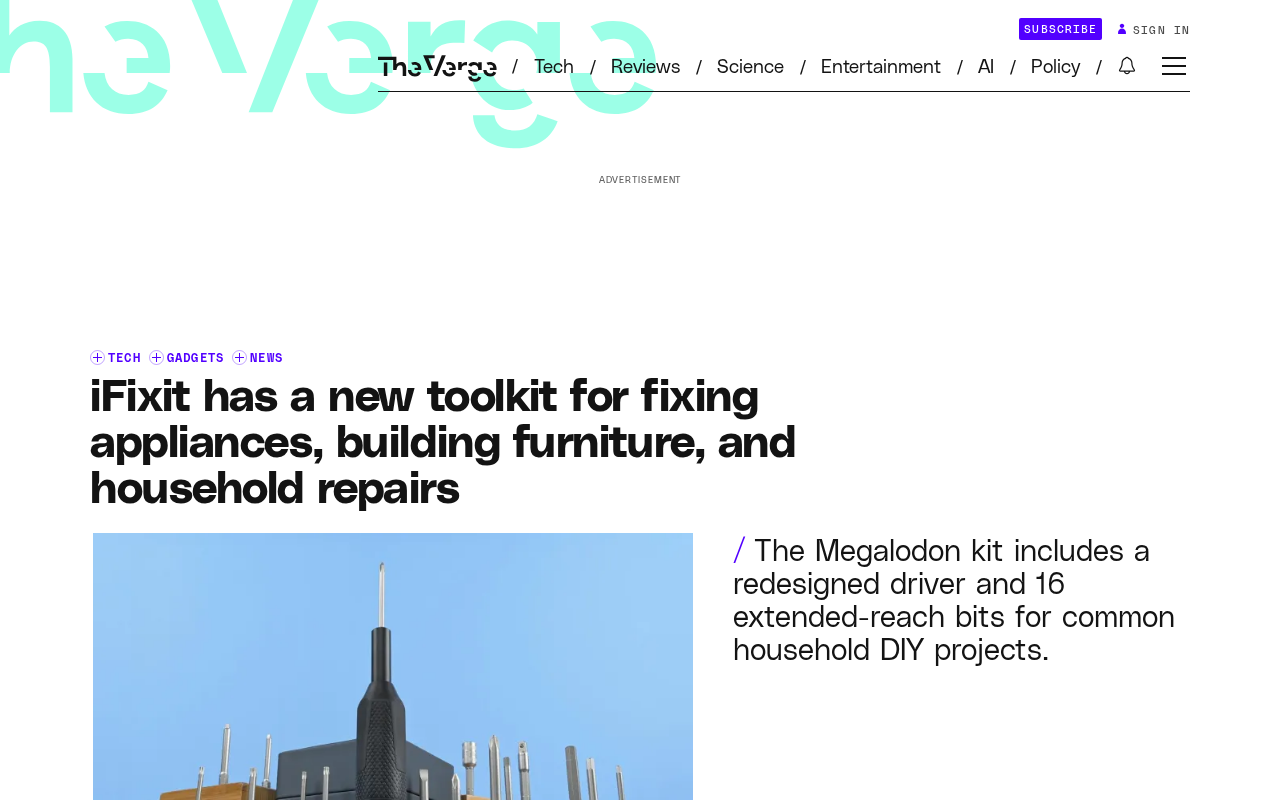
The Megalodon Kit: A Compact Design for Everyday Scenarios
iFixit positions the Megalodon Driver Kit as a "compact kit." The thinking is clear: cover common household repair and installation needs while maintaining good portability, so users can grab it easily in the living room, kitchen, or garage.
From Precision Screws to Furniture Assembly, One Kit Does It All
iFixit's classic products—the Pro Tech Toolkit and the Mako precision screwdriver set—primarily target the tiny screws found in electronics like phones, laptops, and game consoles. Their core strength lies in covering dozens of precision bits such as Phillips #000 through #2, Torx T2 through T10, and Apple's proprietary Pentalobe screws, paired with anti-static designs and fine tweezers, all engineered for nano-scale precision work. The Megalodon, by contrast, shifts its focus toward higher-torque, more diverse fastener scenarios: it needs to cover standard household specifications like Phillips, Flathead, Robertson (square-head screws, common in North American furniture), and hex keys, while delivering higher torque output. From everyday repairs of appliances like refrigerators and washing machines to assembling IKEA-style flat-pack furniture, all of this falls within its scope.
The flat-pack furniture model was popularized by IKEA in the 1950s. Its core logic is to break furniture down into standardized parts shipped flat, with consumers assembling it themselves, dramatically reducing logistics costs. IKEA alone sells hundreds of millions of furniture pieces worldwide each year, giving rise to enormous demand for home DIY. However, many households lack suitable tools, leading to poor assembly experiences or even damaged parts—and the Megalodon is aimed precisely at this pain point.
Behind this shift lies a strategic consideration for iFixit to reach a broader user base. Compared to electronics repair, which has a certain barrier to entry, home repairs and furniture assembly are near-universal needs for virtually every household, offering greater market potential.
Why Is iFixit Expanding Its Product Boundaries?
iFixit's core mission has always been to advance the Right to Repair movement, advocating for consumers to fix their own devices, reduce electronic waste, and extend product lifespans. Extending its tool kits from the electronics domain to household appliances and furniture is a natural extension of this philosophy.
Riding the Trend of "Repair Culture" Spreading to Ordinary Households
In recent years, Right to Repair legislation has made significant progress in many parts of the world, providing fertile policy ground for the spread of this culture. The EU formally passed its Right to Repair Directive in 2024, requiring member states to ensure consumers can access reasonable repair services even outside the warranty period, with manufacturers obligated to provide parts and repair information. In the United States, New York State led the way in 2023 by passing the Digital Fair Repair Act, and several other states are still advancing related legislation. These policy developments have not only opened up space for the independent repair market but also prompted more consumers to recognize the feasibility and legality of DIY repair.
As Right to Repair legislation continues to advance globally and consumer attention to sustainable lifestyles grows, the "do-it-yourself repair" culture is spreading from the tech-geek circle to ordinary households. When an appliance develops a minor fault, many people's first instinct is still to throw it away and buy new—but a suitable set of home repair tools can often make repair readily accessible.
Through products like the Megalodon, iFixit isn't just selling tools; it's lowering the barrier for ordinary users to engage in repair, encouraging more households to try solving problems themselves rather than relying on professional services or simply buying new products.
$34.95: Precisely Targeting the Mass Consumer Market
The home tool kit market has long been dominated by traditional brands like Stanley, Klein Tools, and Craftsman. In recent years, European precision tool brands such as Wiha and Wera have entered the mid-to-high-end consumer market on the strength of superior manufacturing precision. iFixit's differentiated advantage in entering this arena lies in brand trust and its content ecosystem—its vast library of repair tutorials forms a unique moat, making its tools not just hardware products but gateways into a repair knowledge community.
The $34.95 price point falls into the low-to-mid range in the tool kit market—below entry-level kits from brands like Wera, but above generic hardware-store tools—precisely positioning it for mass-market users who want a certain level of quality without overspending. This pricing both continues iFixit's consistent reputation for quality and avoids placing too much burden on ordinary households, helping the product quickly break into the broader home market.
Significance for the Industry and Users
For consumers, the Megalodon Driver Kit offers a practical option that "handles most household scenarios with a single kit," sparing them the hassle of buying separate tool sets for different tasks. For iFixit itself, this product expansion signals that the brand is evolving from the vertical field of electronics repair toward becoming a more comprehensive DIY tool supplier.
Notably, iFixit's brand trust has always been built on its detailed repair guides. If this new kit is accompanied by companion repair tutorials for appliances and furniture, it could replicate the success path it achieved in electronics repair—it is precisely this dual-engine model of "tools + knowledge" that distinguishes iFixit from ordinary tool retailers and further solidifies its benchmark status within the DIY community.
Overall, the launch of the Megalodon Driver Kit is both a pragmatic expansion of iFixit's product line and a microcosm of the Right to Repair philosophy permeating broader everyday life. For household users hoping to reduce waste and improve their hands-on skills, this may well be an entry-level choice worth considering.
Key Takeaways
Related articles

The Privacy Boundaries of AI Data Collection: Your Bedroom Is Becoming a Model Training Ground
A humorous tweet about clothes entering AI training data reveals the privacy dilemma of AI data collection. We explore machine unlearning challenges, consent issues, and how users can balance convenience with privacy.

LangGraph Studio Hidden Features: Practical Tips for Visually Debugging Agent Workflows
Explore LangGraph Studio's hidden features including time travel debugging, interactive state editing, and human-in-the-loop testing to efficiently debug AI Agent workflows.

Mecanum Wheel Motion Simulation Platform: A Detailed Guide to Low-Cost VR Haptic Solutions
A detailed look at a Mecanum wheel-based omnidirectional motion simulation platform using VR trackers for 3-DOF motion simulation and recentering correction — a viable low-cost VR immersion solution.