Implementing LangGraph in TypeScript: Deconstructing the Core Principles of AI Agent Frameworks from Scratch

Implement LangGraph's core concepts in TypeScript to master graph-driven AI Agent orchestration patterns.
This article explores the shift in AI development from simple API calls to building complex Agent systems. It deconstructs LangGraph's three core design elements — State, Node, and Edge — and implements a simplified graph execution engine from scratch in TypeScript. The article also covers the ReAct pattern as the classic Agent paradigm, emphasizing how TypeScript's full-stack consistency and type safety make it an excellent choice for AI Agent development.
Introduction: The Complexity of AI Application Development Is Skyrocketing
If you still think calling the OpenAI API counts as "doing AI development," that mindset is already outdated. Mid-size and large companies hiring for AI-related roles are rapidly raising their expectations — simple API calls are far from enough. What enterprises truly need are engineers who can build complex Agent systems.
An Agent refers to an AI system capable of autonomously perceiving its environment, making decisions, and executing actions. Unlike traditional "input-output" style API calls, Agents possess the ability to plan autonomously, use tools, and perform multi-step reasoning. Academically, the concept of Agents traces back to research in distributed artificial intelligence and Multi-Agent Systems (MAS). In engineering practice, the explosion of projects like AutoGPT and BabyAGI in 2023 brought Agents from academic concepts to production-ready products. Current enterprise-level Agent systems typically need to handle complex engineering challenges such as tool orchestration, memory management, error recovery, and concurrency control — far beyond the scope of simple prompt engineering.

The core topic we're discussing today is: how to understand and implement LangGraph's core design philosophy from scratch using TypeScript, mastering the development paradigm for AI Agent frameworks. This isn't just a technical breakdown — it's also a deep reflection on the future direction of AI application development.
Why Develop AI Agents with TypeScript
The Language Landscape of AI Development Is Shifting
When people think of AI development, Python is usually the first language that comes to mind. That's not wrong, but it's incomplete. A trend that's actively unfolding: full-stack AI development roles are emerging in large numbers, and the core tech stack for these roles happens to be Node.js/TypeScript.

The reason is straightforward — modern AI applications aren't isolated model inference services. They require tight collaboration across three layers:
- Frontend interaction layer: User interfaces, real-time conversations, streaming output
- Server-side logic layer: Agent orchestration, tool invocation, state management
- AI capability layer: Model calls, RAG retrieval, vector storage
RAG (Retrieval-Augmented Generation) is one of the most commonly used architectural patterns in enterprise AI applications today. Its core workflow is: first convert the user query into a vector using an Embedding model, retrieve the most relevant document fragments from a vector database (such as Pinecone, Weaviate, or Chroma), then inject the retrieval results as context into the LLM's prompt, allowing the model to generate answers based on the most current and accurate information. RAG effectively addresses issues like LLM knowledge cutoff dates and hallucination. In Agent systems, RAG is typically integrated as a tool node within the graph structure.
When these three layers need to work seamlessly together, TypeScript's full-stack consistency advantage becomes apparent. One language, one type system, one toolchain — connecting everything from frontend to backend to AI orchestration.
The AI Development Opportunity for Frontend Engineers
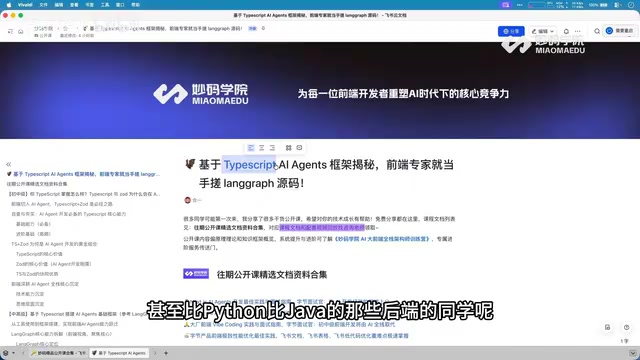
Here's a noteworthy observation: for TypeScript-based AI Agent development, frontend engineers may actually have an advantage over Python/Java backend developers. This isn't an exaggeration — it's based on the following realities:
- LangChain.js / LangGraph.js and similar frameworks are already very mature, with a complete TypeScript ecosystem
- Full-stack roles naturally require both frontend and backend capabilities, and the path from frontend engineer to full-stack is shorter
- The ultimate form of AI applications is products, and products cannot exist without excellent interaction experiences — this is exactly the home turf of frontend engineers
Deconstructing LangGraph's Core Design Philosophy
From LangChain to LangGraph: Why Graph Structures Are Needed
To understand LangGraph, you first need to understand what problem it solves. LangChain was created by Harrison Chase in late 2022 as an AI application development framework, initially launched in Python, with a JavaScript/TypeScript version (LangChain.js) following later. LangChain's core abstraction is the Chain — linking multiple processing steps into a linear pipeline, suitable for linear AI workflows. But real Agent scenarios are far more complex than linear processes:
- Agents need iterative reasoning: think → act → observe → think again
- Agents need conditional branching: taking different paths based on different results
- Agents need state management: maintaining context across multiple interaction rounds
As Agent application complexity grew, linear chains couldn't express control flows like loops and branches, and LangGraph emerged to fill this gap. LangGraph draws from the concepts of Finite State Machines (FSM) and dataflow programming, modeling the Agent's execution process as a directed graph where each node is a computational unit and edges define state transition rules. LangGraph.js was officially released in 2024, deeply integrated with LangChain.js, and has become the recommended approach for building production-grade Agents.
LangGraph's core idea is to replace Chains with Graphs, using Nodes and Edges to describe the Agent's behavioral flow. This design naturally supports loops, branches, and complex state transitions.
Three Core Concepts: State, Node, Edge
LangGraph's architecture can be broken down into three core elements:
1. State
State is the data container that persists throughout the entire graph execution process. In TypeScript, we can define it with an interface:
interface AgentState {
  messages: Message[];
  currentStep: string;
  toolResults: Record<string, any>;
}
LangGraph's state-graph-driven design has deep theoretical roots in the Finite State Machine (FSM) from computer science. An FSM is a computational model consisting of a finite number of states, transition rules between states, and trigger conditions, widely used in compiler design, network protocols, game AI, and other domains. LangGraph makes two key extensions to the FSM: first, states are no longer simple enumerated values but composite objects that can carry rich data (such as message history, tool results, etc.); second, state transitions can not only be based on deterministic conditions but can also be dynamically determined by LLM output, giving the graph's execution path intelligent decision-making capability. This "data-driven dynamic state machine" is the architectural foundation that enables Agents to handle open-ended tasks.
2. Node
Each node is a processing function that receives the current state and returns the updated state. Nodes can be any logical unit — LLM calls, tool execution, conditional checks, etc.
3. Edge
Edges define the transition relationships between nodes, including normal edges (fixed transitions) and conditional edges (dynamically determining the next node based on state).
Implementing a Graph Execution Engine in TypeScript
With the core concepts understood, let's implement a simplified version of the LangGraph execution engine from scratch. The core logic is actually not that complex:
class StateGraph<T> {
  private nodes: Map<string, (state: T) => Promise<Partial<T>>>;
  private edges: Map<string, string | ((state: T) => string)>;

  addNode(name: string, fn: (state: T) => Promise<Partial<T>>) {
    this.nodes.set(name, fn);
  }

  addEdge(from: string, to: string) {
    this.edges.set(from, to);
  }

  addConditionalEdge(from: string, router: (state: T) => string) {
    this.edges.set(from, router);
  }

  async run(initialState: T): Promise<T> {
    let state = { ...initialState };
    let currentNode = 'start';

    while (currentNode !== 'end') {
      const nodeFn = this.nodes.get(currentNode);
      const update = await nodeFn(state);
      state = { ...state, ...update };

      const edge = this.edges.get(currentNode);
      currentNode = typeof edge === 'function' ? edge(state) : edge;
    }

    return state;
  }
}
This code demonstrates the core execution loop: get the current node → execute the node function → update state → determine the next node based on edges → repeat until completion.
Several key design decisions are worth noting here:
- Generics
<T>allow state types to be checked at compile time, avoiding runtime type errors Partial<T>as the node return value means each node only needs to return the portion of state it modifies- Conditional edges implemented as functions dynamically determine the transition direction based on current state — this is the key to how an Agent can "make decisions"
TypeScript's type system plays a critical architectural constraint role here. Generics allow developers to define parameterized types, enabling core classes like StateGraph to adapt to any state structure while catching type mismatches at compile time. Partial<T> is a built-in utility type in TypeScript that makes all properties of type T optional, meaning in the Agent context that each node only needs to declare the state fields it modifies rather than returning the complete state object. Additionally, TypeScript's Union Types and Discriminated Unions can precisely model different state phases of an Agent, and combined with Exhaustiveness Checking, ensure all state branches are correctly handled, significantly reducing the risk of logic omissions in complex Agent systems.
Agent Design Patterns in Practice
ReAct Pattern: The Most Classic Agent Paradigm
In real-world development, the most commonly used Agent pattern is ReAct (Reasoning + Acting). This pattern originates from the 2022 paper "ReAct: Synergizing Reasoning and Acting in Language Models" co-authored by Princeton University and Google Brain. The paper proposes that having LLMs alternate between reasoning (Thought) and acting (Action), while observing action results (Observation), can significantly improve model performance on complex tasks. Compared to pure reasoning (Chain-of-Thought) or pure action (directly calling tools), the ReAct pattern allows models to dynamically adjust strategies based on intermediate results, providing stronger self-correction capabilities.
Describing this pattern in LangGraph terms:
- LLM Node: Receives messages, decides whether to answer directly or invoke a tool
- Tool Execution Node: Executes the tool chosen by the LLM, obtains results
- Conditional Edge: If the LLM decides to call a tool, transition to the tool node; if answering directly, transition to the end
- Loop Edge: After tool execution completes, return to the LLM node to continue reasoning
In engineering implementation, ReAct's cyclical nature (Think→Act→Observe→Think...) maps directly to cycles in the graph structure — this is the core advantage of LangGraph over linear Chain architectures. This cyclic structure is the fundamental advantage of LangGraph over LangChain — it naturally supports the Agent's iterative reasoning process.
Learning Path for TypeScript Engineers
For TypeScript engineers looking to get started with AI Agent development, here's a recommended progression:
- Master the design philosophy first: Even without using the LangGraph framework, learn to design Agent workflows with graph-based thinking
- Start with simple scenarios: First implement a single-tool ReAct Agent, then gradually add complexity
- Prioritize state design: The Agent's state structure determines the system's extensibility and debuggability
- Leverage TypeScript's type system: Use generics and type inference to validate Agent state transitions at compile time
Conclusion: A Mindset Upgrade from Calling APIs to Building Systems
AI application development is evolving from "calling APIs" to "building systems." The graph-driven Agent orchestration philosophy represented by LangGraph is the core paradigm for constructing complex intelligent agents. And TypeScript, with its full-stack capabilities and type safety features, is becoming an important technology choice for AI Agent development.
Whether or not you directly use the LangGraph framework, understanding its underlying design principles — state-graph-driven architecture, node-based orchestration, and conditional loop transitions — will significantly enhance your engineering ability to build AI applications. This isn't just a matter of technology stack choice; it's a mindset upgrade from "writing endpoints" to "building systems."
Key Takeaways
- AI application development complexity is rising sharply; simple API calls no longer meet enterprise needs — mastering complex Agent orchestration is essential
- TypeScript, with its full-stack consistency advantage, is becoming an important technology choice in AI Agent development, especially suited for full-stack roles
- LangGraph's core idea is replacing Chains with Graphs, describing complex Agent behavior through three elements: Nodes, Edges, and State
- The ReAct pattern is the most classic Agent paradigm, and LangGraph's cyclic graph structure naturally supports the Agent's iterative reasoning process
- Even without directly using the LangGraph framework, understanding its state-graph-driven, node-based orchestration design philosophy can significantly improve AI application development capabilities
Related articles
 Tutorials
ChatGPT Plus Subscription Guide: Are GPT-5.5, image-2, and Codex Worth the Upgrade?
A detailed look at ChatGPT Plus features — GPT-5.5, image-2, and Codex — with a Plus vs Pro comparison and a complete step-by-step subscription guide for users outside the US.
 Tutorials
Harness AI Engineering in Practice: Using Claude Code to Master Enterprise-Level E-Commerce Development
Deep dive into Harness AI Engineering: master enterprise e-commerce development with Claude Code using the Rules, Skills, Wiki, and Changes framework.
 Tutorials
Cursor + Codex Dual-IDE Collaboration: A Practical Methodology for Open-Source Project Customization
A complete methodology for open-source project customization based on real-world experience, detailing the Cursor+Codex dual-IDE workflow, seven-stage process, MVP validation, and AI source code reading techniques.