In-Depth Analysis of C++ + AI Full-Stack Training Programs: Career Transition Paths for Developers in 2026

How C++ developers can boost competitiveness by integrating AI skills through structured training programs.
Using Bilibili creator "程序员老秦"'s 2026 C++ & AI Full-Stack Development Plan as a case study, this article analyzes training programs that blend C++ with AI technologies. The curriculum spans C++ fundamentals (STL, Linux, Qt) through AI applications (YOLO detection, CUDA acceleration, AI Agents), while an interest-aligned employment model — where instructor bonuses are tied to student offer quality — drives meaningful service differentiation.
Overview: Why C++ Developers Need to Embrace AI
In today's job market, competition for traditional C++ roles is intensifying, and pure systems-level development is no longer a universal ticket to employment. A growing number of training programs and tech communities are blending C++ with AI technologies to cultivate "C++ + AI" hybrid talent. This article uses the 2026 C++ & AI Full-Stack Development Plan published by Bilibili creator "程序员老秦" (Programmer Lao Qin) as a case study to analyze the curriculum design logic, service model innovations, and practical value of this type of training product.
Curriculum Structure: A Complete Tech Stack from C++ Fundamentals to AI Applications
Foundation Phase: Solid C++ Fundamentals
The foundational curriculum covers the core skill set every C++ developer needs:
- C++ Syntax & STL: Language fundamentals and the Standard Template Library
- Data Structures & Algorithms: Essential algorithmic skills for technical interviews
- Linux Systems & Network Programming: Backend development foundations
- Qt/QML Client Development: Desktop application development capabilities
- MySQL Database: Data storage and management
These topics represent the standard skill requirements for C++ backend/client development and form the baseline for landing roles at major tech companies.
About STL: STL (Standard Template Library) is the core component of the C++ standard library, designed by Alexander Stepanov and incorporated into the C++98 standard in 1994. It provides a complete system of containers (vector, map, unordered_map, etc.), iterators, algorithms (sort, find, transform, etc.), and function objects, all built on the principles of generic programming. STL's design philosophy is "zero-overhead abstraction" — high-level abstractions should not incur runtime performance penalties — which aligns closely with C++'s core design principles. In major tech company interviews, the underlying implementation details of STL (such as red-black trees and hash table rehashing mechanisms) are frequently tested topics. A deep understanding of STL is also a prerequisite for writing high-performance C++ code.
About Qt/QML: Qt is a cross-platform C++ application framework developed by Norwegian company Trolltech (now Qt Group). Since its release in 1991, it has become one of the de facto standards for desktop and embedded GUI development. QML (Qt Modeling Language) is a declarative UI language introduced in Qt 5, drawing on the syntax styles of CSS and JavaScript. It allows developers to describe interface logic in a data-driven manner, significantly reducing the development cost of complex animations and smooth interactions. Qt is widely used in industrial control, medical devices, automotive HMI (Human-Machine Interface), and other domains. Domestic products like WPS and Tencent Meeting also use Qt for their desktop clients. For C++ developers, Qt/QML is an important entry point into client-side development and a key differentiator from pure backend developers.
Project Phase: Hands-On Training Across Multiple Directions
The curriculum includes projects spanning multiple directions. Students are advised to prepare at least two directions to maximize job-seeking flexibility:
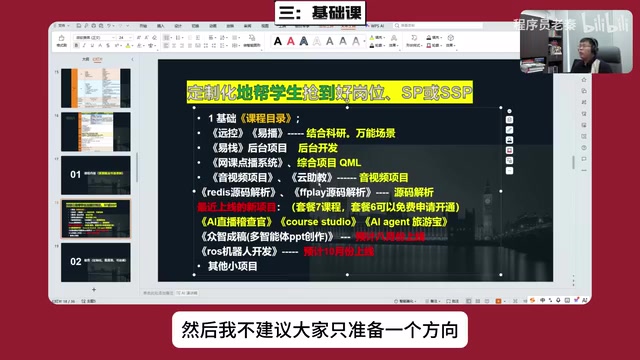
- Remote Control Project: A versatile project with research application framing, supporting customized resume presentation
- Courier Station Backend Project: Targeted at backend development roles
- Online Course Streaming System: A comprehensive project covering QML, audio/video, and backend services
- CoreStudio Live Streaming System: A complete solution integrating capture, streaming, and recording
- Redis Source Code Analysis: A high-frequency topic in backend technical interviews
AI Integration Courses: A Timely Technical Upgrade
The most noteworthy addition is the AI-related curriculum:
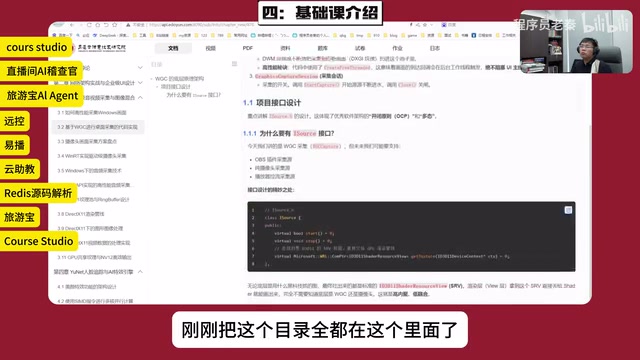
- AI Live Stream Content Moderation: YOLO object detection + CNN convolutional neural networks for real-time violation detection in live streams
- CUDA Accelerated Computing: GPU programming and HPC (High-Performance Computing) applications in engineering
- AI Agent Travel Assistant: Covers Prompt Engineering, RAG, MCP protocol, and other cutting-edge Agent technologies
- Multi-Agent PPT Creation (expected August release): Real-world applications of multi-agent collaboration
- Ground Robot Development (expected October release): AI applications in robotics
About YOLO and CNN: YOLO (You Only Look Once) is currently the most mainstream real-time object detection algorithm family in the industry. Proposed by Joseph Redmon in 2015, its core idea is to reframe object detection as a single-pass regression problem, achieving several times the speed of traditional two-stage detectors like Faster R-CNN. CNN (Convolutional Neural Network) serves as the underlying feature extraction architecture, automatically learning spatial hierarchical features from images through convolutional kernels. In live stream moderation scenarios, YOLO can identify violations in milliseconds. Combined with high-performance C++ inference deployment (e.g., TensorRT acceleration), it can handle the real-time processing demands of high-concurrency live streams. This technology combination has already been deployed at scale in commercial scenarios such as security surveillance, industrial quality inspection, and content moderation.
About CUDA: CUDA (Compute Unified Device Architecture) is a parallel computing platform and programming model introduced by NVIDIA in 2006. It allows developers to use C/C++ to directly schedule thousands of GPU compute cores. Unlike CPUs, which excel at serial logic, the massively parallel architecture of GPUs is naturally suited for matrix operations, image processing, and AI inference workloads. The HPC field has long relied on CUDA, and with the explosion of deep learning, CUDA has become the underlying acceleration engine for mainstream frameworks like PyTorch and TensorFlow. For C++ developers, mastering CUDA means being able to directly optimize model deployment in high-performance scenarios such as inference engines, autonomous driving, and quantitative trading — a core competitive advantage that sets them apart from typical algorithm engineers.
About RAG and AI Agents: RAG (Retrieval-Augmented Generation) is the mainstream engineering solution for addressing the "hallucination" problem in large language models. Its core approach is to retrieve relevant document snippets from an external knowledge base before generating a response, then inject them as context into the prompt — enabling the model to answer based on real data rather than generating content from scratch. AI Agents build on top of LLMs by giving models the autonomous execution capability of "planning → tool invocation → feedback," allowing them to decompose complex tasks and call external tools such as search engines, code executors, and APIs. MCP (Model Context Protocol) is an open protocol released by Anthropic in late 2024, designed to standardize how agents connect with external tools and data sources. It is widely regarded as critical infrastructure for the Agent ecosystem. Together, these three technologies form the core tech stack for enterprise-grade AI application development today.
This "C++ as primary + AI as supplement" combination strategy reflects the genuine market demand for hybrid talent. Companies are no longer satisfied with pure systems development capabilities — they want developers who can integrate AI into their products.
Service Model: An Interest-Aligned Employment Guarantee Mechanism
Dedicated Mentorship and Response SLAs
The most distinctive aspect of this training program is its service design:
- Dedicated Mentorship: Each student is assigned a lead instructor and a responsible teaching assistant, with clear accountability
- Response Time SLA: Queries answered within 30 minutes on business days; an automatic alert is triggered if a response takes more than 20 minutes
- Penalty and Contribution System: Instructors face financial penalties for substandard service
The most critical element is the shared-interest mechanism — instructor bonuses are directly tied to the quality of offers students receive:
| Offer Level | Bonus Multiplier |
|---|---|
| Standard offer | 1x bonus |
| High-salary offer | 1.5x bonus |
| Top-tier company offer | 3x bonus |
| No offer secured | Performance deduction |
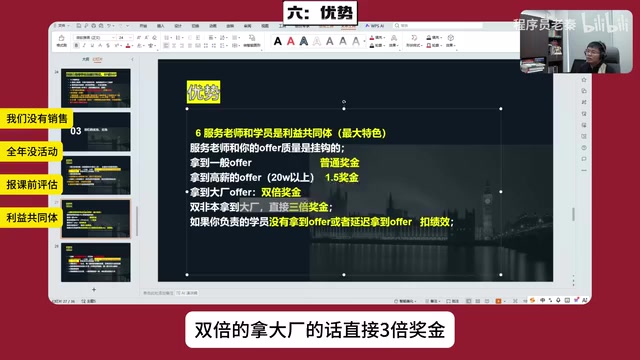
This mechanism structurally ensures that instructors are incentivized to help students land the best possible offers — rather than simply collecting tuition and moving on.
Related articles
 Industry Insights
OpenAI's Internal Codex Usage Surges 56x — AI Coding Is Eating Everything
OpenAI reveals internal Codex usage data: Research up 56x, Customer Support 32x, Engineering 27x, Legal 13x since Nov 2025. AI coding tools are penetrating every department faster than expected.
 Industry Insights
IRS Fully Embraces Claude AI, Accelerating Federal Government's AI Adoption
The IRS is recruiting staff with 24/7 Claude AI access, marking Anthropic's breakthrough into the federal government. Explore the strategic implications and tax use cases.
 Industry Insights
The IRS Mobile App Debate: A Trust Crisis in Government Digital Transformation
The IRS's proposed mobile app has sparked heated debate. This article analyzes the core arguments, exploring data security, privacy, and the trust crisis in government digital transformation.