In-Depth Review of Free AI Aggregator Sites: Is It Legit to Freeload GPT-5.5 and Grok 4.2?

Free AI aggregator sites offering GPT-5.5 and Grok 4.2 pose serious privacy and security risks.
This article examines free AI aggregator sites promoted on Bilibili that claim to offer unlimited access to top models like GPT-5.5, Grok 4.2, and Claude 4.7. It reveals how these sites use reverse proxies and shared account pools, exposes fabricated model version numbers, analyzes data privacy risks from man-in-the-middle architectures, and recommends safer alternatives including official APIs, Chinese AI models, and local open-source deployment.
Introduction: The Temptation of Free Access to Top AI Models
Recently, a wave of popular videos has appeared on Bilibili (B站) claiming that a single "incredible hidden gem site" lets you use ChatGPT 5.5, Grok 4.2, Claude 4.7, and other world-class AI models for free — no VPN required. These videos showcase a range of features, including one-click access to major AI platforms, cross-model context retention in conversations, and unlimited usage.
But are these sites truly a "freeloader's dream," or do they lurk in a risky gray area? This article provides an in-depth analysis from three perspectives: functionality, underlying technology, and security.
Full Feature Overview: Claims of Covering All Major Global AI Models
Based on the video demonstrations, these AI aggregator sites primarily offer the following features:
One-Stop Access to Multiple Models
The site claims to integrate virtually every mainstream AI model currently available, including:
- OpenAI series: GPT-5.5, GPT-3.1 Pro, AMG2 image generation model, etc.
- xAI series: Full Grok 4.2 model lineup
- Anthropic series: Claude OPUS 4.7
- Chinese models: DeepSeek V4 (with web search and deep thinking capabilities)
Users don't need to register accounts on individual platforms or change their network settings — they can switch between all models on a single page.
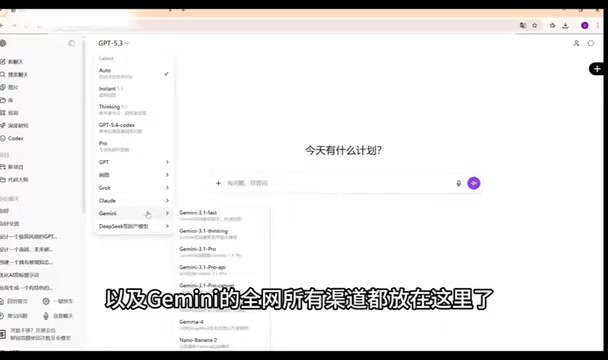
It's worth noting that these AI models each follow their own versioning conventions. OpenAI progressed from GPT-3 to GPT-4o, then to the o1 and o3 series — version numbers don't simply increment but reflect the evolution of underlying architectures. Anthropic's Claude series advanced from Claude 1 to Claude 4, with Opus, Sonnet, and Haiku representing different tiers within the same generation, corresponding to high-performance, balanced, and lightweight use cases respectively. xAI's Grok series has rapidly iterated from Grok 1 to Grok 3 and Grok 4. Understanding these official naming conventions is crucial, because gray-market sites frequently use fabricated version numbers (like "GPT-5.5" or "Claude 4.7") to create the illusion of "exclusive resources," exploiting users' unfamiliarity with versioning to mislead them.
Cross-Model Context Retention
The videos demonstrate an appealing feature — when switching between different models within the same chat window, the conversation context is preserved. For example, you could first use GPT-5.5 to generate an interactive mini-game, then switch to another model to continue the discussion, and the subsequent model can "see" the previous conversation and offer supplementary suggestions.

This "seamless switching" experience is genuinely something that official AI platforms don't currently offer — typically, conversations on each platform are completely independent, and cross-platform comparisons require manual copy-pasting.
However, it's important to understand that large language models inherently lack cross-platform memory capabilities — every API call is stateless. The so-called "context retention" is actually achieved through prompt engineering: the site's backend concatenates all previous conversation turns into a complete messages array and sends it as input with each new request to the target model. While this approach can simulate continuous conversation, it has obvious limitations — as conversation turns accumulate, the concatenated context rapidly consumes the model's context window, causing earlier conversations to be truncated or response quality to degrade. Additionally, every model switch requires resending the complete history, multiplying token consumption and making operational costs far higher than they appear on the surface.
Official Account Pool and Unlimited Usage
The site claims to have "hundreds of official accounts" built in. When one account reaches its usage limit, users can "switch rides" with one click to continue using another account, thereby bypassing official usage restrictions.
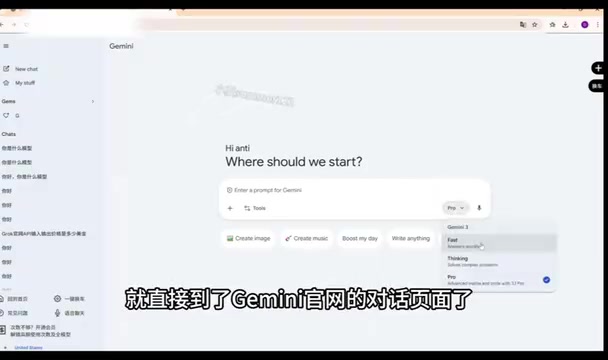
Technical Analysis: How Free AI Aggregator Sites Actually Work
Reverse Proxy and Shared Account Mechanism
From a technical perspective, the core principle behind these sites isn't particularly complex:
- Reverse Proxy: The site acts as an intermediary layer between users and the official AI platforms, forwarding user requests to official APIs or web interfaces and returning the results to users. Users appear to be "directly accessing the official site," but in reality, all traffic passes through a third-party server.
A reverse proxy is a common server deployment pattern in internet architecture. Unlike a forward proxy (where users actively use a proxy to access external resources), a reverse proxy sits in front of the server side, and clients don't know which backend server they're actually accessing. Nginx, Cloudflare, and similar tools are widely used reverse proxy solutions that serve legitimate purposes like load balancing, SSL termination, cache acceleration, and security protection. However, in the context of AI aggregator sites, the reverse proxy is used to intercept communications between users and official AI services — meaning the intermediary layer can fully read, log, and even tamper with data transmitted in both directions, creating a serious Man-in-the-Middle Attack risk.
- Shared Account Pool: Site operators register or purchase large numbers of paid accounts in bulk (such as ChatGPT Plus/Pro subscriptions), then share these accounts across all users. The "switch rides" feature is essentially just switching between different shared accounts.
From a technical implementation standpoint, operators typically manage the login sessions (Session/Cookie) of hundreds of accounts through automated scripts, distributing user requests across different accounts via polling or load-balancing strategies. This model violates the Terms of Service of virtually every AI platform — OpenAI, Anthropic, and others explicitly prohibit account sharing and API key resale. Once abnormal usage patterns are detected (such as a single account receiving a high volume of requests from different IPs in a short period), accounts are immediately banned. More seriously, in some jurisdictions, unauthorized resale of others' services may constitute computer fraud or intellectual property infringement.
- Context Concatenation: The cross-model context retention feature most likely works by having the site's backend send previous conversation history as part of the new prompt to the switched model, rather than the models themselves having any cross-platform memory capability.
Questionable Authenticity of Model Versions
The version numbers mentioned in the videos — "GPT-5.5," "Grok 4.2," "Claude OPUS 4.7" — deserve special scrutiny. As of now:
- OpenAI has indeed released GPT-4o, o1, o3, and other models, but the specific version designation "GPT-5.5" should be verified against official announcements
- Grok's latest versions iterate rapidly, and whether "4.2" is an official version number is worth confirming
- Claude's latest versions include Claude 4/Opus 4, and the version number "4.7" also needs verification
These version numbers may be exaggerated or misleading, and users have no easy way to verify which model version they're actually calling. In fact, even with API calls, the returned model identifier can be tampered with by the intermediary layer — the site could easily package a lower-version model's response as output from the "latest version," and ordinary users would have virtually no way to tell the difference.
Security Risks and Legal Concerns: The True Cost Behind "Free"
Data Privacy Risks
This is the most critical concern. Since all conversations are routed through third-party servers, every piece of information you input — including personal details, work documents, code snippets, and more — could be logged and stored by the site operators.
When users access AI services through third-party aggregator sites, the data flow path changes from "User → Official AI Server" to "User → Third-Party Server → Official AI Server." This additional intermediary introduces multiple privacy risks. First, even if HTTPS encryption is used between the user and the third-party site, data exists in plaintext on the third-party server, allowing operators to read all inputs and outputs in full. Second, the storage location, retention period, and access permissions for this data are completely opaque — it could be stored on overseas servers, used to train other models, or sold to data brokers. Under China's Personal Information Protection Law and Data Security Law, collecting and processing personal information without explicit user consent is illegal, but these sites are typically registered in jurisdictions beyond regulatory reach, making it extremely difficult to seek recourse.
Unlike using official services directly, these third-party sites typically:
- Have no clear privacy policy
- Offer no data encryption guarantees
- Undergo no compliance audits
- Have opaque operating entities
Account Security and Compliance Issues
The shared account pool model itself violates the Terms of Service (ToS) of every major AI platform. This means:
- Accounts can be banned at any time, with no guarantee of service stability
- Your conversations may be mixed with other users' conversations under the same account
- The site could shut down at any moment with no recourse whatsoever
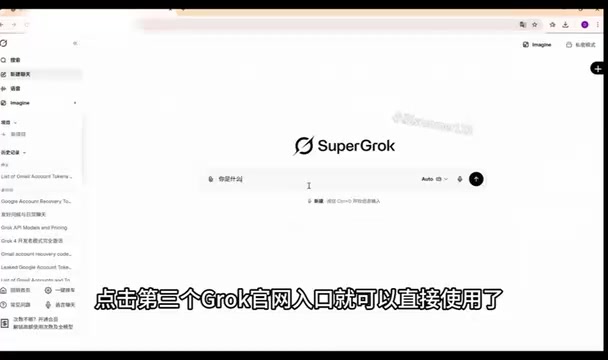
The Business Logic of Traffic Monetization
You may not have noticed, but these videos employ the classic "follow + like/favorite/share + comment to get the link" traffic-driving model. Under this model, the site's true commercial purposes may include:
- Free access initially to build an audience, followed by paid subscription tiers later
- Collecting user data for secondary monetization
- Generating revenue through ads or promotions
- Building user dependency before raising prices
There's no such thing as a free lunch — when a product is free, you yourself are likely the product. This logic has been repeatedly validated across the internet industry — from early free antivirus software bundled with unwanted installations, to social platforms using user data for targeted advertising. "Free" has never truly been free; it simply shifts the cost to places users are less likely to notice.
Safer Alternatives for Using AI Models
If you genuinely need low-cost access to multiple AI models, here are some more reliable options:
- Official free tiers from each platform: ChatGPT, Claude, Gemini, and others all offer free versions. While they have usage limits, data security is guaranteed.
- Chinese AI models: DeepSeek, Kimi, Tongyi Qianwen (通义千问), ERNIE Bot (文心一言), and other domestic models are completely free and require no VPN, with performance approaching world-class levels.
- Official API pay-as-you-go: If your usage is modest, the cost of using official APIs may be far lower than you'd expect. For example, OpenAI's GPT-4o API pricing is approximately $2.50 per million input tokens — a typical conversation costs less than 1 cent.
- Local deployment of open-source models: Open-source models like Llama and Qwen can run locally, giving you complete control over data privacy.
Regarding local deployment of open-source models, a fairly mature technical ecosystem has already emerged. Meta's Llama series, Alibaba's Qwen series, Mistral AI's Mistral/Mixtral series, and others all offer open-source versions with various parameter sizes. Using inference frameworks like Ollama, vLLM, and llama.cpp, users can run models ranging from 7B to 70B parameters on consumer-grade hardware. For example, a single RTX 4090 GPU (24GB VRAM) can smoothly run a 70B parameter model after quantization processing. Quantization reduces the numerical precision of model weights (e.g., from FP16 to INT4), dramatically reducing VRAM usage within an acceptable performance trade-off. For enterprises and individual developers who prioritize data privacy, local deployment is currently the safest way to use AI — all data stays entirely within the local environment.
Conclusion
These AI aggregator sites do offer genuine convenience at the feature level — one-stop access to multiple models, cross-model context retention, and bypassing usage limits. However, from the perspectives of security, compliance, and sustainability, the risks far outweigh the benefits.
For everyday users, we recommend prioritizing official platform services or Chinese AI models. For users with professional needs, official APIs or enterprise subscriptions are the proper path. When choosing AI tools, security and reliability are always more important than free.
Related articles

Disaster and Glory of the Apollo Program: The History We Must Revisit Before Returning to the Moon
From the fatal Apollo 1 fire to Apollo 8's daring lunar orbit to Apollo 11's successful landing—revisiting the disasters, fears, and compromises of the Apollo program and their lessons for today's return to the Moon.

Netflix Trust Exercise Turns Into Firing Trap: Where Are the Boundaries of Corporate Trust?
A Netflix employee was fired after sharing private info in a trust exercise. We analyze the risks of corporate trust exercises and how employees can protect themselves.

AMD CDNA5 Architecture Deep Dive: Technical Evolution and the AI Computing Competition Landscape
Deep analysis of AMD's CDNA5 architecture covering Chiplet packaging upgrades, HBM memory evolution, and low-precision compute optimization, examining how AMD challenges NVIDIA's AI chip dominance.