Introduction to AI Agents: Core Concepts, Principles, and Real-World Examples

Learn what AI agents are, how they work, and explore real-world examples like Manus and Deep Research.
This article demystifies AI agents by breaking down their core definition — autonomous perception, decision-making, and action — and illustrating the concept through three representative products: OpenAI Deep Research, China's Chensi, and Manus. It also explains the underlying engineering principles, including Shell execution, the ReAct paradigm, and the closed-loop feedback architecture that powers modern agents.
What Is an AI Agent?
With the explosive growth of large language model (LLM) technology, "Agent" has become one of the hottest concepts in the AI field. Many beginners still find the term abstract. If you want to build your own AI agent, you first need to answer a fundamental question: What exactly is an AI agent?
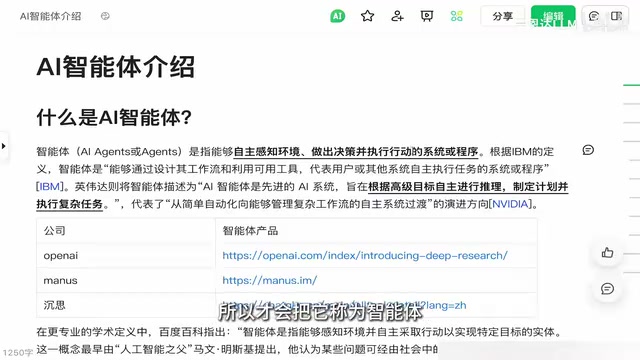
The term AI Agent has a clear definition: a system or program capable of autonomously perceiving its environment, making decisions, and taking actions.
Historical Background: The concept of an "Agent" originated at the intersection of artificial intelligence and philosophy. As early as 1995, Russell and Norvig defined a "rational agent" in their classic textbook Artificial Intelligence: A Modern Approach as an entity that perceives its environment and takes actions to maximize expected utility. This idea was systematically developed in reinforcement learning — the Markov Decision Process (MDP) provides a rigorous mathematical framework for the agent's "perceive–decide–act" loop. In the era of large models, the emergent capabilities of LLMs have endowed agents with unprecedented natural language understanding and reasoning abilities, rapidly transforming them from academic concepts into deployable engineering products.
Breaking down this definition reveals three key elements:
- It is fundamentally a program: An agent is, at its core, a piece of code — nothing mysterious about it.
- Autonomous perception of the environment: Take an intelligent customer service bot as an example — user queries can vary wildly, but the agent can assess the context and determine how to respond.
- Decision-making and execution: After making a judgment, the agent autonomously carries out the corresponding action.
The entire "perceive–decide–act" loop is completed autonomously by the program, behaving as if it possesses intelligence — hence the name "agent." IBM, NVIDIA, and other major tech companies have offered similar definitions in their technical documentation, which interested readers can explore further.
Three Representative AI Agent Products
Pure definitions can feel abstract, so looking at real products makes the concept much more intuitive. There are currently three highly representative AI Agent products worth paying close attention to.
OpenAI Deep Research and China's "Chensi"
The first is OpenAI's Deep Research. Its long-term goal is to advance toward AGI (Artificial General Intelligence), and at this stage it primarily helps users tackle complex reasoning and research tasks.
What is AGI?: AGI (Artificial General Intelligence) refers to an AI system capable of performing any intellectual task across domains at a human level — in sharp contrast to today's "Narrow AI." Narrow AI can only handle specific tasks, such as image recognition or speech transcription, while AGI possesses transfer learning, self-planning, and open-domain reasoning capabilities. OpenAI defines AGI as "a system that outperforms humans on most economically valuable tasks" and treats it as the company's core mission. Deep Research is seen as a milestone on the path toward AGI — its significance lies in being the first AI system to demonstrate systematic reasoning ability comparable to a professional researcher on complex, open-ended research tasks.
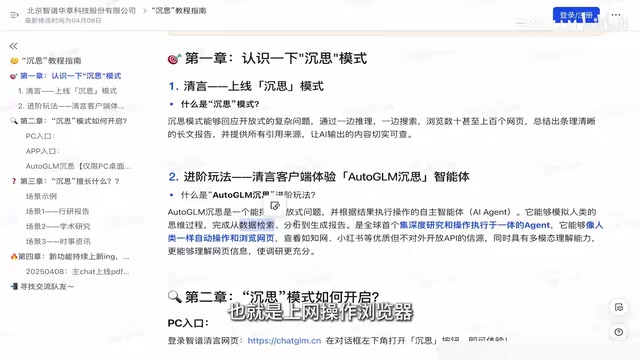
On the Chinese side, "Chensi" (陈思) by Zhipu Youth is functionally very similar to Deep Research, with the tagline "think and act at the same time." Chensi is explicitly positioned as an AI agent, and its defining feature is the ability to search for data while reasoning — browsing the web, controlling a browser to gather information, and then bringing that information back to continue its analysis, resulting in more comprehensive and in-depth research outputs.
Chensi has already released a desktop client. Once users install the browser extension, it can automatically control the browser to read content and generate reports.
Manus: An Agent Exploration Closer to AGI
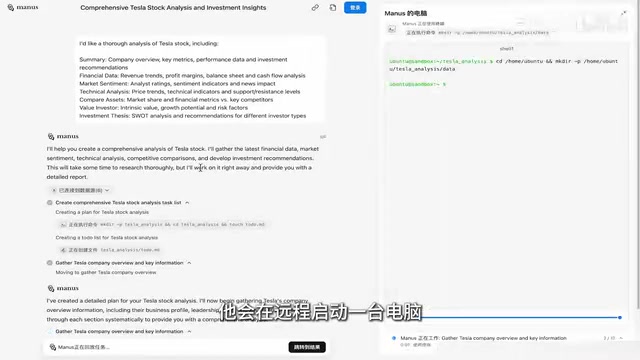
The second product is Manus, considered one of the agents closest to a general artificial intelligence form today, with a visually striking experience.
Take "conducting an in-depth analysis of Tesla's stock" as an example. Manus will remotely launch a computer and execute a large number of complex tasks on that machine — far more than just browsing web pages.
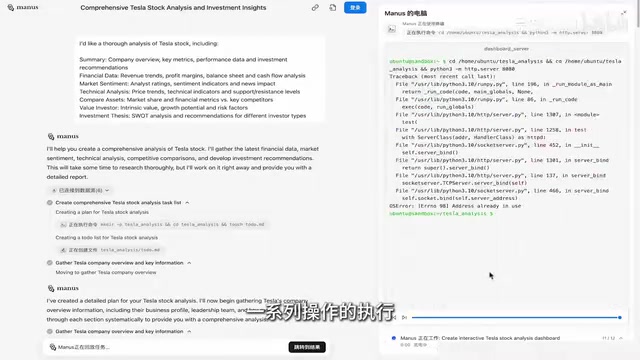
Manus's most critical capability is its ability to execute Shell commands.
What does Shell execution capability mean?: The Shell (command-line interface) is the low-level interaction interface provided by an operating system, allowing programs to directly invoke system resources: file read/write, process management, network requests, code compilation and execution — virtually all computer operations can be performed through Shell commands. Traditional AI is confined to a "sandbox" environment and cannot produce real effects on external systems, limited to returning text. Once an AI gains Shell execution capability, its action space expands from "language space" to "full computer functionality space" — this is the fundamental difference between Manus and purely conversational AIs like ChatGPT. OpenAI's Code Interpreter, Anthropic's Computer Use, and the open-source LangChain Tool Calling framework all represent different engineering approaches to achieving this goal of "opening the execution channel."
This means Manus can perform comprehensive management of an operating system:
- Read and write files, create directories
- Write, deploy, and run code
With Shell execution capability, the boundaries of what an agent can do expand dramatically. Every step in the analysis process is generated by Manus's autonomous decision-making — nothing is pre-scripted by a human. In the end, it produced a complete Tesla stock analysis dashboard website — also created entirely by Manus itself.
The Core Principles Behind AI Agents
Seeing Manus's powerful capabilities may make it seem out of reach. But once you understand the underlying engineering principles, you can absolutely build something similar yourself.
Manus's core capability essentially comes down to script execution. As long as you open up the script execution and Shell invocation channel — enabling the large model to proactively issue commands — you can quickly replicate similar functionality. The entire workflow can be summarized in four steps:
- Have the LLM understand the task — perceive the environment and user intent
- Have the LLM make autonomous decisions — determine what action to take next
- Open the execution channel — let the model truly "take action" via Shell, browser extensions, etc.
- Create a closed-loop feedback cycle — return execution results to the model to trigger the next round of reasoning
The ReAct Paradigm: The Engineering Foundation of This Loop: Modern AI agents widely adopt the "ReAct" paradigm (Reasoning + Acting), formally proposed by Google researchers in 2022. This paradigm has the large model alternate between "Thought" and "Action" during the reasoning process, feeding each action's result (Observation) back into the model to continue reasoning, forming a multi-iteration closed loop. This architecture addresses the core problem that single-pass reasoning cannot handle complex, multi-step tasks. At the engineering implementation level, mainstream frameworks such as LangChain, AutoGen, and CrewAI all use ReAct or its variants as the underlying scheduling logic for agents. Understanding this loop is the key cognitive leap that takes a developer from "calling an API" to "building a truly intelligent agent."
This "think–act–feedback" cycle is the shared technical foundation that Deep Research, Chensi, Manus, and most mainstream agents all follow.
Conclusion: Building Agents Is More Accessible Than You Think
From conceptual definition to real-world product examples, the core logic of AI agents is actually quite clear: it is a program capable of autonomously perceiving, deciding, and acting.
Whether it's Deep Research with its complex reasoning, Chensi's "think and act simultaneously" approach, or Manus controlling an entire computer — the impressive capabilities all follow similar underlying engineering principles. For learners, mastering these principles — especially bridging the gap between a large model and an execution environment (Shell, browser) — provides the foundational skills needed to build your own AI Agent.
Agent Engineering is becoming a core direction for deploying large model applications in the real world. Understanding and practicing in this field is an opportunity no AI developer can afford to miss.
Key Takeaways
Related articles

The Truth Behind Codex 'Build a Website in 5 Minutes': AI Isn't Creating Sites—It's Helping You Copy Them
Exposing the truth behind viral Codex 5-minute website videos: creators aren't building original sites with AI—they're copying shared prompts or scraping others' work. Learn AI coding tools' real limits.

Getting Started with AI Agent Development: A Complete Guide from Concept to Practice
A comprehensive guide to AI Agent architecture and development, covering automated marketing, intelligent customer service, and investment analysis scenarios with single and multi-agent collaboration.

The Truth Behind Codex 'Build a Website in 5 Minutes': AI Isn't Creating Sites — It's Helping You Copy Them
Exposing the truth behind viral Codex 5-minute website videos: creators aren't building original sites with AI — they're copying shared prompts or scraping others' work.