Is GPT Really Approaching the Technological Singularity? Deep Reflections Sparked by a Viral Reddit Post

A viral Reddit joke about 'GPT 9.6' sparks reflection on singularity hype and rational views of LLM progress.
A Reddit post joking that 'GPT is approaching the singularity' reflects the AI community's fatigue with overhyped predictions. This article unpacks the true meaning of the technological singularity, why version numbers don't equal intelligence, and how engineering advances like Scaling Laws, RLHF, and AI Agents represent real yet demystified progress.
The Industry Sentiment Behind a Tongue-in-Cheek Post
Recently, a post sparking heated discussion appeared in Reddit's r/OpenAI community, with a rather exaggerated title—"GPT is getting close to singularity"—and the poster jokingly added, "expecting to see GPT 9.6 by the end of the year."
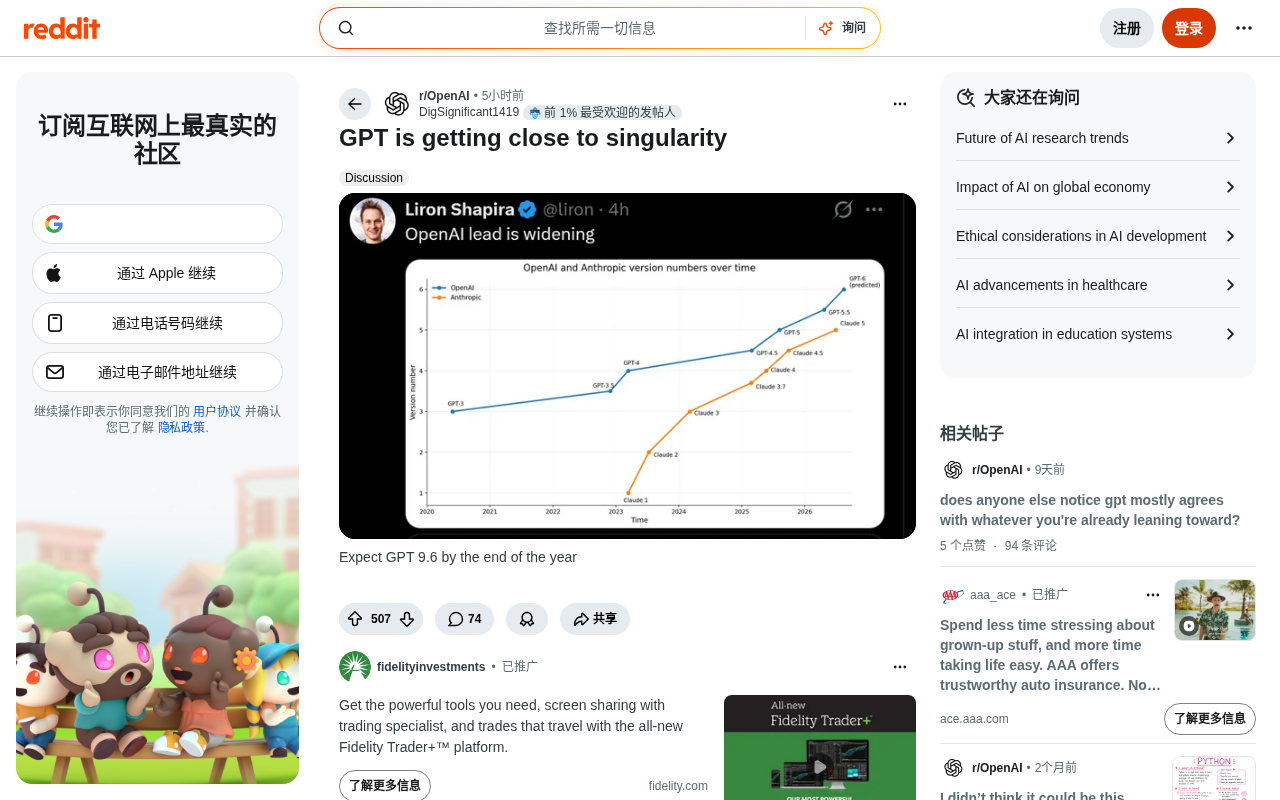
The post itself was brief, even carrying an obvious tone of jest and irony. But it is precisely this half-joking expression that reflects the complex emotions widely present in today's AI community: on one hand, excitement over the rapid leaps in the capabilities of large language models (LLMs); on the other, fatigue and wariness toward the concept of the "Singularity" being overused and overhyped.
What is a Large Language Model (LLM)? A Large Language Model is a massive neural network trained on the Transformer architecture. Through self-supervised learning on enormous amounts of text data, it acquires the ability to understand and generate language. After Google proposed the Transformer architecture in 2017, OpenAI released GPT-1 in 2018, ushering in the LLM era built on the "pre-training + fine-tuning" paradigm. GPT-3 (2020), with its 175 billion parameters, caused a sensation, while ChatGPT (2022) achieved a qualitative leap in conversational ability by introducing Reinforcement Learning from Human Feedback (RLHF), transforming LLMs from research tools into mass-market products. Notably, the core innovation of the Transformer architecture lies in its "Self-Attention" mechanism, which allows the model to process the relationships between words at any position in a sequence in parallel, completely breaking through the bottleneck that previous RNN/LSTM architectures faced with long-range dependencies. It is precisely this feature that made massive parallel training possible.
It's worth noting that Reddit technical communities like r/OpenAI and r/MachineLearning play a unique role in the AI knowledge ecosystem. As one of the world's largest anonymous technical discussion platforms, Reddit's technical subreddits form a distinctive knowledge ecosystem—r/MachineLearning, created in 2009, was one of the earliest online gathering places for AI researchers in both academia and industry, where deep learning pioneers like Yann LeCun and Geoffrey Hinton have participated in discussions directly. The information dissemination mechanisms of such platforms (voting, nested comments, accumulation of user reputation) naturally form a decentralized form of peer review, making it difficult for technical fallacies to survive over the long term. Unlike mainstream media filtered through editorial selection, these communities gather large numbers of frontline engineers, graduate students, and early adopters, whose discussions often combine technical depth with practical experience. Sociologists define such platforms as "Epistemic Communities"—where members collectively calibrate their understanding of a field through shared practice and mutual correction. Such communities are the first to sense the actual boundaries of model capabilities and the first to develop immunity to overmarketing; the ironic culture they cultivate is essentially a collective mechanism of cognitive self-protection.
The so-called "GPT 9.6" claim is obviously an exaggerated take on the pace of OpenAI's version iterations. As of now, OpenAI's publicly available flagship models remain in the GPT-4 series and its subsequent evolutionary stage—far from a version number like "9.6." The poster used this approach to essentially poke fun at the optimistic rhetoric within the community that readily proclaims "artificial general intelligence is imminent."
What Is the "Technological Singularity"?
The Origins and Meaning of the Concept
The concept of the "Technological Singularity" was first prototyped by mathematician John von Neumann—in his conversations with mathematician Stanislaw Ulam in the 1950s, he suggested that technological acceleration would eventually produce "some essential singularity in the history of the race." Von Neumann was one of the most important mathematicians and computer science pioneers of the 20th century; the modern computer architecture "von Neumann architecture" is named after him—this architecture centers on the concept of the "stored program," unifying program instructions and data in memory, read and executed sequentially by the CPU, a design that remains the foundational paradigm of most computer hardware to this day. Precisely because he was deeply involved in the actual construction of early computers, von Neumann's intuitive judgment about computational limits had a practical basis beyond pure thought experiments, and his early thinking about the singularity thus reflected the dual sensitivity of both mathematician and engineer to the limits of exponential growth. Later, science fiction author and computer scientist Vernor Vinge formalized this idea in his 1993 paper "The Coming Technological Singularity," arguing that the singularity would occur between 2005 and 2030—this paper is the landmark text marking the formal entry of singularity theory into academic discussion, in which Vinge explicitly stated that once superhuman intelligence emerges, humans would be unable to predict its consequences. Futurist Ray Kurzweil, in his 2005 book "The Singularity Is Near," used Moore's Law as his core basis to predict that by 2045 humans would deeply merge with machine intelligence, at which point the pace of technological progress would approach an infinitely vertical ascent. Moore's Law refers to the doubling of the number of transistors that can be placed on an integrated circuit every 18 to 24 months, but critics point out that this law itself had gradually slowed after the 2010s—the dual constraints of physical limits (quantum tunneling effects, thermal bottlenecks) and manufacturing costs have increasingly obstructed the path relying solely on increasing transistor density, which fundamentally undermines the core premise of Kurzweil's prediction.
Its core meaning is: once artificial intelligence's capabilities surpass human intelligence, technological progress will self-accelerate at an exponential, unpredictable rate, ultimately reaching a "critical point" that humans cannot understand or control. Within this theoretical framework, once superintelligence emerges, it can improve and iterate on itself, forming an "Intelligence Explosion," causing subsequent societal forms and technological development to completely exceed the imaginative boundaries of present-day humans.
However, profound disagreements have long existed in academia surrounding the technological singularity. Critics represented by AI pioneer Marvin Minsky and cognitive scientist Douglas Hofstadter argue that the "intelligence explosion" hypothesis itself contains logical flaws: self-improvement capabilities cannot stack infinitely, and any system's self-modification is constrained by its physical substrate and knowledge boundaries. Philosopher Hubert Dreyfus pointed out that AI's neglect of "Embodied Cognition" is its fundamental limitation—human intelligence is deeply rooted in bodily perception and social interaction, not pure symbolic computation. These critiques remind us that before the singularity narrative becomes a scientific prediction, it is first and foremost a philosophical stance whose underlying assumptions deserve rigorous scrutiny.
Notably, the discussion of the singularity is also inextricably intertwined with the issues of AI Safety and Alignment. The AI safety camp within Effective Altruism, represented by Eliezer Yudkowsky, argues that unaligned superintelligence is the most pressing existential risk facing humanity; while another camp represented by Yann LeCun holds that current LLM architectures are fundamentally incapable of producing true intelligence, and that "alignment catastrophe" is a serious overestimation of existing technology. OpenAI, Anthropic (founded by the former OpenAI safety team), and DeepMind all maintain dedicated safety teams, a phenomenon that itself reflects practitioners' serious attitude toward the "singularity narrative"—neither wholesale acceptance nor simple dismissal, but rather an engineering-oriented approach to laying out contingency plans in advance.
Why the "Singularity" Is Always Used for Hype
One reason the singularity frequently appears in AI discussions is its dramatic tension and topical appeal. Whenever a new version of GPT or another large model is released, voices proclaiming "AGI is here" and "the singularity is near" flood social media. Such expressions attract traffic while catering to people's imagination of and fear about the future.
It's worth noting that Gartner's Hype Cycle long ago revealed the typical trajectory of new technologies from the "Peak of Inflated Expectations" to the "Trough of Disillusionment" and then to the "Slope of Enlightenment." This analytical framework, proposed by the American consulting firm Gartner in 1995, divides the technology lifecycle into five stages: the Innovation Trigger, the Peak of Inflated Expectations, the Trough of Disillusionment, the Slope of Enlightenment, and the Plateau of Productivity. The AI field is one of the most representative cases of the Hype Cycle: the first AI wave of the 1950s-60s and the expert systems boom of the 1980s both went through complete cycles from fervor to "AI winter"—the expert systems of the 1980s rapidly declined due to uncontrollable rule-base maintenance costs and their inability to handle common-sense reasoning, directly causing the second AI winter (1987-1993), a historical lesson that remains an important reference for keeping AI researchers humble today. The current wave sparked by ChatGPT is currently in a critical transition phase from the peak toward more rational evaluation. Because technical communities like Reddit gather more frontline developers and researchers, they often complete the emotional shift from "overheated" to "rational" earlier than mainstream media, and thus nurture this kind of self-deprecating, ironic culture.
However, directly equating the linear growth of version numbers with an exponential leap in intelligence level is a typical cognitive misconception. Improvements in model scale, parameter count, and benchmark scores do not inherently mean we are approaching some qualitative "singularity."
From Jest to Reflection: The Community's Real Concerns
Version Number ≠ Intelligence Level
By joking with an absurd version number like "GPT 9.6," the poster precisely highlighted a key issue: the public and media are often easily fooled by the apparent speed of iteration. In fact, in the evolution from GPT-3 (175 billion parameters) to GPT-4, researchers have observed an important pattern: the performance gains from simply scaling up parameter count exhibit diminishing marginal returns, a phenomenon known as the "ceiling effect of Scaling Laws."
Scaling Law was first proposed by OpenAI researcher Jared Kaplan and others in 2020: there is a power-law relationship between an LLM's performance and its parameter count, training data volume, and compute, with synchronized growth of all three yielding predictable performance improvements. However, DeepMind's 2022 Chinchilla paper proposed a correction, pointing out that for a given compute budget, a moderately sized model paired with more training data often outperforms simply piling on parameters—Chinchilla (70 billion parameters) beat Gopher (280 billion parameters), which had four times its parameter count, on multiple benchmarks, a result that profoundly changed the industry's simplistic understanding of "scale equals performance." Numerous subsequent studies have further shown that Scaling has clear ceilings in certain dimensions of reasoning ability, prompting the research community to pivot toward architectural innovation (such as Mixture of Experts models), data quality engineering, and Test-Time Compute. The core idea of Mixture of Experts (MoE) is to split the model into multiple "expert" sub-networks, with a lightweight "router" dynamically selecting and activating only a few experts during each inference, thus retaining the knowledge capacity brought by a large parameter count while substantially reducing the computational cost of a single inference—industry analysts believe both GPT-4 and Google Gemini employ similar architectures, which also explains why modern top-tier models can achieve a better balance between inference efficiency and capability. Research from OpenAI, DeepMind, and other institutions shows that breakthroughs in model capabilities increasingly rely on refined engineering approaches such as architectural innovation, data quality optimization, and reinforcement learning alignment (RLHF), rather than simply piling on compute.
Particularly noteworthy in recent years is the new paradigm of Test-Time Compute. OpenAI's o1/o3 series models achieve significant breakthroughs on strongly reasoning-oriented tasks like mathematics and programming by introducing longer Chain-of-Thought and self-verification mechanisms during the inference stage—their performance on International Mathematical Olympiad (IMO) level problems is especially notably improved over previous-generation models. The core logic of this path is: rather than endlessly piling on parameters during the training stage, dynamically invest more computational resources in "slow thinking" when answering each question. This strongly echoes the "System 1/System 2" cognitive framework proposed by Nobel laureate in economics Daniel Kahneman—System 1 corresponds to fast intuition, System 2 to slow reasoning—and also bears a profound structural similarity to how DeepMind's AlphaGo/AlphaZero series dynamically expand the search space during the inference stage via Monte Carlo Tree Search (MCTS), suggesting that "slow thinking" may be a universal path toward stronger reasoning capabilities. This marks LLMs evolving from pure pattern matching toward something closer to deliberate reasoning, and this progress is a directional transformation, not simple linear extrapolation.
This is precisely the deeper reason why the improvement in large language model capabilities increasingly exhibits a "diminishing marginal returns" trend—the leap from GPT-3 to GPT-4 was astonishing, but the progress in subsequent versions is reflected more in specific dimensions such as reasoning ability, multimodal integration, and tool use, rather than some kind of out-of-control acceleration racing toward the singularity.
It's worth mentioning that RLHF (Reinforcement Learning from Human Feedback), the key technology that transformed LLMs from "language prediction machines" into "useful assistants," involves a core process with three steps: first, fine-tuning the base model via supervised learning; second, training a reward model to learn the preference rankings of human annotators; and finally, using the Proximal Policy Optimization (PPO) algorithm to reinforce the main model so its outputs better align with human expectations. PPO (Proximal Policy Optimization) is a "trust region" reinforcement learning algorithm whose key design is to avoid training collapse by limiting the magnitude of each policy update, which is especially important in language alignment scenarios where reward signals are sparse and noisy. Although this technology significantly improves the model's usefulness and safety, its limitation lies in its reliance on the subjective judgment of human annotators and its high cost, which has driven the emergence of simpler alignment methods such as Direct Preference Optimization (DPO)—DPO directly extracts implicit reward signals from human preference data, bypassing the need to separately train a reward model and simplifying the alignment process into a supervised classification problem, greatly reducing engineering complexity. These are all solid engineering advances, not mysterious leaps toward the singularity.
The Cycle of Expectation and Disappointment
The AI community repeatedly experiences an emotional cycle of "high expectations—release—partial disappointment—renewed expectations." Before each new model release, the community accumulates enormous expectations; after the actual release, people again find that it is not all-powerful. This emotional pendulum is precisely the root of why such ironic posts can resonate widely.
For a core technical community like r/OpenAI, its members actually understand better than the general public: real technological progress is incremental and full of engineering details, not a sci-fi movie-style overnight transformation.
Viewing the Pace of AI Development Rationally
Progress Is Real, but Needs Demystification
It must be acknowledged that the development of large language models has indeed been rapid in recent years. From the continuous expansion of context windows, to the significant enhancement of reasoning abilities, to the in-depth exploration of Agent capabilities, AI is demonstrating tangible application value in more and more scenarios.
AI Agents in particular deserve attention—their essence is to endow models with capabilities for planning, tool invocation, multi-step reasoning, and environmental interaction. A complete Agent system typically comprises four core capabilities: planning (decomposing complex goals into subtasks), memory (short-term context and long-term knowledge base), tool invocation (APIs, code executors, browsers, etc.), and reflection (self-evaluation and correction of intermediate results). OpenAI's Function Calling, Anthropic's Claude tool use, and Microsoft Copilot's deep integration all represent concrete practices in this direction. The core engineering challenge facing Agent systems is the problem of "error accumulation in long-horizon tasks": in a multi-step reasoning chain, small errors at each step may be amplified in subsequent steps, leading to significant deviation in the final result. This is precisely why "Reflection" and "Verification" mechanisms are so important in Agent research—they are equivalent to introducing into the model an ability similar to humans "checking their own work."
Unlike the "singularity narrative," the improvement of Agent capabilities is quantifiable, testable engineering progress—SWE-bench (a software engineering benchmark) is an authoritative test set proposed by Princeton University in 2023, containing 2,294 code-defect-fixing problems from real GitHub repositories, requiring models to locate and solve actual engineering problems end-to-end. What gives SWE-bench special industry reference value is that its test scenarios closely mirror the complexity of real software engineering: models need to precisely locate the root cause of problems within large codebases often spanning tens of thousands of lines of code, understand cross-file module dependencies, and generate fix patches capable of passing complete test suites—this is fundamentally different from isolated algorithm problems or knowledge Q&A, and cannot be faked by memorizing answers from the training data. On this benchmark, the automatic code fix rate has risen from an initial less than 5% to over 30%.
However, there is also a meta-problem worth being wary of here: AI benchmark testing itself is facing an "arms race dilemma." As models' performance on specific test sets approaches saturation, that benchmark loses its discriminative power, prompting researchers to develop new benchmarks, which are then quickly conquered by new models, forming a cycle. This phenomenon is a manifestation of "Goodhart's Law"—when a measure becomes a target, it ceases to be a good measure. SWE-bench has strong contamination resistance due to its high fidelity to real engineering scenarios, but even so, no single benchmark can fully capture the complete picture of intelligence. This reminds us: progress on numerical leaderboards is worth noting, but it also needs to be interpreted in a broader context.
"Rapid progress" and "approaching the singularity" are two entirely different propositions. The former is an observable, verifiable engineering achievement; the latter is a hypothetical juncture that has no clear definition and is full of philosophical controversy. Conflating the two does nothing to help us rationally understand the true boundaries and potential of AI.
Maintaining Clear-Headed Technical Judgment
For practitioners and observers, this post provides a valuable reminder: when facing the overwhelming flood of AI hype, one should maintain independent judgment. There's no need to fall into irrational fervor or panic over "singularity theory," nor should one deny the long-term value of the technology due to momentary disappointment.
The truly healthy attitude is to both acknowledge the profound transformations AI brings and remain wary of exaggerated marketing rhetoric. Behind the "GPT 9.6" joke is a collective call from the community for a return to rational discussion.
Conclusion
This seemingly simple Reddit post, in a humorous way, touches on a long-standing tension in the AI field: the game between technological fervor and rational cognition. The technological singularity may eventually arrive, or it may forever remain merely a thought experiment—after all, from von Neumann to Kurzweil, the timetables given by prophets have repeatedly been revised by the complexity of reality. Every prophecy of an "imminent" technological revolution in history has underestimated the long and winding journey of engineering and institutionalization between a laboratory breakthrough and systemic societal adaptation. Real progress often occurs in the details not covered by media headlines: a more stable training algorithm, a set of higher-quality annotated data, an evaluation framework closer to real-world scenarios. But regardless, our attitude toward it should be built on solid observation and rational judgment, rather than being led by one exaggerated version number after another.
Key Takeaways
Related articles

The Truth Behind Codex 'Build a Website in 5 Minutes': AI Isn't Creating Sites—It's Helping You Copy Them
Exposing the truth behind viral Codex 5-minute website videos: creators aren't building original sites with AI—they're copying shared prompts or scraping others' work. Learn AI coding tools' real limits.

Getting Started with AI Agent Development: A Complete Guide from Concept to Practice
A comprehensive guide to AI Agent architecture and development, covering automated marketing, intelligent customer service, and investment analysis scenarios with single and multi-agent collaboration.

The Truth Behind Codex 'Build a Website in 5 Minutes': AI Isn't Creating Sites — It's Helping You Copy Them
Exposing the truth behind viral Codex 5-minute website videos: creators aren't building original sites with AI — they're copying shared prompts or scraping others' work.