Is the iFlytek AI Smart Alarm Clock Learning Device Worth $23? Honest Analysis & Buying Guide

A $23 AI alarm clock can't replace a real learning device — here's why.
This article analyzes a 167-yuan ($23) product marketed as an iFlytek AI-powered learning device and alarm clock. It examines the gap between marketing claims and reality, including the difference between using iFlytek's API and being an official product, hardware limitations at this price point, and the credibility of claimed curriculum coverage. The conclusion: it works as a smart alarm clock, but parents shouldn't expect it to replace a proper learning device.
Product Overview: A Crossover Combo of AI Alarm Clock + Learning Device
Recently, a product labeled "Top Student AI Smart Alarm Clock" has caught the attention of many parents on e-commerce platforms. This device claims to be powered by iFlytek's large language model, combining an alarm clock, learning machine, story player, and timer in one package. It supposedly covers curriculum-aligned courses from kindergarten through middle school, all for just 167.18 yuan (roughly $23) after coupons.
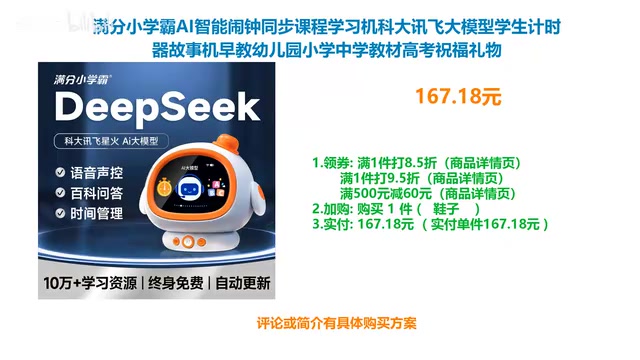
The price is certainly tempting, but can a budget-level "AI learning device" really deliver on all these promises? This article provides an in-depth analysis from three perspectives: product positioning, feature credibility, and purchasing recommendations.
Breaking Down the Selling Points: The Reality Behind the Marketing
What Does "Powered by iFlytek's Large Model" Actually Mean?
The most eye-catching keyword in the product's marketing is "iFlytek Large Model." As a leading Chinese company in voice AI, iFlytek's Spark model (SparkDesk) does indeed have strong capabilities in educational scenarios. However, it's crucial to understand that using iFlytek's technology and being an official iFlytek product are two entirely different things.
iFlytek's Spark Large Model (SparkDesk), officially launched in 2023, is a general-purpose large language model that has gone through multiple iterations. It offers language comprehension, knowledge Q&A, logical reasoning, math capabilities, code generation, and multimodal interaction. In the education sector, iFlytek has over 20 years of deep expertise, accumulating vast educational data and teaching scenario experience. Their official learning devices typically feature models specifically fine-tuned for educational scenarios, paired with proprietary knowledge graphs and personalized learning path algorithms.
However, many third-party hardware manufacturers integrate iFlytek's speech recognition or TTS (text-to-speech) APIs and then market themselves as "iFlytek Large Model products." Third-party hardware makers accessing iFlytek's Open Platform APIs typically can only use speech recognition (ASR), speech synthesis (TTS), or basic natural language processing capabilities. This is fundamentally different from the deeply integrated full-stack AI education capabilities found in iFlytek's official products. Under the API-call model, third-party products are limited in response speed, accuracy, and feature depth by API permissions and call frequency limits.
Consumers need to carefully distinguish: Is this an official iFlytek product, or does it merely call iFlytek's APIs? The two differ enormously in product quality, content ecosystem, and after-sales support.
Does It Really Cover Courses from Kindergarten Through Middle School?
The product claims to support curriculum-aligned courses from kindergarten through middle school — a claim that deserves serious scrutiny at the 167-yuan price point.
Curriculum-aligned course resources in China involve a complex chain of copyright licensing. Textbooks are published by multiple institutions including People's Education Press, Beijing Normal University Press, and others. Different regions use different editions (such as PEP, Jiangsu Education, BNU editions, etc.), with dozens of versions in use nationwide at the elementary level alone. For a learning device manufacturer to achieve "textbook alignment," they need to sign content licensing agreements with each publisher individually, or partner with content providers who hold such licenses. Additionally, quality aligned courses require supporting materials like expert teacher video explanations, animated demonstrations, and interactive exercise databases — all of which are extremely expensive to produce and maintain.
Legitimate textbook-aligned learning resources involve significant copyright licensing fees. iFlytek's official learning devices (such as the T20 series) are priced in the thousands of yuan, with a substantial portion of that cost going toward officially licensed content covering major textbook editions nationwide and continuously updated question banks.
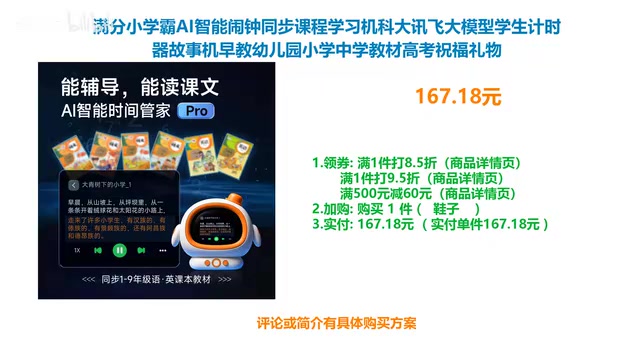
If a budget-level product truly includes full-range curriculum-aligned courses, either the content quality is significantly compromised, or additional payments are required to unlock features later — both scenarios are extremely common in low-cost learning hardware.
What Can $23 Worth of Hardware Actually Do?
The Reality of Hardware Constraints
At a selling price of 167 yuan, after deducting channel costs and profit margins, the hardware BOM cost is likely only around 50-80 yuan.
BOM (Bill of Materials) cost refers to the total procurement cost of all hardware components in a product. In the consumer electronics industry, retail prices are typically 2-4x the BOM cost, as this multiplier needs to cover R&D amortization, tooling costs, assembly labor, quality control testing, packaging and logistics, channel commissions, marketing expenses, and corporate profit. At a 167-yuan selling price, if sold through e-commerce platforms, platform commissions and promotional fees typically account for 15%-25% of the price, plus logistics costs of about 5-10 yuan, leaving the manufacturer with roughly 110-130 yuan. After subtracting packaging, after-sales reserves, and reasonable profit, the budget left for the hardware itself is indeed in the 50-80 yuan range.
Within this cost range, the product most likely features:
- Screen: Small, low-resolution display, or no screen at all with voice-only interaction
- Processor: Entry-level chip with limited capacity for complex AI tasks
- Storage: Limited local storage, with most features dependent on internet connectivity
- Audio: Basic-level speaker
For reference, an entry-level smart voice processing chip costs about 10-20 yuan, a 2-3 inch low-resolution LCD screen about 15-25 yuan, a basic speaker module about 3-5 yuan, a WiFi module about 5-8 yuan, plus the PCB board, battery, casing, etc. — a 50-80 yuan BOM budget is extremely tight.
This means the product is closer to a smart speaker + electronic alarm clock combo rather than a genuine learning device. While both smart speakers and AI learning devices feature voice interaction capabilities, they differ fundamentally in product design philosophy. Smart speakers (like Tmall Genie, Xiaodu, etc.) are built around general-purpose voice assistants, focusing on information queries, music playback, and smart home control. Their children's modes typically only offer shallow educational features like story playback and simple Q&A. Professional AI learning devices, on the other hand, are built around structured teaching systems, requiring capabilities like knowledge point diagnostics, weakness identification, personalized learning path planning, and error analysis — all powered by comprehensive knowledge graphs and adaptive learning algorithms. The difference is similar to that between an "encyclopedia" and a "private tutor" — the former can answer questions, while the latter can systematically help students improve their grades.
Actual Value as a Smart Alarm Clock and Story Player
If you lower your expectations and view it not as a "learning device" but as a smart alarm clock with AI voice interaction, 167 yuan isn't an unreasonable price. For preschool-age children, it can serve as:
- A daily wake-up alarm and bedtime story player
- A simple voice Q&A interactive tool
- A basic study timer and Pomodoro clock
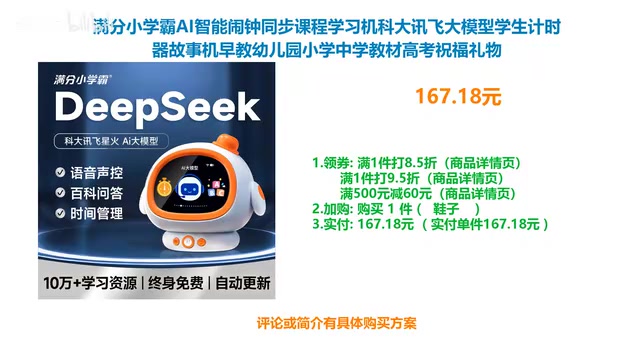
But if you expect it to replace a proper learning device for tutoring elementary and middle school coursework, you'll most likely be disappointed.
Buying Recommendations for Different Needs
Choose the Right Product Based on Your Core Needs
| Use Case | Recommended Solution | Budget Range |
|---|---|---|
| Preschool stories / simple interaction | Budget AI alarm clock products | $14-28 (100-200 yuan) |
| Elementary school curriculum tutoring | Branded learning tablets (BBK / Readboy) | $200-400 (1,500-3,000 yuan) |
| Middle/high school in-depth learning | High-end devices from iFlytek / Xueersi | $400-800 (3,000-6,000 yuan) |
Three Questions You Must Answer Before Buying
-
Does the course content require additional payments? Many low-cost learning devices guide users toward paid content subscriptions after purchase, potentially pushing total costs far beyond expectations. The budget learning hardware market features a business model known in the industry as "hardware for acquisition, content for monetization" — manufacturers attract buyers with extremely low hardware prices, only for users to discover after receiving the device that basic features are free but limited, while core features like textbook-aligned courses, expert teacher video explanations, and AI homework grading require monthly or annual subscriptions, typically costing 200-500 yuan per year. Some products even convert previously free features to paid ones after a period of use. This model borrows from the internet industry's "Freemium" strategy, but in the educational hardware space it easily leads to consumer disputes, as parents typically make purchasing decisions based on the expectation of a one-time investment. Since 2023, consumer protection associations in multiple regions have issued warnings about such practices.
-
What after-sales support is available? Budget products typically offer weak after-sales guarantees. Make sure to understand the return/exchange policy and warranty period in advance.
-
Are there real user reviews? Don't rely solely on the seller's marketing page — searching for genuine user feedback on third-party platforms is far more reliable.
Conclusion: Fine as a Smart Alarm Clock, No Substitute for a Real Learning Device
The AI learning hardware market is a mixed bag, and labels like "iFlytek Large Model" can easily lead parents to transfer brand trust where it may not be warranted. There's nothing wrong with spending 167 yuan on a fun smart alarm clock, but don't expect it to truly replace a professional learning device in improving your child's study efficiency.
Educational spending requires rational decision-making. Cheap doesn't always mean cost-effective, and expensive doesn't always mean effective — what matters is whether the product matches your child's actual learning needs. Rather than being lured by low-price gimmicks, take the time to figure out what kind of learning tool your child actually needs.
Related articles

Disaster and Glory of the Apollo Program: The History We Must Revisit Before Returning to the Moon
From the fatal Apollo 1 fire to Apollo 8's daring lunar orbit to Apollo 11's successful landing—revisiting the disasters, fears, and compromises of the Apollo program and their lessons for today's return to the Moon.
Netflix Trust Exercise Turns Into Firing Trap: Where Are the Boundaries of Corporate Trust?
A Netflix employee was fired after sharing private info in a trust exercise. We analyze the risks of corporate trust exercises and how employees can protect themselves.

AMD CDNA5 Architecture Deep Dive: Technical Evolution and the AI Computing Competition Landscape
Deep analysis of AMD's CDNA5 architecture covering Chiplet packaging upgrades, HBM memory evolution, and low-precision compute optimization, examining how AMD challenges NVIDIA's AI chip dominance.