Java AI Tech Stack Explained: Framework Selection & Learning Path Guide

A practical guide to Java's AI tech stack: framework selection and learning path from basics to enterprise Agents.
Java's AI ecosystem has matured significantly, offering a full stack from basic LLM chat to enterprise-grade Agent development. This guide breaks down four key frameworks — Spring AI, LangChain4j, Spring AI Alibaba Agent Framework, and AgentScope4j — explaining their strengths, use cases, and how they map to Python equivalents like LangChain and LangGraph, with a clear step-by-step learning path for Java developers.
Java Developers Are No Longer Behind in AI
For a long time, when people thought about AI application development, the first thing that came to mind was the Python ecosystem — LangChain and LangGraph had become the industry's default choices. This left Java developers in a state of collective anxiety: do I really need to learn a new language just to build AI applications?
The answer is no. Java has fully filled in every piece of the AI application development puzzle — it's no longer the blank slate it was two or three years ago. Built around the Spring ecosystem, Java has formed a complete tech stack covering everything from basic chat to enterprise-grade Agent development.
This article provides a systematic breakdown of Java's core AI frameworks, their respective strengths, and a clear, actionable learning path to help you make informed framework choices.
Layer One: Basic Chat & RAG — Spring AI and LangChain4j
The foundation of the entire Java AI tech stack rests on two frameworks: Spring AI and LangChain4j.
Their positioning is straightforward — they wrap the core capabilities of mainstream LLMs, including:
- Single-turn LLM conversations (Chat)
- Multimodal calls such as text-to-image and text-to-speech
- Tools (function/tool calling)
- MCP (Model Context Protocol)
- RAG (Retrieval-Augmented Generation)
About RAG: RAG is one of the most widely adopted technical paradigms for enterprise AI deployment. The core idea is: before querying an LLM, retrieve relevant document chunks from an external knowledge base and pass them as context to the model. This enables the model to generate answers grounded in real, up-to-date, private data rather than relying solely on static knowledge from training. RAG addresses three major pain points: hallucinations, fixed knowledge cutoff dates, and inability to access internal enterprise data. Technically, RAG involves document chunking, vectorization (Embedding), vector database storage, and similarity search — all of which Spring AI and LangChain4j fully encapsulate.
About MCP: MCP (Model Context Protocol) is an open protocol standard proposed and open-sourced by Anthropic in late 2024, designed to standardize how AI models connect with external tools and data sources. Before MCP, every AI application had to write custom integration code for each tool (databases, APIs, file systems, etc.), making development extremely costly. MCP defines a unified Client-Server communication spec: the AI model acts as the client, while tools and data sources act as servers — both communicating via a standard protocol. This turns the tool ecosystem into a reusable "plugin marketplace," dramatically lowering the barrier to Agent development. Spring AI already supports MCP, giving Java developers direct access to the vast MCP tool ecosystem.
Use Cases
If your goal is to build single-turn AI conversation features — such as intelligent customer service or a RAG knowledge base system — Spring AI or LangChain4j is more than sufficient. An airline intelligent customer service system and an enterprise RAG knowledge base system are the classic hands-on projects at this layer.
It's important to recognize that these projects sit at the bottom of the technical pyramid. They demonstrate foundational AI application development skills, but don't yet touch the core of Agent development.
Worth noting: LangChain4j closely mirrors Python's LangChain in design philosophy, meaning experience from the Python community translates smoothly to the Java world.
Layer Two: Lightweight Agents — Spring AI Agent Utils
When requirements evolve from "single-turn conversation" to "autonomously completing tasks," the foundational frameworks start to fall short. This is where Agent capabilities come in.
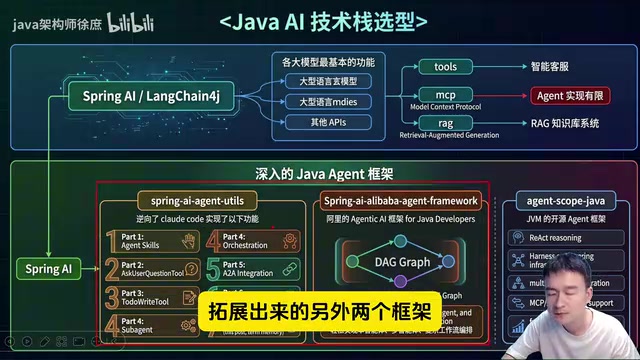
Spring AI Agent Utils is a lightweight Agent utility library released by the official Spring community. One of its highlights is reverse-engineering the core functionality of Claude Code, providing key Agent capabilities:
- Agent Skill system
- Session memory and team memory management
- Multi-Agent collaboration
- Task decomposition — automatically breaking complex tasks into multiple execution steps
Use Cases
If you want to build a coding Agent similar to Claude Code, this lightweight utility library is a great starting point. Within the broader learning path, however, it's positioned more as optional content — it's a utility library, not a full enterprise-grade framework.
Layer Three: Enterprise-Grade Agents — The Spring AI Alibaba Ecosystem
If your goal is to build enterprise-grade, production-ready Agent applications, the Alibaba-backed framework ecosystem is currently the most worthwhile investment — and the core recommendation of this article.
Spring AI Alibaba Agent Framework: Workflow Orchestration
Spring AI Alibaba Agent Framework focuses on the Workflow domain. Its core idea is: developers pre-orchestrate the overall execution flow, and the Agent runs along the predefined path.
The greatest value of this approach is controllability. For enterprises, an Agent whose behavior is predictable and whose process is orchestrable is far more deployable than a "smart" but unpredictable one. It's especially well-suited for automated workflow orchestration in enterprise vertical business scenarios.
The corresponding hands-on project is an end-to-end HR recruitment automation Agent system. This kind of controllable Agent is precisely what enterprises need most for AI deployment — stability and control often matter more than technical novelty.
AgentScope4j: ReAct Agents and Self-Evolution
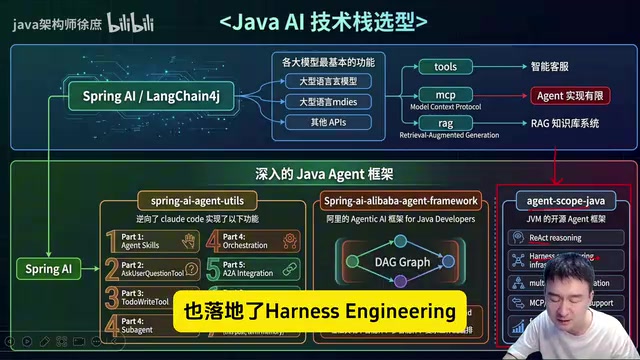
If you want to build a general-purpose Agent similar to Manus, consider another Alibaba open-source framework: AgentScope4j.
It excels at developing ReAct Agents (Reasoning + Acting) — Agents with automatic planning and autonomous thinking capabilities. ReAct is currently the most mainstream Agent execution paradigm, jointly proposed by Princeton University and Google in 2022. The core idea is to alternate between "reasoning" (Thought) and "acting" (Action): the Agent first reasons in natural language about the current task and decides which tool to call and with what parameters; after executing the tool, it receives an observation, then reasons again based on the new information — repeating this loop until the task is complete. This "think-act-observe" feedback loop enables Agents to handle complex tasks requiring multi-step planning.
Going further, AgentScope4j implements Context Engineering, enabling Agent applications to "get smarter the more they're used" — achieving a degree of self-evolution. Context Engineering is a concept that emerged around 2025 in the AI engineering space, considered an evolution of Prompt Engineering. Rather than focusing on the wording of a single prompt, it systematically designs "what information, in what structure, enters the context window at what point in time" — allowing Agents to accumulate experience from past interactions and refine their decision-making strategies.
The corresponding hands-on project is building a Manus-like general-purpose Agent from scratch, with Context Engineering implemented for self-evolution capabilities.
Framework Convergence: Toward Unification
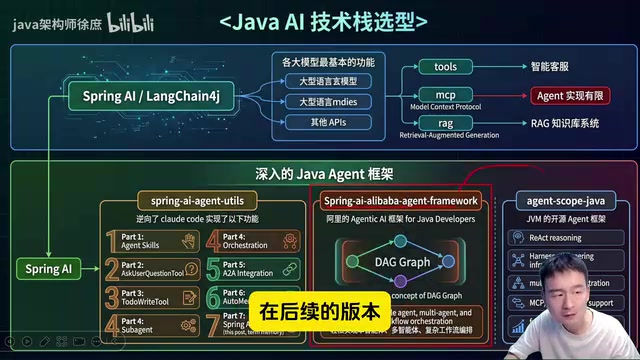
One notable development: the official team has explicitly committed to integrating AgentScope into Spring AI Alibaba in future versions.
This means Spring AI Alibaba Agent Framework will become a "unified" framework — supporting both ReAct Agent development and automated workflow orchestration (Graph engine). This is exactly why it's the framework most worth investing in right now.
In terms of ecosystem mapping, Java's Spring AI Alibaba Graph framework corresponds directly to Python's LangGraph. LangGraph was released by the LangChain team in 2024, with a design philosophy of using a "directed graph" to describe an Agent's execution flow: each node represents a processing step, and edges between nodes define data flow and conditional branching logic. This graph structure naturally supports loops, parallelism, and conditional branching — while maintaining full observability of each node's state. Spring AI Alibaba's Graph engine is the Java implementation of this architecture, allowing Java developers to enjoy equivalent workflow orchestration capabilities without switching to Python.
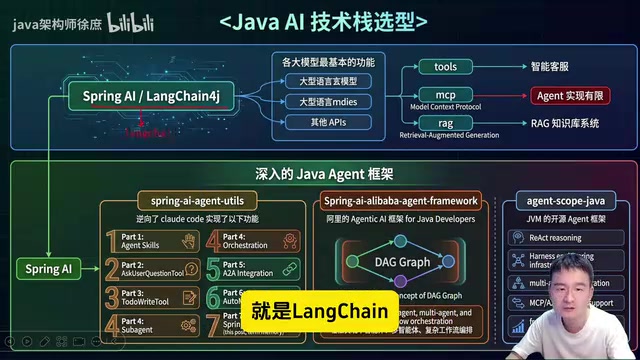
This one-to-one correspondence further validates the maturity of the Java AI ecosystem — nearly everything Python can do, Java now has a corresponding implementation for.
Recommended Learning Path: From Fundamentals to Advanced
Based on the analysis above, here is a clear Java AI learning path:
- Build the foundation: Start with Spring AI — master LLM conversations, Tools, MCP, and RAG; complete the airline customer service and RAG knowledge base projects.
- Advance to the core: Move to Spring AI Alibaba Agent Framework — master enterprise-grade Workflow orchestration; build the HR recruitment automation system.
- Go deep with general-purpose Agents: Learn AgentScope4j — master ReAct Agents and Context Engineering; build a Manus-like application from scratch.
- Learn as needed: Spring AI Agent Utils is a lightweight Agent utility library you can incorporate flexibly based on project requirements.
Framework Selection Quick Reference
| Business Scenario | Recommended Framework |
|---|---|
| Single-turn AI chat, intelligent customer service, RAG knowledge base | Spring AI / LangChain4j |
| Lightweight Agent similar to Claude Code | Spring AI Agent Utils |
| Enterprise-grade automated workflow orchestration | Spring AI Alibaba Agent Framework |
| Autonomous general-purpose Agent (Manus-like) | AgentScope4j |
Final Thoughts
The greatest value of this tech stack overview is breaking the misconception that "Java isn't suitable for AI." From foundational Spring AI, to controllable enterprise-grade Workflow Agents, to self-evolving general-purpose Agents — Java developers now have a complete toolchain.
For the vast majority of Java engineers, there's no need to anxiety-switch to Python. Instead, build on the familiar Spring ecosystem and progress steadily along the path of "foundational capabilities → enterprise Agents → general-purpose Agents." In the wave of AI application deployment, mastering controllable, orchestrable Agent development may well be Java developers' strongest competitive edge.
Related articles

The Truth Behind Codex 'Build a Website in 5 Minutes': AI Isn't Creating Sites—It's Helping You Copy Them
Exposing the truth behind viral Codex 5-minute website videos: creators aren't building original sites with AI—they're copying shared prompts or scraping others' work. Learn AI coding tools' real limits.

Getting Started with AI Agent Development: A Complete Guide from Concept to Practice
A comprehensive guide to AI Agent architecture and development, covering automated marketing, intelligent customer service, and investment analysis scenarios with single and multi-agent collaboration.

The Truth Behind Codex 'Build a Website in 5 Minutes': AI Isn't Creating Sites — It's Helping You Copy Them
Exposing the truth behind viral Codex 5-minute website videos: creators aren't building original sites with AI — they're copying shared prompts or scraping others' work.