Java Developers Transitioning to AI: A Practical Path to a 50% Salary Increase When Switching Jobs

Java developers must master AI skills alongside solid fundamentals to achieve 50% salary increases in 2026.
The 2026 Java job market is being reshaped by AI, with pure Java roles shrinking while Java+AI positions command 30%-60% higher salaries. Developers need to advance on two parallel tracks: LLM capabilities (Prompt Engineering, Spring AI, RAG, Agent orchestration) to direct AI effectively, and solid Java fundamentals (JVM tuning, concurrency, microservices) to take responsibility for AI output quality. The bonus window is still open—early movers gain significant career advantages.
The Job Search Dilemma for Java Developers: No AI Skills, No Opportunities
The Java job market in 2026 is undergoing a profound transformation. Many developers find that their resumes either go unread or get no response; even when they land an interview, their preparation falls far short of what interviewers expect—both in terms of tech stack and project experience, they can't keep up with market demands.
The core reason behind this situation is the rapid penetration of AI. AI is replacing a massive amount of basic development work, and what companies expect from developers has shifted from "can write code" to "can leverage AI to write code." This displacement effect is no exaggeration—take GitHub Copilot as an example: according to Microsoft's official data, developers using Copilot complete tasks 55% faster, with over 46% of new code generated by AI. This means that CRUD work that previously required 3 junior developers can now be handled by a single mid-level developer who masters AI tools. This efficiency leap has directly changed corporate hiring strategies: fewer entry-level positions, higher requirements for AI collaboration skills. Java developers must reassess their competency model to win in this new round of competition.
How Big Is the Salary Premium for Java+AI Roles?
Based on actual recruitment market data, traditional pure Java positions generally offer salaries below 15K (CNY), while Java positions requiring AI capabilities offer significantly higher compensation, with increases typically ranging from 30% to 60%.

This is not an isolated case but an industry-wide trend. Java+AI is currently in a bonus window period—not all developers have mastered large language model-related skills, and those who seize this opportunity will gain a significant career advantage. The market direction is clear: LLM capabilities will become a standard requirement for developers. You can't change the market; you can only adapt to it.
The Future of Development Work
The way development work is done will undergo a fundamental shift:
- You design the solution, AI executes: Developers handle architecture design and task breakdown, AI handles code generation
- You review and take responsibility for AI output: Review AI-generated code to ensure it meets business requirements
- From CRUD engineer to AI application engineer: A fundamental shift in role positioning
This isn't a distant future—it's happening right now.
Two Core Competencies You Must Develop to Land a Higher-Paying Job
If you're planning to switch jobs for a higher salary, you need to focus on improving two key areas:
Competency 1: The Ability to Direct AI (LLM Skills)
The key here is to learn LLM skills specifically in the context of Java positions, rather than studying AI concepts in general. Many online LLM tutorials are too broad and don't align well with Java development roles.
Based on real job requirements from recruitment platforms like Boss Zhipin, the LLM capabilities Java developers need to master can be broken down into the following levels:
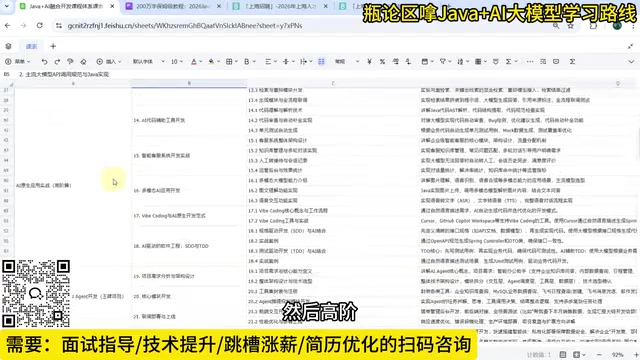
Foundation Layer:
- Basic LLM concepts
- Prompt Engineering
- Memory mechanisms
- Function Calling
Prompt Engineering is the core skill for efficient interaction with large language models. It's not simply about asking AI questions—it's about guiding the model to produce high-quality, expected outputs through carefully designed instruction structures. Common prompt techniques include Few-shot Learning (guiding the model to understand task patterns by providing examples), Chain-of-Thought (guiding the model to reason step by step rather than giving direct answers), and Role-based Prompting (having the model respond as a specific expert). For Java developers, mastering Prompt Engineering means being able to precisely describe code requirements, constraints, and output formats to AI, resulting in high-quality code snippets that can be used directly.
Function Calling is the key mechanism for LLM interaction with external systems. Large language models can only process text—they cannot directly operate databases, call APIs, or execute business logic. Function Calling solves this problem: developers pre-define a set of functions and their parameter descriptions, the LLM determines when to call which function during a conversation, generates structured call parameters, and the application actually executes the function and returns the result to the model. For example, when a user asks "check order status," the model recognizes the need to call the queryOrder function and extracts the order number as a parameter. This mechanism is the foundation for building AI Agents and intelligent business systems.
Intermediate Layer (Integrated with Java Ecosystem):
- AI programming tools: Cursor installation, configuration and usage; GitHub Copilot
- Java LLM frameworks: Spring AI, Spring AI Alibaba, LangChain4J
- Core capabilities: RAG (Retrieval-Augmented Generation), vector databases, text processing
Regarding AI programming tools, Cursor and GitHub Copilot are currently the two most mainstream options, but they have different positioning. GitHub Copilot, launched by GitHub (Microsoft), exists as an IDE plugin, primarily providing line-level and function-level code completion, code explanation, and unit test generation, deeply integrated with VS Code, JetBrains, and other IDEs. Cursor is a standalone AI-native IDE (based on a VS Code fork) that not only provides code completion but emphasizes project-level code understanding and generation—you can describe requirements in natural language, and Cursor will understand the entire project context before generating cross-file code modifications. Cursor's Composer feature allows developers to perform large-scale code refactoring through conversation. For Java developers, Copilot is better suited as a daily coding efficiency tool, while Cursor is more appropriate for scenarios requiring deep AI involvement in architecture design and code generation.
Regarding Java LLM frameworks, Spring AI is the official AI integration framework from Spring, officially released in 2024, designed to seamlessly integrate LLM capabilities into the Java/Spring ecosystem. It provides a unified API abstraction layer supporting multiple model providers including OpenAI, Anthropic, and Ollama—developers can switch AI models as easily as switching databases with Spring Data. Spring AI Alibaba is Alibaba's extended version based on Spring AI, deeply integrated with the Qwen series models and Alibaba Cloud's AI services. LangChain4J is the Java implementation of the LangChain framework, providing rich AI application building tools including chain calls, memory management, and document loading. Each of these three frameworks has its strengths: Spring AI suits enterprise applications on the Spring tech stack, Spring AI Alibaba fits domestic cloud environments, and LangChain4J offers more flexibility in complex AI workflow orchestration.
RAG (Retrieval-Augmented Generation) is the core technical solution for addressing LLM "hallucination" problems and knowledge timeliness issues. LLMs have training data cutoff dates and cannot directly access enterprise internal knowledge bases, causing them to potentially produce incorrect or outdated information when answering domain-specific questions. The RAG workflow is: first, enterprise documents and knowledge bases are converted into vectors through Embedding models and stored in vector databases; when a user asks a question, the system vectorizes the question, retrieves the most relevant document fragments from the vector database, then sends these fragments as context along with the user's question to the LLM, which generates answers based on this real data. For Java developers, RAG is an essential skill for building enterprise-grade AI applications (such as intelligent customer service and internal knowledge Q&A systems).
Vector databases are a key component in the RAG architecture, specifically designed for storing and retrieving high-dimensional vector data. Traditional databases rely on exact matching or keyword search, while vector databases search based on semantic similarity. Text is converted into high-dimensional floating-point arrays (typically 768 or 1536 dimensions) through Embedding models, and semantically similar texts are closer in vector space. Vector databases use ANN (Approximate Nearest Neighbor) algorithms to achieve millisecond-level similarity retrieval. Popular vector databases include Milvus (open source, supports billion-scale vectors), Pinecone (cloud-native managed service), Chroma (lightweight, suitable for prototyping), and PostgreSQL's pgvector extension (suitable for teams with existing PG infrastructure).
Hands-on Layer:
- Must have deployable AI+Java project experience
- Projects that can be listed on your resume with concrete details to discuss in interviews
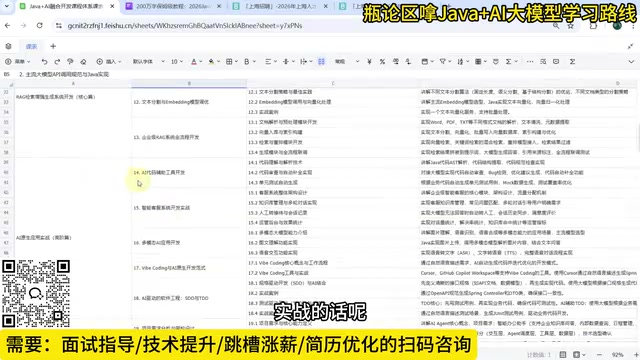
Advanced Layer:
- Agent orchestration (platforms like Dify, Coze)
- Production environment deployment
- Security and boundary issue handling
AI Agent refers to an AI system capable of autonomously perceiving its environment, formulating plans, invoking tools, and completing complex tasks—considered the ultimate form of LLM applications. Unlike simple conversational AI, Agents possess autonomous decision-making and multi-step execution capabilities. Agent orchestration combines multiple Agents or tools according to specific workflows to collaboratively complete complex business tasks. Dify is an open-source LLMOps platform that provides a visual workflow orchestration interface with drag-and-drop AI application building; Coze (under ByteDance) offers a rich plugin ecosystem and Bot building capabilities. In enterprise applications, Agent orchestration can achieve end-to-end automation processes such as "automatically analyze user requirements → query database → generate report → send email." For Java developers, mastering Agent orchestration means being able to build AI automation systems with real business value.
Competency 2: The Ability to Take Responsibility for AI Output (Java Fundamentals)
No matter how powerful LLM capabilities are, if your Java fundamentals aren't solid, you won't be able to effectively review AI-generated code or judge whether AI output meets business requirements. This is the "taking responsibility for AI results" capability.
Specifically, you need:
- Solid Java technical foundation: You don't need source-code-level knowledge, but you must be able to solve real-world problems using Java technologies
- Systematic knowledge structure: Covering Java basics, JVM tuning, concurrent programming, Spring Framework, MyBatis, Spring Cloud microservices, etc.
- Scenario-based problem-solving ability: Not simply memorizing interview Q&As, but understanding how technologies apply in real business contexts
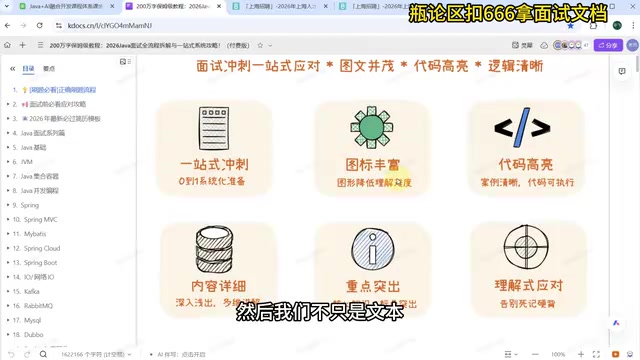
Among these, JVM tuning remains an indispensable core skill for Java developers in the AI era. AI-generated Java code can often achieve functional correctness but has obvious shortcomings in performance optimization—AI struggles to make precise tuning decisions based on specific business scenarios' memory usage patterns, GC (Garbage Collection) pressure, and thread contention. JVM tuning involves multiple dimensions including heap memory allocation strategies (young generation vs. old generation ratios), GC algorithm selection (G1, ZGC, Shenandoah, etc.), JIT compilation optimization, and thread pool configuration—all requiring developers to make judgments based on specific business load characteristics and monitoring data. This is a typical scenario of "taking responsibility for AI results": AI can generate code, but only developers with JVM tuning expertise can ensure that code runs stably and efficiently in production environments.
Practical Interview Preparation Tips
Ditch Pure Memorization, Embrace Scenario-Based Interview Prep
The traditional approach of memorizing rote interview answers is becoming increasingly ineffective. Today's Java interviews focus more on:
- Technical scenario questions: Given a specific scenario, how would you use technical approaches to solve it
- Business scenario questions: For example, designing the complete flow for QR code login, or inventory deduction under high concurrency
- Project highlight extraction: What optimizations did your project implement, and what real problems did it solve
When preparing for interviews, it's recommended to understand and memorize knowledge points through visual diagrams and code examples, rather than simply memorizing text-based answers.
Transformation Path: From CRUD Engineer to AI Application Engineer
- Step 1: Master at least one AI programming tool (Cursor or GitHub Copilot recommended) and integrate it into your daily development workflow
- Step 2: Learn Java ecosystem LLM frameworks like Spring AI, and be able to call LLM APIs from Java
- Step 3: Complete at least one AI+Java hands-on project to create a resume highlight
- Step 4: Understand advanced topics like RAG, Agent orchestration, and develop production deployment capabilities
Conclusion: Parallel Development on Both Tracks Is the Key to High-Paying Offers
In the 2026 Java job market, Java+AI is a definitive trend. We're still in the bonus period—Java developers with LLM capabilities naturally have leverage in salary negotiations because the market itself offers 30%-60% higher compensation.
For Java developers looking to switch jobs for a salary increase, the core strategy is to advance on two parallel tracks: one is the LLM capability track, learning to direct AI, mastering Spring AI, RAG, Agent orchestration, and other skills; the other is the Java fundamentals track, ensuring you can take responsibility for the quality of AI output. Neither track can be neglected—only by pursuing both simultaneously can you truly achieve a salary leap in this rapidly changing market.
Related articles
 Tutorials
ChatGPT Plus Subscription Guide: Are GPT-5.5, image-2, and Codex Worth the Upgrade?
A detailed look at ChatGPT Plus features — GPT-5.5, image-2, and Codex — with a Plus vs Pro comparison and a complete step-by-step subscription guide for users outside the US.
 Tutorials
Harness AI Engineering in Practice: Using Claude Code to Master Enterprise-Level E-Commerce Development
Deep dive into Harness AI Engineering: master enterprise e-commerce development with Claude Code using the Rules, Skills, Wiki, and Changes framework.
 Tutorials
Cursor + Codex Dual-IDE Collaboration: A Practical Methodology for Open-Source Project Customization
A complete methodology for open-source project customization based on real-world experience, detailing the Cursor+Codex dual-IDE workflow, seven-stage process, MVP validation, and AI source code reading techniques.