Kimi K2.7 Code Deep Dive: The Cost-Performance Battle of a Trillion-Parameter Coding Model

Kimi K2.7 Code offers trillion-parameter coding at 1/6th the price of Claude, but awaits independent benchmarks.
Moonshot AI's Kimi K2.7 Code is a trillion-parameter MoE coding model with 32B active parameters per token, 256K context, and aggressive pricing at $4/M output tokens—roughly 1/6th of Claude Opus 4.8. It achieves 30% token savings through optimized reasoning, with a 6x speed version coming June 15. However, all benchmarks are self-reported with no SWE-Bench scores yet, and mandatory thinking mode adds overhead for simple tasks.
Moonshot AI's Major Coding Model Upgrade: K2.7 Code Officially Released
On June 12, Moonshot AI officially released and open-sourced the Kimi K2.7 Code programming large language model. As a major upgrade to the K2 series, K2.7 Code features a total of 1 trillion parameters, employs a MoE (Mixture of Experts) architecture with 32 billion active parameters per token, and supports a 256K context window. Meanwhile, the company announced that a 6x speed high-performance version will officially launch on June 15.
In today's fiercely competitive coding model landscape, K2.7 Code aims to carve out a differentiated path between international giants like Claude and GPT and domestic models through its "high cost-performance + open-source" combination strategy.
Kimi K2.7 Code Architecture Details: MoE Design with 384 Experts
Kimi K2.7 Code adopts a MoE (Mixture of Experts) architecture with the following specifications:
- Number of experts: 384 total experts, with 8 experts plus 1 shared expert selected per token
- Parameter scale: 320 billion total parameters (Note: the video mentions 1 trillion total parameters with 32 billion active parameters)
- Model layers: 61 layers total, including 1 dense layer
- Attention mechanism: MLA (Multi-head Latent Attention)
- Context window: 256K, vocabulary size of 160,000
- Vision capability: Integrated Moon 6T vision encoder (400 million parameters), supporting image and video input
MoE (Mixture of Experts) is a sparsely-activated neural network architecture whose core idea is to distribute model parameters across multiple "expert" sub-networks, activating only a small subset of experts during each inference pass. The advantage of this design is that the model can have an enormous total parameter count (meaning greater knowledge capacity) while keeping inference compute costs proportional only to the number of activated experts. With K2.7 Code activating only 8+1 out of 384 experts per token, the actual computation is approximately 2.3% of what a dense model would require. Google's Switch Transformer and Mixtral are early representatives of the MoE architecture, and by 2024-2025, MoE has become the dominant paradigm for scaling large models.
Regarding the attention mechanism, K2.7 Code's MLA (Multi-head Latent Attention) is an attention mechanism variant first proposed by the DeepSeek team in DeepSeek-V2. Traditional Multi-Head Attention (MHA) requires storing complete Key and Value caches for each attention head, which consumes massive amounts of GPU memory in long-context scenarios. MLA compresses Key-Value pairs into a low-dimensional latent space and decompresses them during inference, dramatically reducing KV Cache memory usage. Compared to GQA (Grouped Query Attention), MLA can compress KV Cache by several times while maintaining model expressiveness—this is crucial for supporting the 256K ultra-long context window.
One notable design decision is that K2.7 Code enforces thinking mode, which cannot be disabled. Attempting to disable it via API returns an error, while the Kimi Code client automatically falls back to the K2.6 version.
Performance Benchmarks: How Much Has K2.7 Code Improved Over K2.6?
Compared to K2.6, K2.7 Code achieved significant improvements across multiple internal benchmarks:
| Benchmark | K2.6 | K2.7 Code | Improvement |
|---|---|---|---|
| Kimi Code Bench VR | 50.9 | 62.0 | +21.8% |
| Program Bench | 48.3 | 53.6 | +11.0% |
| MLS Bench Lite | 26.7 | 35.1 | +31.5% |
| MCP Atlas | 69.4 | 76.0 | +9.5% |
| MCP Mark Verified | 72.8 | 81.1 | +11.4% |
MCP (Model Context Protocol) is an open protocol introduced by Anthropic in late 2024, designed to standardize interactions between large models and external tools and data sources. It's analogous to a "USB-C port" for AI, enabling models to invoke file systems, databases, API services, and other external resources in a unified manner. In programming scenarios, MCP capability means the model can autonomously read project files, execute commands, and query documentation, enabling automated programming that more closely resembles real developer workflows. K2.7 Code's high scores on MCP Atlas and MCP Mark Verified indicate specialized optimization in tool invocation and environment interaction.
However, a critical caveat: K2.7 Code has not yet published SWE-Bench scores, and all performance data is self-reported by Moonshot AI. SWE-Bench is a software engineering benchmark introduced by a Princeton University team in 2023, widely regarded as the "gold standard" for measuring AI coding capabilities. It extracts thousands of Issue-PR pairs from real open-source projects on GitHub, requiring models to autonomously modify codebases to resolve issues given only the issue description. SWE-Bench Verified is a human-verified subset containing 500 high-quality test cases. This benchmark matters because it tests not simple code completion, but a model's comprehensive ability to understand large codebases, locate problems, and write fix code—much closer to real software development scenarios. Previously, K2.6 showed discrepancies of 15-20 percentage points between self-reported scores and third-party reproductions, so independent third-party evaluation is needed for verification.
Inference Efficiency Optimization: 30% Reduction in Token Consumption
One of K2.7 Code's most practical improvements is a 30% reduction in inference token consumption. Moonshot AI achieved this optimization through:
- Retrained inference termination strategies
- Reduced redundant verification
- Optimized long-context attention sparsification
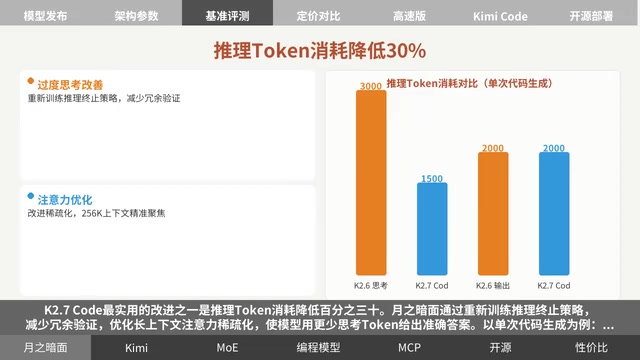
Using a single code generation as an example: K2.6 averaged 5,000 tokens (3,000 thinking tokens + 2,000 output tokens), while K2.7 Code averages 3,500 tokens (1,500 thinking tokens + 2,000 output tokens). Since APIs charge by output tokens, the actual cost per use dropped from approximately ¥0.14 to ¥0.10, an overall decrease of about 30%.
Token-based pricing is the prevailing pricing model in the current industry. One token corresponds to roughly 3/4 of an English word or 1-2 Chinese characters. In thinking mode, a model's token consumption splits into two parts: thinking tokens (the model's internal reasoning process) and output tokens (the final content returned to the user). Different providers have varying billing strategies: some offer free or discounted thinking tokens, while others charge full price. K2.7 Code's reduction of thinking tokens from 3,000 to 1,500 directly impacts total costs when billed by output tokens. For development teams making high-frequency API calls, a 30% token savings could mean thousands or even tens of thousands of yuan saved monthly in API fees.
K2.7 Code API Pricing: Comparison with Claude and GPT
K2.7 Code's API pricing is extremely competitive in the current market:
- Input price: $0.95/million tokens (approximately ¥6.5)
- Output price: $4/million tokens (approximately ¥27)
- Cached input: As low as ¥1.3/million tokens
Price comparison with mainstream international coding models:
- Claude Opus 4.8: $25/million output tokens
- GPT 5.5: $30/million output tokens
- Claude Fable 5: $50/million output tokens
Kimi K2.7 Code's output price is approximately one-sixth of Claude Opus 4.8 and one-seventh of GPT 5.5.
6x Speed High-Performance Version: Balancing Speed and Cost
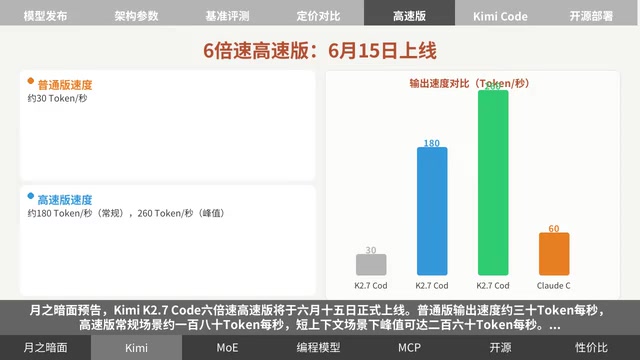
The 6x speed high-performance version announced by Moonshot AI has the following specifications:
- Standard version: Output speed of approximately 30 tokens/second
- High-speed version (normal scenarios): Approximately 180 tokens/second
- Short-context peak: Up to 260 tokens/second
Using a standard Cloud function generation (approximately 200-300 tokens) as an example, the high-speed version can complete generation within 1.5 seconds. The high-speed version is priced at twice the standard version (approximately ¥54/million output tokens), but even so, it remains over 80% cheaper than Claude Opus 4.8. For development scenarios requiring rapid iteration, this will significantly improve the user experience.
The 6x speed improvement likely benefits from inference acceleration techniques such as Speculative Decoding. The core idea of speculative decoding is to use a small "draft model" to quickly generate multiple candidate tokens, which are then verified in parallel by the large model, partially parallelizing what would otherwise be a sequential token-by-token generation process. Combined with the inherent sparse computation characteristics of the MoE architecture, along with possible quantization optimizations and hardware-level customizations, this achieves the leap from 30 tokens/second to 180 tokens/second.
Mandatory Thinking Mode: Advantages and Limitations Coexist
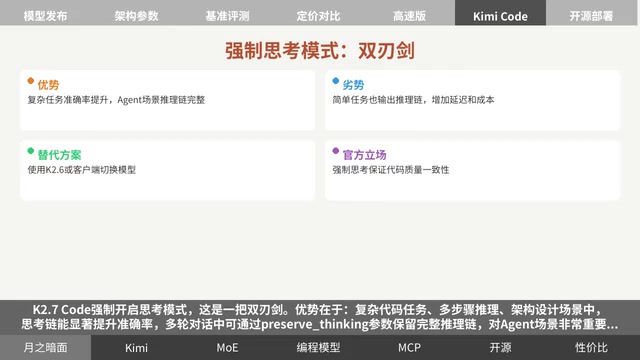
K2.7 Code's mandatory thinking mode is a design choice worth discussing in depth. The core of thinking mode is Chain-of-Thought (CoT) reasoning, which has the model output intermediate reasoning steps before providing its final answer. Google's 2022 research demonstrated that CoT significantly improves large model performance on mathematical and logical reasoning tasks. In programming scenarios, the thinking chain typically includes: analyzing requirements, decomposing sub-problems, designing algorithmic approaches, and considering edge cases. OpenAI's o1 series and DeepSeek-R1 pushed this paradigm to new heights by training models through reinforcement learning to learn when and how to perform deep reasoning. K2.7 Code's mandatory thinking mode essentially treats all programming tasks as complex problems requiring deep reasoning.
Advantages:
- In complex code tasks, multi-step reasoning, and architecture design scenarios, chain-of-thought significantly improves accuracy
- In multi-turn conversations, the
preserve_thinkingparameter can retain the complete reasoning chain, which is very important for Agent scenarios
Disadvantages:
- Simple tasks (such as variable renaming, single-line code completion) still force reasoning chain output, adding latency and cost
- Users cannot flexibly choose based on task complexity
Moonshot AI states that mandatory thinking ensures consistency in code quality. If thinking mode is not needed, users can use K2.6 or switch models in the Kimi Code client.
Coding Model Competitive Landscape: Where Does K2.7 Code Stand?
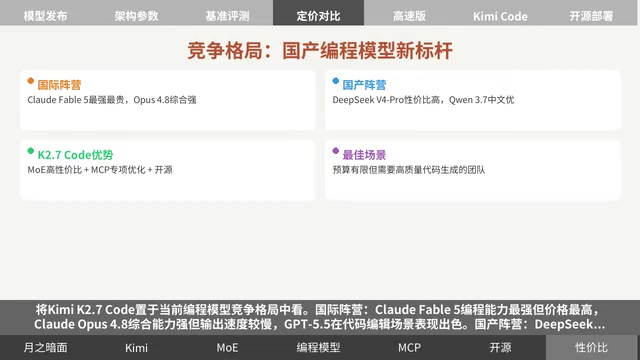
Placing K2.7 Code within the current coding model competitive landscape:
International players:
- Claude Fable 5: Strongest coding capability, but highest price
- Claude Opus 4.8: Strong overall capability, but slower output speed
- GPT 5.5: Excels in code editing scenarios
Domestic players:
- DeepSeek V4 Pro: High cost-performance, but coding-specific capability falls short of K2.7 Code
- Qwen 3.7 Max: Advantages in Chinese and code scenarios
K2.7 Code's unique advantages lie in: the high cost-performance ratio enabled by its MoE architecture, specialized optimization for MCP tool invocation capabilities, and the customization potential offered by open-source weights. For teams with limited budgets that need high-quality code generation, K2.7 Code is currently one of the most attractive options.
Open-Source License and Local Deployment Requirements
Kimi K2.7 Code releases its weights under a Modified MIT license, allowing commercial use. The MIT license is one of the most permissive open-source licenses, allowing anyone to freely use, modify, and commercially distribute code. Modified MIT typically adds some additional terms on top of standard MIT, such as restrictions on model usage, attribution requirements, or usage constraints for specific scenarios. In the large model open-source space, Meta's LLaMA series adopts a similar strategy, balancing open-source community contributions with commercial interests through permissive but conditional licenses. K2.7 Code's choice of this license means enterprises can fine-tune and deploy based on its weights, but must comply with specific additional terms.
However, local deployment requirements are extremely demanding:
- Full-precision model: approximately 600GB
- After INT4 quantization: still requires approximately 240GB of GPU memory
- Recommended inference engines: vLLM, SGLang, and KTransformers
- Ollama Cloud support is already available
Regarding inference engines, vLLM is a high-performance large model inference engine developed by the UC Berkeley team, with its core innovation being PagedAttention technology, which manages KV Cache in a manner similar to operating system virtual memory, improving GPU memory utilization by 2-4x. SGLang (Structured Generation Language) also comes from academia, focusing on structured generation and batch processing optimization, excelling in multi-turn dialogue and complex reasoning scenarios. KTransformers is an inference framework with Moonshot AI's involvement, specifically optimized for MoE architectures, supporting CPU-GPU hybrid inference that can run ultra-large-scale MoE models on consumer-grade hardware. These three engines each have their strengths, providing flexible options for different deployment scenarios.
Individual developers can essentially only use it through the API; local deployment is more suitable for enterprise teams with sufficient computing resources. Taking the 240GB GPU memory requirement after INT4 quantization as an example, at minimum 3 NVIDIA A100 80GB GPUs or 5 RTX 4090 24GB GPUs are needed to barely run it—still a significant barrier for the vast majority of individual developers and small-to-medium teams.
Limitations to Understand Before Adopting K2.7 Code
Before deciding whether to adopt K2.7 Code, the following limitations are worth noting:
- Benchmark credibility needs verification: All benchmark scores are self-reported; third-party evaluations like SWE-Bench are needed
- Limited to coding scenarios: Non-coding tasks should continue using K2.6
- Context window limitations: 256K falls short of Claude's 1M, creating gaps when handling very large codebases. For a typical medium-to-large project, a complete React frontend project source code might reach 500K-1M tokens; the 256K window means the model can only "see" one-quarter to one-half of the project at once, while Claude's 1M window can accommodate most of the entire project
- Mandatory thinking mode: Adds unnecessary latency for simple tasks
Conclusion: A Strong Contender in Cost-Effective Coding Models
Kimi K2.7 Code represents an important breakthrough for domestic coding models in the cost-performance dimension. A 30% reduction in inference token consumption, output pricing at one-sixth to one-seventh of international top-tier models, combined with an open-source commercially-usable strategy, makes it a compelling choice for small-to-medium teams and cost-sensitive developers.
However, before actual adoption, it's recommended to wait for independent third-party evaluation results and comprehensively assess based on your specific scenarios (task complexity, context length, speed requirements) before making a final decision.
Related articles

Network Doctor: An Open-Source Terminal Tool for Network Fault Diagnosis
Network Doctor is an open-source terminal network diagnostic tool that integrates ping, dig, curl, and traceroute, automatically detecting connectivity in stages and outputting fault conclusions in natural language.

LangChain Guardrails Explained: Building Safe and Controllable AI Agents
A detailed guide to LangChain Guardrails covering layered ecosystem architecture, middleware implementation, deterministic and model-driven protection for building production-grade secure AI Agents.

Deep Dive into Microsoft's AI Security Tools: Does Performance Really Surpass the Competition?
Microsoft launches enterprise AI security tools claiming superior performance. This deep analysis examines core capabilities, ecosystem advantages, and risks to guide enterprise security decisions.