Kimi K3 Hands-On: How a 2.8-Trillion-Parameter Open-Source Model Beat Fable5

Kimi K3's 2.8T-parameter open-source model beat Fable5 in blind voting with 87% audience preference.
Kimi K3, Moonshot AI's latest open-source model with 2.8 trillion parameters and a 1M token context window, impressed in a live engineer test — beating Fable5 in blind game-generation voting 87% to 13%. It tops BrowseComp and Spreadsheet Bench leaderboards and outscores Opus 4.8 on knowledge work, though its ~25 token/sec inference speed remains a notable weakness.
An Unexpected Late-Night Livestream
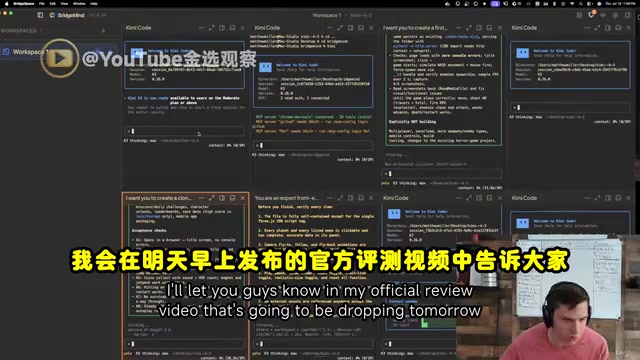
A US-based software engineer and founder of the BridgeMind community had originally planned to release a formal evaluation video of Kimi K3 the following day. But after seeing the test results, he couldn't hold back — he fired up an impromptu livestream that quickly drew thousands of viewers. In his own words: "I wasn't planning to go live today, but after seeing how this model performed, I had to get online."
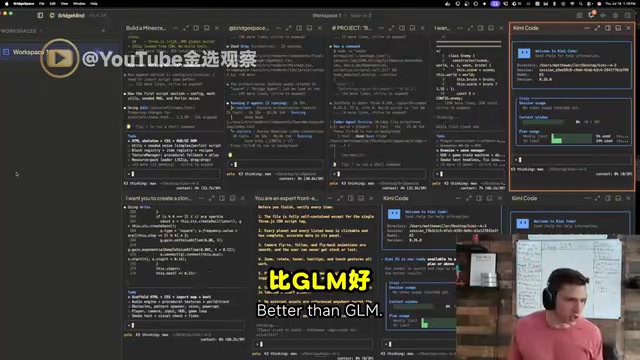
The stream turned into an intensive real-world test of the open-source model Kimi K3, covering game generation, reasoning benchmarks, and real-world codebase debugging. The most striking takeaway: 87% of viewers voted that Kimi K3's generated game was better than Fable5's — a model widely regarded as the best in its class.
From "Budget Model" to 2.8 Trillion Parameters
What the Pricing Signals
Developers familiar with the Kimi lineup know that Kimi K2.7 Code was a classic budget option — input at just $0.72/million tokens, output at $3.50/million tokens, with a 262K token context window. Its positioning was straightforward: help cost-conscious users save money.
Kimi K3 changes that calculus entirely:
- $3 input / $15 output (per million tokens)
- 1 million token ultra-long context window
- 2.8 trillion parameter scale
This puts it on par with Anthropic's Sonnet 5 in pricing — nearly 5x the cost of its predecessor. The engineer sees this price hike as a positive signal: "A lot of Chinese models aren't taken seriously precisely because they're too cheap and feel unreliable. A higher price makes me trust it more — you get what you pay for."
He elaborated: "You can't serve a 2.8 trillion parameter model at $0.72/million tokens — the math doesn't work. And $3 input / $15 output is still relatively affordable for a model approaching 3 trillion parameters."
What 2.8 Trillion Parameters Actually Means
2.8 trillion parameters is a staggering number — it exceeds some frontier closed-source models. Running it requires roughly 700GB of VRAM, and community estimates put the hardware requirement at "an H200 cluster worth $3 million" or multiple datacenter-grade machines. Local deployment is simply out of reach for most users.
Understanding this scale requires familiarity with the MoE (Mixture of Experts) architecture now common among large models. The core idea: although the model has trillions of total parameters, each inference only activates a small subset of "expert" sub-networks, keeping per-inference compute manageable while retaining an enormous knowledge capacity. DeepSeek V3, for example, has ~671 billion total parameters but activates only ~37 billion per token. If Kimi K3 uses a similar design, its inference compute would be far lower than a dense model of equivalent size — but it still needs to store all 2.8 trillion weights, which explains the 700GB VRAM requirement and why an H200 cluster is the minimum viable hardware.
The host was quick to clear up a common misconception: "A lot of people hear 'open-source' and assume they can run it on a DGX Spark. In reality, the strongest open-source models you can reliably run locally today are the Qwen 3.6 series and the Gemma series — roughly equivalent to GPT-5-level intelligence from about a year ago, which is itself a major achievement."
Real-World Performance: Game Generation That Wowed the Room
Haunted House: One-Shot, Zero Bugs
The first demo was a haunted house game generated by Kimi K3. The host was effusive: "This has the best graphics I've seen from any open-source model — better than Fable5, better than GPT 5.6. And it was one-shot — zero bugs."
Compare this to other models: with Grok 4.5, items couldn't be picked up and doors wouldn't open; with Opus 4.8, notes could be picked up but not put back down. In Kimi K3's version, the full interaction loop — pick up note, read it, put it back down — worked flawlessly. The only hiccup was a key spawning in the wrong location in this particular run, though that issue hadn't appeared in earlier tests.
Cherry Blossoms and Soccer: Interactive Details That Shine
Community-submitted demos were equally impressive: an interactive cherry blossom scene with controls for wind speed, petal count, and bloom intensity; a complete soccer game with opponent AI, goal effects, and sound design. The host marveled: "The fact that a model even thinks to include a celebration effect when you score a goal — that's insane."
Subway Surfers Showdown: An 87% Landslide
The most striking comparison came from a Subway Surfers clone test. The host placed Fable5 and Kimi K3 outputs side by side and asked viewers to vote blind. Kimi K3's version featured background music, power-ups (like a jetpack), more dynamic character transition effects, and clearer lane differentiation. Fable5's version lacked these power-ups and extra design touches.
The result: out of over 700 votes, 87% of viewers preferred Kimi K3's version. The host posted in real time: "Kimi K3 beats Fable5 87% to 13% — the model everyone called the best in the world just got beaten by Kimi."
Benchmark Data: Knowledge Work Capability Surpasses Opus 4.8
Arena Head-to-Head
The host showcased BridgeBench — a rebuilt arena-style evaluation system where models like Gemini 3.1 Pro, Grok 4.5, and GLM 5.2 randomly serve as judges in pairwise matchups.
The arena evaluation methodology originates from UC Berkeley's Chatbot Arena project. The core idea is to rank model capabilities through large-scale pairwise comparisons and an ELO scoring system, avoiding the "benchmark gaming" problem that plagues fixed test sets. Once a traditional benchmark's questions are public, developers may optimize specifically for them, inflating scores. The arena approach has judge models vote on their preferred response to the same prompt from two anonymous models — theoretically much harder to game through targeted training. It's worth noting that when the judges are LLMs themselves, their preference styles influence rankings, so BridgeBench results better reflect "relative preferences between models" rather than a strict absolute capability ranking.
In the reasoning dimension, Kimi K3 showed strong form, defeating:
- GLM 5.2
- Opus 4.8
- Opus 4.7
- GPT 5.5
- Qwen
- DeepSeek V4 Pro
It wasn't undefeated, though: it lost to Kimi K2.6, traded wins with Kimi K2.7 Code, and split results with GPT 5.6 Sole.
Official Benchmark Highlights
Benchmark data circulating in the community shows Kimi K3 performing strongly across multiple knowledge-work dimensions:
- BrowseComp: #1
- Spreadsheet Bench: #1
- Job Bench: #2
- GDPVal: #3
- Knowledge work composite score of 1687, surpassing Opus 4.8
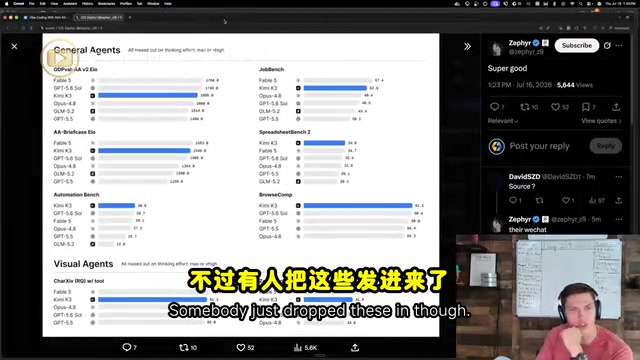
BrowseComp, introduced by OpenAI, evaluates a model's ability to answer complex questions through multi-round web searches and cross-page information synthesis — answers are often scattered across multiple pages, requiring the model to plan search strategies, filter noise, and reason across documents. Kimi K3 topping this benchmark suggests it outperforms other frontier models in tool-assisted knowledge retrieval scenarios. Spreadsheet Bench tests spreadsheet formula comprehension, data analysis, and business logic. Together, these two benchmarks point in the same direction: Kimi K3 has a significant edge in the everyday tasks of knowledge workers — information retrieval, data processing, and document analysis — which aligns closely with Moonshot AI's long-term positioning for the Kimi product line.
Notably, the official leaderboard contains no coding benchmarks at all, which left the host puzzled: "Why isn't there a single coding benchmark? That's pretty surprising."
The Unavoidable Weakness: Inference Speed Is Slow
For all its impressive generation quality, Kimi K3 has one glaring weakness — it's slow.
During the stream, the model output roughly 25–27 tokens per second, while Fable5 on Anthropic's servers hit 38 tokens/second — about 50% faster. The haunted house game took a full 30–45 minutes to generate.
The host was blunt: "Honestly, I'm not happy with the speed. If you're slower than Fable5, why would I choose you? Speed matters."
From a technical standpoint, this speed gap involves several factors. First is infrastructure maturity: at initial release, API providers often haven't yet completed architecture-specific kernel optimizations (like FlashAttention variants or PagedAttention memory management), resulting in throughput below theoretical limits. Second is batch scheduling: under high concurrency, providers bundle multiple requests together to maximize overall throughput, which reduces perceived per-user speed. For MoE models, expert routing load balancing is also critical — if some experts are heavily utilized while others sit idle, GPU utilization becomes uneven, further dragging down inference speed. As more providers like Together AI complete targeted optimizations, speeds could theoretically improve 2–3x. The host offered a similar verdict: the slowness is "more a compute infrastructure gap than a fundamental problem with the model itself."

Real-World Challenges
The host also flagged the gap between single-page HTML tests and real codebases. In an actual project, Kimi K3 successfully located and fixed a login bug (root cause: port 8080 occupied by the wrong server) and generated a passable Remotion marketing video in one shot. But on the million-token context window, he offered a word of caution: "You can say a model supports 1 million tokens, but in practice, once you go beyond 500K tokens, the session basically dies."
This has a deeper technical explanation. Standard attention mechanisms scale quadratically with sequence length — 1 million tokens means enormous attention computation overhead. Even with sparse attention, chunked prefill, and other engineering optimizations, the "Lost in the Middle" problem persists at ultra-long context lengths: models significantly underutilize information positioned in the middle of the context compared to the beginning and end. So there remains a real gap between "supports 1 million tokens" and "effectively uses 1 million tokens."
The model also occasionally produced blank screens — the Subway Surfers game generated as a black screen on the first try and required a second prompt to fix; the solar system simulator also needed two shots. These issues have been observed with Grok 4.5 and other models as well.
Conclusion: A Genuine Leap for Chinese Open-Source Models
After the full session, the host delivered a clear verdict: "This is the best Chinese open-source model I've ever seen, and the strongest open-source model overall right now. It's a completely different species — we've never seen an open-source model like this."
For Moonshot AI, Kimi K3 signals a clear strategic pivot — from a budget-focused model chasing extreme cost-efficiency, to a frontier competitor winning on scale and capability. Its UI design, visual fidelity, and game generation ability can now go head-to-head with top closed-source models, and in blind audience voting, it pulled ahead by a wide margin.
Growth areas remain: slow inference speed, occasional blank-screen failures, and the absence of coding benchmarks. But as the host put it: "This kind of competition is incredibly valuable for the whole industry. When people vote that Kimi K3 does it better, and it costs just a third more than Fable5 — that's what actually moves the industry forward."
A full formal evaluation is coming later, which will determine whether Kimi K3 earns the "BridgeMind Certified" stamp. But based on this impromptu stream alone, it has already proven itself worthy of being taken seriously.
Key Takeaways
Related articles

The Truth Behind Codex 'Build a Website in 5 Minutes': AI Isn't Creating Sites—It's Helping You Copy Them
Exposing the truth behind viral Codex 5-minute website videos: creators aren't building original sites with AI—they're copying shared prompts or scraping others' work. Learn AI coding tools' real limits.

Getting Started with AI Agent Development: A Complete Guide from Concept to Practice
A comprehensive guide to AI Agent architecture and development, covering automated marketing, intelligent customer service, and investment analysis scenarios with single and multi-agent collaboration.

The Truth Behind Codex 'Build a Website in 5 Minutes': AI Isn't Creating Sites — It's Helping You Copy Them
Exposing the truth behind viral Codex 5-minute website videos: creators aren't building original sites with AI — they're copying shared prompts or scraping others' work.