Krea2 Tested: Does the FP8 vs BF16 Quality Gap Still Exist?

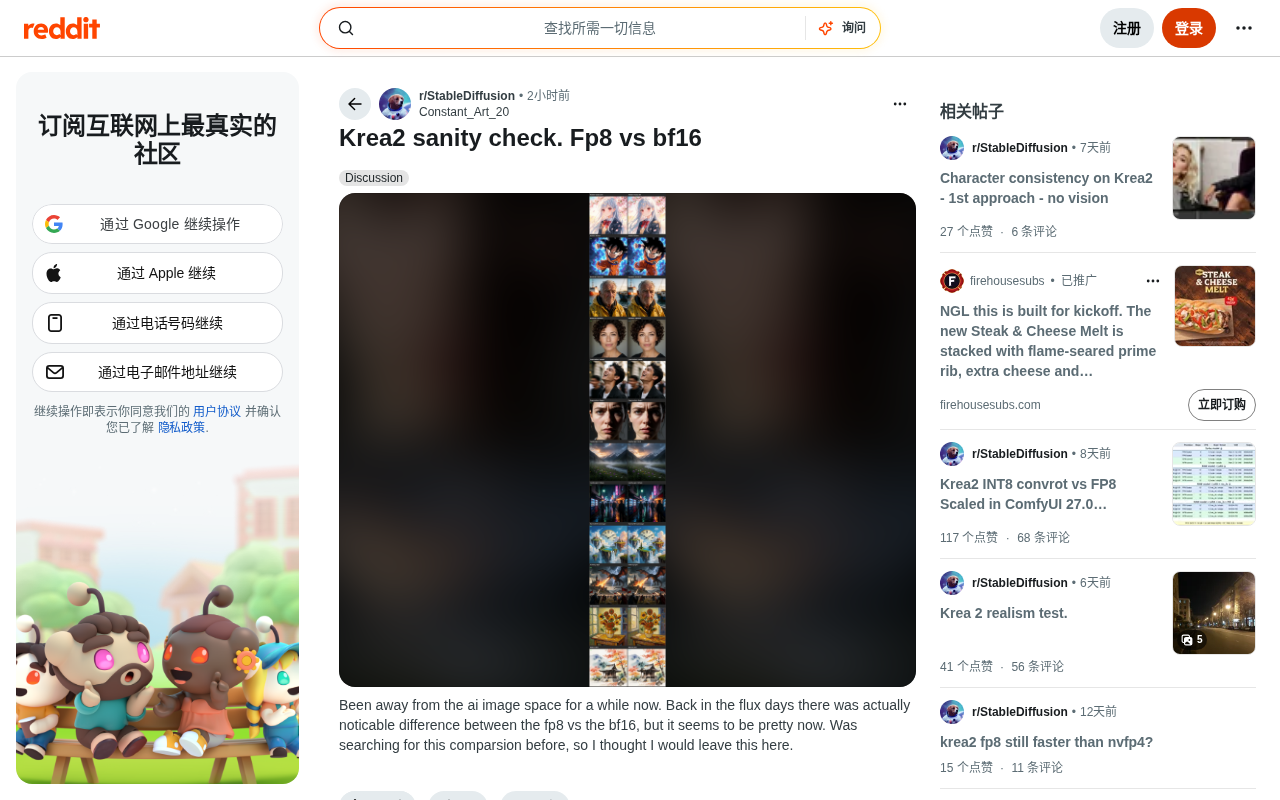
Krea2 testing shows FP8 and BF16 image quality is now nearly identical, unlike the noticeable gap in the Flux era.
A Reddit user's sanity check on the Krea2 model found FP8 and BF16 outputs to be nearly indistinguishable—a sharp contrast to the visible gap of the Flux era. This article explores the technical drivers: matured quantization methods, QAT training, quantization-friendly architectures, and native FP8 hardware support, plus their real impact on VRAM and speed.
Introduction: Revisiting an Old Question
In the field of AI image generation, model quantization precision has always been a topic that players and developers can't avoid. When compressing a model from high-precision BF16 (bfloat16) down to lower-precision FP8 (8-bit floating point), how much image quality is actually lost? This trade-off directly affects VRAM usage, inference speed, and final output quality.
Format background: BF16 (Brain Float 16) is a 16-bit floating-point format developed by the Google Brain team, designed specifically for deep learning. It retains the same 8-bit exponent as FP32 (standard 32-bit floating point), giving it an enormous dynamic range that can represent the distribution characteristics of neural network weights very well, while compressing the mantissa to 7 bits to save memory. FP8 goes a step further, compressing precision to 8 bits. Currently there are two main sub-formats: E4M3 (4-bit exponent + 3-bit mantissa) and E5M2 (5-bit exponent + 2-bit mantissa), optimized for forward propagation and backward propagation respectively. Going from BF16 to FP8 halves memory usage, but numerical representation precision drops significantly—this is the fundamental source of quantization quality loss. It's worth noting that the design philosophy of these two FP8 sub-formats reflects a fundamental trade-off between precision and dynamic range: E4M3 trades lower precision for a larger dynamic range, suitable for forward computation where weight distributions are wider; E5M2 sacrifices dynamic range for higher precision, suitable for backward propagation where gradient values are relatively concentrated. This fine-grained design tailored to the characteristics of each computation phase is a microcosm of how modern quantization technology has matured.
Recently, a Reddit user who had briefly left the AI image community and then returned conducted a sanity check comparing FP8 and BF16 on the Krea2 model. His core finding is quite valuable: In the early Flux era, there was a visible gap between FP8 and BF16, but by the Krea2 stage, this gap seems to have become negligible.
Krea2 background: Krea2 is a next-generation image generation foundation model from Krea AI. Krea AI positions itself as an AI platform for professional creative workers, and its product design philosophy has, from the start, placed a high value on balancing real-world deployment efficiency with user experience. Unlike many research-oriented models that prioritize parameter scale, Krea2 has incorporated the feasibility of low-precision deployment as a core consideration in both its architecture design and training strategy—this is an important reason it outperforms previous-generation models in FP8 quantization robustness. Furthermore, the Krea team provided specially optimized FP8 weights alongside the model release, rather than simply applying post-training quantization (PTQ) to the BF16 weights. This engineering decision also has a non-negligible impact on final quality. From a broader industry perspective, Krea2 represents a new class of "deployment-first" model development paradigm: model capability and engineering feasibility are given equal priority, rather than treating engineering optimization as post-processing after research is complete. This paradigm shift is reshaping the competitive landscape of image generation models.
Inferred engineering path for Krea2's quantization robustness: Based on public information and industry practice, Krea2's excellent FP8 quantization performance likely stems from the combined, mutually reinforcing effects of several engineering decisions. First is a "quantization-friendly" data preprocessing pipeline: the normalization strategy of training data directly affects the numerical distribution of activation values—the more concentrated and symmetric the distribution, the more efficiently FP8's limited dynamic range can cover the actual value range. Second is a possible "quantization-aware fine-tuning" (QA Fine-tuning) strategy adopted by the Krea team: after full-precision pretraining, a small-scale quantization-aware fine-tuning nudges the model weights toward a "quantization-friendly" parameter region. The training cost of this strategy is far lower than doing QAT from scratch, yet it is equally effective at improving PTQ quality. A third possible contributing factor is refined activation calibration: the FP8 quantization scaling factor is typically derived from statistics on a calibration dataset, and the diversity and representativeness of the calibration set directly affect the accuracy of the scaling factor, which in turn affects quantization quality in actual deployment.
From Flux to Krea2: The Evolution of Quantization Precision
The Obvious Gap in the Flux Era
Users familiar with diffusion models should remember that during the period when the Flux series of models was popular, the impact of quantization precision on output quality was quite noticeable. Many users reported that when using FP8 versions, images would show perceptible degradation in detail rendering, texture clarity, and color transitions. For users pursuing ultimate image quality, BF16 was almost the only choice—despite the cost of higher VRAM usage and slower generation speed.
The root of this gap lies in the fact that FP8's dynamic range and numerical precision are relatively limited, and the weight quantization process introduces more numerical error. The inference process of a diffusion model is an iterative denoising process, typically requiring dozens or even hundreds of sequential timesteps. This iterative nature makes it especially sensitive to numerical error: the tiny error of each step is carried into the next step, and after accumulating over many steps, it can have a non-negligible impact on the final image.
The systemic challenge of quantizing diffusion models: Compared to discriminative models and large language models, diffusion models face unique systemic challenges at the quantization level. The core issue is that inference in diffusion models is a temporally coupled dynamic process, not a single forward pass. The input of each timestep—the latent representation of a noisy image—is itself the output of the previous step's computation. This autoregressive state dependency makes the error propagation path far more complex than static inference. Moreover, diffusion models are not uniformly sensitive to quantization error across different timesteps: in early denoising steps with high noise levels, the model is mainly responsible for determining the overall structure and semantic layout of the image, and this stage is relatively insensitive to precision; in later refinement steps with extremely low noise levels, the model needs to handle high-frequency texture details, and any numerical perturbation can directly affect the sharpness and detail authenticity of the final image. This observation has given rise to the research direction of "timestep-aware quantization"—using higher precision for later timesteps and aggressively compressing earlier timesteps, achieving a finer balance between overall computational efficiency and quality at critical stages.
The mathematical nature and propagation mechanism of iterative error: From a signal processing perspective, the denoising process of a diffusion model can be understood as the evolution of a dynamic system. At each timestep $t$, the model predicts the current noise estimate $\epsilon_\theta(x_t, t)$, and updates the image state $x_{t-1}$ accordingly. If a quantization error $\delta_t$ is introduced at each step, then after $T$ steps the accumulated error is approximately $\sum_{t=1}^{T} \delta_t$, and under some denoising schedules there may even be an error amplification effect. This is precisely why the more sampling steps there are, the greater the potential impact of quantization error on the final image—and the default sampling step count of early Flux models was typically between 20 and 50 steps, enough to expose FP8's precision flaws. Worth exploring is that different sampling schedulers vary significantly in how much they amplify error: Markov-chain schedulers like DDPM, where each step's state depends entirely on the previous step's output, have stronger error accumulation than non-Markov schedulers like DDIM; the latter reduces the "intermediate links" of error propagation through step-skipping sampling, making it more tolerant of quantization precision at the same step count. This also explains why many users find that under schedulers like DDIM or DPM-Solver, the gap between FP8 and BF16 is smaller than under DDPM.
Furthermore, the numerous attention mechanisms in the Transformer backbone of diffusion models are particularly sensitive to numerical precision—the softmax operation is prone to numerical overflow or underflow due to insufficient precision when handling extreme values, which in turn affects the sharpness of image details and the smoothness of color transitions. This is precisely the core technical reason why early FP8 quantization results were unsatisfactory. The sensitivity of the attention mechanism is also reflected in its assumptions about the input distribution: the scaling factor $1/\sqrt{d_k}$ in standard scaled dot-product attention is designed for full-precision inputs. When the Q/K matrices are quantized to FP8, their numerical distribution shifts, and the compensation effect of the scaling factor diminishes, ultimately causing the softmax output probability distribution to exhibit "sharpening" or "flattening" bias—the former causes attention to over-concentrate on a few tokens, while the latter causes attention weights to trend toward uniform distribution, both of which undermine the model's ability to finely model the local structure of the image.
The New Changes in Krea2
However, according to this Reddit user's real-world testing, the situation on Krea2 is now quite different. He said the outputs of FP8 and BF16 are "pretty much" indistinguishable. This means users can confidently choose the FP8 version and enjoy lower VRAM usage and faster inference speed with almost no loss in image quality.
It should be noted that this is a single-source individual observation with a limited sample size, and not a rigorous quantitative benchmark test. The following conclusions are for reference only; it's recommended to make your own judgment based on your own testing.
Why Is the Gap Between FP8 and BF16 Shrinking?
Although the original post did not delve into technical details, from the perspective of industry development trends, there may be several reasons behind the shrinking gap.
1. Quantization Technology Continues to Mature
Quantization methods themselves have made significant progress in recent years. From the early crude approach of direct weight quantization to today's more refined mixed-precision quantization, per-channel quantization, and selective strategies that preserve high precision for sensitive layers, these techniques can greatly reduce the quality loss brought by quantization.
Per-channel quantization is a more refined quantization strategy compared to per-tensor quantization. In per-tensor quantization, the entire weight matrix shares the same set of scaling parameters, which easily introduces significant error due to large weight distribution differences between different channels; per-channel quantization independently computes a scaling factor for each output channel, thereby more precisely capturing the numerical distribution of each channel and greatly reducing quantization error. Mixed-precision quantization goes a step further—by analyzing the sensitivity of each layer to quantization error, it preserves BF16 precision for critical layers (such as the Q/K/V projections of attention layers) and applies FP8 compression only to insensitive layers, achieving the optimal balance between model size, inference speed, and output quality.
In engineering practice, mixed-precision quantization has formed a relatively mature decision-making paradigm: by performing layer-by-layer sensitivity analysis on the model (using the Hessian matrix or Fisher information matrix to evaluate the response strength of each layer to quantization perturbation), one can precisely identify which layers are "quantization bottlenecks." For the Transformer backbone of image generation, the Q/K projection matrices of attention layers are typically identified as highly sensitive layers; while most weights in the FFN layers are relatively insensitive to quantization and can be safely compressed to FP8 or even INT8. This strategy of "differentiated compression by sensitivity" allows the overall model to achieve a compression ratio approaching the theoretical limit while maintaining output quality close to full precision.
Similarities and differences between GPTQ, AWQ, and FP8 quantization: The GPTQ (Generalized Post-Training Quantization) and AWQ (Activation-aware Weight Quantization) methods widely used in the large language model community also reflect the trend toward refined quantization technology. The core insight of AWQ is that not all weights are equally important—only about 1% of "salient weights" have a huge impact on model output, and protecting them can maintain model quality at extremely low bit-widths. GPTQ, on the other hand, determines the optimal quantization parameters by minimizing layer-by-layer output error (rather than the weight error itself). Its theoretical foundation comes from second-order optimization methods; while computationally expensive, its quantization precision is significantly better than simple nearest-neighbor rounding. These experiences and methodologies from the LLM quantization field are being borrowed and transferred by the engineering teams of image generation models, further driving the improvement of FP8 quantization quality in image generation models—the cross-pollination of quantization technology between these two fields is accelerating the engineering efficiency evolution of the entire generative AI landscape.
2. Optimization of Model Architecture and Training Strategy
A new generation of models begins to consider low-precision deployment requirements during the training phase. Through quantization-aware training (QAT) or more robust architecture design, models have greatly improved their tolerance for reduced precision, reducing the impact of quantization error at the source.
Quantization-Aware Training (QAT) is a technical strategy that simulates the effect of low-precision quantization during the model training phase. Compared to Post-Training Quantization (PTQ), QAT inserts "fake quantization" nodes during forward propagation, allowing the model to learn to adapt to quantization noise during training, thereby gaining stronger robustness to low-precision representation. Specifically, QAT simulates rounding errors on activation values and weights, so that the direction of gradient updates naturally biases toward a "quantization-friendly" parameter space. The resulting model, when actually quantized for deployment, has far less quality loss than directly quantizing an ordinary full-precision model.
At the engineering implementation level, QAT is not without challenges: the derivative of quantization functions (such as rounding operations) is almost zero everywhere, causing gradients to be unable to propagate normally backward. In engineering practice, the Straight-Through Estimator (STE) is usually used to approximate the gradient of the quantization operation—that is, quantization is performed during forward propagation, while during backward propagation it pretends the quantization operation does not exist and directly passes the upstream gradient. Additionally, QAT usually needs to be initialized with full-precision pretrained weights first, then introduce quantization noise in stages after the model converges; introducing it too early leads to training instability. For models like Krea2 aimed at commercial deployment, the increased training cost brought by QAT (typically 1.2-1.5x standard training) has a significant advantage in engineering economics compared to the deployment quality improvement it brings. This technique has been widely adopted in the engineering deployment of both large language models and image generation models.
Quantization-friendly design at the architecture level: Beyond training strategy, the model architecture itself is also evolving toward being "quantization-friendly." For example, RMSNorm (Root Mean Square Normalization) has stronger constraints on numerical range compared to LayerNorm, with a more concentrated output distribution, naturally reducing the risk of overflow during quantization; gated activation functions like SwiGLU and GeGLU have better numerical stability at low precision compared to the ReLU family—this is because the gating mechanism naturally suppresses extreme distributions of activation values through multiplication operations, making it easier for FP8's limited dynamic range to cover the distribution range of actual activation values. Furthermore, more and more modern architectures introduce QK-Norm (normalizing the Query and Key vectors) into the attention mechanism, a design that directly solves the pain point of softmax numerical overflow under FP8, keeping attention computation stable at low precision. These seemingly minor architectural choices produce considerable quality differences during FP8 quantization deployment—new-generation image generation models (including the generation of products represented by Krea2) have generally adopted these design principles.
3. Hardware and Inference Framework Support Catching Up
Modern GPUs' native support for FP8 is becoming increasingly complete—new-generation cards represented by NVIDIA Hopper and Ada architectures, combined with continuously optimized inference frameworks, make FP8 not only gradually catch up with BF16 in quality, but also have obvious advantages in throughput and energy efficiency.
NVIDIA first introduced native hardware support for FP8 in the Hopper architecture (H100 series, released 2022), achieving dynamic mixed-precision computation between FP8 and BF16/FP16 through Transformer Engine technology. The core innovation of Transformer Engine lies in its Dynamic Scaling mechanism: before each matrix multiplication, the hardware automatically scans the numerical range of the input tensor and computes the optimal scaling factor, ensuring that the quantized FP8 values can fully utilize the effective bit-width, without a large amount of information piling up in the least significant bits or directly overflowing due to a mismatch in numerical range. The consumer-oriented Ada Lovelace architecture (RTX 40 series) also has FP8 Tensor Core support, but the granularity of its dynamic scaling (Per-tensor vs Per-block) differs from Hopper, and engineering teams need to adjust quantization strategies for different hardware platforms to achieve the best results. Combined with the continuous optimization of inference frameworks such as cuDNN and TensorRT, FP8 can achieve nearly 2x throughput improvement compared to BF16, while reducing VRAM usage by about 50%. On the AMD side, the RDNA 3 and CDNA 3 architectures also added FP8 support, and this competitive landscape is accelerating the full adaptation of inference frameworks to FP8.
The current state of FP8 support on consumer GPUs: It's worth noting that not all consumer graphics cards have the same FP8 hardware acceleration capability. The RTX 40 series (Ada Lovelace) has full FP8 Tensor Core support, enabling hardware-level acceleration; while the RTX 30 series (Ampere), although it can run FP8 inference through a software path, actually decompresses FP8 values to FP16/BF16 before computing, and cannot obtain the true hardware acceleration benefit—in some extreme cases, the software simulation path may even be slower than directly using BF16 inference, because the decompression operation itself introduces additional overhead. This means that for users still using the RTX 30 series, the main benefit of choosing the FP8 version lies in VRAM savings (about 50%), rather than a substantial improvement in inference speed—but this in itself is already a considerable practical value, enough to allow more users to run high-quality models that would otherwise lack sufficient VRAM on consumer-grade hardware. For RTX 40 series users, FP8 is the preferred solution that balances speed and quality, offering the dual benefit of both VRAM savings and throughput improvement.
Practical Significance for Ordinary Users
Lowering the VRAM Threshold
For users of consumer-grade graphics cards, the FP8 version can significantly lower the VRAM usage threshold. If image quality is nearly lossless, choosing FP8 is undoubtedly a more pragmatic solution, especially suitable for devices with relatively tight VRAM. Take a typical 12B-parameter image generation model as an example: at BF16 precision, the model itself requires about 24GB of VRAM, and after adding KV Cache and intermediate activation values, it often exceeds the physical limit of consumer-grade cards; after switching to FP8, the model weight VRAM usage drops to about 12GB, leaving ample room for other VRAM demands during inference, making models that were originally impossible to run become possible.
Faster Inference Speed
FP8 inference is usually a notch faster than BF16, with shorter generation wait times. For creators who need to generate images in large batches or frequently iterate and adjust prompts, this efficiency improvement is quite considerable. On RTX 40 series cards equipped with FP8 Tensor Cores, this acceleration effect is most significant; for scenarios limited by memory bandwidth (rather than compute), the reduced memory access brought by FP8 can also translate into considerable speed improvement, partially applicable even on hardware without native FP8 Tensor Cores.
How to Choose?
Combining the reference value of this real-world test, here are some recommendations:
- Sufficient VRAM, pursuing ultimate image quality: Continue using BF16, safe and reassuring.
- Limited VRAM or focused on generation speed: Boldly try FP8; on new models like Krea2, it likely won't bring noticeable image quality loss.
- Best practice: Generate images separately with the same random seed and prompt, and compare them yourself—this is exactly the "sanity check" spirit advocated by the original poster, and also the most reliable way to judge.
Methodological limitations of quantization benchmark evaluation: It's worth being cautious that current quantization evaluation of image generation models generally lacks a standardized evaluation framework, which introduces considerable uncertainty into cross-model, cross-precision quality comparisons. Existing image quality evaluation metrics—whether FID (Fréchet Inception Distance), CLIP Score, or LPIPS—all suffer to varying degrees from a disconnect with human subjective perception. FID measures the statistical distance between the distribution of generated images and the distribution of real images, and is insensitive to the local detail quality of individual images; CLIP Score reflects the degree of text-image semantic alignment, and is not sensitive enough to visual degradation introduced by quantization (such as texture blurring or color drift); although LPIPS introduces perceptual-level evaluation, the feature representations of its underlying network (usually based on VGG or AlexNet) may not fully capture the regions to which the human eye is sensitive regarding image degradation. This means that a model that "passes" in some quantization evaluations may still exhibit noticeable quality degradation under specific types of image prompts—which is why the practical recommendation to "compare yourself with a fixed seed" has irreplaceable practical value in the current absence of a unified evaluation standard.
Practical comparison methodology: When conducting an FP8 vs BF16 comparison test, fixing the random seed is key to controlling variables. In mainstream inference interfaces such as ComfyUI and Automatic1111, the same seed value combined with the same prompt and sampling parameters should theoretically produce a deterministic generation trajectory—any output difference can be directly attributed to the difference in quantization precision. It's recommended to cover multiple prompt types during testing: scenes with complex details (such as human faces, text, dense patterns) are usually most sensitive to quantization error and are the best test cases for exposing precision gaps; while landscapes and abstract patterns have lower precision requirements and often perform similarly under FP8 and BF16. In terms of evaluation methods, besides subjective visual comparison, objective metrics such as SSIM (Structural Similarity Index) or LPIPS (perceptual-based image similarity) can also be used for quantitative evaluation, with the latter especially able to capture texture and detail differences that the human eye is sensitive to, more in line with human visual perception than simple pixel-level MSE. If the LPIPS score difference is less than 0.05, the two precisions can usually be considered to have no significant difference at the perceptual level.
Conclusion: Verify Hands-On, Better Than Blindly Following Trends
Although this share from Reddit is brief, it conveys an important reminder: Experience in the AI field can become outdated, and yesterday's conclusions may not apply to today's models. The widely accepted claim in the Flux era that "FP8 image quality is poor" may no longer hold true by the Krea2 stage.
Technology is iterating rapidly. Quantization schemes (from simple per-tensor PTQ to refined per-channel QAT), model architectures (from standard LayerNorm to quantization-friendly designs empowered by QK-Norm), and hardware support (from software-simulated FP8 to native Tensor Core acceleration in Hopper/Ada architectures) are all continuously advancing. The coordinated evolution of these three dimensions has jointly driven FP8 quantization quality across the leap from "clearly inferior to BF16" to "almost indistinguishable"—and this leap is no accident, but the collective achievement of the long-term efforts of researchers across the three fields of quantization algorithms, model engineering, and chip design. Rather than clinging to old perceptions, it's better to be like this user and run a comparison test yourself, letting the actual results speak. This is both an attitude of taking responsibility for your own creative workflow and a good habit for maintaining technical sensitivity.
Key Takeaways
- The gap between FP8 and BF16 is shrinking: Krea2 real-world testing shows the two outputs are almost indistinguishable, contrasting with the obvious gap of the Flux era
- Technical progress is the main driver: Per-channel quantization, QAT training strategies, quantization-friendly architecture design (RMSNorm, QK-Norm), and hardware FP8 Tensor Core support have jointly driven this progress
- Hardware differences need attention: The RTX 40 series can obtain the dual benefit of FP8 speed + VRAM; the RTX 30 series mainly benefits from VRAM savings
- Conclusions vary by model: Krea2's FP8 performance does not represent all models; it's recommended to verify each model independently
- Evaluation methodology is equally important: Existing objective metrics (FID, CLIP Score) have limited ability to capture the perceptual degradation of quantization quality; subjective comparison with a fixed seed combined with perceptual metrics such as LPIPS is currently the most reliable evaluation combination
- Real-world testing is the only authority: Comparing yourself with a fixed seed and objective metrics such as SSIM/LPIPS beats any anecdotal claim
Related articles

Disaster and Glory of the Apollo Program: The History We Must Revisit Before Returning to the Moon
From the fatal Apollo 1 fire to Apollo 8's daring lunar orbit to Apollo 11's successful landing—revisiting the disasters, fears, and compromises of the Apollo program and their lessons for today's return to the Moon.
Netflix Trust Exercise Turns Into Firing Trap: Where Are the Boundaries of Corporate Trust?
A Netflix employee was fired after sharing private info in a trust exercise. We analyze the risks of corporate trust exercises and how employees can protect themselves.

AMD CDNA5 Architecture Deep Dive: Technical Evolution and the AI Computing Competition Landscape
Deep analysis of AMD's CDNA5 architecture covering Chiplet packaging upgrades, HBM memory evolution, and low-precision compute optimization, examining how AMD challenges NVIDIA's AI chip dominance.