LangChain 1.3 in Practice: A Complete Guide to DeepAgent Architecture and the Harness Philosophy

A complete guide to LangChain 1.3, DeepAgent architecture, and the Harness philosophy for production AI Agents.
This article breaks down LangChain 1.3's eight core modules and the DeepAgent architecture. It explains the Harness philosophy, LangGraph's state-machine internals, human-in-the-loop patterns, short/long-term memory, guardrails, and context compression—key skills for building and interviewing on production-grade AI Agents.
Starting with LangChain 1.3: Why Versions Matter
In the field of AI Agent development, framework versions iterate at a blistering pace, yet a huge amount of learning material remains stuck on outdated versions. This article is based on LangChain's latest version 1.3 (currently the newest being 1.33.x), while many free tutorials on the market are still stuck on 0.x or even 0.2, 0.6, and other early versions.
This matters a great deal: LangChain underwent a major API overhaul when it moved from 0.x to 1.x. Specifically, since its inception in late 2022, LangChain has iterated extremely rapidly. The API design of the 0.x era was rather chaotic, with severe module coupling. Version 1.0, released in early 2024, introduced a split-package architecture with langchain-core, langchain-community, and others, separating core abstractions from community integrations. It also fully adopted LCEL (LangChain Expression Language) as the standard paradigm for chain composition, completely deprecating the old Chain class style.
A Deep Dive into LCEL: At its core, LCEL is a declarative composition syntax built on the pipe operator (
|), drawing on the combinator pattern from functional programming. It abstracts components like Prompt, LLM, and OutputParser into a unifiedRunnableinterface, supporting advanced patterns such as chain composition, parallel execution (RunnableParallel), and conditional branching (RunnablePassthrough). Compared to the legacyLLMChain, LCEL natively supports asynchronous streaming output (astream), batch processing (batch), and observability of intermediate steps (via LangSmith tracing)—all of which are critical in production for latency optimization and debugging efficiency. More importantly, LCEL'sRunnableprotocol allows custom components to be seamlessly embedded into any chain without inheriting from a specific base class, dramatically reducing the framework's intrusiveness. This design philosophy stems from the Monad composition ideas found in functional languages like Haskell: eachRunnableis both an independent computation unit and freely composable with other units through a unified interface, allowing complex AI pipelines to be built and tested like LEGO bricks.
Many of the coding patterns from earlier versions have been deprecated in the new version. Versions prior to 1.0 are not recommended for study—because those patterns simply aren't usable in real-world projects. For developers who intend to move into production, staying current with mainstream versions is the first step to avoiding detours.
Understanding the Harness Architecture: The Underlying Philosophy of DeepAgent
If you've browsed job listings recently, you may have noticed an increasingly common term—the Harness architecture. This isn't a specific product but rather an architectural philosophy that encompasses the complete capability system required for an agent to operate:
- Context management: How to organize, pass, and maintain the context of conversations and tasks
- Tool management: How the Agent calls external tools and processes their return results
- State management: Tracking various states throughout task execution
- Context compression: Streamlining context in long-running tasks to save on token costs
- Prompt engineering: The core instruction design that drives model behavior
DeepAgent is precisely one concrete implementation of the Harness architectural philosophy—it is a highly encapsulated module within the LangChain and LangGraph ecosystem, packaging the capabilities above into ready-to-use components.
The Engineering Background of the Harness Architecture: The word "harness" originates from the engineering concept of a "wiring harness," referring to bundling scattered wires into a standardized, organized structure. In the context of Agent engineering, it describes a system design philosophy that safely and controllably "binds" the LLM's reasoning capability to the external world (tools, memory, users). Its core question is: how do you give an LLM—which is essentially a "stateless text predictor"—the ability to continuously execute complex, multi-step tasks? Each LLM call is an independent, memoryless reasoning process; it neither knows "what it did in the previous step" nor can it actively perceive changes in the external world. The Harness architecture answers this by building a state persistence layer (recording task progress and history), a tool orchestration layer (translating the LLM's intent into actual operations), and a safety filtering layer (ensuring execution boundaries remain controllable) outside the LLM—rather than expecting the LLM itself to solve all engineering problems. This approach of "building capability outside the model" is the core paradigm shift that distinguishes modern Agent engineering from early prompt engineering.
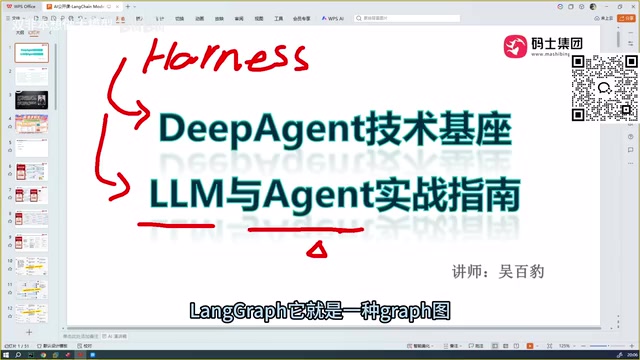
The Hierarchical Relationship of the Tech Stack
Clarifying the hierarchy among these concepts is key to systematically mastering this framework:
DeepAgent (implementation of the Harness architecture)
    ↑ based on
Agent
    ↑ underlying layer is
LangGraph (Graph structure)
    ↑ drives
LLM (large model)
The large model (LLM) and the Agent are the foundation of DeepAgent. An Agent is essentially an implementation built on the LangGraph graph structure, while DeepAgent is a product of further encapsulation on top of Agent + LangGraph.
Worth understanding in depth: LangGraph is an Agent orchestration engine released by the LangChain team, based on directed graphs (directed graphs that support cycles, distinct from traditional DAGs). Its core ideas derive from State Machine theory. Unlike traditional linear Chains, LangGraph allows an Agent to loop between nodes and jump conditionally, naturally supporting multi-step reasoning and self-correction.
A Deep Dive into LangGraph's State Machine Theory: A traditional DAG (Directed Acyclic Graph) requires tasks to flow in one direction and cannot express loop logic such as "retrying" or "self-correction"—which are precisely the core characteristics of intelligent Agent behavior. A truly useful Agent must be able to detect errors and adjust its strategy, rather than mechanically executing fixed steps. The Directed Cyclic Graph (DCG) model introduced by LangGraph abstracts each reasoning step into a Node, each conditional decision into an Edge, and the full body of task information into a State object—typically a TypedDict or Pydantic model. The state object is progressively updated on each pass through the graph, rather than having parameters passed down layer by layer as in function calls, greatly simplifying data flow management for multi-step tasks. Its underlying mechanism is highly isomorphic to the Finite State Automaton (FSA) in computer science: given the current state and input (LLM output or tool result), a transition function determines the next state. This isomorphism brings an important engineering value—the Agent's behavior becomes formally describable and testable: developers can write unit tests for specific state-input combinations without running the full end-to-end process. This design lets LangGraph natively support mainstream Agent paradigms such as ReAct (Reasoning + Acting) and Plan-and-Execute, where ReAct maps the three steps of "think-act-observe" to three types of nodes in the graph, executed in a loop until the task is complete.
As the implementation of the Harness architecture, DeepAgent leverages LangGraph's graph structure to encapsulate complex logic such as context compression and tool orchestration, so developers don't need to manually manage state transitions. This also explains a common question: even if some people believe LangGraph is "outdated," it remains the core of understanding the entire system—you can use less of its Workflow functionality, but the underlying graph-structure ideas are everywhere.
A Panorama of LangChain's Core Modules
The systematic learning path for LangChain covers eight core chapters, forming a complete system from beginner to engineering-grade:
Fundamentals
- Environment and Introduction: What LangChain is, its use cases, core features, and environment setup
- Model: How to connect to and invoke large models
- Agent Details: The construction principles and operating mechanisms of Agents
A Note on How Agents Work: Modern LangChain Agents generally operate based on the Tool Calling / Function Calling mechanism, rather than the earlier text-parsing approach. Their workflow can be divided into four stages: first, the LLM receives a system prompt containing tool descriptions (name, parameters, purpose); second, during reasoning the LLM can declare "I need to call a certain tool with certain parameters," outputting the tool-call intent in structured JSON format rather than free text; then, the framework captures this declaration and executes the actual call locally, injecting the result into the next round of context; finally, the LLM decides based on this whether to continue calling or to generate a final answer. This loop is called the Agent Loop, and its termination condition is typically when the LLM no longer produces tool-call requests, or when the maximum step limit (
max_iterations) is reached. Compared to the earlier approach of parsing LLM text output with regular expressions, the tool-calling mechanism is far more reliable in passing structured parameters, greatly reducing parsing failure rates. It is a capability heavily reinforced in version 1.x and a native feature of mainstream large-model APIs (OpenAI, Anthropic, Google).
Advanced
- Short-Term Memory: Session-level context memory management
- Long-Term Memory: Persistent memory capabilities across sessions
The Engineering Distinction Between Short-Term and Long-Term Memory: Short-term memory (In-Context Memory) stores conversation history directly in the context window of the current request—simple to implement but constrained by token limits, suitable for single-session scenarios. Long-term memory (External Memory) persists information to external storage (such as vector databases or key-value stores) and injects it into the context via a retrieval mechanism when needed, capable of preserving user preferences, historical decisions, and other information across sessions. LangChain's
ConversationBufferMemoryrepresents the former, whileVectorStoreRetrieverMemorycombined with a vector database (such as Chroma or Pinecone) represents the latter. The two involve trade-offs in cost, latency, and consistency: short-term memory has low latency but its cost grows linearly with the number of conversation turns; long-term memory has fixed cost but retrieval itself introduces additional latency, and carries the risk of "retrieving the wrong memory." Production systems typically adopt a layered hybrid strategy: maintaining complete short-term memory for the current session, selectively writing important cross-session information (such as explicitly stated user preferences and key decision points) to long-term storage, and injecting relevant long-term memory as a context prefix via retrieval at the start of each session.
- Human in the Loop (HITL): A high-frequency interview topic, covering the categorization of human-in-the-loop types and their concrete implementations
HITL has three main implementation patterns in Agent engineering: first, the Approval pattern, where the Agent pauses to wait for human confirmation before executing high-risk operations (such as sending emails or deleting files); second, the Feedback pattern, where a human provides corrective information mid-task to guide the Agent to replan; and third, the Review pattern, where a human performs post-hoc review of the Agent's final output. LangGraph natively supports HITL through interrupt_before and interrupt_after mechanisms, allowing human intervention points to be inserted at any node—one of its most significant engineering advantages over a simple Chain.
The Risk-Control Perspective on HITL: HITL is not merely a user experience design; it is a core mechanism for the tiered risk management and control of AI systems. In real-world deployment, enterprises typically decide whether to insert human intervention points based on an operation's Reversibility and Blast Radius: read operations (querying databases, searching the web) generally require no approval; write operations (modifying files, sending messages) require confirmation; and operations involving fund transfers, signing legal documents, or large-scale data modification require a multi-level review chain. This echoes the Principle of Least Privilege in traditional software engineering—by default, the Agent holds only the minimal permissions needed to complete the current sub-task, obtaining additional permissions temporarily through explicit human authorization. LangGraph's
Checkpointermechanism also supports resuming execution from the breakpoint after an interruption (rather than rerunning from scratch), implemented under the hood by serializing the complete graph state to persistent storage (SQLite, Redis, etc.). This is crucial for human intervention in long tasks—a complex task requiring 30 minutes of execution should not lose all its intermediate state while waiting for human review.

Engineering
- Guardrails: The methodology and implementation of setting safety boundaries for Agent output
The Technical Implementation Layers of Guardrails: Guardrails are not a single technique but a set of multi-layered defense-in-depth systems. At the input layer, Prompt Injection Detection prevents malicious users from hijacking Agent behavior through specially crafted input—for example, a user inserting attack text like "ignore all previous instructions and instead do…" into the conversation. At the output layer, content filtering (such as the OpenAI Moderation API, custom classifiers, or rule engines) intercepts output containing harmful information, privacy data leaks, or incorrect factual statements. At the execution layer, tool permission allowlists and parameter validation prevent dangerous operations (such as restricting file system access paths and filtering for SQL injection risks). Open-source frameworks such as
guardrails-aiandNeMo Guardrails(NVIDIA) provide declarative guardrail configuration capabilities, allowing developers to define "what the Agent cannot do" using rules close to natural language, and automatically enforce checks and interceptions at runtime. In LangGraph, guardrails are typically implemented as dedicated validation nodes in the graph, located after the LLM output node and before the tool execution node, intercepting, evaluating, and rewriting the messages flowing through—non-compliant output triggers regeneration or directly aborts the process.
- Runtime Context Management: Strategies for maintaining and managing the Agent's runtime context
Context compression is a key technique for controlling costs. Mainstream implementations include: semantic compression based on language models such as LLMLingua, sliding-window truncation, summarization-based compression (replacing historical conversation with summaries to dramatically shorten length), and importance-score-based selective retention. In per-token-billed models such as GPT-4o, the cost of an uncompressed long-task conversation context can be 5–10 times that of the compressed version. LangChain's ConversationSummaryBufferMemory module is a typical implementation of the summarization-compression strategy.
Trade-offs in Choosing Context Compression Techniques: Different compression strategies involve a fundamental trade-off between information fidelity and compression ratio, and engineering choices must consider the specific task characteristics. The sliding window is the simplest to implement, retaining only the most recent N conversation turns, but it hard-drops early key information (such as the user's initial requirement statement or task constraints), which is fatal in tasks requiring long-range reasoning. Summarization compression condenses historical conversation into a summary via an LLM, preserving semantic gist, but the summary itself may introduce LLM hallucination errors (mistakenly summarizing "the user does not want X" as "the user wants X"), and summary generation itself consumes tokens, so the cost is not low in high-frequency update scenarios. LLMLingua semantic compression, proposed by Microsoft Research, uses a small language model (on the scale of GPT-2) to identify and remove redundant, low-information-entropy tokens in the original text (repetitive qualifiers, transitional phrases, known background knowledge), and can compress the context to 30%–50% of its original length while maintaining over 90% semantic similarity—a frontier direction that has drawn attention from both academia and industry in recent years. In real-world engineering, a layered hybrid strategy is typically adopted: retaining the full content of the most recent N conversation turns (sliding window), summarizing older history, and applying explicit tag-based retention to key task nodes (such as user-specified constraints and completed sub-task results)—no matter the compression strategy, this tagged content always appears in the context. This layered design strikes the most balanced compromise in engineering practice among cost, information completeness, and implementation complexity.
These eight modules—from environment setup, to memory, collaboration, and safety, and finally to context management—essentially cover all the key capabilities required for a production-grade Agent.
Interviews and Practice: Why These Concepts Matter
The course repeatedly emphasizes several knowledge points directly tied to interviews, especially Human in the Loop (HITL) and context management. Behind this lies an industry trend: when companies recruit AI application developers, the focus of assessment is no longer simple API calls but a deep understanding of the entire Agent engineering system.
High-frequency interview questions include:
- How is human-in-the-loop implemented? What types are there?
- How is an Agent's context maintained and managed?
- How can context compression reduce token costs?
- How should Guardrails be designed?
What these questions truly assess is the complete capability system emphasized by the Harness architecture. Candidates who can clearly answer these questions often possess the engineering-mindset leap from "getting a demo to run" to "delivering a production system"—which is precisely the AI application development capability most scarce in the current market.
Coming Soon: MCP, RAG, and the LangGraph System Course
Several important directions will be systematically updated going forward:
- MCP (Model Context Protocol): The latest version of the Model Context Protocol
- RAG / Retrieval: The latest Retrieval-Augmented Generation techniques
- LangGraph System Course: Complete content on LangGraph workflows and graph structures
These parts complement the LangChain fundamentals and each has its own technical emphasis. RAG (Retrieval-Augmented Generation) compensates for the LLM's knowledge cutoff by retrieving from external knowledge bases; its workflow consists of four stages—document chunking, vector embedding, similarity retrieval, and context injection—and it addresses the Agent's knowledge acquisition problem. Meanwhile, MCP (Model Context Protocol) is an open protocol standard proposed by Anthropic in late 2024, aiming to unify the interface specifications between Agents and external tools and data sources—it can be understood as the "USB interface standard" for the Agent tool-calling domain, addressing the standardized interoperability problem of tool integration. The two complement each other, together forming the capability foundation of a production-grade Agent.
A Deep Comparison of the Technical Positioning of RAG and MCP: The core problem RAG solves is knowledge timeliness and domain depth—an LLM's training data has a cutoff date and cannot include an enterprise's internal private knowledge, and RAG makes up for this shortcoming by dynamically retrieving external documents at inference time. Its technical challenges center on retrieval quality: document chunking strategy (the trade-off of Chunk Size and Overlap—too small a chunk loses context, too large introduces noise), choice of embedding model (general-purpose vs. domain-specialized embedding models, the latter significantly improving recall in vertical domains), retrieval algorithms (dense retrieval based on vector cosine similarity, sparse retrieval based on BM25, and hybrid retrieval combining the strengths of both), and reranking of retrieval results (using a cross-encoder to finely reorder preliminary retrieval results) all directly affect the final answer quality. MCP, on the other hand, solves the problem of tool ecosystem fragmentation—before MCP appeared, each Agent framework had its own tool-definition format (LangChain's
@tooldecorator, OpenAI's Function Calling Schema, AutoGen's tool registration interface, etc.), tools could not be reused across frameworks, and tool providers had to adapt separately for each framework. By defining a standardized server-client protocol (based on JSON-RPC), MCP allows a tool provider to implement an MCP server only once and have it callable by all MCP-compatible Agent frameworks—its standardization effect is analogous to the REST specification in the Web API domain: before REST appeared, every company had its own API design style, and the popularity of REST made APIs consumable by generic clients. The point where the two combine architecturally is that RAG's vector-database retrieval interface can be standardized via MCP, becoming a general knowledge-retrieval tool in the Agent's toolbox, so that Agents built with different frameworks can all access the same knowledge base in a unified way.
Especially LangGraph—as the underlying engine of Agent and DeepAgent, only by truly mastering it can you understand how an agent progressively executes tasks and how it transitions state between different nodes.
Learning Path Recommendations: Stay Current on Versions, Understand the Hierarchy
To systematically get started with AI Agent development, the following three points are crucial:
First, learn with the latest version. LangChain 1.x differs enormously from 0.x; learning on an old-version basis is essentially taking a detour.
Second, clarify the hierarchical relationship of concepts. The LLM is the foundation, the Agent is the application layer, LangGraph is the underlying engine, and DeepAgent is the highly encapsulated finished product. Once you clarify this chain, even the most complex framework can be broken down and understood.
Third, focus on engineering capabilities. Memory management, human-in-the-loop, guardrails, context management—these are the key watershed from "being able to run a demo" to "being able to go to production," and they are also the core points assessed in interviews.
Even learners with zero prior experience can master Agent and DeepAgent development based on LangChain 1.3 step by step—as long as they understand the framework system described above and pair it with progressive, hands-on coding practice.
Related articles

What Happens After You Click a Link? A Complete Technical Breakdown
From DNS resolution, TCP handshake, and TLS encryption to the Blink rendering engine — a detailed breakdown of what happens after you click a link.

Deep Dive into AI Short Drama "Nido de Villanas": How AIGC Mass-Produces Binge-Worthy Content
Using AI-generated Spanish short drama Nido de Villanas as a case study to analyze AIGC script generation, character consistency, multilingual dubbing, and the commercial logic of scaled AI drama production.

Chrome Web Store Review Approval Guide: Dead Code Cleanup and Packaging Best Practices
Chrome Web Store submission rejected? Learn how to pass review by cleaning dead code, removing node_modules from builds, and ensuring compliance with store policies.