LangChain 1.3 in Practice: A Complete Technical Guide from LLMs to DeepAgent

A complete technical breakdown of LangChain 1.3, from LLMs to DeepAgent, for AI engineers.
This article explains the core knowledge system of LangChain 1.3, tracing the technical roadmap from LLMs to Agents and DeepAgent. It covers the Harness architecture philosophy, LangGraph fundamentals, Agent memory mechanisms, human-in-the-loop, guardrails, and upcoming MCP and RAG topics.
Why We Need to Rethink Agent Architecture
As LLM application development moves into deeper waters, Agents have become an unavoidable core topic in both AI engineer interviews and real-world practice. In a systematic lecture based on LangChain version 1.3, the instructor laid out the complete technical roadmap from large language models (LLMs) to Agents, and further to DeepAgent, connecting the widely discussed "Harness architecture" concept with concrete framework implementations.
This article breaks down the technical evolution logic of LangChain 1.3, helping readers understand the underlying principles of Agent development—rather than staying at the level of API calls.
Harness Architecture: A High-Frequency Term in the Job Market
If you've browsed AI-related job listings recently, you may have frequently encountered the word "Harness." The instructor points out that Harness is essentially an architectural philosophy, not a specific product.
It encompasses several key capabilities required to build a complete agent system:
- Context Management: How to organize and pass conversational and task context
- Tool Management: How the agent orchestrates external tools
- State Management: Maintaining various states during execution
- Context Compression: Preserving key information within a limited window
- Prompt Engineering: The core means of driving model behavior
The Harness architecture is not a concept exclusive to LangChain—it emerged from broader AI systems engineering practices. Context compression techniques (such as sliding windows, summary compression, and token pruning) stem from the inherent context window limitations of large models—even though GPT-4o supports 128K tokens, it still faces information overflow in long conversations or complex tasks. State management draws on ideas from finite state machines (FSM) and event-driven architecture, ensuring the Agent doesn't lose execution state across multi-step tasks. Behind tool management lies the standardized encapsulation of Function Calling technology; modern mainstream models (GPT-4, Claude 3, Gemini) all natively support structured tool calls, and Harness builds upon this to further provide unified tool registration, routing, and error handling mechanisms.
In other words, Harness is not an isolated technical point but an entire engineering methodology. Truly grasping this is an important prerequisite for moving beyond the "package-caller" mindset and systematically mastering Agent development.

DeepAgent's Positioning: The Framework Implementation of the Harness Philosophy
What is the concrete implementation of the Harness architectural philosophy? The answer is DeepAgent.
The instructor makes it clear that DeepAgent did not appear out of nowhere—it is a highly encapsulated product built on the LangChain and LangGraph frameworks. Its technical foundation can be broken down into a clear dependency chain:
DeepAgent = Agent + LangGraph (heavily encapsulated)
Agent's foundation = LangGraph (graph structure)
LangGraph = An LLM-driven graph execution engine
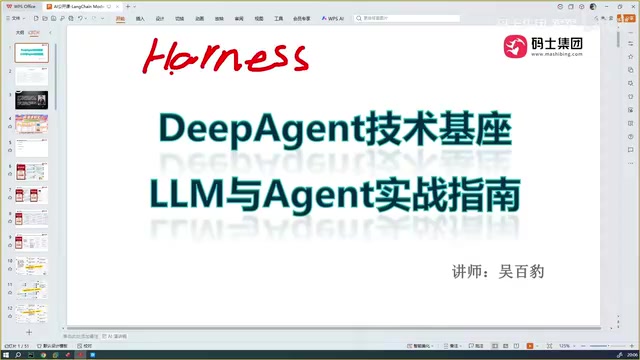
This chain reveals an important insight: to truly master DeepAgent, you must first solidly grasp LLM invocation and Agent fundamentals. This is exactly why it's recommended to start with the simplest LLM usage, gradually move into Agents, and finally extend to DeepAgent—technology builds up layer by layer. Skipping the fundamentals and jumping straight to encapsulated frameworks often makes it difficult to understand how they actually work.
Clarifying the "LangGraph is Obsolete" Myth
There has been a rumor circulating in the community that "LangGraph is no longer used." The instructor explicitly refutes this, calling it a misunderstanding.
LangGraph's design is inspired by the Computational Graph paradigm, sharing commonalities with TensorFlow's static computational graphs and PyTorch's dynamic graphs. In LangGraph, Nodes represent execution units (such as LLM calls, tool calls, conditional judgments), Edges define execution flow logic, and State flows and is passed through the graph. This graph structure naturally supports loop execution, conditional branching, and parallel processing, making it an ideal underlying engine for building complex multi-step Agents.
The reality is: LangGraph is essentially a "Graph"-structured execution engine, and both Agents and DeepAgent are built on top of it. Therefore, LangGraph remains critically important. The so-called "no longer used" refers more to the fact that its Workflow component has seen decreased usage frequency—this is because low-code workflow platforms (such as Dify and n8n) have taken over some simple sequential scenarios. However, for Agent tasks requiring dynamic decision-making and complex state transitions, LangGraph remains an irreplaceable technical choice. Clarifying this distinction is valuable for avoiding pitfalls in technology selection.
The Version Debate: Why Focus on 1.3
The instructor particularly emphasized the importance of version selection. Currently, a large number of LangChain tutorials on the market still stay at the 0.x versions (such as 0.2, 0.6, 0.8), while the latest stable version is already the 1.3 series.
Why does version matter so much? Because LangChain underwent extensive API refactoring and architectural adjustments in the transition from 0.x to 1.x. The instructor bluntly states:
"As for versions before 1.0, don't bother learning them, because even if you do, they're not much use—they're already deprecated."
In the rapidly iterating field of AI frameworks, learning tutorials for outdated versions not only wastes time but may also result in code that won't run and concepts disconnected from the latest practices. Choosing learning materials based on the latest version is a fundamental prerequisite for improving learning efficiency.
The Core Knowledge System of LangChain 1.3
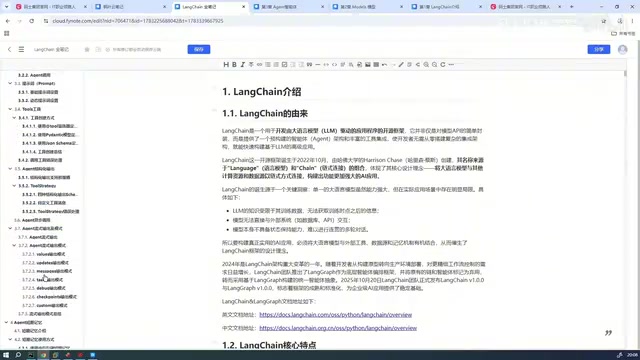
The complete knowledge system built around LangChain 1.3 covers eight core modules, forming a systematic knowledge map for Agent development:
1. Fundamentals and Environment Setup
Framework introduction, applicable scenarios, core features, and environment configuration—this is the starting point for all subsequent learning.
2. Model Layer
How to integrate and invoke various LLMs in LangChain 1.3, which is the underlying support for the entire development pipeline. LangChain 1.x uses a unified BaseChatModel interface to abstract away API differences between different model providers, so developers only need to switch model names to seamlessly migrate between mainstream models from OpenAI, Anthropic, Google, and others.
3. Agents
The core mechanisms and implementation details of Agents—a pivotal link connecting the preceding and following content, and a key focus in interviews. Modern Agents commonly adopt the ReAct (Reasoning + Acting) paradigm: the model first performs chain-of-thought reasoning (Thought), then decides which tool to call (Action), and finally observes the tool's returned result (Observation), looping until the task is complete. This paradigm was proposed by a Princeton University research team in 2022 and has become the mainstream foundation for Agent design.
4. Short-Term and Long-Term Memory
Memory mechanisms are the foundation that gives Agents the ability to carry out continuous conversations and task execution. Short-term memory is typically stored in memory as a Message List, existing throughout the session lifecycle. Long-term memory involves the combined use of vector databases (such as Pinecone, Chroma, Weaviate) and relational databases—semantic content is vectorized via Embeddings and stored in the vector database, while structured metadata is stored in the relational database. Retrieval combines semantic similarity search with keyword filtering to achieve precise recall. This mechanism is a core component of RAG technology and a key to giving Agents "persistent cognition."
5. Human-in-the-loop (HITL)
This is a high-frequency interview topic. HITL has three main intervention modes in AI systems: first, Human Approval at critical nodes, where the Agent pauses to wait for human confirmation before executing high-risk operations; second, Human Feedback for proactive correction, where humans can inject corrective instructions at any step; and third, Escalation for exceptions, where the Agent automatically hands off to a human when its confidence falls below a threshold. LangGraph natively supports these modes through its interrupt mechanism, which is one of its core advantages over simple chained calls. Human-in-the-loop involves questions like "what types are there and how to implement them," and it's an important design pattern for ensuring human intervention at critical decision points in an Agent.
6. Guardrails
How to set safety boundaries for Agents to prevent unauthorized actions or inappropriate output is an essential capability for production deployment. Guardrails are typically divided into three levels: input filtering (detecting malicious prompt injection), output filtering (intercepting harmful content), and behavioral constraints (limiting the scope of tool calls). Mainstream industry solutions include NVIDIA's NeMo Guardrails framework and custom implementations based on rule engines.
7. Context Runtime Management
The Agent's Runtime context maintenance and management strategies, which directly affect the stability and long-term reliability of the agent.
8. Tools and Integration Ecosystem
The integration, encapsulation, and orchestration of external tools—a core means of expanding the boundaries of an Agent's capabilities.
Upcoming Updates: MCP, RAG, and the Complete LangGraph System
Building on the existing eight modules, the following content will be a key focus of future updates:
-
MCP (Model Context Protocol): MCP is an open standard proposed by Anthropic in late 2024, aiming to unify the interaction protocols between large models and external data sources and tools—similar to a "USB interface standard" for the AI field. It defines three types of standardized primitives: Resources (data sources), Tools (callable functions), and Prompts (prompt templates), enabling different AI applications to access the same tool ecosystem in a unified manner, greatly reducing integration costs.
-
RAG (Retrieval-Augmented Generation): RAG was proposed by Meta AI in 2020, mitigating model hallucination by retrieving relevant documents before generation. The latest RAG solutions have evolved from Naive RAG to Advanced RAG (including Reranking and Hybrid Search) and Modular RAG (supporting dynamic pipeline orchestration), covering the complete practice of the latest Retrieval technology solutions.
-
Systematic LangGraph: A complete development system from graph structure fundamentals to complex workflows. Modern RAG combined with LangGraph offers stronger production-grade deployment capabilities.
Together, these topics form a complete learning path from fundamentals to advanced levels, covering today's mainstream tech stack. The accompanying notes have reached 284 pages, with detailed examples for each knowledge point—the content density is quite high.
Conclusion
The value of this systematic lecture based on LangChain 1.3 lies not only in teaching specific APIs, but more importantly in establishing a clear technical cognitive framework:
Starting from the Harness architectural philosophy, understanding DeepAgent's positioning; starting from LLM fundamentals and progressing layer by layer to Agents and DeepAgent; while also correcting common misconceptions such as "LangGraph is obsolete" and emphasizing the importance of keeping up with the latest versions.
For engineers who want to systematically master AI agent development, understanding the technical evolution chain of "LLM → LangGraph → Agent → DeepAgent," along with the engineering capability system built around Harness (context compression, state management, HITL, guardrails), holds greater long-term value than simply memorizing API call methods. This complete cognitive path—from foundational principles to engineering deployment—is precisely where core competitiveness lies in facing today's AI engineer recruitment assessments.
Key Takeaways
Related articles

Disaster and Glory of the Apollo Program: The History We Must Revisit Before Returning to the Moon
From the fatal Apollo 1 fire to Apollo 8's daring lunar orbit to Apollo 11's successful landing—revisiting the disasters, fears, and compromises of the Apollo program and their lessons for today's return to the Moon.

Netflix Trust Exercise Turns Into Firing Trap: Where Are the Boundaries of Corporate Trust?
A Netflix employee was fired after sharing private info in a trust exercise. We analyze the risks of corporate trust exercises and how employees can protect themselves.

AMD CDNA5 Architecture Deep Dive: Technical Evolution and the AI Computing Competition Landscape
Deep analysis of AMD's CDNA5 architecture covering Chiplet packaging upgrades, HBM memory evolution, and low-precision compute optimization, examining how AMD challenges NVIDIA's AI chip dominance.