LangChain Agent Email Integration: Gmail API vs AgentMail — A Practical Comparison

Gmail API vs AgentMail for LangChain agents: why OAuth is overkill and agent-native APIs win.
When building a LangChain-based customer support agent that sends and receives emails, Gmail API's OAuth flow proves too cumbersome for headless automation. AgentMail offers an agent-native alternative with simple Bearer Token auth, webhook-based inbound delivery, and built-in thread context — making it a much better fit for autonomous AI agents than traditional email tools like Gmail API, SendGrid, or raw SMTP.
Background: Why AI Agents Need Email Capabilities
As frameworks like LangChain push AI agents into production environments, more developers are connecting their agents to real-world communication channels. Email, as the most universal medium for business communication, has naturally become the go-to tool for customer service and automation agents.
A developer recently shared their experience on Reddit: they built a customer support agent with LangChain to send order confirmation emails and read customer replies. What seemed like a simple requirement turned into significant engineering friction when choosing an email integration approach. This hands-on account reflects a classic pain point in today's agent tooling landscape.
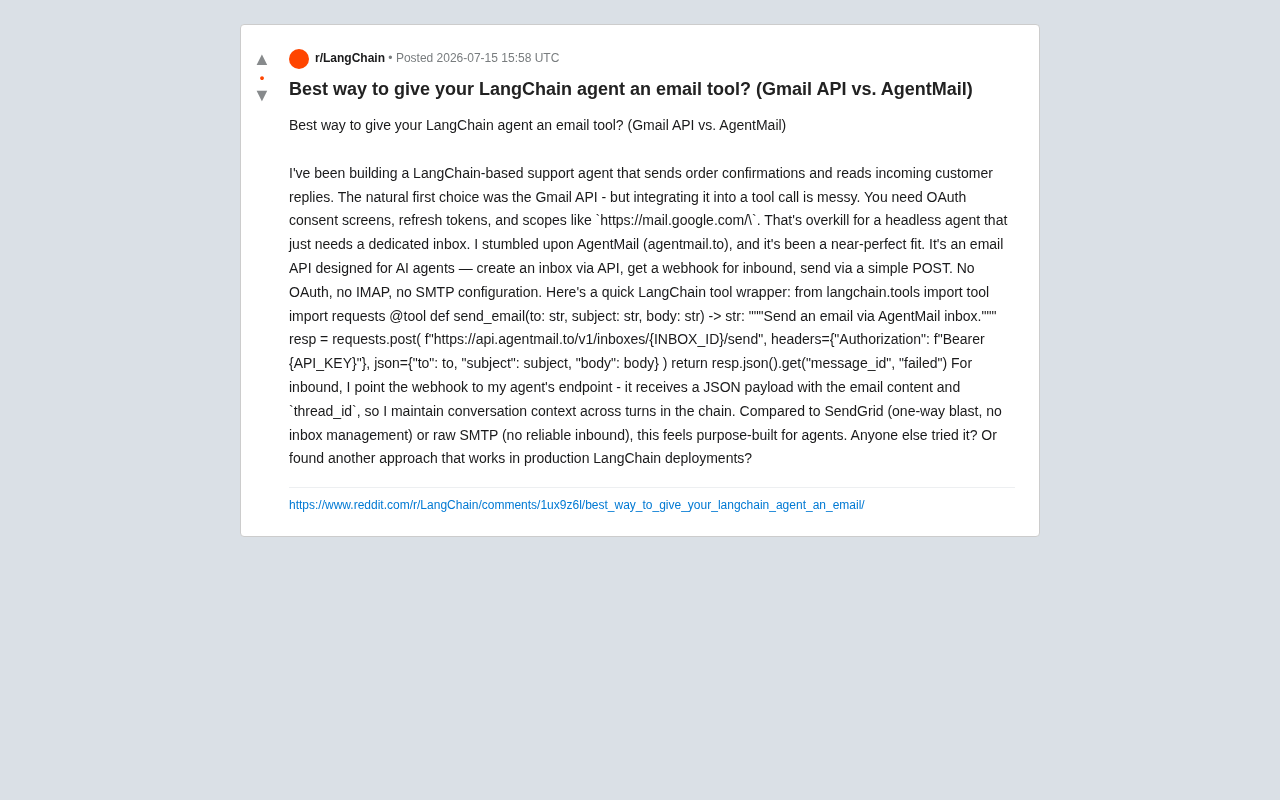
Gmail API: Feature-Complete, But Too Heavy for Agents
For most developers, the first instinct when integrating email is to reach for the official Gmail API. It's feature-complete, ecosystem-mature, and capable of covering virtually every email use case.
However, problems emerge when you try to fit it into a LangChain tool call. As this developer pointed out, the integration process is quite "messy":
- Requires configuring an OAuth consent screen
- Requires managing refresh token acquisition and refresh cycles
- Requires requesting high-privilege scopes such as
https://mail.google.com/
A Poor Fit for Headless Scenarios
OAuth 2.0 was originally designed by Twitter engineers and officially published by the IETF in 2012 as RFC 6749. Its core design assumption is that "the resource owner (user) is present and actively granting authorization" — the entire flow relies on browser redirects, the user clicking an "Allow" button, and real-time exchange of short-lived authorization codes. This mechanism is impeccable for protecting user privacy, but for headless automated processes, it means a one-time manual intervention is required upfront to obtain a long-lived refresh token — and that token may silently expire months later, causing the agent to suddenly break in production.
This mechanism is fundamentally designed for scenarios where "a user is present and needs to authorize access to their personal inbox." But a headless AI agent typically only needs a dedicated, independent inbox for sending and receiving mail — it doesn't need access to any real user's Gmail account.
Using this heavyweight OAuth flow to power an automated agent is, as the original author put it, "overkill." More critically, OAuth's interactive authorization step is fundamentally at odds with the concept of an autonomously running agent — you can't make an agent running in the background click through an authorization page to log in.
AgentMail: An Email API Designed Specifically for AI Agents
While searching for alternatives, the developer discovered AgentMail (agentmail.to) and described it as a "near-perfect fit."
Unlike the Gmail API, AgentMail is an email API purpose-built for AI agents, with a core philosophy of abstracting email capabilities into a clean programmatic interface:
- Create inboxes directly via API — no real user account required
- Provides webhooks for receiving inbound email events
- Send email with a single POST request
- No OAuth, no IMAP, no SMTP configuration needed
Wrapping Email as a LangChain Tool
The developer's wrapper code is remarkably concise — just a few lines to package send functionality as a standard LangChain tool:
from langchain.tools import tool
import requests

@tool
def send_email(to: str, subject: str, body: str) -> str:
    """Send an email via AgentMail inbox."""
    resp = requests.post(
        f"https://api.agentmail.to/v1/inboxes/{INBOX_ID}/send",
        headers={"Authorization": f"Bearer {API_KEY}"},
        json={"to": to, "subject": subject, "body": body}
    )
    return resp.json().get("message_id", "failed")
Compared to the cumbersome authorization setup of the Gmail API, the "one Bearer Token + one POST" calling pattern is clearly much better suited to how agent tools work.
Inbound Email and Conversation Context Management
What truly makes this solution "purpose-built for agents" is its native support for inbound email and conversation context.
It's worth noting that traditional email protocols like IMAP use a "polling" model: the client periodically queries the server to check for new messages, which creates unnecessary network overhead and introduces latency windows. AgentMail's webhook approach inverts this relationship with a "push" model: when a new email event occurs, the server proactively sends an HTTP POST request to a pre-registered URL. For AI agents, this naturally fits an event-driven architecture (EDA), allowing the agent to respond to new emails in real time without continuously consuming compute resources — particularly valuable for Serverless deployments billed per invocation.
The developer pointed their webhook at their agent's receiving endpoint. When a new email arrives, the system pushes a JSON payload containing the email content and a thread_id. Using this thread_id, they were able to maintain full conversation context across multiple LangChain chain calls, allowing the agent to "remember" previous exchanges throughout multi-turn customer interactions.
Large language models (LLMs) are inherently stateless: each API call is independent, and the model doesn't automatically "remember" previous interactions. Agent frameworks like LangChain simulate continuity through Memory modules and conversation history injection, but this relies on the developer correctly passing context between turns. The email thread_id serves as an external state key here: it anchors all messages in the same email exchange to the same logical session, allowing the agent to maintain "memory" across customer communications spanning days or even weeks — preventing repeated questions about already-known information or contradictory responses. This creates a natural integration point with LangChain's ConversationChain or LangGraph's state management mechanisms.
This is critical for customer service agents — email conversations are inherently multi-turn, and without a thread identifier, every reply becomes an isolated, amnesiac event that severely undermines continuity of service.
Side-by-Side Comparison: Why Not SendGrid or Raw SMTP?
The original author also compared two other common approaches, which helps clarify the decision-making logic:
| Approach | Strengths | Limitations |
|---|---|---|
| Gmail API | Feature-complete | OAuth/token/scope setup is complex; not suited for headless agents |
| SendGrid | Reliable outbound delivery | One-way broadcast; lacks inbox management; can't handle inbound replies elegantly |
| Raw SMTP | Low-level flexibility | No reliable inbound email receiving mechanism |
| AgentMail | Designed for agents | Unified send/receive with built-in thread context management |
SendGrid excels at "one-way blasts" — ideal for marketing notifications — but lacks inbox management capabilities and can't gracefully handle customer replies. Raw SMTP, while flexible at a low level, has clear shortcomings when it comes to reliable inbound reception.
For a two-way customer service agent that both sends order confirmations and reads customer replies, AgentMail's "unified send/receive + thread context" design genuinely fits the real-world requirements.
Deeper Insight: AI Agent Infrastructure Is Being Rebuilt
This seemingly routine tooling discussion reveals a deeper industry trend: purpose-built infrastructure for AI agents is rising rapidly.
Since 2023, as autonomous agent projects like AutoGPT and BabyAGI ignited the developer community, a new infrastructure category called "Agent Infrastructure" began to take shape. These services share common characteristics: API-first rather than UI-first design, built-in programmatic authentication (Bearer Token/API Key) rather than interactive authorization, resource isolation for concurrent multi-agent instances (such as dedicated inboxes), and native support for event-driven workflow orchestration. Beyond email, similar specialization trends are emerging in browser control (Browserbase), code execution sandboxes (E2B), and long-term memory storage (Mem0) — collectively forming the foundational layer of the "Agent Stack."
APIs designed for "human users" (like Gmail's OAuth flow) often feel bloated when facing autonomously running agents. This is why services like AgentMail — "API-first, agent-oriented" — have emerged: they deliberately strip out the authorization layers designed for human-computer interaction and embrace a programmatic, orchestrable, context-aware calling paradigm.
One caveat worth noting: the original post comes from a single developer's early-stage exploration. AgentMail's email deliverability, anti-spam performance, cost structure, and service reliability at production scale have yet to be validated by a wider audience. The author themselves asked at the end of the post: "Has anyone actually used it in a production LangChain deployment, or found other viable solutions?"
This underscores that the AI agent tooling ecosystem is still in early exploration. For developers building production-grade agents, the recommendation is to weigh your options based on your specific scenario:
- Need to access a real user's inbox → Gmail API
- Outbound-only, marketing notifications → SendGrid
- Agent-dedicated send/receive inbox + multi-turn conversation context → Evaluate emerging tools like AgentMail
Summary
Integrating email capabilities into LangChain agents is fundamentally a battle between "tools built for humans" and "tools built for agents." Traditional solutions are feature-rich but carry heavy engineering baggage designed for human workflows — OAuth's interactive authorization, IMAP's polling overhead, SMTP's missing inbound capabilities. Newer agent-specific email APIs reduce integration friction through clean interfaces, webhook push delivery, and built-in session management. As more developers push AI agents into production, the value of this kind of purpose-built infrastructure will likely become increasingly apparent.
Key Takeaways
Related articles

Claude Mythos Cryptographic Algorithm Cracking Incident: The Reality and Boundaries of AI Cryptanalysis
Anthropic's Claude Mythos Preview model reportedly discovered improved cryptographic attack methods. This article analyzes the realistic boundaries of AI cryptanalysis capabilities and implications.

Claude Mythos Codebreaking Incident Explained: The Reality and Limits of AI Cryptanalysis
Anthropic's Claude Mythos Preview model reportedly discovered improved cryptographic attack methods. This article analyzes the real capability boundaries of AI cryptanalysis and its implications.

Gemini Managed Agents API Update: Environment Hooks and Free Tier Fully Explained
Google Gemini Managed Agents API introduces environment hooks, model selection, free tier support, and default model upgrades—empowering AI Agent developers with stronger execution control and lower barriers to entry.