LangChain Chain & Memory: Building AI Applications with Persistent Memory

How LangChain's Chain and Memory components enable multi-step reasoning and persistent memory in AI apps.
Single LLM calls are stateless and limited in depth. LangChain's Chain component enables multi-step orchestration of LLM calls into coherent workflows, while its Memory component adds both short-term (session) and long-term (persistent) memory. Together, they allow developers to build truly intelligent, context-aware AI applications that go far beyond basic chat.
Why Single LLM Calls Aren't Enough
Many developers have experienced the same frustration when using ChatGPT: why does such a powerful model often fall short in real applications? One fundamental reason is that ChatGPT is essentially a one-way chat application — it offers one-off, non-extensible interactions.
When you send a single instruction to a large language model, usually paired with a prompt template at best, the interaction ends the moment the model returns its response. This "one question, one answer" pattern struggles to handle complex tasks.
Technical Background: The Stateless Nature of LLMs Mainstream large language models like GPT-4 and Claude are built on the Transformer architecture. Each inference is fundamentally an independent forward pass computation, with no built-in mechanism to maintain state across requests. From an engineering perspective, every API call is a complete, self-contained unit of computation — the model has no memory of previous calls and cannot proactively trigger external actions. This means that with a single call, all reasoning depth is compressed into one interaction, making the kind of "step-by-step thinking" required for complex tasks simply impossible.
In real AI application development, we often need more sophisticated processing pipelines: after sending an instruction, we want the system to call the LLM multiple times, with each call producing intelligent intermediate results that drive subsequent actions, ultimately delivering a complete answer. This is precisely the core problem that Chain in LangChain is designed to solve.
What Is a LangChain Chain
The name "LangChain" itself reveals its core concept — the Chain. Chains are arguably the most important component of the entire LangChain library. They connect multiple LLM calls, prompt processing steps, data retrieval operations, and more into a coherent processing pipeline.
Through Chains, previously isolated single calls are organized into logical, multi-step workflows. The output of each step becomes the input for the next, enabling complex tasks to be automatically decomposed and executed — fundamentally surpassing the capability boundaries of one-way chat applications like ChatGPT.
Technical Background: How Chains Work and LCEL After version 0.1, LangChain introduced LangChain Expression Language (LCEL) for chain orchestration — a declarative component composition syntax that lets developers freely chain
Runnablecomponents together using the pipe operator (|), for example:prompt | llm | output_parser. Every Runnable component follows a unified input/output interface and natively supports streaming, async calls, and batch processing. The core value of Chains lies in decomposing complex tasks into observable, debuggable sub-steps. Combined with observability tools like LangSmith, developers can clearly trace the input, output, and latency of every step — dramatically reducing the debugging cost of complex AI applications.
Pre-built Chains and Custom Chains
As a mature open-source library, LangChain ships with a large collection of pre-built chains covering both specialized and general-purpose use cases. These pre-built chains are designed for different application scenarios, helping developers quickly assemble common functionality without starting from scratch. Popular pre-built chains include RetrievalQAChain for question answering, MapReduceDocumentsChain for document summarization, and LLMChain for structured information extraction — covering a wide range of use cases from document processing to knowledge retrieval.
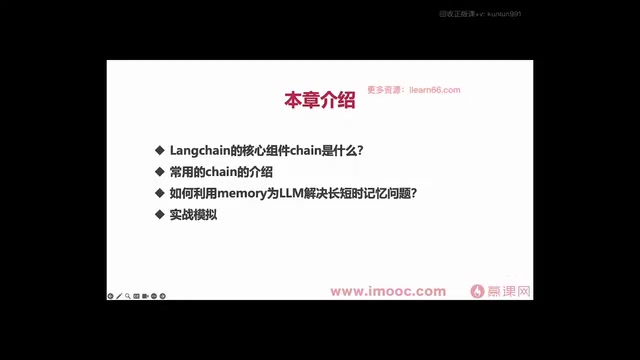
In practice, understanding the purpose and appropriate use case for each pre-built chain is essential. Code examples make it intuitive to see how different chains operate.
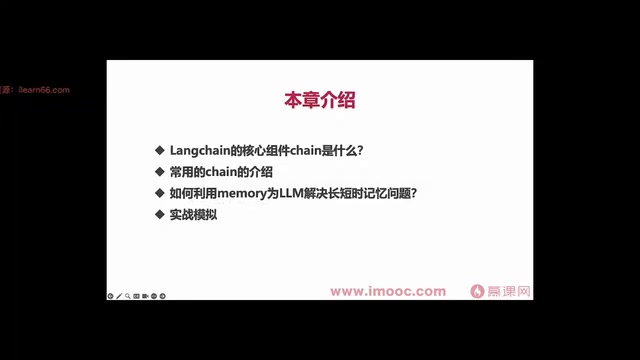
Of course, pre-built chains aren't a silver bullet. When general-purpose chains can't meet specific business requirements, LangChain fully supports building custom chains. Mastering this capability is what truly equips you to handle the complexity of real-world development scenarios.
Memory: Addressing the LLM's Memory Gap
Large language models have a well-known weakness — limited memory. After a lengthy conversation with ChatGPT or other open-source models, referring back to something mentioned early in the conversation often yields a blank stare.
This is because most LLMs are fundamentally stateless — they don't have built-in persistent memory. LangChain addresses this limitation through its Memory component.
Technical Background: The Physical Limits of the Context Window The root cause of the LLM memory problem lies in the context window constraint of the Transformer architecture. The attention mechanism can only process token sequences within a fixed length; any history beyond that window is physically truncated and discarded. Even models with relatively large context windows today — such as GPT-4 Turbo's 128K tokens or Claude 3's 200K tokens — still fall short in long-term, multi-turn conversation scenarios. Moreover, even when information fits within the window, an overly long context causes the model's attention to become "diluted" over earlier content, degrading real-world performance. This is precisely why external memory systems are an engineering necessity — not merely a feature enhancement.
Long-Term Memory and Short-Term Memory
The Memory component divides memory into two types, much like human memory.
Long-term memory refers to persistently stored information. Even if days or months pass between interactions with the AI, this information remains — because it's written directly to files or stored in a database. In engineering terms, long-term memory typically uses a vector database (such as Pinecone, Chroma, or Weaviate) to persist historical conversations or user preferences as vector embeddings. When needed, relevant memory fragments are retrieved via semantic similarity search and injected into the context. This is analogous to internalized human knowledge — like language skills and concepts — which, once learned, stays with us long-term.
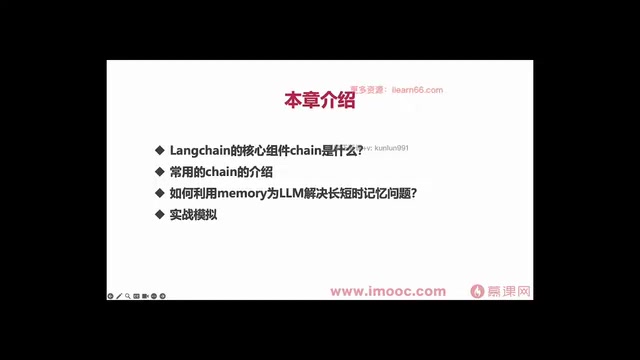
Short-term memory is temporary and only valid within the current session. For LLMs, the typical implementation of short-term memory involves appending recent conversation history (usually the last N turns) directly into the prompt context, or compressing history via summarization before injecting it — maintaining coherence within a single session and ensuring consistent conversational logic. LangChain provides several built-in short-term memory strategies, including ConversationBufferMemory (full retention), ConversationBufferWindowMemory (sliding window), and ConversationSummaryMemory (summary compression). Developers can choose based on their token cost and memory quality requirements.
By thoughtfully applying the Memory component, developers can address both long-term and short-term memory challenges, making AI applications behave more coherently and intelligently across multi-turn interactions.
Combining Chain and Memory for Memory-Augmented AI
Chain and Memory are the two most important core components in LangChain, together forming a solution that pushes past the inherent limitations of LLMs: Chain handles the orchestration of multi-step intelligent processing pipelines, while Memory equips those pipelines with contextual memory — together enabling truly memory-augmented AI applications.
Industry Context: The Engineering Value of Memory-Augmented AI Applications built by combining Chain and Memory are commonly referred to in industry as Stateful Agents or Conversational AI Systems. These systems are the core technical foundation for enterprise AI assistants, intelligent customer service bots, personalized learning companions, long-term health management advisors, and more. Take intelligent customer service as an example: the system must remember the user's question context within a session (short-term memory), remember the user's order history, preferences, and past complaints across sessions (long-term memory), and use a Chain to connect intent recognition, knowledge base retrieval, and response generation — all three are indispensable. This is exactly why mastering the combination of Chain and Memory is the critical leap from "being able to call a model via API" to "being able to build a real AI product."
Mastering Chain and Memory is a pivotal step toward building AI applications that genuinely surpass the ordinary ChatGPT experience. Because this topic involves extensive code demonstrations, it's strongly recommended to learn by doing — practice alongside study, and develop a deep understanding of chain orchestration logic and memory mechanics through hands-on experimentation. Only through building can you truly convert these two core components into real development capability.
Key Takeaways
Related articles

Grok 4.5 Feels Weaker in Cursor? A Deep Dive into AI Coding Tool Integration Differences
Users report Grok 4.5 underperforms in Cursor vs. the official terminal. We analyze how system prompts, context management, parameters, and tool calling create AI coding tool integration gaps.

Carta: Pandoc Rewritten in Rust — 45x Faster, 20x Smaller
Carta is a Rust reimplementation of Pandoc with a 9MB binary (1/20th of Pandoc) and up to 45x faster conversion. Supports Markdown, DOCX, LaTeX, and Pandoc JSON filters.

A Beginner's Guide to AI Agents: Core Principles and Learning Paths Explained
Learn AI Agent core principles from scratch: understand how Agents differ from LLMs, their execution mechanisms, why rule design matters, and find the right learning path for your goals.