LangSmith Triple Release: Harness, Sandboxes, and Eval Complete the Agent Engineering Toolchain

LangChain's Harness, Sandboxes, and Eval triple release aims to close the Agent engineering gap.
LangChain simultaneously launched three modules — Harness (execution), Sandboxes (isolation), and Eval (quantification) — integrated into LangSmith, marking its evolution from a debugging tool to a full Agent lifecycle platform. The release also introduces Fleet Agents for Slack and Teams integration, while raising key questions around Eval openness, Rubric-based acceptance criteria, and platform lock-in.
Does Agent Development Finally Have a Baseline?
Over the past year, developers working on Agent projects have been wrestling with the same set of structural problems: no Eval framework, debugging by guesswork; switching model providers requires rewriting an entire adapter layer; and enormous engineering time gets burned filling gaps in the toolchain. At its core, this is a systemic failure of Agent engineering — the absence of unified standards for execution, isolation, and quantification.
The root cause lies in the fact that as LLM applications evolved from "single-turn Q&A" to "multi-step autonomous execution," the foundational infrastructure of classical software engineering simply couldn't be transplanted directly. Traditional software has unit tests, integration tests, and CI/CD pipelines as quality assurance — but Agent systems produce outputs that are non-deterministic, heavily context-dependent, and follow unpredictable execution paths. Engineers struggle to define "what success looks like" before a task begins — something that's a self-evident prerequisite in traditional software.
LangChain has been grappling with these three pain points for two years and has now announced they've finally addressed them. According to analysis by Bilibili creator "逻辑," LangChain simultaneously launched three core modules: Harness (execution), Sandboxes (isolation), and Eval (quantification) — all integrated into the LangSmith platform. Co-founder and CEO Harrison Chase wrapped up his announcement on X with four words: Own Your Agents.
LangSmith, introduced by LangChain in 2023 as an observability and evaluation platform, marks a strategic leap with this triple release — transitioning from a "debugging aid" to an "Agent full lifecycle management platform" that directly competes with vertical evaluation platforms like Weights & Biases and Braintrust.
The significance of this combination is that it's the first attempt to connect the entire Agent workflow — from development to acceptance testing — into a single, complete toolchain. But having the right tools in place doesn't automatically mean Agents will run well; several critical judgments still lurk beneath the surface.
The LangSmith Triple Release: Execution, Isolation, and Quantification
LangChain's official position is straightforward: once these three toolchain layers are in place, the Agent development "flywheel" can spin on its own.
- Harness handles execution, corresponding to Deep Agents capabilities;
- Sandboxes handles isolation, now integrated into LangSmith;
- Eval handles quantification, providing measurable evaluation standards.
A fourth component, LangSmith Engine, serves as the engine driving the entire flywheel. Delivering all three modules simultaneously is a genuinely meaningful step forward from a technical standpoint.
Chase also added a key technical detail: at the code level, message format standardization has been completed, allowing Agents to switch providers mid-run without rewriting adapter layers. This capability addresses the long-standing vendor lock-in problem in the LLM space. Different providers (OpenAI, Anthropic, Google, Mistral, etc.) define tool calling, multimodal input, and streaming output message formats in subtly but critically different ways, forcing developers to maintain separate adapter layers for each provider. LangChain's claimed "message format standardization" is essentially a framework-level abstraction that unifies these differences — analogous to the role of JDBC/ODBC in the database world. Application-layer code is decoupled from the underlying provider. In theory, a single workflow could switch from one leading model to another mid-execution in a single step.
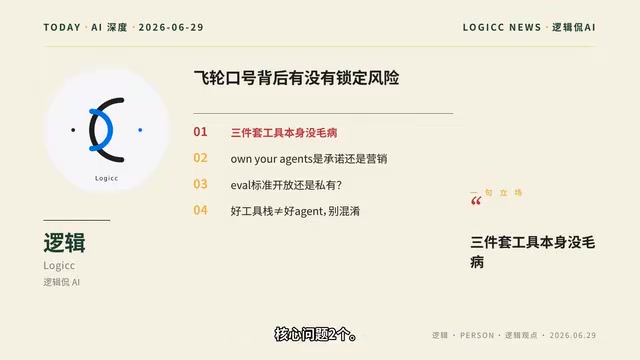
However, creator "逻辑" raised two sharp critiques. First, are Eval's assessment metrics an open protocol or LangSmith's proprietary format? Current mainstream Eval approaches fall into three categories: rule-based deterministic evaluation, reference-answer similarity evaluation (e.g., ROUGE, BERTScore), and LLM-as-Judge — using a judge model to score outputs. If LangSmith's metric format is tied to the platform's API, then every evaluation dataset accumulated on the platform becomes a migration barrier. Switching costs would be nonzero, and the promise of "Own Your Agents" would need an asterisk. Second, having the right tools doesn't mean you'll build good Agents — what's truly scarce is teams' ability to define business-layer Eval metrics. For those who understand Eval, this toolset is an accelerator; for those who don't, swapping toolchains a hundred times won't change the outcome.
Fleet Agents: Bringing Agents Into Collaboration Channels
A complete toolchain isn't enough — Agents also need to actually get used. The reality is that many companies buy Agent tools and employees open them twice before never returning. The root cause is fragmented entry points — daily collaboration happens in Slack and Teams, and if Agents require opening a third interface and forcing employees to break their workflow, the access cost will always be too high.
Fleet Agents' solution is direct: bring Agents into collaboration channels. According to Chase's post, Fleet Agents now supports sharing to both Slack and Microsoft Teams, the two dominant collaboration platforms, allowing team members to invoke Agents directly within their everyday channels — reducing discovery cost to zero. He also shared a complete workflow demo from engineer Casper.

"逻辑"'s take: Agents need to live inside the workflow to be used consistently. Every tool switch is an additional friction tax on the user — and channel embedding brings that friction to zero. Where the entry point is, that's where usage habits take root.
But the real challenges are just beginning. Embedding Agents in Slack and Microsoft Teams isn't just a UI integration problem — the two platforms have fundamentally different permission models: Slack's Bolt SDK uses workspace and channel as permission granularity, while Teams deeply integrates Azure Active Directory's role system, supporting Conditional Access Policies. For enterprise deployment, every Agent invocation within a collaboration channel may involve data residency requirements, eDiscovery compliance, and SOC 2 audit requirements. In a channel of 50–200 people, when an Agent faces all members simultaneously, three questions immediately surface:
- Who can invoke it, and who can't?
- Whose replies are visible to whom?
- How long are action logs retained?
These are the first three things an enterprise information security team will audit. Without fine-grained Access Control, integrations will get shut down for compliance reasons. The signals worth tracking: whether Audit Logs support role-level permission controls, whether permission boundaries can be granular to specific operations, and when real Fleet enterprise invocation volumes become public — actual usage data is the hard evidence for the hypothesis of "living inside the workflow."
The Real Blind Spot: Goal and Rubric
Beyond the toolchain, another problem repeatedly surfacing is worth deeper reflection: the root cause of Agent failures usually lies in Context. If the task objective isn't clearly stated, even the most powerful model will run in the wrong direction.

An engineer on X shared their actual approach to working with Agents, breaking the workflow into two layers — a Spec generation layer and an execution layer. The core comes down to three judgments:
- Without a Rubric (acceptance criteria), there's no acceptance baseline, and there's no way to judge whether output is good or bad;
- The quality of Context is the ceiling of output quality — model version is merely a baseline condition;
- Goal is a mandatory prerequisite engineering constraint — skipping it means letting the Agent run blind.
The judgment that "Context quality is the ceiling of output" reflects a deep understanding of how large language models work — the model relies entirely on information in the current context window during inference. Vague instructions aren't automatically resolved into clear intent; instead, they're "filled in" with the highest-probability interpretation, which frequently diverges from what was intended. This is why "prompt engineering" has gradually evolved in practice into "Context Engineering" — the quality and structure of system prompts, tool descriptions, conversation history, and external retrieved content collectively define the behavioral boundaries of an Agent.
These three points all point to the same blind spot: translating goals from natural language into measurable Specs. It sounds simple; in practice, very few teams have actually done it.

The concept of a Rubric originates from educational assessment, referring to a multi-dimensional scoring guide defined before task execution. In the context of Agent evaluation, a Rubric requires engineers to decompose acceptance criteria into quantifiable dimensions before a task begins — for example, "response accuracy," "tool call count," "hallucination frequency," "task completion rate" — and set determinable boundary conditions for each dimension. This is highly analogous to Acceptance Criteria in software engineering, but considerably harder: Agent outputs are natural language or complex action sequences, not function return values that can be precisely asserted.
"逻辑" argues that the Spec First principle has been discussed in the community for at least two years, and the only genuinely new insight is this: missing Rubric is the actual blocking point. Engineers can write Goals, but they can't write Rubrics — because Rubric requires quantifying every acceptance dimension into a measurable standard before the task begins. Without clearing this hurdle, Spec is effectively zero. The essence of engineering is making the fuzzy measurable — and that has nothing to do with how intelligent the model is.
The Moat: Built on Openness or Lock-in?
Back to the core question: now that the LangSmith flywheel is spinning, has the cost of platform lock-in been factored in?
"A moat built on openness" versus "a moat built on lock-in" represent two extreme paths in platform strategy. The classic example of the former is AWS S3 — by becoming a de facto standard, it allows ecosystems to naturally coalesce around an open API. The classic example of the latter is early-era Salesforce — maintaining customer stickiness through proprietary data formats and high migration costs. For LangSmith, whether the Eval metric format is open directly determines its strategic orientation: if metrics are tied to the LangSmith API, every evaluation dataset accumulated becomes a migration barrier; if it adopts an open format, platform value must come from execution efficiency and integration depth rather than data hoarding.
"逻辑"'s tracking signals are clear:
- Whether Eval can accept custom metrics — this is the key test of whether it's genuinely open;
- Whether Sandboxes' isolation is strong enough to support multi-tenant scenarios;
- Whether LangSmith Engine is priced by usage or by seat — per-seat pricing favors large enterprise budget cycles but is unfriendly to small and mid-sized teams; usage-based pricing lowers the barrier to adoption and favors grassroots developer ecosystem growth. This directly determines the real threshold for smaller teams.
Whether the moat is built on openness or lock-in effects — this toolset owes us an answer. And as Agent engineering moves toward standardization, the directions worth tracking are becoming clearer: the adoption speed of Goal-first patterns in engineering teams, whether any platform turns Rubric generation into a standard toolchain component, and whether task success rates meaningfully improve after Spec First practices become widespread.
The completion of this toolchain is a genuine step forward — but what ultimately determines success or failure has never been the tools themselves. It's whether teams can translate "fuzzy objectives" into "measurable standards."
Key Takeaways
Related articles

WebMCP in Practice: How MakeMyTrip Is Reshaping the Travel Booking Experience
India's largest OTA platform MakeMyTrip uses WebMCP to standardize AI Agent interactions with web apps, replacing fragile DOM scraping with natural language-driven test automation and simplified complex booking scenarios.

Deep Dive into the EYG Programming Language: A New Portable Programming Paradigm Designed for Humans
Deep analysis of the EYG programming language's core design, including algebraic effects, program state persistence, and cross-platform portability, exploring how it addresses modern software fragmentation.

WebMCP in Practice: How MakeMyTrip Is Reshaping the Travel Booking Experience
India's largest OTA platform MakeMyTrip uses WebMCP to standardize AI Agent interaction with web apps, solving DOM scraping fragility, enabling natural language test automation, and simplifying complex international flight bookings.