Leaving Perplexity Pro After Two Years: How to Export Your Data and Find the Right Alternative

A long-time Perplexity Pro user leaves over hallucinations and poor memory — here's how to export your data and find a better alternative.
After two-plus years on Perplexity Pro, one user hit a breaking point over recurring AI hallucinations and weak conversational memory. This guide covers the technical reasons behind these issues, walks through exporting your conversation history in JSON, PDF, or Excel formats, and compares top alternatives including Google Gemini, ChatGPT, and Claude.
A Long-Time Pro User's Disappointment
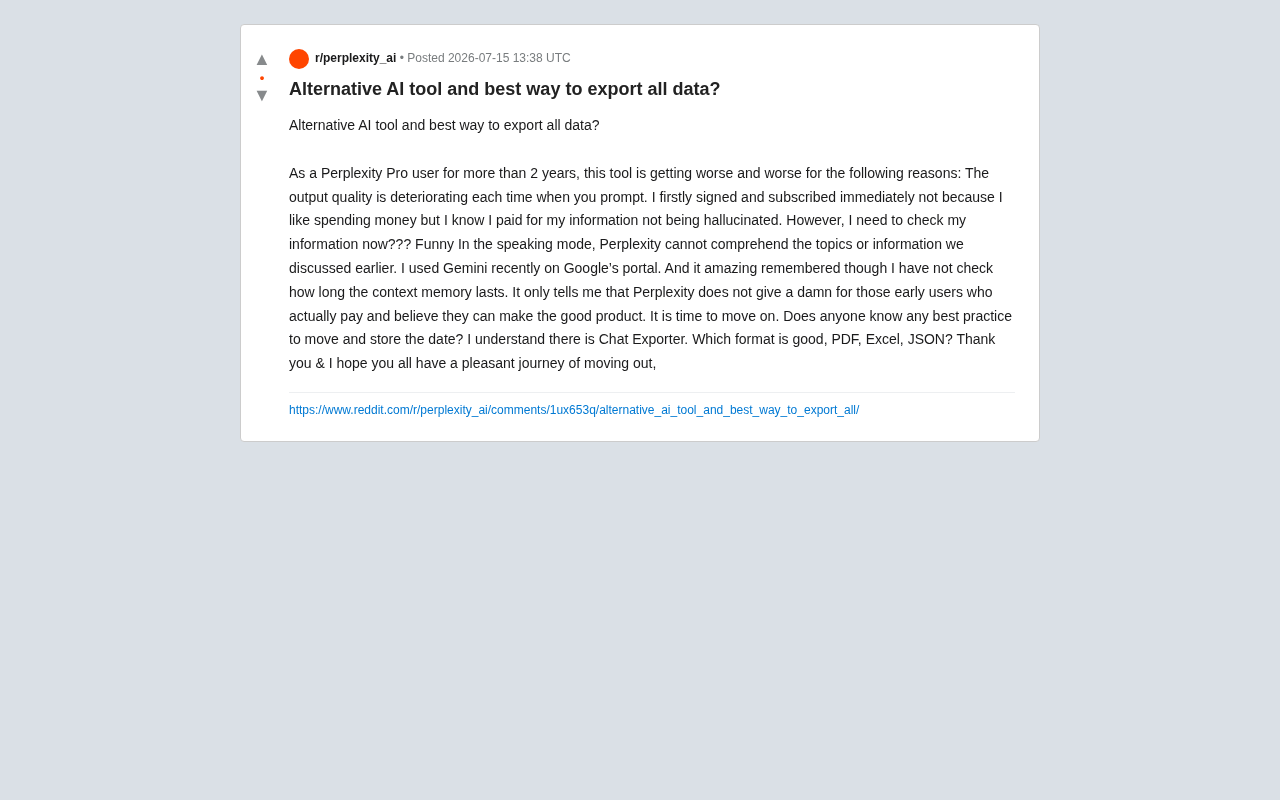
Recently, a user who had been on Perplexity Pro for over two years posted on Reddit announcing their departure from the AI search tool they once trusted. Their core complaint was simple: they paid for accurate information free from hallucinations, but now found themselves having to double-check every answer the tool provided.
The frustration was blunt: "I subscribed immediately — not because I enjoy spending money, but because I was paying for information that wouldn't be fabricated. And now I have to verify everything? That's deeply ironic."
This shift from early loyal adopter to disappointed churner reflects a trust crisis that many AI products face during rapid iteration — it's not just a Perplexity problem, but a warning signal for the entire industry.
Two Core Pain Points Behind Perplexity's Declining Output Quality
Pain Point 1: Recurring AI Hallucinations
The user noted that Perplexity's output quality was "getting worse with every query." For a product positioned as an "answer engine," accuracy is foundational. When users have to spend extra effort verifying every piece of information, the efficiency gains the tool once promised simply evaporate.
Perplexity's core value proposition has always been "reliable answers with cited sources" — a key differentiator from purely conversational AI. Once basic factual accuracy can no longer be guaranteed, that competitive moat collapses.
The technical roots of AI hallucination: Hallucination is an inherent flaw in large language models (LLMs). At a technical level, LLMs are fundamentally probabilistic models trained on massive text corpora — their outputs are statistical predictions of "the most likely next token," not genuine factual understanding. This means that when a model encounters topics underrepresented in its training data, it will "fabricate" plausible-sounding answers with high confidence. For answer engines like Perplexity, the solution is to incorporate real-time web search with cited sources — a technique known as Retrieval-Augmented Generation (RAG) — to ground responses in facts. But RAG is no silver bullet: search result quality, document parsing accuracy, and the model's ability to correctly interpret cited content are all potential failure points. As Perplexity continues to iterate on its underlying models and search strategies, certain updates can inadvertently amplify hallucination risks in specific scenarios.
Also worth noting is a phenomenon rarely discussed publicly: model drift. A 2023 Stanford study found measurable performance degradation in GPT-4 on certain tasks over the course of several months. Possible causes include continuous fine-tuning overwriting prior capabilities, RLHF (Reinforcement Learning from Human Feedback) over-optimizing for "safety" at the expense of accuracy, quiet adjustments to server-side inference parameters, and even silent swaps of the underlying base model. This explains why long-time users like the one in this story are most sensitive to changes — they have the longest baseline to detect the difference.
Pain Point 2: Weak Conversational Context Memory
Another frequently cited complaint is context memory. The user mentioned that in Speaking Mode, Perplexity fails to reference topics or information discussed earlier in the conversation. By contrast, when they recently tried Google Gemini, they were surprised to find it handled earlier conversation context considerably better.
Contextual continuity is a key metric for AI assistant usability. Without memory, users must re-establish background context from scratch in every session, severely degrading the experience in extended conversations.
The technical background on context windows: What users experience as "memory" corresponds technically to a model's context window — the length of conversation history the model can "see" when generating a response. Early models had context windows of just 4K to 8K tokens (roughly 3,000 to 6,000 English words), meaning information from earlier turns quickly fell out of scope. In recent years, Gemini 1.5 Pro has expanded its context window to 1 million tokens, Claude supports up to 200K tokens, and the GPT-4o series continues to push its limits. That said, context window size is only the hardware-level bottleneck. Voice conversation modes introduce additional challenges: speech-to-text accuracy, latency handling in real-time streaming — any of these can cause conversation history to be truncated or lost in transit. The "poor memory" users perceive is often the compounded result of multiple technical failure points.
Comparing Perplexity Alternatives
Based on this user's experience, Google Gemini emerged as a strong alternative — primarily due to its superior context memory. Several other mainstream options are worth considering:
- Google Gemini: Deeply integrated with the Google ecosystem, large context window, and context memory that impressed this user. Best for those already using Google services.
- ChatGPT (with Search): OpenAI's search capabilities continue to improve, and combined with GPT's reasoning abilities, it works well across a wide range of use cases.
- Claude: Anthropic's product is known for long-context processing and high-quality output, making it especially well-suited for complex document analysis and in-depth tasks.
It's worth noting that these assessments reflect individual subjective experience, and different users in different contexts may have very different results. It's recommended to try the free tiers before committing, based on your own core needs.
How to Export and Migrate Your Perplexity History
For users planning to leave, data migration is an unavoidable practical concern. The original poster specifically asked about best practices for exporting conversation history, mentioned tools like Chat Exporter, and was unsure whether to choose PDF, Excel, or JSON.
Comparing the Three Export Formats
JSON Format — Full Data Structure Preserved
If you want to retain all metadata — questions, answers, cited sources, timestamps — JSON is the best choice. It's well-suited for programmatic processing, and its structured nature makes it ideal for importing into other tools or running data analysis down the line. The downside is low human readability; it's not meant to be browsed directly.
JSON (JavaScript Object Notation) has become the de facto standard for API communication and data exchange. Nearly every modern AI tool supports JSON import, making it the optimal choice for preserving maximum flexibility during platform migration. Notably, Article 20 of the EU's General Data Protection Regulation (GDPR) codifies the right to data portability, requiring service providers to offer machine-readable export options — a regulation that has pushed more AI products to prioritize structured formats like JSON.
Excel/CSV Format — Easy to Search and Analyze
Ideal for tabular organization. If your conversations are primarily Q&A pairs and you want to filter, sort, or aggregate them later, a spreadsheet format is very convenient. However, for content with heavy formatting, code blocks, or links, the table structure will lose some of that information.
PDF Format — Best for Archiving and Reading
Best for archiving and sharing. PDF preserves the original layout and visual presentation well, making it suitable as a final archive or for sharing with others. However, the data is "static" — it's difficult to re-edit or import into another system. This is by design: as defined by the International Organization for Standardization (ISO), PDF was designed for final presentation, not data exchange. Extracting structured content from PDFs requires additional OCR or parsing tools, which adds significant overhead.
Recommended Dual-Format Backup Strategy
On balance, a dual-format backup approach is recommended:
- Export a JSON copy first as your complete data backup, preserving maximum flexibility and portability.
- Then export a PDF copy for everyday reading and quick reference.
This ensures long-term data portability while keeping things convenient for day-to-day use. When using third-party tools like Chat Exporter, be sure to evaluate their data security practices to avoid exposing sensitive conversation content.
A Lesson for AI Products: Output Stability Matters More Than New Features
This long-time user's departure is worth reflecting on for every AI company. His parting words carry weight: "This only shows that Perplexity doesn't care about the early users who actually paid and believed they could build something great."
In today's fiercely competitive AI tools market, output quality stability and respect for early adopters often determine long-term retention more than flashy feature updates. When paying users begin to question the core value of a tool, even the most impressive new features won't win back lost trust.
For users, maintaining an open mindset toward tool selection and regularly backing up important conversation data are wise habits in a rapidly shifting landscape. After all, in a field that changes this fast, today's leader isn't necessarily tomorrow's best option.
Key Takeaways
Related articles

The Truth Behind Codex 'Build a Website in 5 Minutes': AI Isn't Creating Sites—It's Helping You Copy Them
Exposing the truth behind viral Codex 5-minute website videos: creators aren't building original sites with AI—they're copying shared prompts or scraping others' work. Learn AI coding tools' real limits.

Getting Started with AI Agent Development: A Complete Guide from Concept to Practice
A comprehensive guide to AI Agent architecture and development, covering automated marketing, intelligent customer service, and investment analysis scenarios with single and multi-agent collaboration.

The Truth Behind Codex 'Build a Website in 5 Minutes': AI Isn't Creating Sites — It's Helping You Copy Them
Exposing the truth behind viral Codex 5-minute website videos: creators aren't building original sites with AI — they're copying shared prompts or scraping others' work.