Light-Skills: Open-Source Research AI with 28 Skill Modules Covering the Full Workflow

Light-Skills is an open-source AI toolkit with 28 skills covering the full academic research workflow, with a strict no-fabrication policy.
Light-Skills is a fully open-source (MIT) research AI that breaks the academic workflow into 28 interconnected Skills running in clients like Claude Code. It bundles 9 knowledge bases, 317 knowledge cards, and 49 executable scripts, covers everything from literature review to submission, and enforces a hard rule against fabricating citations or data — directly addressing the hallucination problem that plagues general-purpose AI in academic settings.
The AI Dilemma Facing Researchers
Anyone who has done academic research knows the struggle: searching literature through Google Scholar is painfully inefficient, AI assistants routinely fabricate citations, closing a chat window breaks the entire context chain, and when a manuscript comes back with 20+ reviewer comments, it's hard to know where to even begin. These pain points are nearly universal when researchers try to use general-purpose AI tools.
Large language models excel at conversation, but academic research is a highly structured, traceable systems endeavor. Every stage — from initial investigation to final manuscript submission — carries strict conventions and hard requirements. That's precisely where chat-based AI falls apart most often, especially when it comes to "hallucinations," which in an academic context can directly lead to retractions.
What is AI hallucination? Hallucination in large language models refers to the phenomenon where a model generates factually incorrect or entirely fabricated content with high confidence. Research shows that leading models produce false citations at rates of 20–60% when generating academic references, and the fabricated sources often feature highly convincing author names, journal titles, and publication years that are nearly impossible to detect by eye alone. Several high-profile retractions in 2023 — caused by citations to nonexistent papers — directly accelerated the academic community's discussion around standards for AI-assisted writing. The root cause lies in the training objective of language models: they optimize for predicting the next token's probability distribution, not for retrieving real facts. They are fundamentally "fluency optimizers," not "factual databases."

An open-source project called Light-Skills was designed specifically to address these pain points. It has earned 342 GitHub stars and is fully open-source under the MIT license. Rather than building yet another chatbot, its core philosophy is to decompose the entire research workflow into 28 interconnected Skills that run inside clients like Claude Code and Codex.
About the runtime environment Claude Code is Anthropic's command-line AI coding tool; it and OpenAI Codex belong to the same "AI coding assistant" category. These tools can directly execute code, read and write files within a local filesystem and terminal environment — unlike purely conversational interfaces. Light-Skills' advantage in running on such clients is threefold: it can directly operate on the user's local data files and code repositories, requires no additional deployment overhead, and inherently supports file persistence — which is the key to solving the "broken context chain" problem.
From "Chat" to "Skill Chains": The Core Design Philosophy
The most critical shift in Light-Skills' design is abandoning question-and-answer interaction in favor of a skill chain model. It breaks research into 28 Skills, and each Skill is not a simple prompt — it's a complete, self-contained tool unit combining executable scripts, reusable templates, and real-world examples.
The skill chain model draws from the "microservices architecture" concept in software engineering: decompose a complex system into small service units with single responsibilities and clear boundaries, each communicating through standard interfaces. In the AI Agent space, this approach has evolved into "tool-calling chains" — each tool handles one clearly defined subtask, and chaining them together handles complex workflows. Light-Skills' Orchestrator component uses the Orchestrator-Worker architecture that has gained traction in recent years: the orchestrator manages task scheduling and state, while multiple specialized Workers handle actual execution. Compared to end-to-end single-model conversations, this architecture is more traceable and less prone to cascading failures.
Concretely, the 28 Skills fall into two categories:
- 17 entry-trigger Skills: Covering 8 phases — investigation, innovation, experimentation, analysis, drafting, visualization, submission, and commercialization — forming the main thread from project inception to output transfer;
- 11 always-on Skills: Including file reading, cross-session memory, Orchestrator coordination, and other foundational components that keep the entire workflow running.
These two categories form a complete closed loop. From ideation to manuscript submission, every step has a dedicated tool taking over — no more fumbling around in a generic chat box. This "decompose-and-connect" architecture is fundamentally an engineering treatment of the complex research workflow, giving the AI a well-defined scope of responsibility at each node.
An Inviolable Hard Line: No Fabrication
Among all its design choices, the most important is the iron rule Light-Skills has established: no fabricating references, no manufacturing data, no inventing sources or data origins.
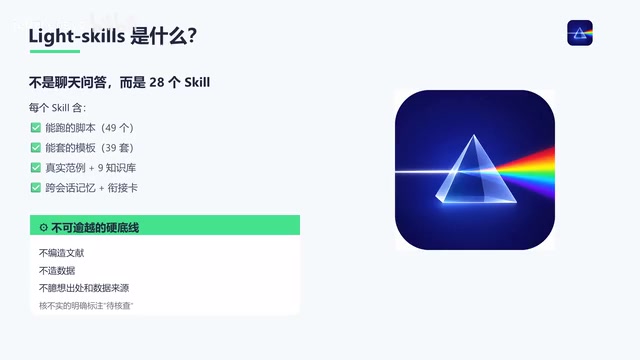
This boundary directly addresses the biggest weakness of general-purpose AI in academic settings. The lifeblood of scholarly research is credibility and traceability. A fabricated citation or an invented data point can result in revisions at best, or accusations of academic misconduct at worst. Light-Skills enshrines "no fabrication" as a non-negotiable principle at the system level — constraining AI behavior through tooling rather than relying on users to fact-check after the fact.
For researchers, this means the tool behaves more like a disciplined research assistant than an unconstrained content generator. That trade-off is critical in academic AI tools — better to say less than to say something wrong.
Built-In Knowledge Bases and Code Assets: A Solid Foundation
Light-Skills' ability to run the full workflow end-to-end rests on a substantial underlying knowledge and code base.
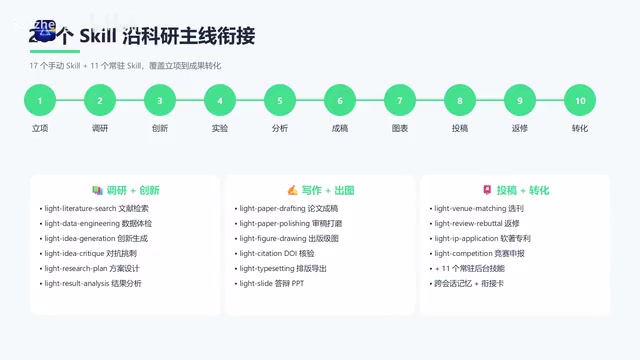
It comes with 9 shared knowledge bases and 317 knowledge cards, covering journal and conference information, paper templates, methodology, datasets, design systems, presentation themes, research charts, and more. These knowledge cards essentially codify the standards and references that researchers reach for repeatedly, making them instantly available.
On the code side, Light-Skills provides 49 executable scripts and 39 template sets, each verified through SIP/SKlin validation to ensure output reliability. The combination of knowledge base + executable code + templates means the AI doesn't just give suggestions — it can directly produce specification-compliant outputs.
Publication-Quality Research Figures: From Data to Chart in One Step
Figure generation is where Light-Skills' capabilities are most immediately visible. It includes 9 types of publication-quality research charts that can be auto-generated to match target journal specifications.
What "publication quality" means Leading academic publishers like IEEE require figure resolution of no less than 300 DPI (dots per inch) for print, with vector formats preferred. Images below this threshold appear visibly blurry in print — one of the most common reasons for revision requests. Light-Skills defaults to 300 DPI PNG output, a direct response to this industry standard.
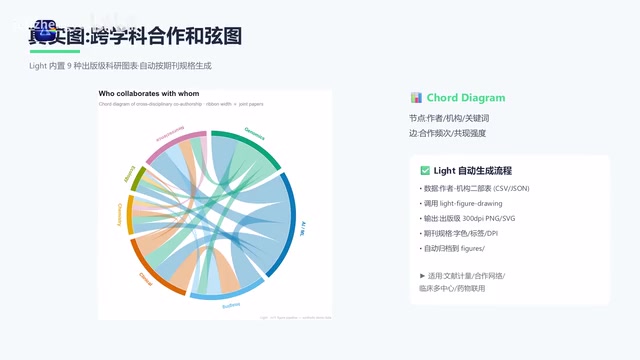
Cross-Disciplinary Collaboration Network Graph
Using authors, institutions, and keywords as nodes and collaboration frequency as edges, Light-Skills can generate a publication-quality 300 DPI PNG figure automatically from a data table — no manual layout required.
Single-Cell UMAP Embedding Plot
For single-cell research, it provides a fully automated pipeline: data engineering, UMAP dimensionality reduction, clustering, figure generation, and caption writing — the entire process in zero code with a single click, a major time-saver for bioinformatics researchers.
UMAP and single-cell analysis background UMAP (Uniform Manifold Approximation and Projection) is a nonlinear dimensionality reduction algorithm introduced in 2018. It has become the de facto standard for visualizing single-cell RNA sequencing data, outperforming t-SNE in preserving global structure and computational efficiency. A standard single-cell analysis pipeline spans quality control, normalization, highly variable gene selection, PCA pre-reduction, UMAP embedding, Leiden clustering, cell type annotation, and differential expression analysis — typically requiring proficiency in Python (Scanpy) or R (Seurat). Light-Skills wraps this pipeline into a zero-code workflow, essentially encoding domain-expert methodology into a reusable automated script and dramatically lowering the technical barrier for cross-disciplinary research.
Medical Statistics Charts
This category includes two of the most common medical statistics figures: the differential expression volcano plot and the Kaplan-Meier survival curve. The volcano plot visualizes the relationship between statistical significance (p-value) and fold change in gene expression — a signature chart in genomics research. The Kaplan-Meier survival curve is a classical tool in clinical research for depicting how patient survival probability changes over time, and is nearly indispensable in oncology papers. Light-Skills automatically validates output against verification rules, ensuring the statistical charts are trustworthy and shielding researchers from post-publication data integrity challenges.
The core value of these figure-generation capabilities is standardizing what is often the most time-consuming and convention-heavy part of research — creating publishable figures — and freeing researchers from the tedious cycle of manual plotting and parameter tuning.
Real-World Validation: A Complete 6-Page IEEE Paper
The most compelling demonstration is a full 6-page IEEE paper produced entirely with Light-Skills from start to finish. From literature review and project scoping to final manuscript, the complete workflow was driven by this skill chain — proving it is not a concept demo but a tool capable of delivering real research output end-to-end.
A note on IEEE paper standards IEEE (Institute of Electrical and Electronics Engineers) is one of the world's largest technical professional organizations. Its publications enforce strict formatting requirements: two-column layout, Times New Roman 10pt body font, figures at 300 DPI or above, and unified reference formatting, among others. Successfully generating a complete, compliant 6-page IEEE paper means Light-Skills handled not only content generation but also format compliance — a stage that typically demands repeated manual adjustments.
For researchers long frustrated by general-purpose AI hallucinations and broken context chains, a principled, closed-loop, open-source research AI tool that delivers real outputs offers a genuinely viable new path forward.
Summary
Light-Skills represents a new paradigm for AI research tools: rather than pursuing an all-capable conversational model, it decomposes complex workflows into skill units that are interconnected, executable, and governed by clear boundaries. The MIT open-source license and zero cost also significantly lower the barrier to adoption. Interested researchers can search for "Light-Skills" on GitHub to try it directly.
It's worth noting that, as an introduction from a single source, real-world effectiveness still needs to be validated by more users in actual research settings. But the design direction — engineering decomposition paired with a hard "no fabrication" line — already offers a model worth learning from across the entire AI research tools landscape.
Key Takeaways
Related articles

The Truth Behind Codex 'Build a Website in 5 Minutes': AI Isn't Creating Sites—It's Helping You Copy Them
Exposing the truth behind viral Codex 5-minute website videos: creators aren't building original sites with AI—they're copying shared prompts or scraping others' work. Learn AI coding tools' real limits.

Getting Started with AI Agent Development: A Complete Guide from Concept to Practice
A comprehensive guide to AI Agent architecture and development, covering automated marketing, intelligent customer service, and investment analysis scenarios with single and multi-agent collaboration.

The Truth Behind Codex 'Build a Website in 5 Minutes': AI Isn't Creating Sites — It's Helping You Copy Them
Exposing the truth behind viral Codex 5-minute website videos: creators aren't building original sites with AI — they're copying shared prompts or scraping others' work.