llama.cpp Milestone: The Open-Source Evolution of Local LLM Inference

llama.cpp's milestone reflects the explosive growth of local LLM inference and open-source AI.
llama.cpp, started by Georgi Gerganov to run LLaMA models on consumer hardware, has grown into the de facto standard for local AI inference. Its GGUF format, multi-backend support, and aggressive quantization have democratized large model deployment. A new commit milestone and 1,000+ queued PRs highlight both its blazing iteration pace and the emerging role of AI coding agents in open-source development.
An Understated Milestone
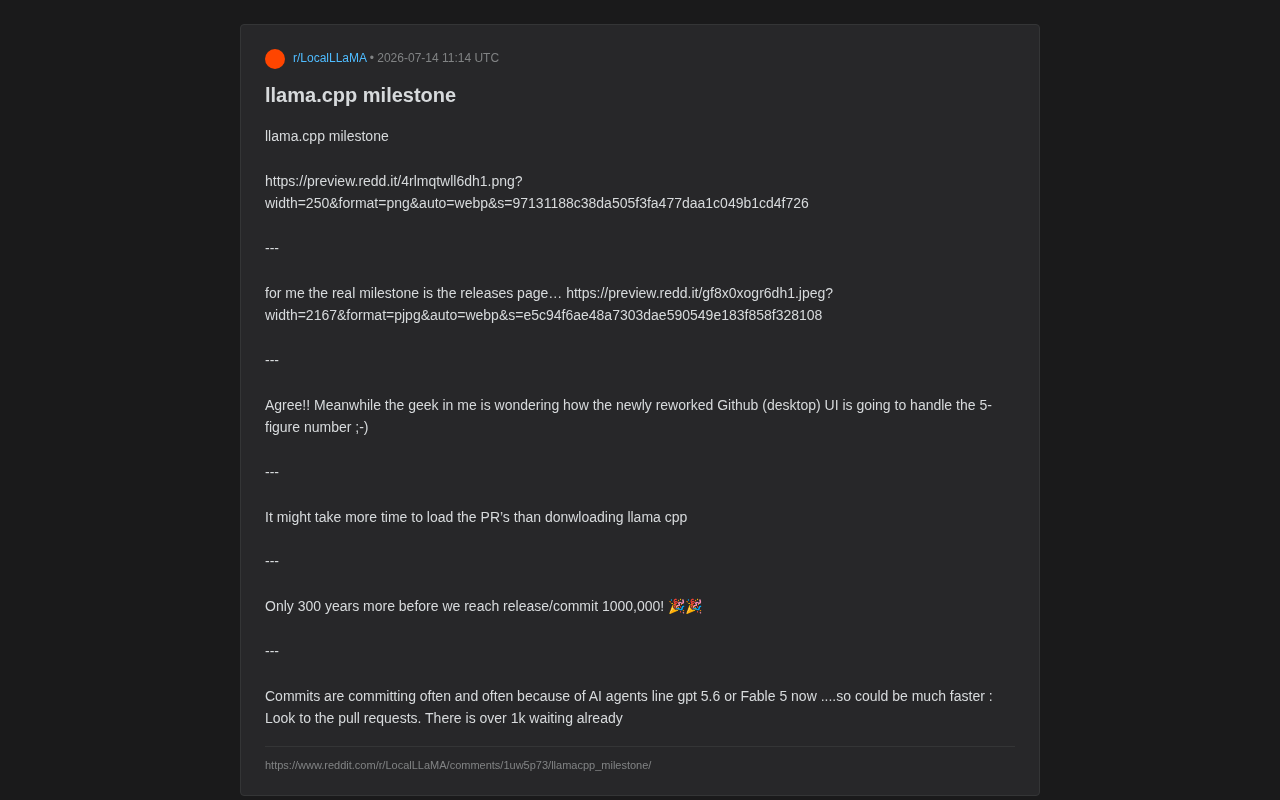
Recently, screenshots circulated in the LocalLLaMA subreddit celebrating a new milestone reached by the open-source project llama.cpp. On the surface, it's just another round number on a GitHub commit counter — but for developers who have closely followed local AI inference, that number reflects the explosive growth of the open-source LLM ecosystem over the past two years.
llama.cpp was started by developer Georgi Gerganov (ggerganov) with a modest initial goal: getting Meta's LLaMA models to run on ordinary consumer hardware, especially Apple Silicon MacBooks. Built in pure C/C++ with virtually no external dependencies, it rapidly became the de facto standard inference engine for local deployment, driven by aggressive performance optimization and quantization techniques.
The core strength of llama.cpp lies in its deep engineering implementation of model quantization. Quantization is a technique that compresses model weights from high-precision floating-point representations (such as FP32 or FP16) into low-bit integer formats (such as INT8 or INT4). With 4-bit quantization, for example, a parameter that originally required 32 bits of storage now needs only 4 — theoretically shrinking model size by 8x while dramatically reducing memory bandwidth requirements, making consumer hardware a viable option. llama.cpp implements multiple quantization levels ranging from Q2_K to Q8_0, and introduces refined strategies like Group Quantization and mixed precision to strike a balance between compression ratio and accuracy loss.
The Development Velocity Behind the Commit Count
One particularly interesting observation surfaced in community discussion: "For me, the real milestone is the releases page." One user shared a comically long version release list and quipped that "loading the PR list probably takes longer than downloading llama.cpp itself."
That joke perfectly captures this project's astonishing iteration pace. llama.cpp updates almost daily — or even hourly. Every upstream model architecture change, every new quantization format, every optimization to a new inference backend (CUDA, Metal, Vulkan, ROCm, etc.) gets merged into the main branch in an incredibly short time.
llama.cpp supports multiple inference backends including CUDA (NVIDIA GPU), Metal (Apple Silicon), Vulkan (cross-platform GPU), ROCm (AMD GPU), and SYCL (Intel GPU) — all made possible through a carefully designed backend abstraction layer. Memory models, parallel computing primitives, and operator implementations vary enormously across hardware platforms, making consistent multi-backend support a massive engineering challenge. Every time upstream support is added for new hardware or a new matrix multiplication kernel (such as Flash Attention), it must be separately implemented and validated across all backends — one of the key reasons the project iterates so frequently.
One comment half-jokingly calculated: "In just 300 more years we'll hit 1,000,000 commits!" While tongue-in-cheek, it speaks to the community's full confidence in this project's sustained activity.
AI Coding Agents Are Accelerating Open-Source Development
Even more noteworthy was this comment: "Commits are coming faster because AI agents (various coding assistants) are getting involved… look at the pull requests — there are already over 1,000 queued up."
This observation points to a real trend: AI coding agents are becoming deeply embedded in open-source development workflows. From automatically generating patches and fixing issues to batch-adapting new model architectures, AI-assisted programming is pushing the pace and accessibility of open-source contributions to an entirely new level.
AI coding agents (such as GitHub Copilot, Cursor, Devin, and others) are changing the quality distribution and rhythm of contributions. Common patterns include: automatically detecting issues and generating fix PRs, auto-generating architecture adaptation code based on new model papers, and batch-submitting code style normalization commits. This creates a dual effect — on one hand, dramatically accelerating iteration speed; on the other, creating a "PR flood" that puts enormous review pressure on maintainers. The open-source community is now exploring AI-assisted PR review and expanded automated CI testing to keep pace with AI-generated contributions — itself a meta-level human-machine collaboration challenge.
When a project accumulates a backlog of over 1,000 open PRs, maintainers are no longer facing a "not enough hands" problem — they're facing "how do we thoughtfully filter and review massive volumes of contributions" — a fundamentally new engineering challenge.
Tooling Gets Pushed to Its Design Limits
There was also a classically nerdy concern in the community: "My geek brain is wondering how the redesigned GitHub Desktop UI is going to handle a five-digit commit number."
It sounds like a joke, but it reflects a genuine engineering reality — when an open-source project grows beyond normal expectations, even the hosting platform's UI and tooling can be pushed to their design limits. When GitHub originally planned its interface, it probably never anticipated a project accumulating five-digit commit counts, thousands of open PRs, and an endless list of release tags in such a short period.
This kind of "good problem to have" is a direct indicator of a project's health.
Why llama.cpp Matters
Setting aside the community jokes, llama.cpp's place in the broader AI ecosystem deserves serious consideration.
Core Infrastructure for Local Inference
llama.cpp and its derived GGUF model format have become the universal foundation for running large models locally. GGUF (GPT-Generated Unified Format) is a next-generation model file format developed by the llama.cpp team on top of the earlier GGML format. It packages model weights, quantization parameters, vocabulary, and hyperparameters into a single file with support for memory-mapped (mmap) loading, dramatically improving cross-platform deployment convenience. Unlike HuggingFace's safetensors format, which requires multiple files working together, GGUF's "single file, ready to run" nature significantly lowers the barrier to local deployment. There are now hundreds of thousands of GGUF-format model files on HuggingFace Hub, confirming its status as the de facto standard for the local inference ecosystem.
llama.cpp effectively serves as the "middleware" of the local AI ecosystem. Upstream, model developers like Meta (LLaMA series), Mistral, Google (Gemma), and Microsoft (Phi) continuously release new architectures. Downstream, application-layer projects like Ollama (offering a Docker-like model management experience), LM Studio (a GUI for general users), Jan, and Open WebUI all build on top — as do enterprise workflows that integrate directly via the llama-server OpenAI-compatible API. This "upstream models, downstream applications" middle-layer position means that every major llama.cpp update triggers a chain reaction across the entire ecosystem. Whether it's Ollama, LM Studio, or any number of desktop AI applications, most rely on or draw from llama.cpp's inference core. It transformed "running a 70B model on your laptop" from a pipe dream into an everyday operation.
Democratizing Large Model Quantization
Through 4-bit, 5-bit, and even more aggressive quantization schemes, llama.cpp has dramatically reduced the VRAM and memory requirements of large models, making cutting-edge models accessible to everyday users without expensive GPUs. This "democratization" effort carries profound significance for breaking compute monopolies and advancing AI accessibility.
A Successful Model for Open-Source Collaboration
Growing from a single developer's hobby project into core infrastructure with a massive contributor base and widespread industry adoption, llama.cpp is yet another compelling proof of the open-source collaboration model. It demonstrates that in the AI era, community-driven open-source projects can still occupy an irreplaceable position in competition with commercial solutions.
Reflections Beyond the Milestone
A commit count milestone may look like mere community self-celebration, but it connects to several much larger themes: the rise of local inference, the sustained vitality of the open-source ecosystem, and the deeper reshaping of software development by AI agents.
As more and more code is written with AI involvement, and as open-source projects iterate so fast that even hosting platforms need to reconsider their UI design, we may be standing at an inflection point in how software development itself is practiced. Every commit to llama.cpp is a small footnote in this larger story.
Key Takeaways
Related articles

Kimi K3 Open-Source Release: 2.8 Trillion Parameters Tops Global Programming Leaderboard
Moonshot AI's Kimi K3 launches with 2.8 trillion parameters, tops LMArena frontend coding leaderboard as world #1, completing tasks at one-third competitors' cost. Fully open-source for commercial use.

July 24 AI Daily Brief: Flux 3 Multimodal Release, Kimi K3 Lags in Testing, Qwen Tops TTS Rankings
July 24 AI news: Black Forest Labs launches Flux 3 multimodal model, Kimi K3 lags in US-UK gov tests, Alibaba Qwen tops TTS rankings, Etched raises $300M, AMD unveils MI430X.

Kimi K3 Real-World Testing in 3D Modeling & Game Development: Can Open-Source Models Overtake Closed-Source Giants?
In-depth testing of Kimi K3 in 3D modeling, physics simulation, animation rigging, and game development vs Fable 5 and GPT Solve 5.6. Open-source model delivers top-tier results at one-quarter the price.