LLM Job Interviews: Multi-Agent and Harness Engineering Are Now Must-Know Topics

Multi-Agent systems and Harness engineering are now essential skills for landing LLM job interviews.
This article analyzes the core requirements for LLM job interviews, explaining why Multi-Agent architecture and Harness engineering have become must-know topics. It covers Agent Loop mechanisms, sandbox isolation, memory management, and RAG fundamentals, while providing practical interview tips and career transition advice for engineers of all ages.
Using AI Tools Doesn't Mean You're Qualified for LLM Positions
Many people assume that proficiency with Cloud Code, OpenAI Codex, Hermes Agent, and similar tools is enough to land a job in the LLM space — but that's far from the truth. These tools have an extremely low learning curve: programmers can pick them up in a day or two, and non-programmers can master them within a week at most. They're essentially just "using things other people built," which is miles away from what LLM positions actually require.
So what skills do you actually need to land an LLM-related job? The core answer is: Multi-Agent systems + Harness engineering.
Two Main Career Directions in LLM
The current AI/LLM job market splits into two clear directions. Understanding which one suits you is essential for targeted interview preparation.
Engineering & Implementation Direction (~90% of positions)
Relevant roles include: LLM Application Algorithm Engineer, Agent Engineer, LLM Engineer, etc. This direction has relatively relaxed education requirements — a bachelor's degree is sufficient. The core work involves building agents, fine-tuning, alignment, and other post-training tasks on top of foundation models.
Fine-tuning refers to further training a pre-trained LLM using domain-specific or task-specific data to improve its performance in that area. Alignment ensures model outputs conform to human intent and values, using techniques like RLHF (Reinforcement Learning from Human Feedback) and DPO (Direct Preference Optimization). These post-training techniques are fundamental skills for the engineering direction.
Algorithm Research Direction (~10% of positions)
This direction focuses on developing the next version of foundation models and requires higher educational credentials (Master's from top-tier universities and above). Although positions are scarce, competition isn't as fierce because very few people qualify.

It's worth emphasizing that different roles within the same direction don't have rigid boundaries in interviews. For example, when interviewing for an "LLM Application Engineer" role, interviewers may occasionally ask about Transformer principles (roughly 10% probability), so you should understand them without needing deep expertise. Transformer is the underlying architecture of virtually all current LLMs, with its core innovation being the Self-Attention mechanism that captures dependencies between any positions in a sequence. Interviews typically test concepts like multi-head attention, positional encoding, and KV Cache.
Why Multi-Agent Has Become a Must-Ask Interview Topic
The Industry Trend Is Crystal Clear
The hottest general-purpose agents right now — Cloud Code, Codex, Hermes Agent, and Open Cloud — all use Harness architecture with multi-agent solutions. Enterprises have recognized the viability of the multi-agent technical approach, and virtually 100% have begun adopting multi-agent solutions for new agent projects.
A Multi-Agent system is an architecture where multiple independently decision-capable agents collaborate. Each agent has specific roles, goals, and capability boundaries, completing complex tasks through message passing, shared state, or negotiation mechanisms. Compared to single agents, multi-agent systems enable task decomposition, parallel processing, and specialized division of labor. For example, a coding task can be decomposed into: a planning agent for breaking down requirements, a coding agent for implementation, a testing agent for verification, and a review agent for code quality control. The advantage of this architecture is that each agent's prompts and toolsets can be highly specialized, avoiding performance degradation from overly long context or too many responsibilities in a single agent.
Harness in agent engineering refers to an orchestration and governance framework responsible for coordinating the lifecycle, communication, error handling, and resource scheduling of multiple agents. It's similar to a "runtime container" or "orchestration engine" in traditional software engineering, but specifically designed for LLM-driven agents. A Harness architecture typically includes these core components: a task router (deciding which agent handles which subtask), a state manager (maintaining global and local state), a tool registry (managing external tools agents can invoke), and monitoring & fallback mechanisms. Unlike frameworks such as LangGraph or CrewAI, Harness emphasizes production-grade reliability, observability, and horizontal scalability.
A direct signal: DeepSeek's official website recently posted a position called "Agent Harness R&D Engineer" — the shift from hiring only kernel/operator engineers to hiring Agent Harness engineers marks a very clear directional change.
Resumes Without Multi-Agent Projects Rarely Get Interview Calls
The conclusion is straightforward: if your resume only lists single-agent projects, no matter how fancy the descriptions, you'll struggle to get interview calls. Your resume should include:
- At least one multi-agent project
- Preferably a project based on Harness architecture (major bonus points)
- RAG projects are still necessary (evaluation, reranking, and query rewriting are always asked about)
RAG (Retrieval-Augmented Generation) is a technical approach that combines external knowledge bases with LLMs. Its core workflow is: user asks a question → retrieve relevant documents → inject documents as context into the prompt → model generates an answer. The three high-frequency interview topics are: Evaluation — how to quantify RAG system answer quality, with common metrics including faithfulness, relevance, and completeness; Reranking — performing secondary sorting on initial retrieval results using cross-encoder models to improve relevant document rankings; Query Rewriting — reformulating vague or referential questions from multi-turn conversations into standalone, clear retrieval queries to improve recall.
Agent Loop: The Built-in Iteration Mechanism of Agents
Excellent Agents Have Built-in Loop Capabilities
Through actual project demonstrations, a self-developed CodeX project based on Harness architecture demonstrates the following capabilities:
- Automatically decomposes coding tasks into subtasks
- Generates complete technical plans and waits for confirmation
- Executes step by step, automatically retrying on failure
- Automatically tests, validates, and submits PRs

Key insight: All agents based on Harness engineering support Agent Loop by default. If an agent still requires you to add loops externally, it indicates a design flaw. A properly designed agent has built-in loops — it automatically retries on validation failure and automatically seeks alternative paths when no solution is found.
Agent Loop refers to the built-in "observe-think-act-verify" iteration mechanism within an agent during task execution. This concept originates from the ReAct (Reasoning + Acting) paradigm but has further evolved in engineering practice. A mature Agent Loop includes: task execution, result verification, failure detection, strategy adjustment, and retry. The key lies in designing loop exit conditions — maximum retry counts, timeout mechanisms, and degradation strategies must be set to prevent infinite loops from consuming tokens. In Harness architecture, Agent Loop is a framework-level built-in capability; developers only need to define success conditions and failure handling logic without manually writing loop control code.
The Practical Value of Async Sub-Agents
In enterprise projects, Async Sub-Agents allow background task execution while users continue interacting with the main agent without waiting. However, not all sub-agents should be async — otherwise user experience actually suffers. The sensible approach is choosing synchronous or asynchronous execution based on task characteristics.
Specifically, tasks suitable for async execution include: time-consuming code compilation and testing, large-scale file searching and index building, and operations requiring external API calls with wait times. Tasks requiring synchronous execution are typically scenarios where users explicitly need results before making their next decision, such as plan confirmation or critical information queries. Technically, async sub-agents usually communicate with the main agent through message queues or event-driven mechanisms, notifying the main process via callbacks or state updates upon completion.
Key Technical Points for Enterprise-Grade Agents
Sandbox Security Isolation
Enterprise-grade agents require server-level sandbox mechanisms, essentially Docker containers. Each user has an independent sandbox where all file operations and SQL queries run, preventing data leaks and malicious code execution.
Sandbox technology is particularly critical in agent scenarios because LLM-generated code is inherently unpredictable — models may generate code that deletes files, accesses sensitive paths, or makes network requests. Docker containers provide OS-level isolation with independent file systems, network stacks, and process spaces for each container. Even if generated code poses security risks, it's confined within the container without affecting the host machine or other users.
Advanced solutions include:
- Sandbox pre-warming: Pre-starting and initializing container instances into a resource pool, assigning ready containers when user requests arrive, reducing cold-start latency from tens of seconds to milliseconds
- User scope isolation: Independent containers per user ensuring data security
- Shared sandbox solutions: A compromise when resources are limited, achieving lightweight isolation through Linux namespaces and cgroups
More advanced approaches also include: network policy restrictions (preventing containers from accessing sensitive internal resources), resource quota controls (CPU/memory/disk limits to prevent resource exhaustion attacks), and execution timeout mechanisms (preventing infinite loop code from hogging resources).
Memory Management Is Indispensable
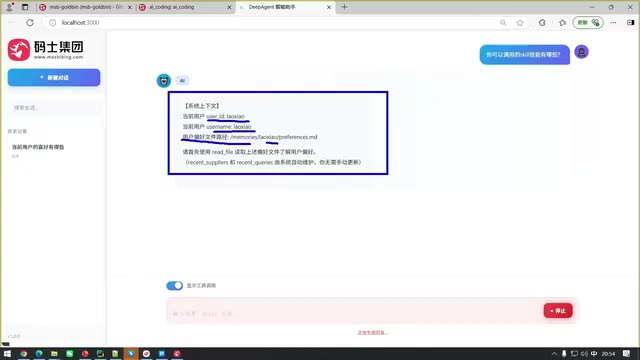
Context compression and pruning inevitably lose semantic information. Therefore, good agent projects must have independent memory file management in addition to context summarization and pruning. This part needs to be implemented by yourself — frameworks don't provide it. Each user has dedicated preference memory files to compensate for information loss from compression.
Context management is one of the most critical technical challenges in agent engineering. Although LLM context windows keep expanding (from 4K to 128K and beyond), longer context means higher inference costs, slower response times, and "needle in a haystack" attention dilution — research shows that when context is too long, model attention to information in middle positions drops significantly. Engineering strategies for context management include: sliding window (retaining the most recent N conversation turns), summary compression (using models to compress conversation history into brief summaries), importance scoring (selectively retaining information based on semantic relevance), and hierarchical storage (short-term memory in context, long-term memory in external storage like vector databases or file systems). Memory files are essentially a concrete implementation of hierarchical storage strategy — persisting users' long-term preferences, project backgrounds, and other information to files, retrieving and injecting them into context when needed.
Practical Interview Tips and Employment Landscape
High-Frequency Interview Topics
Based on actual interview feedback, here are the most frequently tested areas:
- Context management (high-frequency, almost always asked) — how to efficiently manage multi-turn conversation information within limited context windows
- RAG evaluation, reranking, query rewriting (~30% probability)
- Multi-agent architecture design — how agents communicate, handle conflicts, and ensure consistency
- Harness engineering practices — orchestration logic, error recovery, observability design
- Scenario questions (testing practical problem-solving ability) — e.g., "What if an agent enters an infinite loop?" or "How do you handle contradictory results from multiple agents?"
Interestingly, interviews now almost never require writing code on the spot (~5% probability), because in actual work, over 80% of code is already completed by AI Coding tools. This reflects a fundamental shift in how the industry defines engineer capabilities — from "can write code" to "can design systems and leverage AI tools to complete complex engineering."
Age and Education Aren't Absolute Barriers
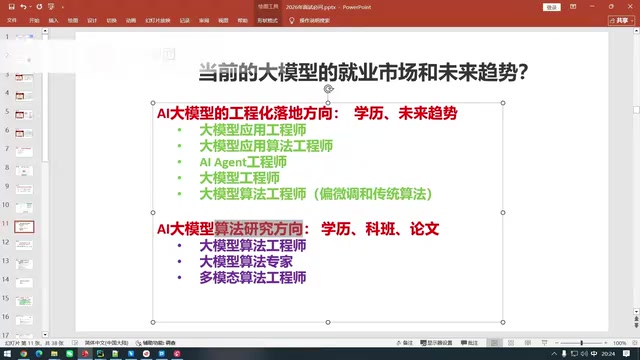
From actual employment data:
- Most successful career changers are over 33 years old
- Cases include a 31-year-old transitioning from frontend, and 34 and 35-year-olds successfully landing positions
- Former Java developers can reach 400K-450K RMB annual packages after transitioning
- A bachelor's degree is sufficient, with no major restrictions (for the engineering direction)
- Associate degree holders need IT programming work experience
The logic behind this phenomenon: LLM application development is an entirely new technical field where the traditional "age = outdated skills" logic no longer applies. Everyone is essentially starting from the same line, and developers with rich engineering experience actually have advantages in system design, troubleshooting, and project management.
Pragmatic Advice for Future Development
- Focus on the present: Get an LLM job offer first, establish yourself, then plan ahead
- Keep observing: Watch whether AI creates new roles (like FDE engineers and other emerging positions). FDE (Full-stack Developer Experience) Engineer is a recently emerged role primarily responsible for building the complete experience chain for developers using AI tools
- Full-stack trend: In the future, companies may only hire AI full-stack engineers — one person with AI tools could replace 10-20 traditional developers
The hiring trend is becoming increasingly clear — companies only want engineers with AI capabilities, and traditional pure-programming positions will continue to shrink. Mastering Multi-Agent and Harness engineering early is the key to landing LLM positions.
Key Takeaways
Related articles

The Truth Behind Codex 'Build a Website in 5 Minutes': AI Isn't Creating Sites—It's Helping You Copy Them
Exposing the truth behind viral Codex 5-minute website videos: creators aren't building original sites with AI—they're copying shared prompts or scraping others' work. Learn AI coding tools' real limits.

Getting Started with AI Agent Development: A Complete Guide from Concept to Practice
A comprehensive guide to AI Agent architecture and development, covering automated marketing, intelligent customer service, and investment analysis scenarios with single and multi-agent collaboration.

The Truth Behind Codex 'Build a Website in 5 Minutes': AI Isn't Creating Sites — It's Helping You Copy Them
Exposing the truth behind viral Codex 5-minute website videos: creators aren't building original sites with AI — they're copying shared prompts or scraping others' work.