Loop Engineering Explained: An Engineering Approach to Making AI Coding Agents Run Autonomously in Loops

Loop Engineering turns repetitive AI prompting into self-driving closed-loop systems for coding agents.
Loop Engineering, proposed by Cobus Greyling, shifts AI programming from single-shot prompting to closed-loop systems where agents autonomously iterate, self-check, and stop. The Rhythmic framework implements this via automated triggers, specialized sub-agents, connectors, external memory, and state objects. While promising for multi-step tasks, risks include escalating token costs and error amplification in poorly designed loops.
From Single Prompts to Loop Systems: A Paradigm Shift in AI Programming
If you frequently use AI coding assistants, you've surely experienced this pain: write a prompt, wait for a response, realize it's off, add more context, check again, nudge it to the next step… The longer the task, the more likely the AI is to "drift off," and the time you spend on repeated corrections can even exceed the time it would take to write the code yourself.
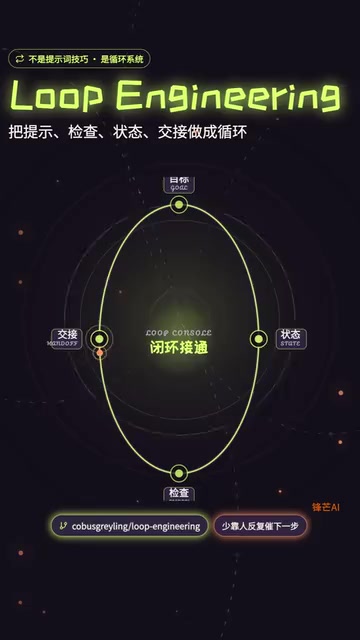
Loop Engineering, proposed by Cobus Greyling, is a systematic solution to exactly this problem. Its core idea isn't about teaching you to write better prompts — it's about turning the AI coding agent's prompting, checking, state management, and task handoff into a closed-loop system — so the agent itself knows when to continue, when to stop, and when to hand control back to a human.
Core Principles of Loop Engineering
Not Prompt Tricks — Engineering Control Theory
Traditional Prompt Engineering focuses on "how to write a sentence so the AI understands me" — essentially a one-shot input-output pattern. Loop Engineering takes a completely different approach: it bakes goals, boundaries, acceptance criteria, and stopping mechanisms into the system, forming a self-driving loop.
This is more like a feedback loop in industrial control systems — set a target value, continuously monitor output, automatically adjust when deviation exceeds a threshold, and stop when the standard is met. This analogy is far from arbitrary. In a classic PID controller (Proportional-Integral-Derivative controller), the system continuously compares actual output against the desired target and automatically adjusts input parameters based on deviation. PID controllers are widely used in temperature control, autonomous driving, industrial production lines, and more. Bringing this concept into AI programming means no longer relying on humans to manually judge whether each step's output is correct. Instead, an automated closed loop of "sense-compare-adjust" is built into the system. This is why Loop Engineering is closer to "engineering control theory" than "prompt tricks" — it focuses on system-level stability and convergence, not the quality of a single interaction.
The AI is no longer a passive tool waiting for instructions — it becomes an autonomous loop executor with self-assessment capabilities.
Engineering Away Repetitive Prompting, Not Outsourcing Judgment
There's a key distinction here: Loop Engineering aims to automate the mechanical work of "repeatedly feeding the AI context and checks," not to have the AI make all decisions for you. Its value lies in turning the corrections and guidance you manually perform each time into built-in rules and checkpoints within the system.
The Rhythmic Framework: Loop Engineering in Practice
The most concrete implementation of Loop Engineering to date is the Rhythmic framework. It decomposes the loop into multiple composable engineering modules:

Five Core Components of the Rhythmic Framework
-
Automated Triggers: Define what conditions start the loop and what conditions advance it to the next step.
-
Workers & Project Skills: Assign specialized sub-agents to different tasks, each with clearly defined capability boundaries. This design belongs to one of the hottest directions in AI today — Agentic AI. Unlike traditional single-turn dialogue models, Agentic AI allows multiple AI agents with different specializations to collaborate, with each agent responsible for specific subtasks. The theoretical foundation of this architecture traces back to Multi-Agent Systems (MAS) research, which was widely discussed in the distributed AI field as early as the 1990s. In recent years, projects like AutoGPT, CrewAI, and LangGraph have brought this concept back into practice. What makes Rhythmic unique is that it not only defines agent capability boundaries but also solves inter-agent communication and context synchronization through connectors and state objects — precisely the most error-prone aspect of multi-agent systems.
-
Connectors: Communication and data-passing mechanisms between sub-agents.
-
External Memory: Cross-loop state persistence to avoid starting from scratch every time. This component addresses a fundamental limitation of LLMs: limited context windows and no persistent memory. Even the most advanced models have context window caps (typically 128K–200K tokens), and every new session starts from zero. External memory is typically implemented using vector databases (such as Pinecone, Chroma, Weaviate) or structured storage, encoding key information from historical interactions as vector embeddings and retrieving relevant context via semantic search when needed. This technique is closely related to RAG (Retrieval-Augmented Generation). In a loop system, external memory enables the Nth iteration to efficiently access the decision basis from the 1st iteration without stuffing the entire conversation history into the context window, striking a balance between information completeness and token cost.
-
State Objects: Real-time tracking of the current loop's progress and context.
The design philosophy of this architecture is clear: the subject is AI, but the methodology resembles an engineering control console.
Rhythmic's Practical Command Entry Points
Rhythmic provides a set of out-of-the-box command tools:
- Pattern Picker: Select the loop pattern best suited for the current task
- Starter: Quickly initialize a loop task
- Loop Audit: Audit the quality and efficiency of loop execution
- Loop Init: Initialize loop parameters and state
- Loop Cost: Track token consumption and costs of the loop
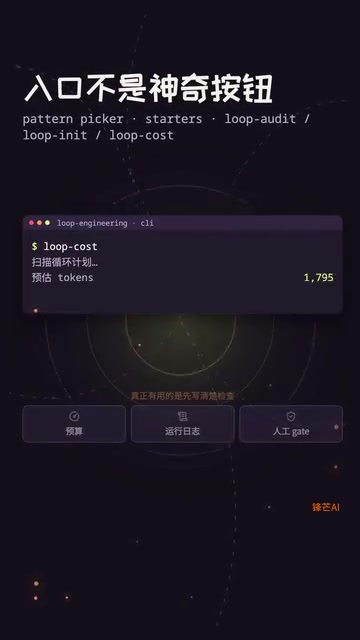
The four mechanisms with real practical value are: budget control, execution logs, automated checks, and human gates. Budget control prevents runaway token burn, logs make every step traceable, automated checks replace repetitive manual verification, and human gates preserve human final judgment at critical decision points.
The human gate mechanism deserves special attention. It embodies an important concept in current AI system design: Human-in-the-Loop. This concept was first rigorously enforced in military decision-making and nuclear weapons control systems — no matter how high the degree of automation, critical decisions must be confirmed by humans. In AI programming, this means the system pauses the loop before high-risk operations like code deployment, architecture changes, or database migrations, waiting for human approval. In fact, after the early hype around fully autonomous agents like AutoGPT, the industry has widely recognized that the hallucination problem and unreliable reasoning of current LLMs make fully unsupervised automation too risky for production environments. The human gate is essentially a risk management tool that draws a clear boundary between automation efficiency and human control.
A Sober Look at Loop Engineering: Hype and Risks Coexist
Project Status
To be objective, as of the time of content collection, Rhythmic's GitHub stats show 413 Stars and 57 Forks. This level of activity indicates some interest, but the project is far from having a mature ecosystem.

Risks That Cannot Be Ignored
Rhythmic's official documentation explicitly warns: Token costs increase significantly with the number of loop iterations. This is no small issue — the essence of a loop system is trading more computation for less human intervention, but if the loop is poorly designed, costs can grow exponentially.
To understand the severity of this risk, you need to grasp the basic logic of token economics. A token is the fundamental unit by which large language models process text, roughly equivalent to 3/4 of an English word or 1–2 Chinese characters. Taking GPT-4o as an example, the price per million input tokens is approximately $2.50–$5.00, with output tokens being even more expensive. In a loop system, each iteration requires re-feeding the previous context into the model (since LLMs are inherently stateless), meaning the context window grows linearly or even super-linearly with the number of iterations. Suppose a task requires 10 iterations, with each iteration adding 2,000 tokens of context — by the 10th iteration, a single API call's input already reaches approximately 20,000 tokens. This is precisely why Rhythmic specifically designed the Loop Cost tracking tool and budget control mechanism — a loop system without cost constraints is unsustainable in production environments.
An even more critical risk: loops amplify errors. If the initial goal is set with a bias, or if the checking mechanism isn't strict enough, the AI will run further and further in the wrong direction, with each iteration burning real money in tokens. This is far more costly than a single bad prompt.
Who Should Pay Attention to Loop Engineering?
If you fit the following profile, Loop Engineering is worth a deep dive:
- Developers who frequently need to repeatedly feed AI context and check results
- Teams using AI for long-chain, multi-step tasks
- Engineers with high demands for controllability and predictability from AI coding assistants
But you should also clearly recognize its limitations: Loop Engineering leans toward retrieval and execution tasks. For scenarios requiring creative judgment, its capabilities are limited. It solves the problem of "engineering away repetitive prompting," not the problem of "having AI think for you."
Summary
Loop Engineering represents an important direction in the evolution of AI programming tools: from "writing good prompts" to "designing good systems." Its value lies not in some magical prompt template, but in using engineering thinking to standardize and control the human-AI collaboration workflow.
Of course, validation is still ongoing, and no one can guarantee that its loops are stable and reliable in all scenarios. But for developers who spend significant time every day "nudging AI, checking AI, and correcting AI," this approach itself is worth taking seriously.
Key Takeaways
Related articles

Disaster and Glory of the Apollo Program: The History We Must Revisit Before Returning to the Moon
From the fatal Apollo 1 fire to Apollo 8's daring lunar orbit to Apollo 11's successful landing—revisiting the disasters, fears, and compromises of the Apollo program and their lessons for today's return to the Moon.

Netflix Trust Exercise Turns Into Firing Trap: Where Are the Boundaries of Corporate Trust?
A Netflix employee was fired after sharing private info in a trust exercise. We analyze the risks of corporate trust exercises and how employees can protect themselves.

AMD CDNA5 Architecture Deep Dive: Technical Evolution and the AI Computing Competition Landscape
Deep analysis of AMD's CDNA5 architecture covering Chiplet packaging upgrades, HBM memory evolution, and low-precision compute optimization, examining how AMD challenges NVIDIA's AI chip dominance.