Master LLMs in 3 Months with Zero Background: A Complete Learning Roadmap from Beginner to Job-Ready

A structured 3-month roadmap to go from zero to job-ready in large model development.
This article outlines a three-stage, three-month learning roadmap for complete beginners looking to break into large language model development. It covers Python and Transformer foundations in month one, Agents and LLM core modules in month two, and fine-tuning plus private deployment in month three — building toward real job-market readiness in China's rapidly growing AI sector.
Why Now Is the Window to Break Into Large Language Models
Large model technology is moving out of the lab and into real-world industry applications, driving a surge in talent demand. According to CCTV reports, China's AI talent gap is projected to reach 5 million by 2030. Behind that number lies a sweeping reshaping of salaries, career transition opportunities, and professional ceilings for practitioners in this space.
For anyone with a basic capacity to learn, large models are not an insurmountable domain. With the right roadmap and consistent effort, three months of structured study is entirely sufficient for a complete beginner to develop entry-level project development skills and land a foot in the door of LLM-related roles. This article provides a structured breakdown and grounded analysis of that learning path.

The Core Logic Behind the 3-Month Roadmap
This roadmap divides three months into three progressive stages, with each month focused on one capability level — and a strong emphasis on daily learning discipline. The rationale is straightforward: the LLM knowledge ecosystem is vast, and without clear stage boundaries, learners can easily get lost in a sea of concepts.
Month 1: Build a Solid Foundation
The first stage focuses on developing three foundational skills: Python programming, neural network fundamentals, and the Transformer architecture. These three form the bedrock for understanding any large model — Python is the tool, neural networks provide the conceptual framework, and Transformer is the shared architectural backbone of every major LLM today (GPT, LLaMA, Qwen, and more).
The Transformer architecture was introduced by a Google research team in 2017 in the landmark paper Attention Is All You Need, fundamentally transforming the landscape of natural language processing. Its core innovation — the Self-Attention mechanism — allows the model to attend to all positions in a sequence simultaneously when processing data, rather than working step-by-step like earlier RNN/LSTM architectures. This dramatically improves parallel computation efficiency and long-range semantic understanding. Today, virtually every major LLM — including OpenAI's GPT series, Meta's LLaMA, Alibaba's Qwen, and Baidu's ERNIE — is built on the Transformer as its backbone. Learning it is essentially learning the shared grammar of the entire LLM family.
This stage is the one most commonly underestimated by beginners. Many people rush to get a "cool demo" running and skip over the underlying mechanics — attention mechanisms, backpropagation, and so on — only to find themselves unable to debug problems later. A solid first month very often determines the ceiling of the next two.
Month 2: Master the Three Core Modules
The second stage dives into the three most critical directions in large model development: AGI concepts, AI Agents, and LLMs (Large Language Models). Agents in particular deserve deep focus — they represent the leap from LLMs as "conversational tools" to AI systems capable of autonomously executing complex tasks.
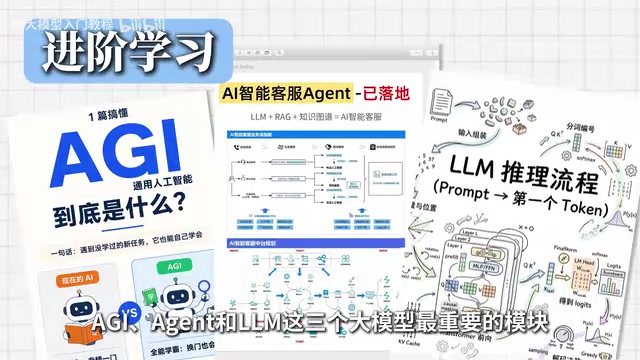
In the context of large models, an Agent refers to an AI system that can perceive its environment, form plans, and call external tools to complete complex tasks. Unlike a purely conversational LLM, an Agent has a cyclic "Think–Act–Observe" capability (the ReAct framework), enabling it to autonomously search the web, execute code, call APIs, manipulate file systems, and more. Representative frameworks include LangChain, AutoGPT, LlamaIndex, and Microsoft's open-source AutoGen. On the industry side, Agents are rapidly penetrating use cases in RPA (Robotic Process Automation), customer service systems, data analysis, and software development — widely seen as the second wave of AI deployment following the emergence of large models.
In real-world industry settings, the value of Agents is being validated quickly. From code generation to workflow automation, intelligent systems with tool-calling and task-planning capabilities are at the forefront of enterprise AI adoption. The skills learned in this stage map directly to the most in-demand and hardest-to-fill roles in the job market.
Month 3: Tackle Fine-Tuning and Private Deployment
The third stage focuses on two engineering capabilities: LLM fine-tuning and private/on-premise deployment. Fine-tuning adapts a general-purpose model to specific business scenarios; private deployment addresses enterprise concerns around data security and cost control — and these are precisely the capabilities enterprises are genuinely willing to pay for.
Fine-tuning involves taking a pre-trained large model and performing a second round of training on domain-specific data, aligning the model's output style, knowledge scope, and task behavior with a particular business context. Because full fine-tuning is extremely compute-intensive, the mainstream approach today is Parameter-Efficient Fine-Tuning (PEFT), with LoRA (Low-Rank Adaptation) being widely adopted due to its low VRAM requirements and the fact that only a small fraction of parameters need to be updated. Private deployment typically leverages inference frameworks such as Ollama, vLLM, or TGI to deploy open-source models (e.g., LLaMA, Qwen, Mistral) on enterprise local servers, avoiding the compliance risks associated with uploading sensitive data to public cloud services. Together, these two capabilities form the complete technical loop for building customized enterprise AI solutions — and represent the core technical moat for AI service providers.
Once theory is understood, the next step is completing several hands-on projects. LLM job interviews don't test your ability to recite concepts — they assess whether you can independently execute the full pipeline from data processing to model deployment. Practical projects are both a validation of your learning and the most compelling evidence you can put on a resume.
What This Roadmap Offers — and What to Keep in Perspective
From a structural standpoint, the design logic is clear and consistent with industry understanding: foundations → core modules → engineering deployment → hands-on projects, each stage building naturally on the last, with no jarring leaps. For determined beginners starting from zero, it offers an actionable timeline and a complete knowledge map.
That said, some realism is warranted. "Master LLMs in three months" is, to a degree, motivational framing. The more accurate picture: three months is enough to get you started and build entry-level project competency, but becoming truly fluent in real engineering environments will require continued practice over time. Think of these three months as the entry ticket into the field — not the finish line.
Additionally, structured learning materials can genuinely help you avoid common pitfalls, but no materials can substitute for hands-on practice. Real growth happens when you're debugging code yourself, tracing through errors line by line.

What You Can Expect After Completing This Roadmap
Concrete outcomes you can realistically aim for include: a resume that passes AI role screening filters, the ability to answer LLM interview questions confidently, landing a developer offer in a related specialization, and a meaningful increase in salary. These aren't empty promises — they're real opportunities that exist today in a talent market where supply falls well short of demand.
But achieving these outcomes still hinges on consistent execution. No roadmap, however well-designed, delivers results without daily follow-through. For anyone still on the fence: rather than agonizing over whether three months is "enough," just write your first line of Python code today. The window of opportunity won't stay open forever — and people who genuinely master these skills will always be in short supply.
Key Takeaways
Related articles

Transformer²: Achieving Co-Design of Robot Morphology and Control with a Unified Architecture
Deep dive into how Transformer² uses a unified Transformer architecture to integrate robot morphology design and motion control into one model, enabling task-driven end-to-end co-design for embodied AI.

Tutorial: Installing Tailscale on a Jailbroken Kindle to Create a Private Network Node
Learn how to deploy Tailscale on a jailbroken Kindle, turning an idle e-reader into a private network node. Covers cross-compilation, power optimization, and risk considerations.
Tutorial: Installing Tailscale on a Jailbroken Kindle to Create a Private Network Node
Learn how to deploy Tailscale on a jailbroken Kindle to turn an idle e-reader into a private network node. Covers cross-compilation, power optimization, and risk considerations.